


Why Zambia Is a Practical Market for Honeycomb Briquette Production?
Zambia has a mature charcoal consumption culture. Urban households in Lusaka, Ndola, and Kitwe, along with roadside food vendors and small bakeries, rely on solid fuel for daily cooking. Traditional lump charcoal is irregular, smoky, and increasingly expensive because of transport cost and seasonal supply gaps. UM honeycomb briquette charcoal machine in Zambia answers a specific local problem: how to turn cheap, overlooked powder waste into a cleaner, stackable, longer-burning cooking fuel.
The honeycomb shape is not decorative. The through-holes create controlled airflow, lower ignition temperature, and produce a steadier heat curve than irregular lumps. For a household cook timing a meal, that predictability matters more than any brochure specification.
Local Feedstock Available to the Zambia Client
During the pre-shipment consultation, the client confirmed access to three low-cost inputs:
Coal dust from nearby screening yards, charcoal fines recovered from broken bagged charcoal, and a limited volume of sawdust from a furniture workshop. O máquina de perfuração de favo de mel we supplied was configured to accept all three after crushing and binder mixing.
Power Supply and Workshop Conditions
The client’s workshop runs on 380 V three-phase supply with frequent minor voltage dips. We specified a 7.5 kW main motor with a magnetic starter and overload relay, compatible with 220 V / 380 V / 415 V African site norms. Tropical heat, dusty air, and concrete flooring are normal in Zambian light-industrial units, so the machine frame was treated with anti-rust primer and the transmission housing was sealed against fine coal powder.
What a Máquina formadora de briquete de carvão em favo de mel Actually Does?
UM honeycomb charcoal coal briquette forming machine is a rotary-table punching press. Pulverized carbon material is fed into a hopper, pushed into a mould cavity on a rotating table, and struck by a punch head fitted with pins. The pins create the holes; the cavity wall defines the outer shape. The finished piece is ejected onto a belt conveyor.
Core Working Stages
Feeding stage uses a screw or rotary vanes to keep the hopper throat full without bridging. Moulding stage compresses the blend at roughly 20 para 35 MPa depending on recipe. Punching stage drives the steel pins through the compacted puck. Ejection stage uses a bottom pin to push the briquette out cleanly so the next cavity can index into position.
Why Honeycomb Geometry Improves Combustion?
Solid fuel blocks without holes burn from the outside in, smothering their own core. A honeycomb briquette exposes the interior to oxygen from multiple directions. In our Zambia burn test, um 140 mm hexagonal piece with 19 holes of 15 mm diameter reached cooking temperature in about 17 minutes and held usable heat for 2 horas 45 minutes in a standard mbaula stove. Equivalent-weight lump charcoal burned out in under 2 hours with uneven flares.
Pre-Shipping Preparation at Weiwa Factory in Zhengzhou
Before the container left China, o máquina de carvão briquete de favo de mel underwent a three-phase check in our Zhengzhou workshop. Phase one verified bolt torque on the main frame, mould seat, and gearbox. Phase two ran a no-load trial for 30 minutes to confirm bearing temperature and noise. Phase three ran a loaded trial with local-style coal dust and starch binder to validate pressure setting and mould release.
Mould Selection for the Zambia Order
The client chose a 140 mm hexagonal mould with 19 holes. This size fits common Zambian cooking stoves and balances stroke speed with handling weight. Single-cavity output at 35 para 40 strokes per minute yields roughly 2.1 para 2.4 tonnes per eight-hour shift. The same máquina de fazer briquetes de carvão platform accepts 100 mm, 120 mm, 160 mm, e 220 mm moulds with only a turret swap.
Spare Parts Packed for the Zambia Client
We packed two full sets of punch pins, one spare mould sleeve, V-belts, a scraper blade, lubrication syringe, and a Chinese-English illustrated manual. For African clients we also include extra hopper liner plates because abrasive coal fines wear liners faster than the manufacturer’s European test data suggests.
Arrival and Unloading at the Zambia Site
The machine arrived in a 20-foot container at the client’s yard near Lusaka. Our engineer supervised unloading with a forklift and timber skids. Concrete foundation had been poured one week earlier to our drawing: 150 mm thick, 1.2 m by 1.4 m, with four M16 anchor bolts. Depois 48 hours of curing verification, we placed the base frame and levelled it within 0.5 mm using a machinist’s spirit level.
Aligning the Punch Head and Mould Cavity
Misalignment is the most common cause of stuck briquettes and premature die wear. We inserted the hexagonal sleeve, locked the turret, and lowered the punch head manually. Concentric entry was checked with feeler gauges at four points. Correction beyond 0.2 mm was made by shimming the mould seat. O máquina de perfuração de favo de mel cannot hold hole accuracy if this step is rushed.
Hydraulic and Electrical Connection
Although the featured model is mechanically driven, it uses a small hydraulic unit for auto-lubrication and optional mould clamp. We routed hoses with cable ties, bled air, and pressure-tested to 1.25 times working pressure. The control panel was wired to the client’s distribution box through a 32 A circuit breaker. Emergency stop, motor protection, and phase-failure relay were demonstrated to the local electrician.
Raw Material Preparation Demonstration
Good briquettes start with good feed. The Zambia team prepared a blend of 70% pó de carvão, 25% charcoal fines, e 5% serragem. Particle size was reduced below 3 mm in a hammer crusher. Moisture was adjusted to 10 para 12% by spraying water during mixing. Binder was 4% cassava starch cooked into a paste, then folded into the blend in a horizontal paddle mixer for eight minutes.
Why Moisture and Binder Ratio Decide Quality?
Too dry, and the puck crumbles on ejection. Too wet, and the binder never activates, leaving a soft centre. During the first Zambia trial we intentionally ran one batch at 7% umidade; every piece cracked on the drop test. No 13.5% moisture the machine stuck every third stroke. The sweet spot for this recipe was 10.5 para 11.5%, which produced dense, ringing briquettes.
First Trial Run of the Honeycomb Briquette Charcoal Machine in Zambia
We started the máquina de carvão briquete de favo de mel in jog mode, then shifted to continuous run at 36 strokes per minute. Within seven minutes, uniform hexagonal briquettes with sharp hole edges discharged onto the belt. Noise at one metre was 74 dB(UM). Vibration was within limits. The Zambian operator, trained for half a day, could maintain feed rate and read the digital hour counter without supervision.
Sample Dimensions Measured On Site
Ten random pieces were measured with calipers:
Diameter 140 mm ±1 mm, height 78 mm ±2 mm, hole diameter 15 mm ±0.5 mm, hole count 19, average green weight 1,250 g, average dried weight 1,080 g. Apparent density by water displacement was 0.92 g/cm³. That density class is what gives the briquette its long burn time and its resistance to breakage on unpaved village roads.
Drop Test and Surface Inspection
We dropped five dried samples three times from one metre onto concrete. No edge chipping, no hole collapse. Surface was smooth with a faint matte sheen from starch film. Hole walls were clean, confirming the punch pins penetrated fully and the ejector pin timing was correct.
Burn Demonstration for the Zambia Client and Neighbours
The client invited two neighbouring cafe owners and a hardware shopkeeper. We lit three honeycomb briquettes in a mbaula with dry kindling. Ignition to visible flame took 8 minutos. Cooking temperature came at 17 minutos. The briquettes held heat 2 horas 45 minutos. The cafe owners noted the smoke was lighter than their usual charcoal and the stove needed no stirring.
Household Feedback Collected Later
The client distributed 200 dried briquettes in 10 kg sample bags across Matero and Chawama townships. Sixteen of twenty households said the briquettes outlasted their normal charcoal. Fourteen mentioned less smoke. Twelve said they would switch if the price per kilo stayed equal. That field response is why search interest for honeycomb briquette charcoal machine in Zambia is climbing among local entrepreneurs, not just importers.
Operator Training and Daily Maintenance
Before leaving, our engineer ran a half-day session with the client’s staff. Topics covered: start-up sequence, hopper bridging clearance, grease points on open gears weekly, sealed bearings monthly, mould change procedure, and fault diagnosis for uneven density.
Common Field Faults and Fixes
Bridging in hopper: tap side wall or reduce feed screw speed. Sticking in mould: raise moisture 0.5% or reduce stroke pressure 5%. Off-centre holes: re-check punch concentricity. Low density: increase binder activation time or raise compaction pressure within rated limit. None of these faults appeared in the final Zambia run after day two.
Commercial Logic for a Zambian Briquette Plant
Using trial data, the client modelled input cost at roughly 1,800 Zambian kwacha per tonne of finished briquettes, covering raw material, binder, poder, labour, and depreciation. Retail bagged charcoal in Lusaka ranged 3,500 para 5,000 kwacha per tonne at the time. Even at the low end, gross margin exceeds 45%. O máquina de fazer briquetes de carvão is the largest single capital item, but payback on a single-shift line with a 140 mm model lands inside 8 para 14 months if feedstock is sourced locally and not resold as dust.
Why a Honeycomb Punching Machine Beats Generic Presses?
Generic screw extruders make solid sticks. Roller presses make pillows. Only a máquina de perfuração de favo de mel makes the perforated block Zambian cooks recognise and trust. The holes are the product. Buyers do not ask for “briquettes”; they ask for “honeycomb charcoal” by shape. Machine choice is therefore a marketing decision as much as an engineering one.
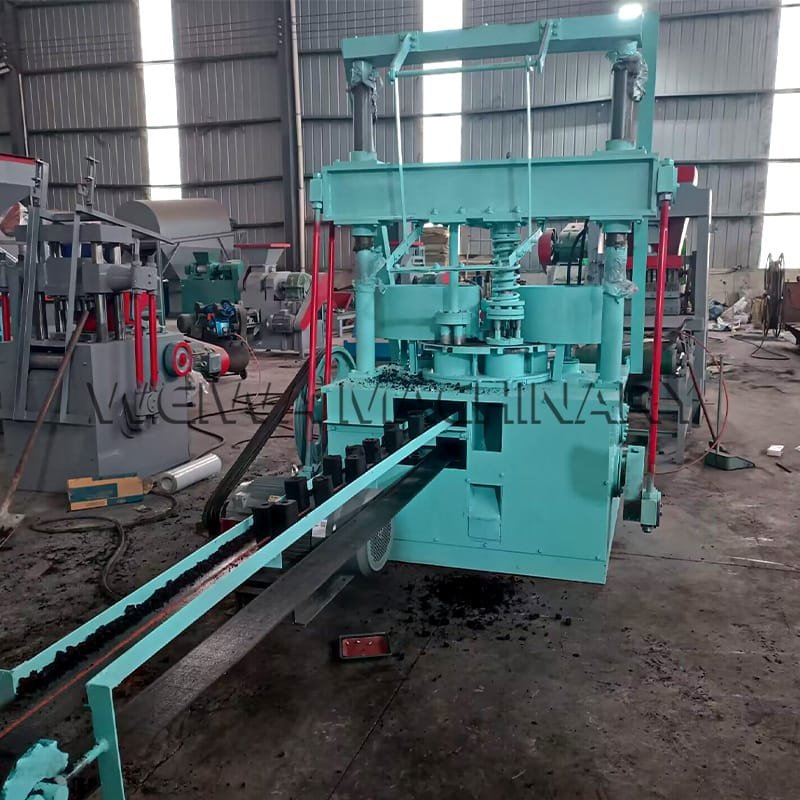
Technical Highlights of the Weiwa Unit Supplied to Zambia
Modelo: WW-HBC140. Motor principal 7.5 kW, 380 V, 50 hertz. Stroke rate 35 to 45/min. Mould 140 mm hexagonal, 19 holes. Throughput 2.1 para 2.4 t/shift. Frame cast steel with anti-rust coating. Mould sleeve chromium alloy steel HRC 58 para 62. Punch pins high-speed tool steel, individually replaceable. Gear reducer helical type. Belt conveyor 3 m. Control panel with start, stop, emergency, and hour meter.
Customisation Options for Africa
Weiwa can change mould diameter, hole count, hole diameter, forma (redondo, quadrado, hexagonal, flower), motor power (7.5 / 11 / 15 kW), voltage (220 / 380 / 415 V), and colour. Diesel drive is available where grid power is unstable. A full line can add a hammer crusher, paddle mixer, and mesh-belt dryer.
Sample Gallery Description
The photo set from the Zambia trip includes: container unloading, foundation and anchor bolts, punch-mould alignment check, mixer loading, first briquette on belt, caliper measurement, drop test, mbaula burn test, and bagged 10 kg samples.
What the Samples Prove?
The Zambia samples prove three things. Primeiro, local coal dust and charcoal fines can be reborn as premium fuel. Second, a Chinese máquina de carvão briquete de favo de mel can be tuned to African raw material in under two days. Third, the honeycomb shape is not a gimmick; it changes burn behaviour in ways Zambian users immediately feel.
Sobre Máquinas de Weiwa
Weiwa Machinery is a Zhengzhou-based manufacturer of briquette machines, carbonisation equipment, and complementary plants for coal, carvão, and biomass processing. Our equipment runs in more than 130 países incluindo a Indonésia, Índia, Malásia, Vietnã, Peru, Polônia, África do Sul, e Zâmbia. We handle pre-sale recipe testing, mould customisation, embalagem de contêiner, on-site installation guidance, e fornecimento de peças de reposição. We do not only sell a máquina de fazer briquetes de carvão; we help clients build a fuel product that fits their local market.
For quotation, mould drawing, or a trial appointment in Zhengzhou, contact our sales team directly.
Móvel / Whatsapp: +8613838093177
E-mail: info@cjlmachinegroup.com
Product reference: https://cjljx.com/product/honeycomb-charcoal-briquettes-machine


 WeChat

 +8615937143060
