


Why South Africa Ordered a Full Máquina de briquetagem de serragem Line?
The South African client approached Weiwa after running a manual charcoal bagging operation for two years. They were buying lump charcoal from middlemen, repacking it, and losing margin to inconsistent quality. Their goal was to control the upstream process: own the briquette, own the carbonization, and supply supermarkets, braai chains, and rural distributors under their own brand.
UM sawdust briquette machine answers that goal because it standardizes shape, densidade, e tempo de queima. Na África do Sul, braai culture is strong, and buyers care about whether a briquette lights in under five minutes, holds heat for 90 minutos, and leaves low ash. Those metrics are achievable only when the extrusion screw, die temperature, and carbonization curve are tuned together. That is why we shipped a line, not a single machine.
Local Feedstock Profile in South Africa
South Africa produces biomass waste from multiple sectors. Timber mills around Mpumalanga and KwaZulu-Natal generate pine and eucalyptus sawdust. Sugar mills outside Durban and Pietermaritzburg produce bagasse. Farming belts in Free State and North West leave peanut shells, sunflower stalks, and maize cob waste. A well-configured sawdust briquetting machine accepts all of these after crushing and drying.
For this client, the base mix is 70 percent pine sawdust from a local sawmill and 30 percent bagasse from a sugar cooperative. Both materials are below 8 percent moisture after drying, which is the correct zone for lignin activation during extrusion.
Energy and Environmental Pressure
South Africa’s power profile makes self-reliant fuel attractive. Load shedding pushed many bakeries, poultry farms, and tobacco curing houses to install biomass boilers. Those boilers accept briquette chunks from a sawdust extruder because the uniform diameter feeds screw conveyors without bridging. At household level, townships and rural villages use charcoal for cooking; briquettes reduce the number of trees cut for lump charcoal.
From a carbon standpoint, briquetting does not claim to be carbon negative, but it is waste-positive. It diverts residues that would rot or burn openly, locks them into a higher-value fuel, and cuts smoke particulates versus green-wood charcoal.
Loading Day at the Weiwa Workshop
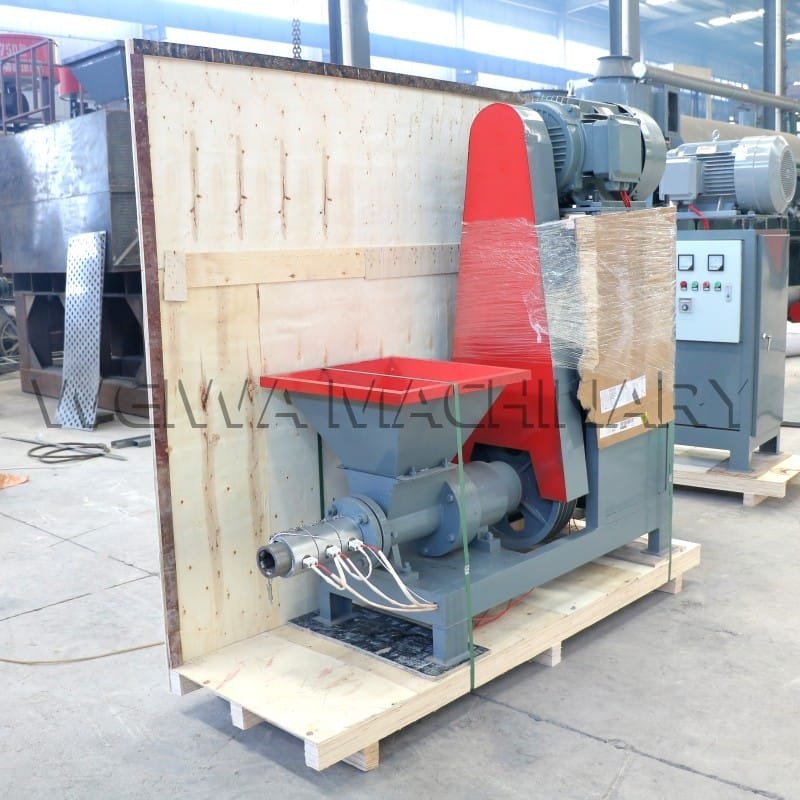
On loading day, the container was backed into bay three at 8:10 sou. The fumigated wooden crates were stacked in sequence: crusher first, then dryer drum, then the main sawdust extrude machine in South Africa configuration with 80 mm hexagonal die, then carbonization furnace, then electric panel and spare screw set.
Each crate carried a bilingual label in English and Chinese, a shock indicator, and a humidity card. The export team wrapped the screw shaft in anti-rust paper and filled the control cabinet with silica gel. For South African customs, we attached phytosanitary treatment certificates on wooden packaging, commercial invoice, packing list, and bill of lading with HS code 8479.89.
Why We Pack a Line as One Coordinated System?
Many first-time buyers ask why they cannot just buy the extruder. The answer is yield. UM sawdust extruder only performs if the input is 3 para 5 mm in particle size and under 12 porcentagem de umidade. If the crusher leaves long fibers, the screw jams. If the dryer leaves moisture at 18 por cento, the barrel steams instead of melting lignin. Shipping the full line guarantees the client reaches spec on day one.
We also pre-wired the dryer and extruder to one PLC panel so the South African electrician only needs to land three incoming cables. That decision came from past shipments where clients lost three weeks hiring a controls engineer.
How a Sawdust Extruder Turns Waste Into Charcoal Sticks?
The core of the line is the sawdust extruder. It is a horizontal screw press with a tapered compression chamber and a heated die head. Dried biomass enters the hopper, the augur pushes it forward, friction and external heating rings raise the mass to roughly 260 para 300 graus Celsius, and natural lignin softens and acts as binder. No cement, amido, or chemical glue is added.
The material exits the die as a continuous hollow stick, usually hexagonal with a 15 para 20 mm central hole. The stick is not yet charcoal. It is a raw briquette, sometimes called a green briquette, with density around 1.1 para 1.3 tons per cubic meter.
Step One Crushing and Sizing
Raw offcuts arrive up to 40 mm. The hammer crusher breaks them to below 5 mm. Oversize pieces bypass the screw flight and score the barrel, so sizing is non-negotiable. Na África do Sul, where pine knots are hard, we specified a 22 kW crusher with manganese screens instead of mild steel.
Step Two Drying to Below 12 Percent Moisture
The rotary dryer uses a 0.8 MW biomass burner firing on screened rejects from the same line. Incoming sawdust at 35 percent moisture leaves at 8 para 10 percent after a 12-minute pass. The client monitors outlet moisture with a handheld pin meter every two hours. UM sawdust briquetting machine runs coldest and longest when moisture is stable, not just low.
Step Three Extrusion and Stick Forming
The dried meal drops into the extruder hopper. The main motor on this South African unit is 22 kW, producing 280 para 320 kg per hour of 80 mm hexagonal stick. The heating ring sits at 280 graus Celsius. The screw compacts the mass, pressure peaks at the die throat, lignin films the particles, and the stick emerges smoking slightly and firm.
Operators cut the stick to 300 ou 400 mm lengths depending on braai pack size. UM sawdust extrude machine in South Africa typically runs 20 hours a day in commercial plants, with the screw rebuilt every 600 para 800 running hours.
Step Four Carbonization Into Finished Charcoal
Green sticks are loaded into a horizontal carbonization furnace. The furnace ramps to 450 para 600 degrees Celsius under low oxygen. Volatiles escape and are either burned off in a flare or condensed in an optional tar recovery unit. Depois 10 para 14 horas, the sticks become black charcoal briquettes with fixed carbon around 68 para 75 por cento.
South African buyers prefer the 80 mm hexagonal shape because it stacks in 10 kg bags without breaking. The central hole increases surface area, shortening lighting time on a braai grid.
Step Five Cooling Screening and Bagging
Charcoal exits the furnace at 60 degrees Celsius and cools on a steel conveyor for 40 minutos. A vibrating screen removes fines under 10 mm. Finished briquettes go to a semi-automatic bagger. The client prints batch number, weight, and Weiwa line ID on each 10 kg and 25 kg pack.
Technical Specification Shipped to South Africa
O sawdust extruder in this line uses a replaceable tungsten-coated screw, um 80 mm hexagonal die with edge option, and a temperature-adjusting indicator on the control panel. The complete line occupies 220 square meters under roof, requires 65 kVA incoming power, and consumes roughly 35 liters of diesel equivalent per ton of finished charcoal when the dryer burner runs on briquette reject.
Machine highlights from the order:
The sawdust briquette machine body is welded from 12 mm steel plate with stress-relief annealing. The dryer drum is 1.2 m by 8 m with lifting flights every 600 mm. The carbonization furnace is a three-door batch type with refractory lining rated to 900 graus Celsius. The electric panel carries Schneider contactors, Omron temperature modules, and a Siemens touchscreen in English.
Shape and Diameter Options
Weiwa dies cover 50, 60, 70, e 80 mm diameters. Cross-section choices include square, Pentágono, Pentágono com borda, quadrilateral hollow, and hexagonal hollow. South Africa’s retail braai market favors hexagonal 80 mm; the industrial boiler market often asks for 70 mm square without hole. The same sawdust extruder swaps die in 25 minutos.
Calorific and Physical Performance
Finished charcoal from this line tests at 4,600 para 5,000 kcal per kg, sobre 20 percent higher than average South African lump charcoal at 3,800 kcal per kg. Ash content stays under 6 por cento. Drop resistance after carbonization exceeds 92 por cento, meaning fewer broken pieces in the bag.
South African Charcoal Market Context
South Africa consumes several million tons of charcoal and biomass fuel annually across household cooking, braai retail, and small industrial heating. Import substitution is active: buyers want local briquettes instead of Tanzanian or Mozambican lump. A local plant running a sawdust briquette machine can land 10 kg at a lower landed cost than imported lump after freight and markup.
Braai and Retail Channel
Retail buyers in Gauteng and Western Cape ask for low-smoke, quick-light briquettes. The Weiwa line meets that by controlling carbonization endpoint. If the furnace is pulled early at 420 degrees, the briquette lights faster but is softer. If held to 580 degrees, it is harder, denser, and slower burning. The client chose a 520-degree midpoint for braai packs.
Industrial and Boiler Channel
Bakeries in Polokwane and mushroom farms near Johannesburg use 70 mm square briquette chunks in fixed-bed boilers. O sawdust extruder output, when cut into 50 mm chunks instead of 300 mm sticks, feeds those boilers without secondary crushing. This dual-product flexibility is why the client selected one line instead of two.
Field Science Why Lignin Binding Works Without Glue
Biomass contains lignin, hemicellulose, and cellulose. Under high pressure and 260 para 300 graus Celsius, hemicellulose partially decomposes and lignin softens to a glassy phase. When the material exits the die and cools, lignin re-solidifies as a natural adhesive film around wood particles. That is the entire binding mechanism inside a sawdust briquetting machine.
This matters for South Africa because chemical binders attract tax and storage rules. A glue-free briquette passes most clean-air municipal checks and avoids supplier audits on starch sourcing. The machine itself becomes the binder reactor.
Moisture and Particle Size as Hidden Levers
Most extruder failures in African plants come from moisture drift, not mechanical fault. No 14 porcentagem de umidade, the barrel temperature swings and the stick surface blisters. No 6 porcentagem de umidade, the material overheats and the screw wears faster. The sweet zone is 8 para 11 por cento. Particle size matters equally: 3 para 5 mm lets the augur bite; above 6 mm, bridging forms at the hopper throat.
Installation Plan After Durban Arrival
Após desembaraço aduaneiro, the container moves to the client site in KwaZulu-Natal. Weiwa sends a pre-installation checklist: concrete foundation 150 mm thick, three-phase 380 V supply, compressed air for pneumatic lock, and stormwater slope away from the dryer burner.
Remote Commissioning Sequence
Week one is mechanical assembly with local fitters and Weiwa drawings. Week two is electrical landing and dry run of the crusher and dryer. Week three is first extrusion on pine sawdust, tuning barrel temperature to 280 degrees and screw speed to 38 hertz. Week four is first carbonization batch and bagging trial.
A Weiwa engineer joins by video for the first 72-hour continuous run. The South African team records stick temperature at die exit, moisture before extrusion, and furnace ramp curve. Those three logs decide whether the line is handed over.
Spare Parts and Screw Life
The export crate includes one complete spare screw, two heating rings, one die set, and a seal kit. Screw life on pine sawdust runs 700 horas; on bagasse-heavy mix, 550 horas. The client stocks two screws on site to avoid downtime during peak braai season in December.
Comparing Sawdust Extruder and Sawdust Briquetting Machine Terms
Buyers often search both sawdust extruder e sawdust briquetting machine as if they are different products. In Weiwa’s catalog, the extruder is the screw press that forms the green stick. The briquetting machine is the same machine described by function rather than mechanism. UM sawdust extrude machine in South Africa inquiry and a sawdust briquette machine inquiry usually resolve to the same quotable unit, with die size and motor power as the real variables.
We keep the terminology overlapping on purpose. Google searchers in South Africa, Nigéria, and Kenya use different words. The blog and product page should echo all of them so the page matches query language without keyword stuffing.
Common Mistakes New South African Operators Make
The first mistake is feeding unscreened crusher output. Fibers wrap the screw and mimic a motor fault. The second is chasing output by raising barrel temperature to 340 degrees, which carbonizes the stick inside the die and locks the screw. The third is skipping dryer calibration and trusting weather drying, which fails in KwaZulu-Natal humidity.
UM sawdust extruder is forgiving on material but unforgiving on consistency. The South African plant avoided these errors by assigning one operator to moisture testing and one to die pressure logging, instead of rotating staff hourly.
ROI View for a 1 Ton Per Day Charcoal Plant
With 1 ton of finished charcoal per day, 25 working days per month, and wholesale braai price around mid-range local rate, the line covers equipment cost inside 12 para 18 months before labor and rent. The math improves when bagasse is free from a sugar partner and reject fines fire the dryer. UM sawdust briquette machine is not a high-margin luxury item; it is a throughput arbitrage between waste cost and fuel price.
Variable That Changes Payback Most
Not machine price, but raw material distance. If sawdust is 80 km away, transport eats the margin. The Weiwa client signed a 12-month sawdust supply contract with a sawmill 9 km from the plant gate. That single decision shortened payback by four months compared to the original plan of importing sawdust from Johannesburg.
Why Weiwa Configures Per Market Instead of Selling Stock Units?
South Africa got a 22 kW extruder, 80 mm hexagonal die, English PLC, 380 V panel, and tropical-grade electrical enclosures. A Kenyan order might get 18.5 kW, 50 mm square die, e 415 V. A Indonesian order might get 70 mm pentagon and 220/380 V dual input. O sawdust extrude machine in South Africa label on this shipment means the machine was engineered to South African conditions, not relabeled from warehouse stock.
Engineering Touches in This Container
We enlarged the dryer inlet to handle damp bagasse, added a second thermocouple at the die throat, swapped the standard paint for epoxy primer resistant to coastal salt, and printed the manual with local emergency contact format. None of these show up in a spec sheet, but all of them decide whether the machine runs past year three.
Carbonization Choices Batch Versus Continuous
This South African line uses a batch horizontal furnace because the client runs three shifts and wants to inspect every batch. Continuous furnaces suit single-feedstock plants with steady demand. For mixed pine and bagasse, batch carbonization lets the operator adjust soak time per load. UM sawdust extruder pairs with either furnace type, but the furnace choice shapes labor count more than the extruder does.
Tar Handling and Emission Rule
South African environmental officers ask about volatile combustion. Weiwa fitted a secondary chamber on the furnace stack that burns off-gases at 800 graus Celsius. The client avoids open blue smoke, which is the usual complaint against small charcoal kilns. This upgrade was mandatory for the permit, not optional.
Staff Training and Safety On Site
Weiwa delivered a 40-page English manual, a 12-minute safety video, and a laminated startup card in Zulu and English. Operators learn to lock out the extruder before opening the die, never probe the hopper while running, and watch bearing temperature on the screw housing. UM sawdust briquetting machine has few guards because the risk is heat and rotation, not sharp blades, so behavior discipline replaces hardware barriers.
Production Logging Habit
The client adopted a one-page daily log: incoming moisture, extruder amps, die temperature, stick color, furnace peak, batch weight out, bag count. Depois 30 days, the data showed that stick blistering correlated with rain-day moisture spikes, not screw wear. That insight saved a false spare-part order.
Future Expansion Path for the Same Client
The foundation was poured for a second extruder bay. When retail contracts exceed 40 tons per month, the client can add a 70 mm square die extruder in parallel, share the existing crusher and dryer, and double output without duplicating the front end. UM sawdust extruder line is modular if the civil works plan for it on day one.
Adding Shisha and Restaurant Grade
If the client later targets shisha lounges, they need coconut shell char blended at 30 por cento. The same briquette machine can press the blend, but carbonization must shift to 600 degrees and cooling must slow. Weiwa already left a spare thermocouple port and a slower conveyor option in the panel for that upgrade.
Closing Scene Container Sealed for Durban
Por 4:50 p.m., the container doors were sealed with a Weiwa tamper-evident lock, the bill of lading showed sawdust extrude machine in South Africa as cargo description line one, and the client’s logo was stenciled on the side crate. The line will clear Durban, move inland by flatbed, and start commissioning within 30 days. In roughly six weeks, pine sawdust that once rotted behind a Mpumalanga sawmill becomes braai briquettes on a Gauteng shelf.
That is the full loop a sawdust extruder closes: desperdício, machine, aquecer, pressão, carbon, package, sale. Weiwa Machinery does not only sell the press. We ship the loop.
Sobre Máquinas de Weiwa
Máquinas de Weiwa, also known as WEI WA MACHINERY, designs and manufactures biomass briquette machines, extrusoras de serragem, charcoal carbonization furnaces, trituradores, secadores, and complete charcoal production lines. With equipment running in over 130 countries across Africa, Sudeste Asiático, o Médio Oriente, and Latin America, Weiwa has become a long-term supplier to more than 2 million end users and factory owners. Every sawdust briquette machine leaving the workshop is load-tested on real sawdust, packed to ISPM-15 export standard, and backed by remote commissioning, spare-part pricing, and custom plant layout drawing.
For a tailored quotation on a sawdust extrude machine in South Africa specification, contact the Weiwa team directly:
Móvel / Whatsapp: +8613838093177
E-mail: info@cjlmachinegroup.com
Product reference: https://cjljx.com/product/sawdust-extrude-machine
Weiwa Machinery welcomes factory visits, sample material trials, and joint layout design before any deposit is signed.


 WeChat

 +8615937143060
