


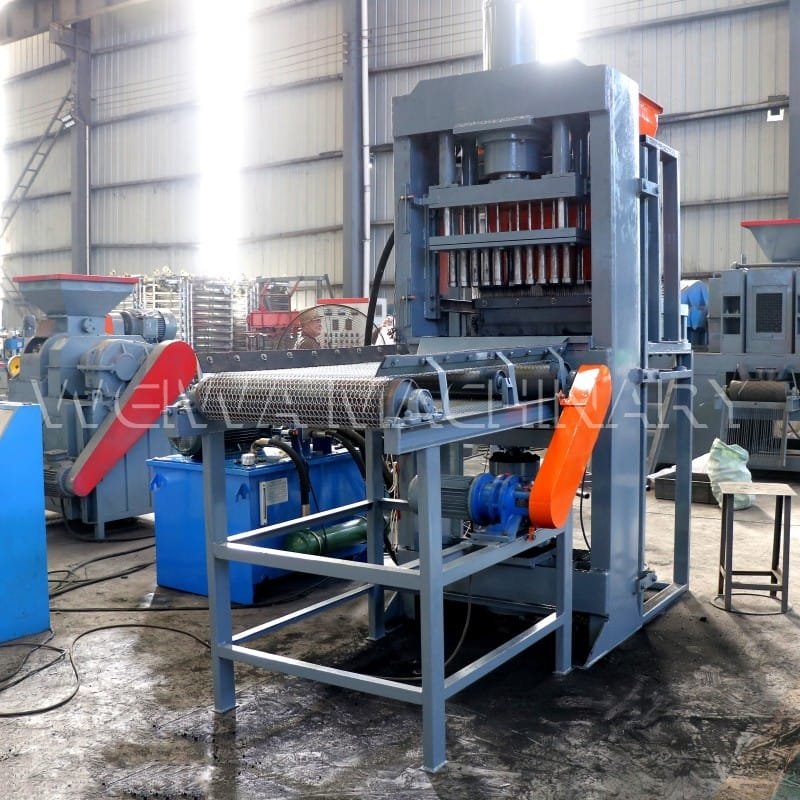
A hydraulic briquette press is not the same as a rotary tablet press or a roller press. It uses a hydraulic pump station to drive a main cylinder that compresses charcoal powder into dense shapes at 100 para 200 toneladas. For the Tanzania market, this matters because buyers there are moving away from irregular lump charcoal and toward uniform fuel that survives road transport to Arusha, Mwanza, and across borders into Kenya, Uganda, e Ruanda.
Why Tanzania Charcoal Producers Need a Hydraulic Briquette Press?
Tanzania has one of the most interesting charcoal demand profiles in East Africa. Urban hookah culture in Dar es Salaam and Zanzibar keeps growing. Hotel grilling and backyard BBQ demand in Dodoma and Mbeya is steady. Ao mesmo tempo, most local charcoal is still sold as dusty lump or inconsistent powder mix. A hydraulic briquette machine closes that gap by turning low-value carbon waste into premium shaped fuel.
Raw Material Base in Tanzania That Fits a Hydraulic Briquette Machine
Coastal zones near Tanga and Zanzibar generate large volumes of coconut shell waste. Inland miombo woodlands supply acacia and brachystegia lump charcoal. Milling corridors around Morogoro and Mwanza produce rice husk, serragem, and maize cob residue. None of these need to enter the press as perfect powder. With a front-end crusher and a binder mixer, even coarse charcoal fragments become feedstock for a hydraulic briquette machine for Tanzania without expensive pre-processing.
During the trial we blended three simulated recipes: coconut shell charcoal powder from coastal Tanzania, acacia lump charcoal crushed to below 3 mm, and a rice husk carbon mix with cassava starch binder. The goal was to mimic what the client would actually collect in his first six months of operation.
Product Shapes Tanzanian Buyers Actually Want
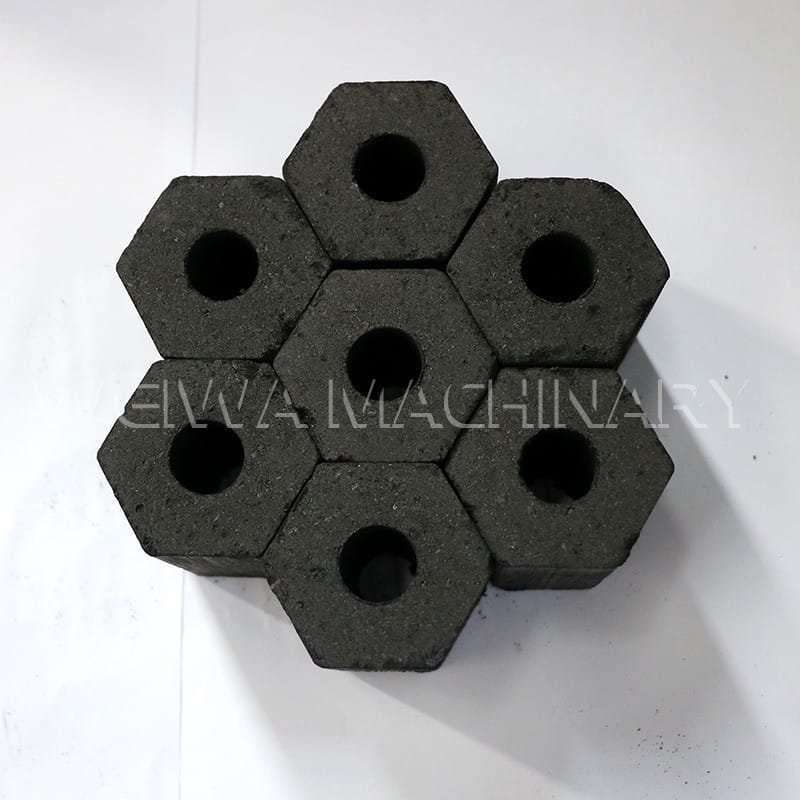
The Dar es Salaam client asked for three mold sets in one frame. The first was a 25 mm cubic shape for traditional shisha lounges. The second was a 33 mm round tablet for retail quick-light packs sold in supermarkets. The third was a 40 mm hexagonal finger for hotel BBQ and butchery use. A hydraulic briquette press handles this easily because mold changeover takes under twenty minutes and the PLC keeps pressure logic independent from mold geometry.
How Weiwa Prepared the Hydraulic Press Briquetting Machine for Trial?
We installed a 160-ton main cylinder, a dual-cooling hydraulic pump station, and a PLC cabinet with automatic, semi-automatic, and manual modes. The frame was the same export model we ship to Africa and the Middle East. The difference in this session was that every parameter was tuned live while the Tanzania client watched on video call and our engineer narrated each adjustment.
Hydraulic Station and PLC Configuration
The hydraulic station carried a branded motor, a visible pressure gauge, and an external cooler to handle continuous summer running. The PLC system controlled dwell time, stroke length, and ejection timing. For Tanzanian workshops where voltage can dip, manual mode allows the operator to hold pressure and release the mold without a full restart. This is one reason a hydraulic press briquetting machine outperforms fully automatic rotary presses in rural African setups.
Mold Changeover and Pressure Tuning for Tanzania Recipes
We started the cube test at 120 tons with 1.2 seconds dwell. Piece weight variance stayed around 4 grams. After checking edge finish, we raised pressure to 160 tons for export-grade cubes. Round tablets needed shorter dwell at 140 toneladas. Finger charcoal needed a wider ejection stroke. The same hydraulic briquette machine produced all three shapes in one working day without mechanical rebuild.
What the Factory Trial Showed About Hydraulic Briquette in Tanzania?
The trial confirmed that hydraulic briquette in Tanzania is not a future concept. It is a current business case. Density readings on 25 mm cubes reached 1.05 gram per cubic centimeter. Drop-test resistance from 1.2 meters showed zero fragmentation. Moisture after pressing was 8 por cento, low enough for direct packing if a dryer is added later.
Density, Weight Variance, and Surface Finish
Uniform weight matters more than most new investors expect. Lounges in Dar es Salaam buy by the box, not by the kilogram, so a 4-gram variance across 1000 pieces means the box weight stays consistent and the cafe owner trusts the supplier. Surface finish from the CNC-machined mold stayed smooth with no flash. That is the segment where hydraulic briquette in Tanzania beats imported Middle East tablets on price while matching them on quality.
Power Fluctuation Handling for African Workshops
Many Tanzanian workshops run on unstable grid power or generator backup. The PLC on our hydraulic briquette press allows pressure hold during brownouts and resume without scrapping the current piece. Manual mode also lets a junior operator learn the cycle before switching to automatic. This lowers training time from two weeks to three days.
Market Potential of Hydraulic Briquette Machine for Tanzania
A hydraulic briquette machine for Tanzania owner can sell to at least four channels. The first is shisha cafes in Dar es Salaam and Arusha. The second is supermarket quick-light packs in round tablet form. The third is butcheries and hotel kitchens buying finger charcoal. The fourth is cross-border traders shipping cubes to Nairobi, Kampala, and Kigali.
Domestic Hookah and BBQ Demand
Tanzania’s urban population grows every year and with it the number of hookah lounges, rooftop bars, and beach grills. Uniform cubes burn longer and create less ash than lump charcoal. That alone justifies the switch for venue owners. A local producer with one hydraulic press briquetting machine can lock in ten to fifteen venue accounts within six months.
Cross-Border Export Route from Dar es Salaam
Dar es Salaam port gives Tanzanian producers a logistics edge. Containers move north to Mombasa and west to Rwanda and DRC. A producer who starts with domestic cubes and adds a mesh belt dryer in month seven can pack export cartons by month nine. The hydraulic model supports this scaling because the same press serves domestic and export grades by changing pressure and mold, not by buying a second machine.
From Single Hydraulic Briquette Press to Full Production Line
Most Tanzania buyers do not start with a full line. They start with one hydraulic briquette machine, a small crusher, a binder mixer, and sun-drying space. As cash flow stabilizes, they add a carbonization furnace for coconut shell, a conveyor belt, and a hot-pump dryer with PLC. Weiwa sends a CAD workshop layout before payment so the client can prepare foundation, electrical inlet, and roof height. UM 100 square meter starter line fits most suburban plots. UM 300 square meter line fits export volume.
O Máquina de prensa hidráulica de shisha churrasco we manufacture is the same platform used in this Tanzania trial. It supports 100 para 200 ton pressure, quick mold change, and PLC control in three languages including English and Arabic. Clients who want the full picture can read our earlier write-up on a hookah charcoal making mahine line to Tanzania or the hydraulic briquette machine field test insights from our factory. For market context, the ball charcoal briquettes machine shipment analysis explains wider East Africa demand.
Why Buyers Choose Weiwa Machinery for Hydraulic Briquette Projects?
Weiwa Machinery has more than thirty years of experience in charcoal and biomass briquetting equipment. Our team does not only sell a hydraulic briquette press. We design the workshop, simulate your raw material recipe, run a live trial, pack the line for container shipping, and support commissioning after arrival. Our after-sales team answers WhatsApp calls, sends spare-part lists by weight and volume, and provides mold redraws when a client wants a new shape six months later.
Customization is standard. If your Tanzania site has 220V instead of 380V, we change the motor. If your binder is molasses instead of starch, we adjust mixer speed. If your target is 25 mm cube today and 40 mm finger next year, we ship both molds in the same crate. That flexibility is why a hydraulic briquette machine for Tanzania from Weiwa is not a commodity purchase but a production partnership.
Our factory welcomes visits. We pick clients up from Zhengzhou airport or railway station, show the press running with your own sample powder, and hand over a written trial report with pressure curves. More than two million customers worldwide have used Weiwa equipment in over ninety countries. The Tanzania trial described here is one example of how we turn a factory test into a client’s business plan.
Contact Máquinas de Weiwa for Hydraulic Briquette Press Quotation
If you are evaluating a hydraulic press briquetting machine for Tanzania or any East African market, send us your raw material photo, moisture level, and target shape. We will return a recommended line configuration, a CAD layout, and a USD quotation within two working days.
Whatsapp / Móvel: +8613838093177
E-mail: info@cjlmachinegroup.com
Site: https://cjljx.com
Weiwa Machinery is a Henan-based manufacturer with over thirty years of work in hydraulic and mechanical briquette presses, fornos de carbonização, trituradores, e secadores. We provide customized molds, workshop design drawings, spare parts planning, and remote commissioning. Whether you need one hydraulic briquette machine or a full container line for hydraulic briquette in Tanzania, our engineering team will run the trial before you pay the balance.


 WeChat

 +8615937143060
