


Why Bhutan Is an Ideal Market for a Biomass Briquette Machine?
Bhutan is a country with abundant forest coverage and active agro-forestry sectors that generate large volumes of sawdust, sekam beras, Debu buluh, sekam kopi, Bagasse tebu, and crop stalks every year. Secara tradisinya, much of this biomass waste is either open-burned or left to decompose, which contributes to greenhouse gas emissions and wastes a valuable energy resource. Introducing a biomass briquette machine in Bhutan allows local enterprises, farming cooperatives, and eco-tourism lodges to compress loose biomass into high-density hollow briquettes that can later be carbonized into premium charcoal.
The Royal Government of Bhutan promotes clean energy and sustainable resource use aligned with the Gross National Happiness development philosophy. Producing charcoal locally with a sawdust extruder reduces dependence on imported fossil fuels and fire wood, cuts indoor smoke pollution from traditional open-fire cooking, and creates rural employment in feedstock collection, machine operation, and briquette distribution. For a landlocked mountainous region, the compact footprint and modular design of a sawdust briquetting machine from Weiwa Machinery make it realistic to install even in smaller workshops close to raw material sources.
Overview of the Charcoal Briquette Production Line Shipped to Bhutan
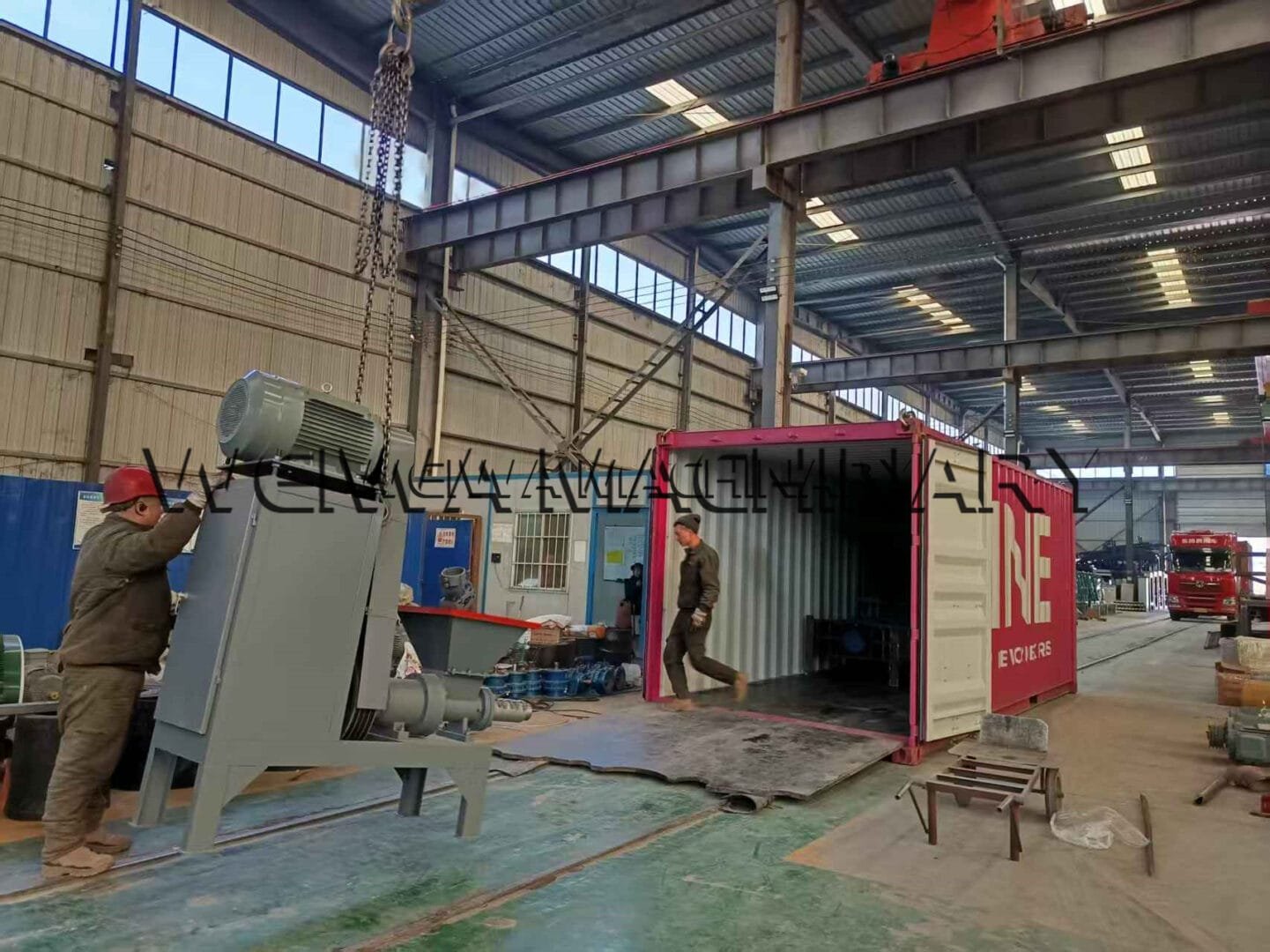
The production line dispatched to our Bhutanese client consists of four core units arranged in a logical workflow. Pertama, a wood crusher reduces branches, Buluh, and wood offcuts into particles smaller than 5 mm. Second, an airflow rotary dryer lowers the moisture content of the crushed sawdust to below 12 percent. Third, the dried material feeds continuously into the main biomass briquette machine—our heavy-duty screw-type biomass extruder—which heats, compresses, and shapes the biomass into hollow hexagonal or quadrangular rods. Fourth, a batch or continuous carbonization furnace pyrolyzes the briquettes into finished charcoal with high fixed carbon content and low ash.
Each machine in this line was inspected, run under no-load and load tests in our workshop, then packed in fumigated wooden crates compliant with international phytosanitary standards. For the overland segment from the nearest seaport to the Bhutan site, we added PE film wrapping and shock-absorbing inserts to protect the mesin briket habuk papan screw propeller and heating ring against vibration and moisture. Our export documentation included CE-related compliance papers, a multilingual operation manual, and a spare-parts list so that local technicians can perform routine maintenance without delay.
Key Specifications of the Sawdust Extruder in This Shipment
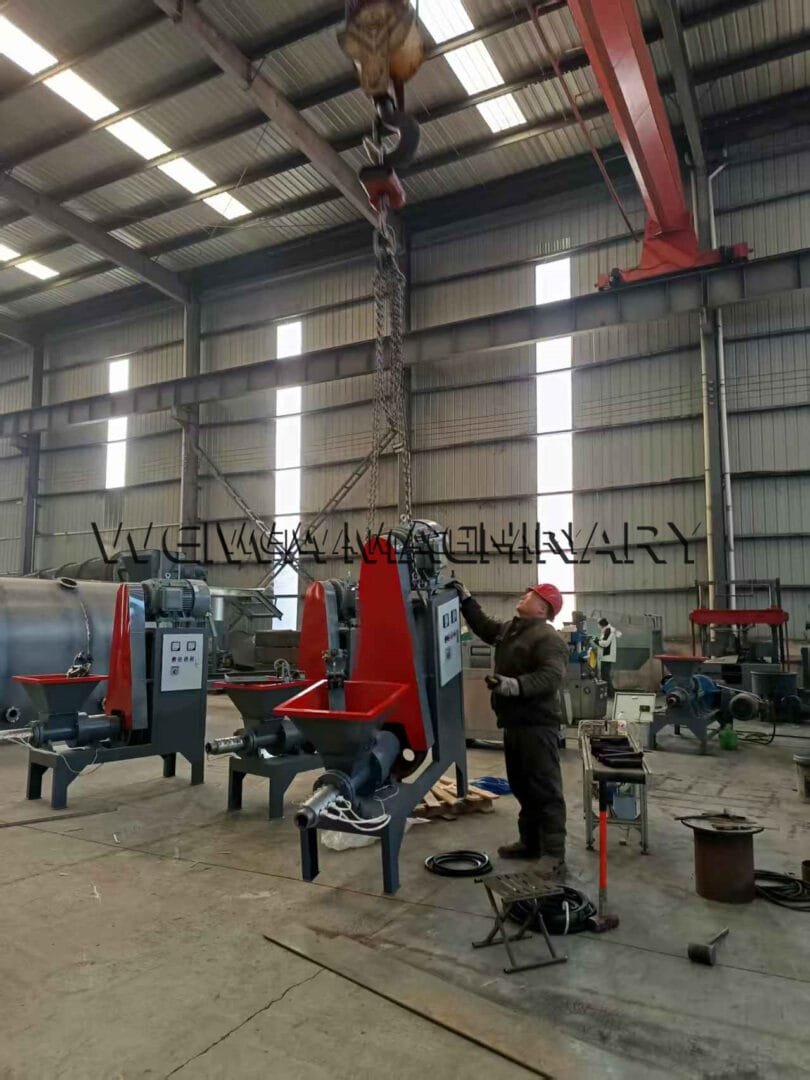
The penyemperit habuk papan supplied is a screw-propeller type biomass extruder equipped with an adjustable temperature-indicating controller on the heating ring. It processes dried sawdust, sekam beras, shell kacang, Palm ingat, Debu buluh, and similar biomass under high pressure and temperature, causing the natural lignin in the fiber to soften and act as an internal binder. No chemical additives or starch are required. The output briquette is typically 45 mm to 80 mm in outer diameter with a 15–20 mm central hole, available in square, pentagonal, Hexagonal, or hexagonal-with-edge profiles depending on the die mold installed. Calorific value of the carbonized product is normally more than 20 percent higher than that of ordinary firewood, and the high density makes storage and road transport economical even across mountainous terrain.
Step-by-Step Working Principle of a Biomass Briquette Machine and Sawdust Extruder
Understanding the science behind a mesin briket biojisim helps operators in Bhutan achieve stable output and consistent charcoal quality. The full process contains five sequential steps.
Raw Material Preparation and Crushing
Biomass raw materials must first be reduced to a uniform particle size of approximately 3–5 mm. Oversized chips will cause poor compression and surface cracking, while excessively fine flour-like powder may block the feed hopper. A hammer mill or disc crusher is normally used, and the choice of screen mesh depends on the hardness of the feedstock. For bamboo and hardwood offcuts common in Bhutan, a 4 mm screen is recommended.
Drying to Controlled Moisture Content
Moisture content is the single most critical parameter before briquetting. The sawdust must be dried to 8–12 percent, with 10–11 percent being optimal for most screw-type sawdust briquetting machines. If moisture exceeds 12 percent, flash vaporization of water inside the extrusion chamber can cause the so-called cannon-fire effect where material is ejected violently. If moisture is below 6 percent, the lignin plasticization temperature may not be reached uniformly, resulting in brittle briquettes. An airflow dryer with a cyclone separator is the standard solution, and inlet air temperature is adjusted according to initial moisture level.
Briquetting by the Biomass Extruder
Dried biomass is conveyed into the feeding port of the penyemperit biojisim. Inside the compression chamber, a high-chromium alloy screw propeller forces material forward while the heating ring raises the temperature to roughly 280–350 °C in the forming zone. Under this combined thermal and mechanical pressure, lignin melts into a viscous adhesive that binds cellulose fibers together. The material is then pushed through the shaped die to form a continuous hollow rod. The screw pitch, compression ratio, and die resistance are engineered so that the briquette exits the machine with a smooth, carbonizable skin and a dense internal structure.
Natural Cooling and Sizing
Freshly extruded briquettes leave the die at 250–300 °C and must be laid flat on a cooling rack for 30–60 minutes depending on ambient temperature and diameter. Premature handling can deform the still-soft lignin matrix. Once cooled, briquettes are cut into standard lengths—usually 300–500 mm—or left as continuous sticks if the downstream carbonization furnace accepts them whole.
Carbonization Into Finished Charcoal
The final stage is pyrolysis in a sealed carbonization furnace under limited oxygen. Temperatures of 400–600 °C drive off volatile matter and leave a fixed-carbon rod with high energy density, low smoke, and minimal ash. The charcoal produced from a properly tuned penyemperit habuk papan line is widely used for barbecue, metallurgical reduction, or as clean household cooking fuel in areas transitioning away from raw firewood.
Feedstock Options Suitable for a Biomass Briquette Machine in Bhutan
A major advantage of the biomass briquette machine in Bhutan supplied by Weiwa Machinery is its tolerance for mixed feedstocks. Hardwood and softwood sawdust, sekam beras, sekam kopi, shell kacang, Bagasse, tangkai kapas, Batang bunga matahari, jerami padi, Debu buluh, Palm ingat, soybean husk, and tea waste can all be processed provided particle size and moisture are corrected upstream. Blending two or three types—such as 70 percent pine sawdust with 30 percent rice husk—often improves briquette surface finish and combustion characteristics. Operators are advised to keep a record of feedstock mix ratios and corresponding briquette density to fine-tune production for local material availability across seasons.
Logistics and Installation Considerations for Shipping a Sawdust Extruder to Bhutan
Delivering industrial machinery to a landlocked Himalayan country involves careful coordination. The recent Weiwa shipment to Bhutan was routed through a major Indian port, then transferred to trucks for the final overland leg. Our team pre-confirmed road clearance heights, verified voltage specifications (commonly 415 V / 50 Hz three-phase in the region), and supplied simplified electrical wiring diagrams with English and pictorial annotations to assist local electricians. Upon arrival, our remote technical support team guided the client through foundation leveling, machine alignment, belt tensioning, and initial no-load trial. For buyers who request it, Weiwa Machinery can dispatch engineers on-site for commissioning and operator training.
Spare-part recommendations for a mesin briket habuk papan typically include one spare screw propeller tip, one heating coil, and a set of forming dies, because the screw tip experiences the highest wear from abrasive silica in some biomass types. Using wear-resistant hard-facing on the screw extends service intervals significantly and is part of our standard manufacturing process.
Environmental and Economic Benefits of Localized Charcoal Production With a Biomass Extruder
Deploying a penyemperit biojisim and complete charcoal line in Bhutan delivers measurable environmental benefits. Diverting sawdust and crop residues from open burning cuts PM2.5 and methane emissions. Substituting briquetted charcoal for partially combusted firewood reduces indoor air pollution in rural households. High-density briquettes also mean fewer truck trips per unit of energy delivered compared to loose biomass, lowering transport-related CO₂.
Economically, a modest-capacity penyemperit habuk papan processing 300–500 kg of raw material per hour can generate a viable small enterprise supplying nearby towns, monasteries, schools, and eco-resorts. Women-led cooperatives have successfully adopted similar models in other South Asian countries, using the income to reinvest in community services. Because the technology requires no imported binders and uses widely available waste as input, the operating cost structure remains stable even when fossil-fuel prices fluctuate.
Troubleshooting Common Issues When Running a Sawdust Briquetting Machine
Briquette Surface Cracks
If extruded rods show longitudinal cracks, check first for over-dry raw material or excessive heating-ring temperature. Slightly increasing moisture within the 8–12 percent window or reducing the heating coil setpoint often resolves this. Worn screw compression sections can also cause incomplete densification, in which case the screw should be rebuilt with hard-facing alloy.
Material Backflow or Feeding Jam
Backflow usually indicates that feedstock is too fine or that the hopper vibrator—if fitted—is not functioning. Ensure the crusher screen matches the recommended 3–5 mm range and confirm that the inlet chute is not obstructed by foreign objects such as nails or stones.
Abnormal Smoke Color During Warm-Up
White smoke during initial heating is normally evaporating residual moisture. Blue or black smoke accompanied by a burnt smell suggests friction overheating from a worn propeller tip or misaligned die. Reduce feed rate, inspect the screw nose, and replace parts if needed before resuming full production.
Why Choose Weiwa Machinery for Your Biomass Briquette Machine and Sawdust Extruder?
Weiwa Machinery specializes in the design and manufacture of mesin briket biojisim, penyemperit habuk papan, and complete charcoal production lines. With customers in more than 130 countries—including Indonesia, India, Malaysia, Vietnam, the Philippines, Pakistan, Turki, Poland, Mesir, Afrika Selatan, and now Bhutan—we have accumulated deep practical experience in adapting equipment to diverse climates, altitudes, and feedstock conditions. Every machine is shop-tested before shipment, and we provide free production-line design based on your raw material type, moisture level, and target hourly capacity.
Our after-sales service covers installation guidance via video or on-site dispatch, latihan pengendali, spare-parts supply, and ongoing technical consultation. Whether you need a single mesin briket habuk papan or a turnkey charcoal plant, Weiwa Machinery works with you from the first inquiry through to long-term operational success.
Contact Jentera Weiwa
Interested in a biomass briquette machine in Bhutan or a sawdust extruder for your local market? Contact us today for a free customized proposal.
- Mob / WhatsApp: +86 138 3809 3177
- E-mel: info@cjlmachinegroup.com
Weiwa Machinery — Turning Biomass Waste Into Valuable Energy, Worldwide.


 WeChat

 +8615937143060
