


Thailand has abundant agricultural and wood-processing residue. Factories, furniture workshops, rubber plantations and rice mills all generate material that is often dumped, burned or left unused. A sawdust extruder changes that equation because it turns low-value residue into dense, combustible charcoal sticks with stable shape and high energy content.
Why Thailand Needs Sawdust Extrude Machines?
The Thai fuel market is shifting. Traditional lump charcoal is still common, but buyers now ask for cleaner combustion, uniform size, longer burning time and easier stacking for export. A sawdust briquette machine answers those demands because the extrusion process controls diameter, density and surface finish.
In many Thai provinces, humidity is high and raw sawdust often arrives with unstable moisture. That makes drying and feeding control very important. The sawdust extrude machine in Thailand must not only press material. It must handle variation in fiber length, kelembapan, ash content and bulk density.
Raw Material Conditions In Thailand
Semasa perbicaraan, the client supplied mixed hardwood sawdust, rubber-wood offcuts, rice husk and a small portion of coconut shell powder. Rubber wood is common in southern Thailand. Rice husk is common in central and northeastern regions. Coconut shell residue is widely available in coastal areas. Each material behaves differently inside the extruder.
Sawdust gives good lignin release under heat and pressure. Rice husk increases ash if overdosed. Coconut shell powder improves fixed carbon but is more abrasive on screws and dies. The sawdust extruder must be built with wear-resistant alloy parts if the client wants long service intervals.
Moisture Control Before Extrusion
Biomass must enter the sawdust extrude machine with moisture generally around 8 ke 12 percent. Too wet, and the stick expands, cracks or fails to hold shape after cooling. Too dry, and the material may overheat, burn inside the barrel or create excessive fine dust.
For the Thailand trial, Weiwa Machinery used a rotary drum dryer followed by a buffer silo. The silo allowed material to stabilize before entering the hopper. This reduced feeding fluctuation and helped the sawdust extruder maintain constant pressure.
What The Thai Client Wanted From The Charcoal Line?
The Thai client was not looking for a single machine only. They wanted a line that could start from workshop waste and end with carbonizable briquette sticks. Their requirements included stable hourly output, low breakdown risk, simple operator training, spare parts availability and sticks suitable for later carbonization in a kiln or continuous carbonizer.
They also cared about export appearance. Charcoal sticks for barbecue markets must have clean edges, low crack rate and consistent length. A charcoal stick extruding machine with the right die geometry can produce square, hexagonal or round hollow sticks depending on market preference.
How The Sawdust Extruder Was Prepared For Trial?
Before extrusion, Weiwa technicians checked particle size. Oversized chips were returned to the crusher until most material passed the recommended size range. Then the dryer was adjusted until moisture readings stayed inside the target window. Only after that did the sawdust extruder begin continuous running.
The machine uses a large screw to push biomass through a heated barrel and forming die. Heat softens natural lignin. Pressure reorganizes the fibers. No chemical binder is required. The output is a semi-finished briquette stick with enough mechanical strength for handling, cooling and transport to the carbonization stage.
Temperature control was critical. If the barrel was too cold, sticks came out soft. If too hot, surface scorching appeared. The Weiwa sawdust extrude machine uses an adjustable heating ring so the operator can tune temperature according to raw material blend.
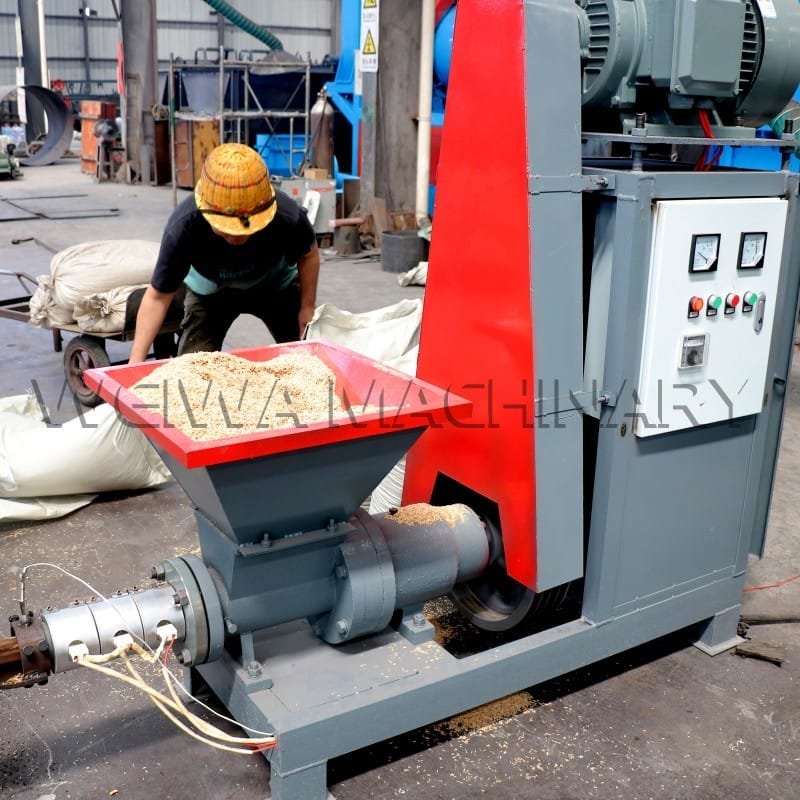
Trial Results From The Thailand Charcoal Stick Line
The trial ran in several batches. Output diameter was set for the client’s export specification. Stick surface was smooth, ends were clean, and post-extrusion breakage remained low after cooling. The client measured stick density, length uniformity, color, smell and hardness before sending samples to carbonization.
Density And Calorific Value After Trial
Extruded sticks showed high bulk density compared with loose sawdust. Selepas pengkanan, the charcoal sticks delivered longer and steadier combustion than ordinary lump charcoal from the same region. Higher density means less air gap, slower burning and better heat retention.
For the Thai market, this matters because end users want charcoal that lights predictably, burns without frequent refueling and produces manageable ash. The sawdust briquette machine helped the client move from informal batch charcoal toward standardized fuel products.
Operator Training And Local Support
Machine quality is only part of the result. Weiwa Machinery also trained the Thai team on feeding rate, dryer adjustment, screw wear inspection, die change, bearing lubrication and emergency stop procedure. Operators learned how to read abnormal noise, overheating and uneven stick formation before minor issues became major breakdowns.
For overseas buyers, after-sales clarity is as important as machine price. The client received a spare-part list, maintenance calendar and WhatsApp support channel so routine problems could be solved without waiting for an engineer to fly in.
Why Southeast Asia Prefers Sawdust Briquette Machine Output?
Across Vietnam, Indonesia, Malaysia, the Philippines and Thailand, biomass waste is plentiful but scattered. A sawdust briquette machine allows small and medium factories to collect local residue, process it nearby and sell finished charcoal without importing expensive raw fuel.
Southeast Asian buyers also value binder-free production. Adding starch or chemical binders raises cost and can create smoke during carbonization. The sawdust extruder relies on natural lignin, which fits both cost control and environmental expectations.
Another reason is export potential. Uniform charcoal sticks pack better in containers, survive handling better than fragile lump charcoal and meet buyer specifications more easily in Japan, Korea, Europe and the Middle East.
How Charcoal Stick Extruding Machine Improves Carbonization?
Carbonization is the stage where extruded biomass sticks are converted into true charcoal. If the green stick has uneven density, carbonization creates cracks, partial charring or excess fine material. A charcoal stick extruding machine improves carbonization because uniform input leads to uniform thermal decomposition.
In the Thailand trial, sticks made by the Weiwa extruder carbonized with fewer broken pieces. The hollow center helped heat penetrate, while the compact wall kept structural strength. The client reported better yield of marketable charcoal and less material loss as dust.
For factories planning kiln carbonization, the extruded stick length should match kiln basket size. For continuous carbonizers, feeding consistency matters more than maximum peak output. The sawdust extrude machine should be matched to the carbonization system, not selected alone.
Weiwa Machinery Factory Advantage For Thai Buyers
Weiwa Machinery designs biomass densification and charcoal equipment for real workshop conditions. Our sawdust extruder models are built for continuous duty, not showroom demonstration only. Key advantages include adjustable heating, wear-resistant screw and die materials, stable feeding design, low maintenance structure and flexible die options for square, hexagonal or round sticks.
We also customize the line according to local material. A Thailand client processing rubber wood and rice husk needs different dryer capacity than an Indonesian client processing coconut shell and sugarcane bagasse. Weiwa engineers review moisture, fiber type, target diameter, daily capacity and carbonization method before recommending the full system.
Our factory can supply crusher, pengering, conveyor, sawdust extrude machine, cutter, relau karbonisasi, cooling unit and packaging support. Thai clients can request a video test, shared-line reference, spare-part kit and operator manual in English. For larger projects, on-site installation and training can be arranged.
The Thailand trial confirmed what many Southeast Asian charcoal makers are starting to realize. A properly tuned sawdust briquette machine is not just a waste processor. It is the backbone of a modern charcoal business.
Mengenai Jentera Weiwa
Weiwa Machinery is a manufacturer of biomass briquette machines, charcoal stick extruding machines, carbonization equipment and complete charcoal production lines. We have supplied equipment to customers in Thailand, Indonesia, Malaysia, Vietnam, India, the Philippines, Afrika, Europe and the Middle East.
Our focus is practical factory performance: stable extrusion, correct moisture control, durable screws and dies, energy-efficient drying, and charcoal output that meets real market specifications. Whether a client needs one sawdust extruder or a full automated charcoal plant, we design the solution around local raw material and export requirement.
Products from Weiwa Machinery help factories turn sawdust, cip kayu, sekam beras, shell kelapa, Bagasse tebu, bamboo dust and crop stalks into high-density briquettes or charcoal sticks. The goal is simple: reduce waste, increase fuel value, and make charcoal production repeatable for Southeast Asian and global markets.
If you want to test a sawdust extrude machine in Thailand, Vietnam, Indonesia or Malaysia, Weiwa Machinery can run a material test, propose a production flow and provide a customized quotation.
Contact Weiwa Machinery
Mob: +8613838093177
WhatsApp: +8613838093177
E-mel: info@cjlmachinegroup.com


 WeChat

 +8615937143060
