


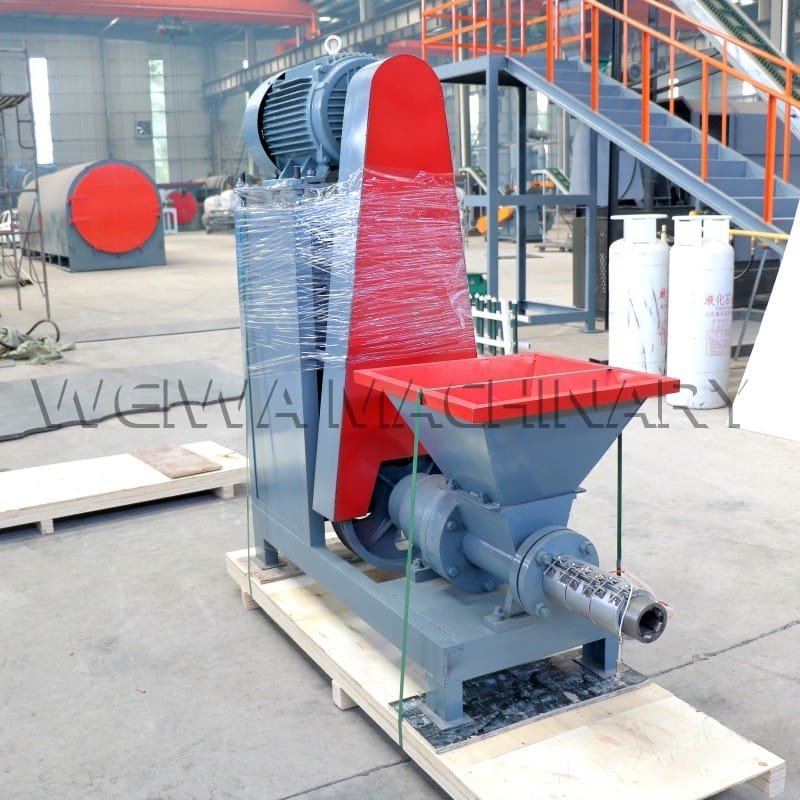
Uganda is one of the fastest growing biomass fuel markets in East Africa. Urban demand for clean burning charcoal continues to rise in Kampala, Jinja, Mbarara, and Entebbe, while rural sawmills and agro processors accumulate wood waste that is often burned openly or left to rot. Our Ugandan client wanted a system that could run on unstable grid power, handle high moisture seasons, and produce uniform charcoal sticks that survive carbonization without cracking.
Why Uganda Is a Strategic Country for Sawdust Extruder Applications?
Uganda produces massive volumes of agricultural residue every year. Coffee husks from the central region, sugarcane bagasse from Lugazi and Kakira mills, maize cobs from the north, and eucalyptus sawdust from timber yards around Kampala form a steady year round feedstock base. Traditional charcoal making still relies on earth kilns and felled trees, which creates uneven quality, high smoke emission, and shrinking forest cover. A modern sawdust briquette machine changes the equation by pressing loose biomass into dense rods, which are later carbonized into smokeless charcoal sticks with higher calorific value.
For local entrepreneurs, the math is simple. Loose sawdust has low transport value. After passing through a sawdust extruder, the same material becomes a 50 mm to 80 mm diameter stick with a 15 mm to 20 mm central hole, weighing three to four times more per cubic meter. Transport cost drops. Burning time rises. Retail price in Kampala urban kitchens is 20 ke 35 percent higher than ordinary lump charcoal. That margin is what makes a sawdust extrude machine in Uganda attractive to small factories and cooperative groups.
What Weiwa Loaded Into the Container for Uganda?
The production line we sent was configured after a 40 minute video call with the client’s engineer. We did not sell a standard carton. We designed a flow that matches Ugandan humidity and raw material mix. The loaded items included:
A model 80 screw sawdust extruder with 37 kW motor, fitted with a hexagonal die and reinforced compression chamber. A sawdust briquette machine pre-grinder with 22 kW hammer mill. A 1000 mm diameter rotary dryer with biomass burner. A screw conveyor and buffer hopper. A four layer continuous carbonization furnace with secondary combustion chamber. Spare screws, heating coils, bearings, and a full English operation manual with Swahili glossary. All machines were packed in fumigated wooden boxes compliant with East African phytosanitary import rules. Tight container spaces were solved with PE film wrapping for auxiliary parts.
Our quality team ran a pre shipment dry test using simulated Uganda blend sawdust at 11 percent moisture. The extruder reached stable barrel temperature at 280 degrees Celsius and produced 340 kg per hour of solid fuel sticks. Surface was smooth. Hole was centered. No screw overload alarm triggered. That same setting was documented in the trial report handed to the client.

How a Sawdust Extruder Works Without Chemical Binders?
A sawdust extruder is not a hydraulic press. It is a heated screw compression system. Prepared biomass enters the hopper, is pushed by a large auger through a heating barrel, and is forced into a forming sleeve. Inside the barrel, friction and external heating raise the temperature to between 260 dan 320 darjah celcius. At this range, natural lignin inside wood fiber softens and behaves like an internal glue. No starch, no cement, no chemical binder is added.
As the material exits the die, it forms a hollow quadrangular or hexagonal cylinder. After cooling, the stick is rigid, water resistant on the surface, and ready for carbonization. The charcoal stick extruding machine stage is therefore the bridge between loose farm waste and marketable solid fuel. If extrusion pressure is too low, the stick crumbles in the kiln. If temperature is too high, the lignin burns instead of binding. Weiwa controllers use an adjustable temperature indicator and segmented heating rings to keep the sweet spot stable for eight hour shifts.
Raw Material Standard for Uganda Blend
Ugandan sawdust is often mixed with bark, sand, and wet coffee pulp if not screened. Before extrusion, particle size must be below 5 mm. Moisture must be 8 ke 12 percent. Our technician advised the client to run eucalyptus sawdust through the hammer mill first, then blend 70 percent sawdust with 20 percent coffee husk and 10 percent bagasse. This blend improved lignin release and reduced screw wear during the trial.
Why Hexagonal Die Was Chosen?
Ugandan buyers prefer hexagonal sticks because they stack tightly in sacks, allow airflow during carbonization, and break less during loading. Our sawdust extruder for Uganda was thus equipped with a 50 mm hexagonal die with edge reinforcement. Square and pentagonal dies are optional, but the client confirmed hexagonal charcoal sticks sell faster in Kampala retail bags.
On Site Trial Result After Arrival in Uganda
Two weeks after container clearance, our remote guidance engineer joined the client on WhatsApp video. Local electrician connected the 37 kW extruder to a 415 V three phase line with voltage stabilizer. The dryer was fired with waste wood offcuts. First batch used pure eucalyptus sawdust at 13 percent moisture. Initial sticks showed slight surface hairline cracking, so the team slowed feeder speed and raised barrel zone two temperature by 15 degrees.
Second batch used the recommended 70/20/10 blend at 10.5 percent moisture. Output stabilized at 318 kg per hour. Stick diameter measured 50.4 mm. Central hole 15.2 mm. Density 1.15 g per cubic centimeter. After 14 hours in the continuous carbonizer at 480 darjah celcius, carbonization yield reached 31 percent. Final charcoal stick length was uniform. Burning test in a local stove showed continuous flame for 58 minutes per 500 g sample, compared to 41 minutes for traditional lump charcoal.
The client sent us a short voice note: “Machine started smoking a little at hour one, then ran clean. Sticks came out hot but straight. Selepas pengkanan, the charcoal is black, light, and does not powder. We already sold two sacks in Jinja market.” That field feedback is more valuable than any factory brochure.
Charcoal Quality Difference Compared to Traditional Kiln Charcoal
Traditional Ugandan kiln charcoal is made by stacking wood in a pit, covering with soil, and burning slowly with limited oxygen. The result is inconsistent. Some pieces are half carbonized. Some are ash. Smoke pollutes the village. A sawdust briquette machine plus carbonizer line removes the guesswork.
Weiwa extruded charcoal sticks carry these advantages. Fixed diameter enables uniform carbonization. Hollow center lets heat penetrate faster. Dense structure means less oxidation loss. Natural lignin binding means no foreign odor. Calorific value measured 4200 kcal per kg after carbonization, which is more than 20 percent higher than ordinary firewood and about 15 percent above average Ugandan lump charcoal. Ash content stayed below 4 percent. Moisture after cooling was 2.8 percent.
Kuasa, Penyelenggaraan, and Local Service Reality in Uganda
Many Ugandan factories face power fluctuation. Our sawdust extruder ships with a control cabinet that tolerates plus minus 10 percent voltage swing. For off grid sites, we offer diesel generator pairing advice and soft starter option. Daily maintenance is simple. Operator checks screw wear every 40 operating hours. Heating coil resistance is logged weekly. Bearing grease is refreshed monthly. One local mechanic trained by our video guide can handle 90 percent of field issues.
Spare parts strategy matters for Uganda. We stock screws, sleeves, and coils in our China warehouse and ship by air to Entebbe within five days. The client in this project received one spare screw and two heating rings inside the same container, so production never stops during first three months.
Economic Return for a Small Uganda Charcoal Stick Plant
Using the trial numbers, a single shift of eight hours produces about 2500 kg of green sticks. After carbonization yield of 31 percent, that becomes roughly 775 kg of finished charcoal. At current Kampala wholesale price of 3200 Uganda shillings per kilogram, daily gross is about 2.48 million shillings. Raw material cost using sawdust purchase at sawmill gate is low. Electricity, labor, and dryer fuel subtract around 600000 shillings. Net daily profit sits near 1.8 million shillings, meaning the machine line can pay back inside seven to nine months. This is why inquiries for sawdust extruder in Uganda keep climbing across our sales inbox.
Common Mistakes Ugandan Buyers Make When Importing Extruders
First mistake is buying on price alone. A cheap sawdust extruder with thin screw and no temperature control will jam within two weeks on Ugandan coffee husk. Second mistake is ignoring dryer capacity. Extrusion fails if moisture is above 12 percent. Third mistake is mixing raw materials without testing lignin behavior. Fourth is forgetting voltage and spare part route. Weiwa solves these by supplying matched line components, not isolated machines.
Jentera Weiwa Positioning for East Africa
Weiwa Machinery is a Chinese manufacturer of biomass briquette and charcoal production equipment with more than thirty years of factory experience. We have supplied machines to over 130 countries including Indonesia, India, Malaysia, Tanzania, Ethiopia, and Uganda. Our product range covers sawdust extrude machine, penyemperit habuk papan, sawdust briquette machine, charcoal stick extruding machine, relau karbonisasi, crusher, pengering, and turnkey plant design. Every Uganda bound line receives free process design, English manuals, WhatsApp remote commissioning, and optional on site training.
This Uganda shipment proved again that a sawdust extruder for Uganda must be tuned for local fiber, local humidity, and local voltage. We do not believe in one size fits all. We believe in trial data, screw metallurgy, and after sales response time.
Conclusion and Next Step
The charcoal machine line leaving our workshop for Uganda is now in commercial operation. Trial run confirmed stable extrusion, clean carbonization, and market grade charcoal sticks. For Ugandan entrepreneurs sitting on sawdust piles or coffee husk waste, the sawdust extrude machine in Uganda is no longer an experiment. It is a repeatable business model.
If you plan to start a charcoal stick plant in Kampala, Jinja, Mbarara, or any East African city, contact Weiwa Machinery for a free layout drawing and raw material evaluation. We will recommend the right sawdust extruder model, dryer size, and carbonizer type based on your daily target and moisture condition.
Contact: Mob +8613838093177, WhatsApp +8613838093177, Email info@cjlmachinegroup.com


 WeChat

 +8615937143060
