


How the Relau karbonisasi berterusan Was Prepared for Qatar?
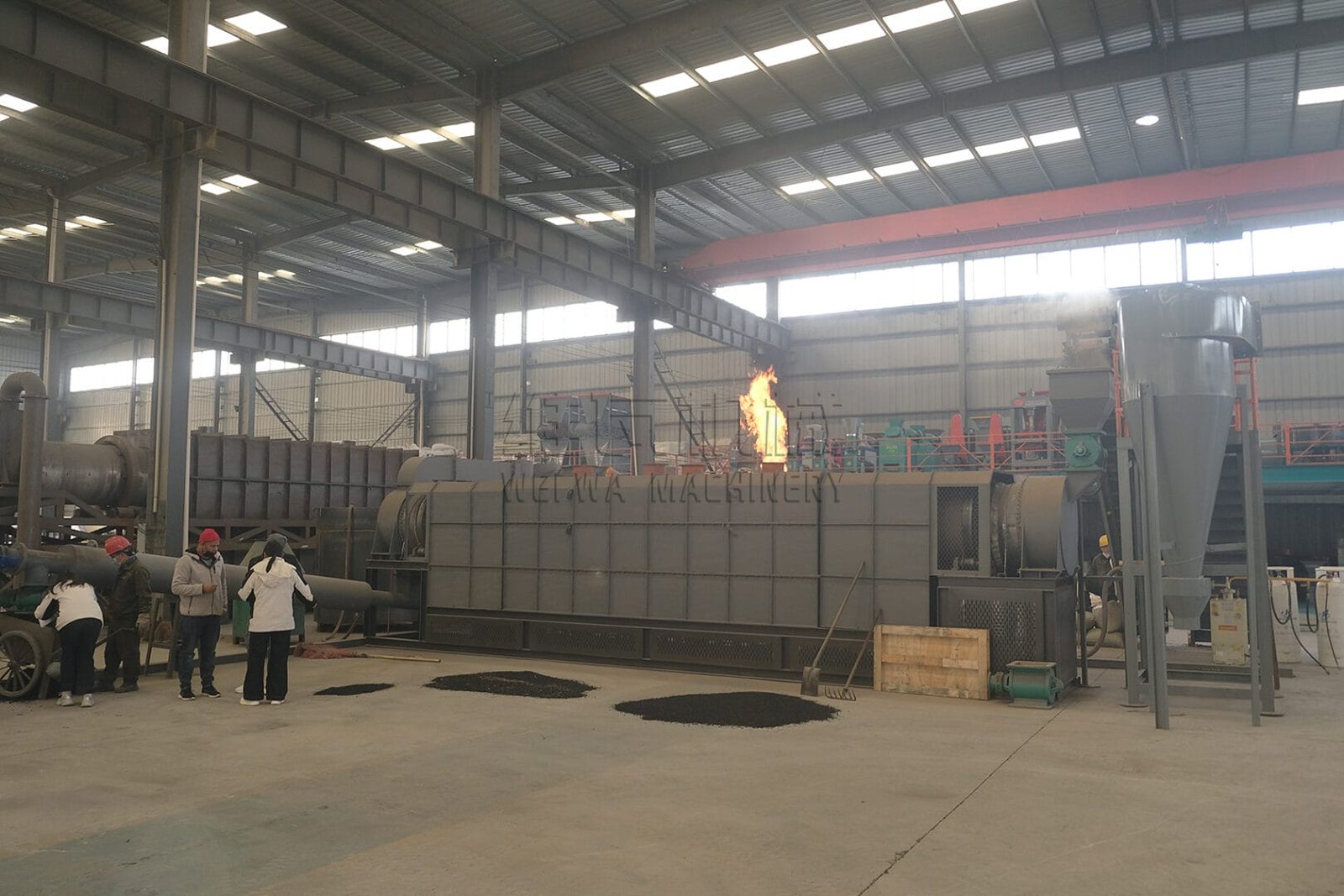
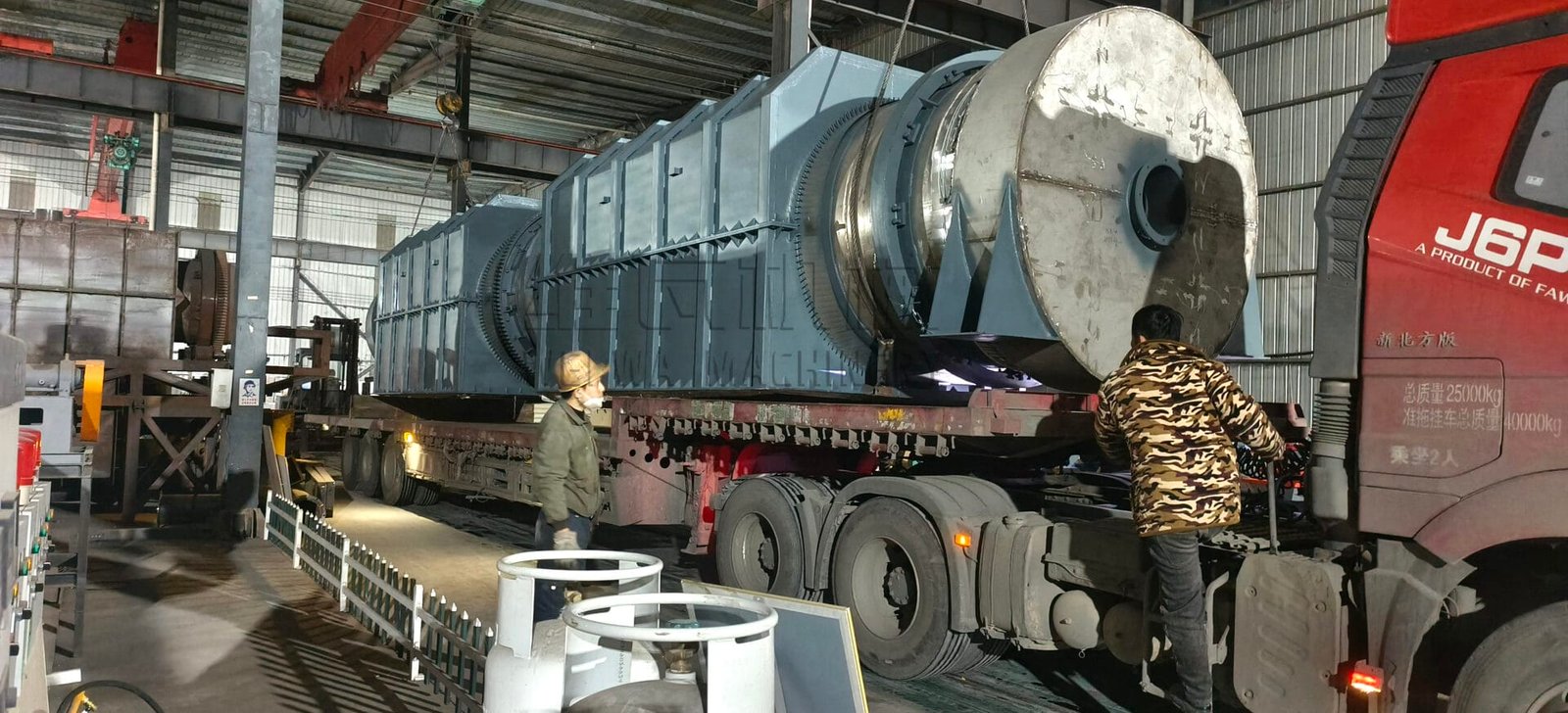
The loading site was organized around three zones. The first zone held the main rotary drum assembly. The inner drum for drying and outer drum for carbonization were wrapped in moisture-proof film, then secured with steel belts on a flat rack. The second zone held the combustion and gas recirculation units. The third zone contained electrical cabinets, spare parts, and installation tools. Our QC team checked flange torque, thermocouple channels, and the self-sustaining gas loop before the truck entered the port.
For a continuous carbonization furnace for sale to a hot and coastal market like Qatar, corrosion resistance matters. We applied marine-grade paint on the skid frame, used stainless transition sections on the gas pipe elbows, and pre-set the PLC parameters for ambient temperatures above 45 darjah celcius. The client requested English and Arabic equipment labels, so the final panel carried both scripts.
One detail worth noting: the buyer did not ask for the cheapest unit. The conversation centered on uptime, uniform barrel temperature around 500 ke 600 darjah celcius, and the ability to run coconut shell, wood chip, and rice husk in the same line. That profile fits the double-cylinder continuous design better than a batch kiln, and it explains why the continuous carbonization furnace price was evaluated against lifetime charcoal yield rather than upfront cost alone.
What the Client in Qatar Wanted to Solve?
The Qatar buyer operates in the landscaping and greenhouse supply segment. They import large volumes of coconut fiber and wood packaging material, and they wanted a way to convert the residue into a stable carbon product. Their team had already read about biochar revenue potential from wastepaper and food waste in Qatar, and they viewed charcoal as the first step before later upgrading part of the output into biochar or activated carbon.
During the factory test, we ran a 6-hour continuous cycle on rice husk. The system kept the outer drum at 560 degrees Celsius with plus or minus 15 degrees swing. Combustible gas from the pyrolysis section was routed back to the burner, which cut LPG support to near zero after the first 40 minutes. That self-sustaining loop is the core reason many buyers now compare a continuous carbonization furnace in Qatar against imported charcoal, which carries freight and carbon cost.
Qatar and Biochar: Why the Question Is No Longer If, But How
Qatar generates substantial organic waste streams despite its small land area. Published research from Qatari universities estimates the country produces around 1.8 million tonnes of food waste annually, alongside animal waste, municipal sludge, and imported agricultural residue. A 2023 pyrolysis study on Qatar waste streams calculated that wastepaper alone could yield hundreds of thousands of tonnes of biochar, with revenue potential running into tens of millions of dollars per year at commercial scale.
Qatar National Vision 2030 pushes waste diversion away from landfill and supports circular economy pilots. In that policy frame, biochar is attractive because it locks carbon in soil-like matrix, improves water retention in arid greenhouse farming, and can be counted in voluntary carbon markets. The global biochar market is forecast to climb from under 900 million dollars in 2025 toward 3.6 billion dollars by 2035, a trajectory that Gulf investors watch closely.
Where Charcoal Stops and Biochar Starts?
A continuous carbonization furnace produces charcoal. Biochar is charcoal with a defined use: soil amendment, carbon sequestration, or feedstock for activation. The same furnace can serve both paths if the feedstock is clean and the temperature curve is controlled. For Qatar, rice husk and coconut shell give a bright, low-ash charcoal that can be crushed into biochar powder for greenhouse media. Wood pallet waste gives a denser lump charcoal for grilling and industrial reduction.
This flexibility matters because Qatar charcoal consumption still relies heavily on imports. Market data shows Qatar imported over 14,000 tonnes of charcoal in 2024, while domestic output stayed near 770 tonnes. The gap is an opening for local continuous production, especially when the line can switch feedstock without a full rebuild.
Why the Continuous Carbonization Furnace Fits the Qatar Operating Model?
Qatar sites are often space-limited, labor-aware, and automation-friendly. A batch kiln needs manual loading, multi-day cooling, and produces inconsistent barrels. A continuous carbonization furnace feeds from one end and discharges from the other while recovering syngas. In our Qatar trial reference, one line delivered six to eight tonnes of finished charcoal per week versus one to two tonnes from a traditional kiln.
The double-cylinder rotary design solves two field problems at once. The inner drum pre-dries wet rice husk so the outer drum does not lose heat to evaporation. The outer drum holds the carbonization zone at stable temperature. Because the spiral flight pushes material forward, the operator avoids opening the chamber mid-run, which keeps oxygen ingress low and fixed-carbon ratio high.
Continuous Carbonization Furnace Price: What Actually Drives the Number
Buyers searching continuous carbonization furnace price usually receive quotes between wide bands. The reason is configuration. A 500 kg per hour line with basic PLC costs less than a 1.5 tonne per hour line with marine coating, dual-language HMI, and overseas installation. Freight to Hamad Port, Arabic labeling, and spare-part kits add line items that do not show in a base ex-works price.
For the Qatar order, the client selected mid-range capacity with full gas recovery and remote diagnostics. The continuous carbonization furnace price in that bracket is justified by fuel savings: once the gas loop stabilizes, external LPG drops to startup-only use. Over a 24-month run, the energy saving alone recovers a meaningful share of the equipment premium compared with a cheaper batch setup.
Weiwa does not publish a single fixed price because feedstock moisture, local voltage, and discharge style change the bill of materials. Instead we quote against a feedstock sample and a target shift pattern. That method prevents the common mistake of buying a furnace too small for the dried throughput, then running it overloaded and shortening the refractory life.
Continuous Carbonization Furnace in Qatar: Market Prospect to 2030
Regional biomass carbonization forecasts put Qatar at roughly 7.3 million dollars of equipment market value by 2034 with an 11.6 percent CAGR, part of a wider Middle East and Africa movement that already counts more than 150 announced projects between 2022 dan 2024. The drivers are not only environmental. They are economic.
Pertama, Qatar imports most of its charcoal, so local production hedges price volatility. Second, greenhouse agriculture in dry climates pays for substrates that hold water and buffer salts; biochar from coconut shell fits that spec. Third, Qatar Energy and industrial water treatment units buy activated carbon, and high-purity charcoal is the precursor. Fourth, carbon credit buyers increasingly sign offtake deals with durable removal products like biochar, which gives a secondary income line to furnace owners.
Barriers That Buyers Should Plan For
The prospect is real but not automatic. Feedstock in Qatar is scattered: food waste needs dewatering, wood pallets need shredding, rice husk arrives in bags from ports. A furnace alone does not solve the front-end logistics. The successful Qatar buyer pairs the continuous carbonization furnace with a shredder, a dryer buffer silo, and a screened discharge conveyor. Permitting for pyrolysis units also touches environmental clearance, so early dialogue with local consultants saves months.
Another barrier is operator skill. A continuous line rewards steady feeding. If the feed hopper starves and refills in surges, barrel temperature swings and charcoal quality drops. That is why Weiwa includes a 7-day on-site commissioning and trains two local operators before sign-off. For the Qatar shipment, our engineer will travel after customs clearance to supervise alignment, gas leak test, and the first 48-hour run.
Jentera Weiwa: Three Decades Behind the Furnace
Weiwa Machinery was founded in 1990. Over more than thirty years we have built biomass briquette presses, carbonization furnaces, and auxiliary lines for clients in Asia, Afrika, Europe, and the Middle East. Our engineering team handles mechanical design, combustion modeling, and PLC logic in-house. When a client in Qatar, Kenya, or Indonesia buys a continuous carbonization furnace for sale from us, the order includes drawings, spare-part mapping, and the option of overseas installation guidance.
The Qatar delivery continues a pattern. We do not treat export as container drop and goodbye. We treat it as commissioning partnership. Our technician checks foundation bolts, flame failure sequence, and discharge cooling water before the client runs commercial shifts. That approach is why many repeat buyers return for a second line instead of switching brands.
Continuous Carbonization Furnace for Qatar: Next Steps
If you are evaluating a continuous carbonization furnace for Qatar, start with feedstock. Send us a 5 kilogram sample of coconut shell, sekam beras, or wood chip, and tell us your target running hours per day. We return a proposal with capacity, moisture limit, gas recovery rate, and a continuous carbonization furnace price broken into machine, coating, control, and freight. For clients ready to move, we arrange factory video inspection, then load the line with the same QA checklist used for the Qatar order.
Qatar’s biochar story is still early. But the pieces are visible: organic waste volume, import substitution pressure, greenhouse agriculture demand, and carbon market interest. A continuous carbonization furnace will not answer all of those at once, yet it is the physical anchor that turns biomass residue into a storable, shippable, upgradable carbon product.
Contact Jentera Weiwa
Weiwa Machinery manufactures and exports continuous carbonization furnace systems for charcoal and biochar precursors. For specifications, continuous carbonization furnace price, or shipment schedule to Qatar and nearby GCC ports, reach our team directly:
Mob: +8613838093177
WhatsApp: +8613838093177
E -mel: info@cjlmachinegroup.com
Whether you need one line for a greenhouse substrate trial or a full 24/7 charcoal plant, we engineer the furnace around your feedstock, not the other way around.


 WeChat

 +8615937143060
