


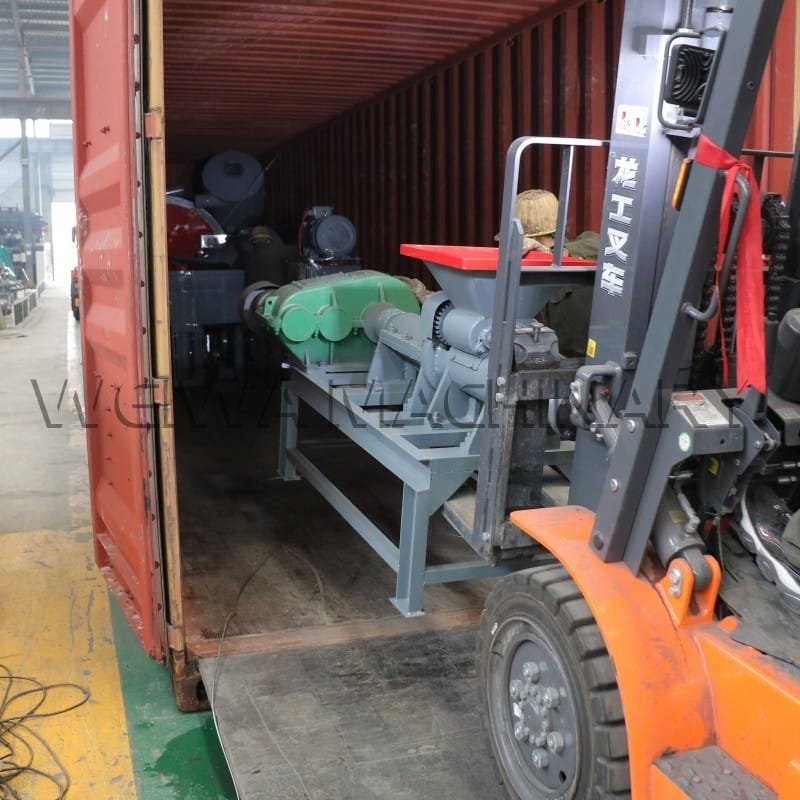
This dispatch is not only a logistics milestone for Weiwa Machinery. It is a field level example of how a charcoal extruder machine, when matched with the right crusher, wheel grinder mixer, and dryer, turns agricultural and forestry waste into a dense, tanpa asap, transport friendly fuel product. In the sections below we walk through the loading scene, explain how the coal rod machine works, break down the configuration we sent, and analyze why the charcoal briquette machine and charcoal making machine business is entering a strong growth phase in Côte d’Ivoire.
Dispatch Scene of the Coal Rod Machine Line at Weiwa Workshop
The container loading began at 8:20 in the morning. Our yard supervisor checked the packing list against the commercial invoice, then opened the plastic wrapped pallets one by one. The central unit in this line was a single screw charcoal extruder machine with a 75 kW copper coil motor, a hardened manganese alloy screw, and a floating coupling transmission. Around it we loaded a hammer type charcoal crusher, a grinding wheel mixer with binder spray ring, a mesh belt dryer with 18 kW fan group, and a spare parts crate containing two extra dies, one screw set, belt tensioners, and a full set of hydraulic clamps.
Before the machine entered the container, our quality inspector ran a 30 minute no load trial. The screw rotated clockwise, the reducer stayed at 62 decibels, the bearing housing temperature rose from 24 ke 41 darjah celcius, and the die head showed no axial shake. Only after this test did we shrink wrap the motor, paint the shipping marks “ABIDJAN COTE DIVOIRE / WEIWA 2026 / LINE A”, and strap the base to the container floor with ratchet belts rated at 2,000 kilograms each.
For buyers evaluating a coal rod machine in Côte d’Ivoire, this pre shipment routine matters more than the photo itself. A machine that passes a no load test in China still needs correct moisture control and binder ratio in West Africa. That is why every Weiwa line ships with a commissioning manual written for high humidity conditions, French and English labels on the control box, and a WhatsApp after sales channel that connects the Ivorian operator directly to our Zhengzhou engineer.
What a Coal Rod Machine Actually Does in a Charcoal Making Machine Line?
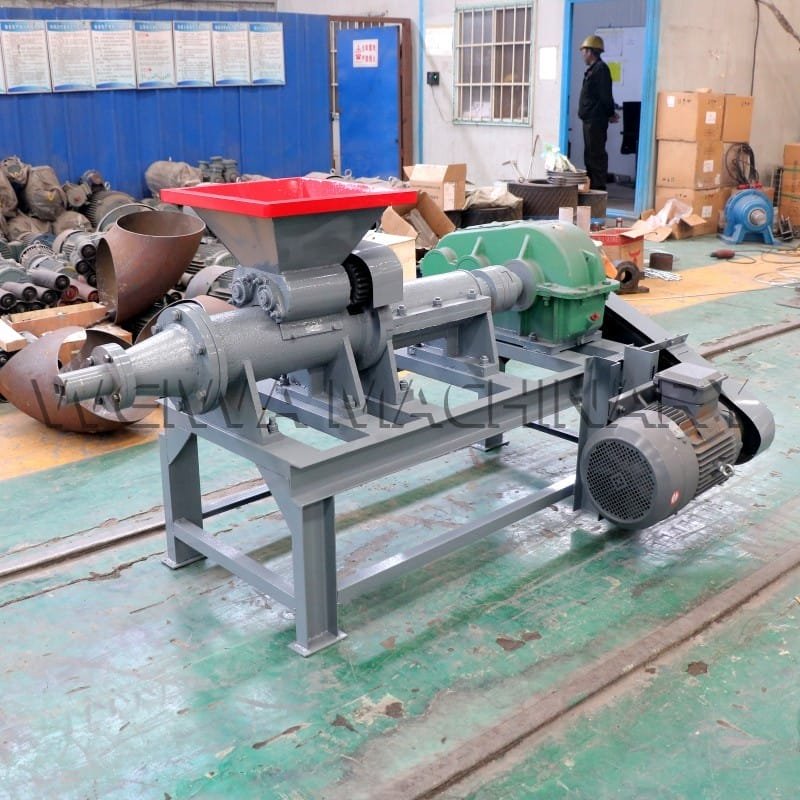
A coal rod machine is a screw extrusion device. It takes charcoal powder or coal powder under 3 millimeters, mixes it with a small percentage of starch or molasses binder, and pushes the material through a tapered alloy die at 35 ke 40 MPa pressure. The output is a continuous stick that is cut into 300 ke 600 millimeter lengths. The cross section can be cylindrical, Dataran, Hexagonal, or plum shaped depending on the die insert. In Côte d’Ivoire most buyers request a 50 millimeter outer diameter hollow hexagon because it ignites faster and burns longer in street food braziers.
Screw Extrusion Principle Without Keyword Stuffing
The motor transmits power to the reducer through a triangle belt. The reducer output shaft connects to the propulsion shaft through a floating coupling that absorbs misalignment. On the propulsion shaft sits a continuous flight screw. As the screw rotates, charcoal powder from the hopper is dragged forward, compressed in the taper zone, heated slightly by friction, and forced out of the die orifice. The high pressure rearranges the particles, activates the binder, and forms a rod with density around 1.1 ke 1.3 grams per cubic centimeter. After cutting, the rod is brittle green and must pass through a dryer or a sealed carbonization furnace before it becomes finished charcoal.
This is also why the charcoal extruder machine is different from a roller press. A roller press makes pillow or oval briquettes from dry powder under cold pressure. A screw extruder makes longer rods and tolerates slightly higher moisture, which suits Ivorian workshops that do not want to over invest in industrial drying at the start.
Charcoal Powder Crusher Mixer and Dryer Coordination
In the line we shipped, the crusher reduces lump charcoal and coconut shell charcoal to below 3 millimeters. The wheel grinder mixer then blends the powder with water and cassava starch binder until the mixture reaches 11 ke 13 percent moisture. The mesh belt dryer removes surface water before extrusion, because if feed moisture exceeds 15 percent the screw slips and the rod surface cracks. These three machines are not optional accessories. They decide whether the coal rod machine in Côte d’Ivoire will run at 80 percent capacity or stall at 30 percent.
Charcoal Extruder Machine Configuration for the Côte d’Ivoire Order
The Ivorian client selected a mid range configuration rather than the largest model. His daily target is 4 tonnes of green rods, which carbonizes to roughly 2.6 tonnes of finished charcoal. The chosen charcoal extruder machine runs at 600 ke 800 kilograms per hour depending on moisture. We equipped it with a cylindrical and a hexagonal die so he can serve both household barbecue buyers and shisha blending exporters. The gear box is a hardened tooth surface unit rated for continuous 18 hour operation. The base uses national certified carbon steel. The screw is surfaced with high manganese alloy and can process around 200 tonnes of charcoal powder before resurfacing.
We also added a French label option on the emergency stop, a 380 volt 50 Hz panel compatible with Ivorian industrial supply, and a spare coupling kit. For first time African buyers, these small modifications reduce commissioning time from two weeks to four days.
Market Potential of Charcoal Briquette Machine and Coal Rod Machine in Côte d’Ivoire
Côte d’Ivoire consumes biomass for a large share of national energy use. Urban districts in Abidjan, Bouake, and Yamoussoukro still cook with solid fuel. Traditional lump charcoal is irregular, loses 10 ke 15 percent as dust during transport, and sells at a discount because restaurants must sieve out the fines. A charcoal briquette machine reverses this logic: it takes the dust that used to be waste and sells it back as a premium rod.
Abidjan San Pedro and Yamoussoukro Fuel Demand
Abidjan alone has thousands of street grills, bakery ovens, and fish smoking units. San Pedro’s timber port generates sawdust from iroko and mahogany offcuts. Yamoussoukro’s cocoa cooperatives discard pod shells by the tonne every harvest. All three cities are within trucking distance of each other, which means one coal rod machine in Côte d’Ivoire can pull feedstock from multiple streams and sell finished rods into multiple channels. Wholesale charcoal in Abidjan currently trades in a range where a denser, cleaner burning rod can command a 12 ke 18 percent premium over ordinary lump charcoal.
Cocoa Pod Sawdust and Coconut Shell Waste as Feedstock
Ivory Coast is the world’s largest cocoa producer. The shells and husks are usually burned in the open. A charcoal making machine line can carbonize this residue first, then crush it, then extrude it. Coconut shell charcoal imported from coastal traders can also be blended with hardwood charcoal fines to adjust calorific value. Our laboratory sample from a similar West African setup showed 7,200 ke 7,500 kcal per kilogram, fixed carbon above 70 percent, and ash under 5 percent. That profile matches what Abidjan grill houses ask for when they want steady heat without relighting every ten minutes.
Why Ivorian Buyers Choose a Charcoal Extruder Machine in Côte d’Ivoire
The first reason is recovery of waste value. Charcoal dust today is often sold at 30 ke 40 percent of lump price. After extrusion and carbonization, the same material becomes a branded rod with uniform length. The second reason is logistics. A 20 foot container carries about 11 tonnes of loose lump charcoal but 17 ke 18 tonnes of packed rods. For an importer shipping from San Pedro inland to Burkina Faso or Mali, that freight difference is direct margin. The third reason is durability. Rods do not crumble in transit the way lump charcoal does, so the distributor absorbs less breakage loss.
A charcoal extruder machine in Côte d’Ivoire also fits the local labor model. One operator feeds the hopper, one watches the cutter, and one manages the dryer. No highly skilled CNC staff required. Spare screws and dies are cheap compared to hydraulic press tools. For a first generation fuel entrepreneur in West Africa, that low complexity is the difference between a project that runs and a project that sits idle.
Container Loading Quality Check and Export Documentation
For this Abidjan order we followed our standard export protocol. Each machine base was bolted to a wooden sill inside the container. The crusher and mixer were film wrapped, then foam cornered. The dryer panels were nested to save 1.4 cubic meters of space. The spare parts crate carried a separate packing list and was strapped opposite the motor side to balance weight. We issued commercial invoice, packing list, bill of lading, CE conformity statement, and French version operation manual PDF. Our forwarder booked a direct Shanghai to Abidjan service with transit around 34 days, not counting customs clearance.
We also recorded a 12 minute loading video and shared it with the client on WhatsApp before the vessel departed. In our experience, Ivorian buyers trust a supplier more when they see the actual belt tension, the actual shipping mark, and the actual bolt position rather than a generic factory photo.
Field Notes on Operating a Coal Rod Machine in Ivorian Conditions
Humidity in Abidjan can stay above 80 percent for weeks. That changes the drying math. Green rods that dry in 6 hours in Henan may need 9 hours in Côte d’Ivoire unless the binder ratio drops slightly. We advise Ivorian operators to keep feed moisture at 10 ke 12 percent, binder at 4 ke 6 percent cassava starch, and die temperature zone monitored by infrared gun. If the rod surface shows spiral cracking, the screw compression ratio is too high for that powder grade. If the rod crumbles at the cutter, moisture is below 8 percent and the binder is not activating. These are not machine faults. They are formula adjustments, and our after sales team walks the local staff through them on a video call.
Another field note: do not mix fresh sawdust and pre carbonized charcoal in the same hopper without separate metering. Sawdust has lignin and can extrude with heat alone, while charcoal powder needs binder. A coal rod machine in Côte d’Ivoire that wants to serve both biomass stick and charcoal rod markets should keep two mixers or run batch recipes, not continuous blind mixing.
Comparing Charcoal Extruder Machine and Roller Briquette Press for West Africa
Buyers often ask us whether they should take a charcoal extruder machine or a roller type charcoal briquette machine. The answer depends on the product shape. If the target is hexagonal BBQ rods, shisha blending stock, or long furnace sticks, the screw extruder wins on shape flexibility and continuous output. If the target is 30 millimeter pillow briquettes for retail supermarket bags, the roller press is faster and uses less power per tonne. Many of our Côte d’Ivoire inquiries actually start with one charcoal extruder machine, prove the rod market, then add a roller press later for the pillow line. That phased investment suits a trader who already has warehouse space but not full factory financing yet.
Environmental Angle of the Charcoal Making Machine Business in Côte d’Ivoire
Traditional earth mound charcoal making emits heavy smoke and wastes wood. A modern charcoal making machine line captures more fixed carbon, uses sawdust that would rot in a yard, and produces rods that burn with less visible smoke when carbonized in a sealed furnace. For Ivorian municipalities facing urban air complaints, this is not a marginal benefit. It is the license to operate. Development banks and cocoa cooperatives are more willing to co finance a briquette project when the environmental narrative is clear. A coal rod machine in Côte d’Ivoire is therefore not only a mechanical purchase. It is part of a cleaner fuel story that local governments already understand.
Mengenai Jentera Weiwa and How to Request a Quote
Weiwa Machinery has more than thirty years of experience in designing and manufacturing charcoal making machine systems, biomass carbonization furnaces, rotary dryers, and screw extrusion equipment. Our team has delivered machines to over 130 negara, termasuk Indonesia, India, Turki, Mexico, Mesir, and now Côte d’Ivoire. We are not a trading company that rebrands unknown units. We build the frame, assemble the reducer, balance the screw, and test the line in our own yard before it leaves Zhengzhou.
Every order from Weiwa includes free production line design, site layout drawing in CAD, French or English manuals, spare parts recommendation, container loading photos, and lifetime technical consultation. Our after sales engineers answer WhatsApp messages in working hours across African time zones. For buyers who are still shaping their business plan, we can model raw material cost, local selling price, labor count, and payback period before any deposit is paid.
If you are evaluating a charcoal extruder machine, a coal rod machine in Côte d’Ivoire, or a full charcoal briquette machine line for Abidjan, San Pedro, or Yamoussoukro, contact us directly. We will send you the same loading video style report we gave this client, plus a customized flow sheet for your feedstock.
Mobile / WhatsApp: +86 138 3809 3177
E -mel: info@cjlmachinegroup.com
Weiwa Machinery welcomes Ivorian traders, wood market associations, and agro processing cooperatives to request a customized flow sheet. Factory visits in Zhengzhou can be arranged with airport pickup.


 WeChat

 +8615937143060
