


India is a country with massive coal output, a fast-growing biomass residue base, and an industrial heating sector that increasingly cares about uniform fuel shape. A charcoal making machine line that converts loose powder into high-density rods or sticks answers several problems at once. It reduces dust, improves combustion control, and lets small factories build a repeatable product.
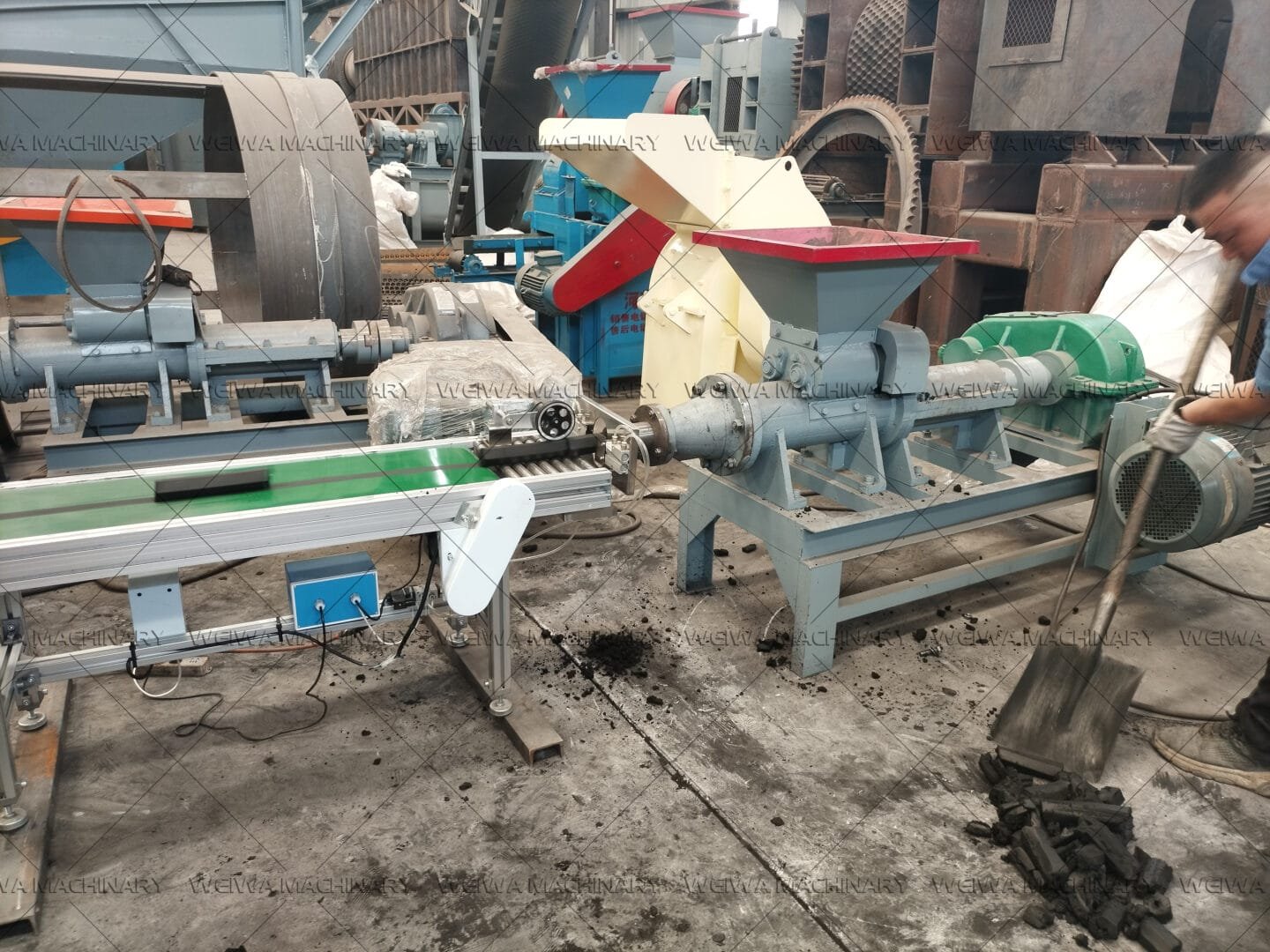
Coal Rod Machine Trial Scene at Weiwa Factory
The machine prepared for the India client was a single-screw charcoal extruder machine with a configurable die head. Around mid-morning, after the painting team finished the final coat, our technician connected the 100% copper coil motor to the control panel and ran the transmission test. The triangle belt transferred power from the motor to the gearbox. The output shaft then drove the propulsion shaft through a floating coupling. We intentionally ran the line without material for fifteen minutes to check vibration, bearing temperature, and coupling alignment.
After the no-load run, we fed prepared charcoal powder mixed with a small ratio of binder. The wheel grinding mixer had already homogenized the batch to under 3 mm particle size, with moisture adjusted to the range our India client specified for his raw material. The screw propeller, made from high manganese alloy, pushed the material forward. Because the screw pitch narrows toward the die, pressure builds gradually. At the die head, the material exits as a continuous coal rod with cylindrical profile and smooth surface.
The India client requested a 40 mm cylindrical mold and a spare square-column mold. Semasa perbicaraan, we swapped the die head once to show how quick changeover works. The formed rod length was cut by a simple rotary cutter. Our quality inspector measured bulk density three times. The reading stayed within the agreed tolerance. The Indian side sent a short message through WhatsApp: “Pressure stable, shape clean, ready for packing.”
Weiwa Machinery treats a trial not as a sales表演 but as a contract preview. Every charcoal briquette machine leaving for overseas markets passes dimensional check, weld check, motor insulation check, and load trial. For the India order, we also simulated voltage fluctuation by running the panel at 415V with 50 Hz, because many Indian workshops operate on three-phase 415V supply. The control cabinet handled it without trip. That detail matters more than it sounds, because a coal rod machine in India often runs beside existing crushers and mixers on shared power.
Screw Propulsion and Die Head Pressure
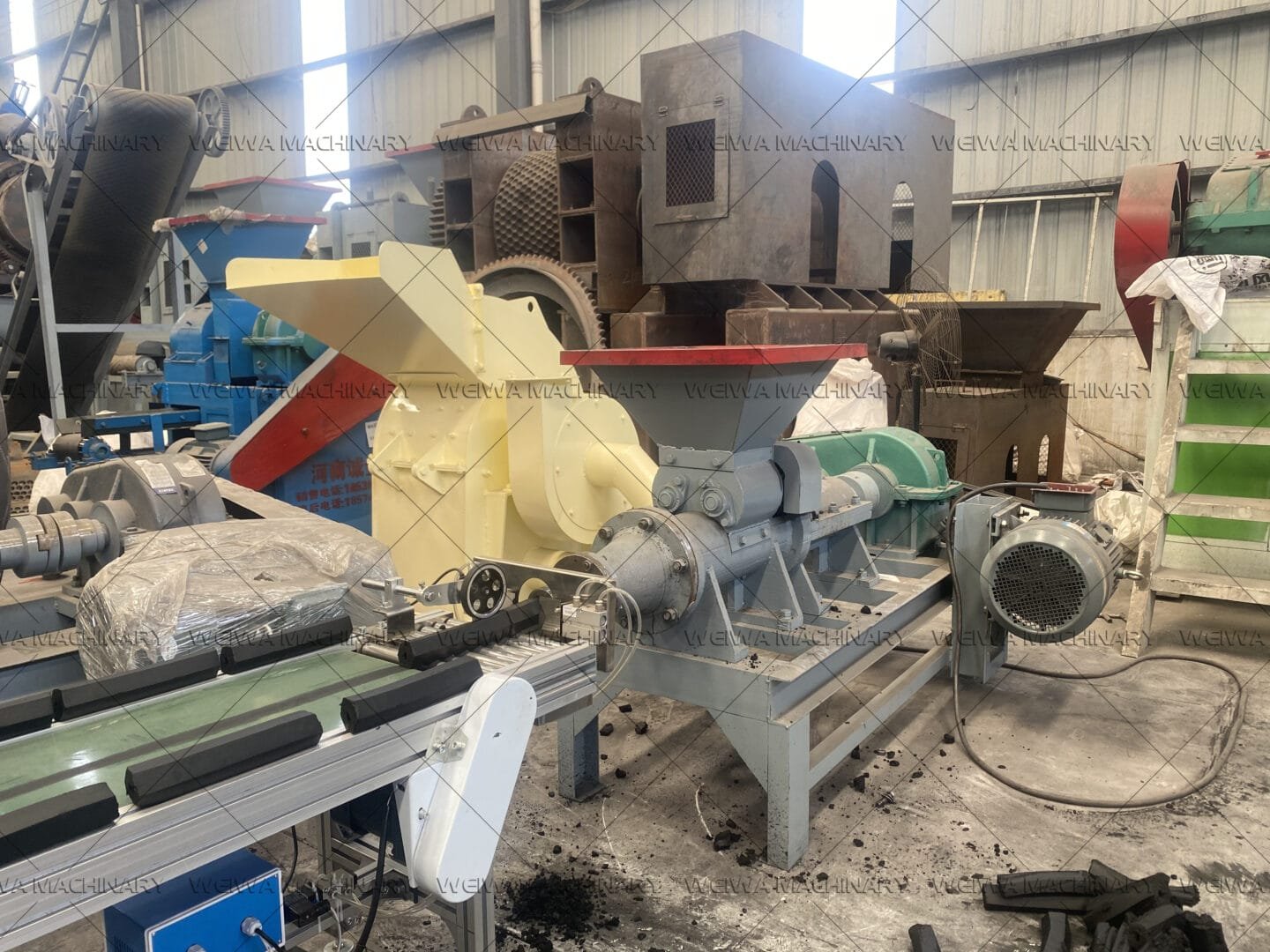
The heart of a charcoal extruder machine is the screw and die relationship. Material enters loose, leaves dense. The screw does not “press” in the hydraulic sense; it conveys and compresses by geometry. As the flight pitch decreases, free space between flights drops, so powder compacts. The die head final restriction determines linear pressure. If the die hole is too small for the feed moisture, the motor amps spike. If too large, the rod lacks hardness. Weiwa engineers tune screw compression ratio against customer raw material, not against a generic chart.
Raw Material Preparation Before Extrusion
A coal rod machine is only as good as the feed. In the India case, the client will use charcoal powder, some coal powder, and possibly rice husk charcoal powder. We advised him to keep input size below 3 mm. If his incoming lumps are larger, a charcoal crusher must run first. Then a wheel grinding mixer blends powder with binder and water. Only then does material enter the charcoal extruder machine hopper. Skipping preparation is the most common reason a charcoal making machine “looks weak” on-site. The machine is fine; the recipe is wrong.
What a Charcoal Extruder Machine Actually Does?
Many buyers searching for charcoal extruder machine or charcoal briquette machine assume the equipment magically turns waste into perfect fuel. In reality, it is a forming terminal in a short process chain. The chain usually contains crushing, mixing, extruding, and drying. The extruder itself shapes. It does not carbonize, and it does not dry. Understanding this prevents wrong factory layout.
In operation, the charcoal extruder machine receives a plastic-like mass. The binder can be starch, molasses, bentonite, or a proprietary blend depending on burn requirement. The screw rotates, the mass moves forward, air escapes backward through the feed throat, and the die forces reorganization of particles into a oriented, dense rod. High manganese alloy propellers resist abrasion from charcoal grit. #45 steel die heads give economical life for most commercial runs. For abrasive coal powder, Weiwa sometimes suggests wear-resistant coating on the screw flight.
The final rod from a coal rod machine can be cylindrical, Dataran, Hexagonal, or oval. In India, cylindrical rods dominate for hookah charcoal and heating sticks, while square columns appear in industrial boiler trials. The same charcoal making machine chassis can serve both if the client buys interchangeable dies. That modular thinking lowers the India buyer’s risk: he starts with one shape, tests local demand, then expands SKUs without buying a second machine.
Coal Rod Machine in India Market Potential
India produced close to 893 million tonnes of coal in FY2023–24 and targets beyond one billion tonnes annually. That scale alone creates a steady stream of coal fines, screen rejects, and washery tailings. Traditionally much of this is sold cheap or discarded. A coal rod machine in India lets processors re-form those fines into standardized bars for boilers, brick kilns, or metallurgical auxiliary fuel. Steel plants care about uniform calorific value. Briquetted coal bars give that uniformity better than loose fines.
Beyond coal, India generates enormous agricultural residue: sekam beras, shell kelapa, Bagasse tebu, habuk papan. Carbonization of these residues yields charcoal powder. A charcoal extruder machine turns that powder into exportable hookah charcoal or domestic cooking sticks. States with strong coconut processing like Kerala and Tamil Nadu, plus rice hubs in Punjab and Andhra Pradesh, are natural landing zones for a charcoal briquette machine line.
Statewise Demand Signals in India
Without overgeneralizing, we see inquiry patterns from Maharashtra for industrial coal rods, from Gujarat for incense and agarbatti charcoal sticks, from Uttar Pradesh and Bihar for household cooking briquette trials, and from Rajasthan for foundry auxiliary fuel. The coal rod machine in India is not one product; it is a platform. Weiwa Machinery quotes each case differently because moisture, raw mix, and voltage differ by state.
Policy context also helps. India’s bioenergy and cleaner cooking programs encourage densified fuels. While enforcement is uneven, the direction is clear: loose powder burning is discouraged, shaped fuel is preferred. A charcoal making machine workshop that can show consistent rod hardness and low ash deformation stands a better chance in tenders and institutional supply.
Why Indian Buyers Choose Charcoal Briquette Machine Lines?
When an India entrepreneur compares options, he rarely asks only for “a machine.” He asks for a line that fits his shed, his labor, and his raw material moisture. Weiwa Machinery answers with a four-unit minimum: crusher, wheel mixer, Mesin extruder arang, and dryer. We avoid overselling automation to a first-time buyer. A coal rod machine in India running at 500 kg/h with two workers often beats a 2 t/h line that sits idle due to feed inconsistency.
Indian buyers also weigh spare parts. Screw shafts and dies wear. Our response is to ship one extra propeller and three extra die heads in the same container, with clear drawings. The client in this blog order bought a second square die immediately after the trial because he wants to test temple offering charcoal and BBQ stick demand in parallel. That is smart: one charcoal extruder machine, two molds, two market tests.
Price matters, but total cost per ton matters more. A cheap charcoal briquette machine with thin screw and soft die may save USD 800 upfront and cost USD 2,000 in downtime within four months. Weiwa Machinery uses national certified carbon steel frame, proper gearbox, and copper coil motor precisely so the India client does not lose festival-season production days.
Jentera Weiwa Factory Advantage and Contact
Weiwa Machinery has more than thirty years of working experience in charcoal and coal forming equipment. Our workshop in Gongyi has built lines for clients in Indonesia, India, Malaysia, Vietnam, Pakistan, Turki, Poland, Afrika Selatan, Mexico, and more than 130 countries in total. We are not a trading company that rebrands someone else’s machine. We cut the steel, weld the frame, machine the screw, and run the trial.
Our after-sales team provides installation guides, bilingual manuals, electrical schematics, and remote commissioning through video. For overseas clients including India, we prepare customized design drawings and workshop layout plans before payment balance, so the buyer knows where the crusher, pengadun, Mesin extruder arang, belt, and dryer go inside his shed. Mold customization is standard. Voltage customization is standard. Container loading photos are standard.
If you are evaluating a coal rod machine in India, a charcoal extruder machine for hookah charcoal, or a full charcoal making machine line, contact Weiwa Machinery directly. We reply with a layout drawing, not just a PDF price list.
Mobile / WhatsApp: +8613838093177
E -mel: info@cjlmachinegroup.com
Product reference: charcoal extrude machine
We welcome India clients to send a raw material sample. We will crush, mix, extrude, and dry it in our factory, then ship you the actual rods by courier so you can burn-test them before ordering. That is how a charcoal briquette machine project should start: with evidence, not promises.
Closing View on Charcoal Extruder Machine and India Road Ahead
The trial we ran this month is small in container terms but meaningful in strategy. A coal rod machine in India is no longer a curiosity. It sits at the intersection of coal fines reuse, biomass waste upgrading, and clean-shaped-fuel demand. The charcoal extruder machine is the most misunderstood yet most central unit in that chain. Buyers who learn screw compression, die pressure, and feed recipe will win. Suppliers who only ship steel without trial, layout, and spare parts will fade.
Weiwa Machinery intends to stay on the side of the buyer who wants to produce. For our India client, the next step is ocean freight and on-site commissioning. For readers of this blog, the next step is simpler: send your material photo and moisture, tell us your target rod shape, and get a workshop plan. A charcoal making machine line is not a purchase; it is a production decision.


 WeChat

 +8615937143060
