


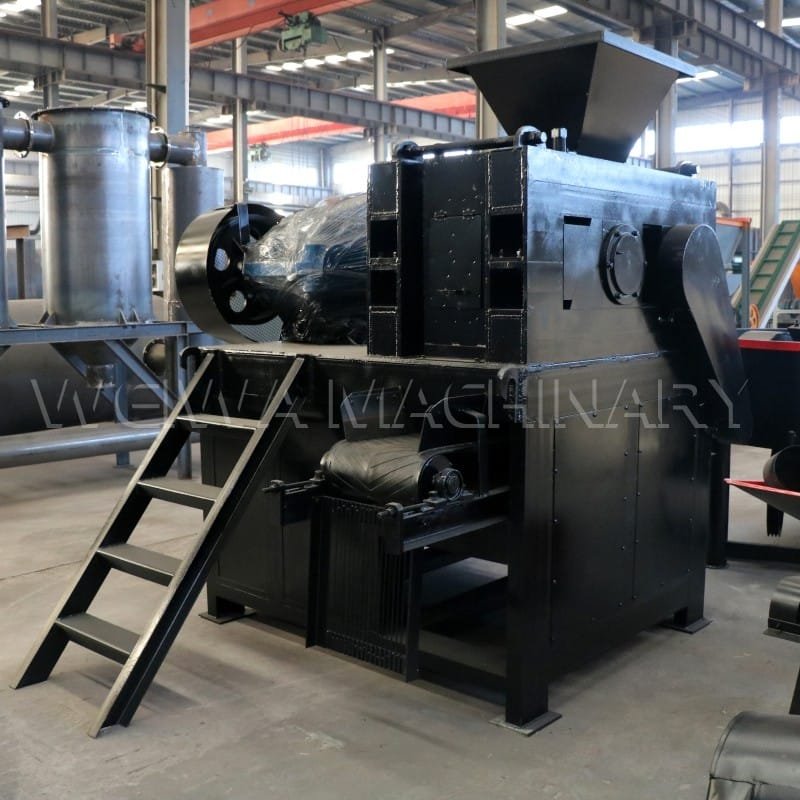
In recent weeks, Weiwa Machinery completed another factory loading and container sealing of a full set Ball Charcoal Briquettes Machine production line destined for Lagos, Nigeria. This shipment includes a double roller charcoal ball press machine, crusher, twin shaft mixer, storage silo, and mesh belt dryer, all inspected, anti rust coated, and packed according to international export standards. For Nigerian entrepreneurs exploring making charcoal balls as a sustainable fuel business, this dispatch represents more than just equipment leaving our workshop in Gongyi, China. It reflects the accelerating demand for Charcoal Briquette Machine lines across West Africa, where biomass waste is abundant, energy costs are rising, and clean burning fuel is increasingly valued by households, BBQ vendors, and industrial users alike.
Nigeria Market Context and Why Making Charcoal Balls in Nigeria Matters
Nigeria is the most populous nation in Africa with more than two hundred million people, and a significant portion of the population still relies on firewood and irregular lump charcoal for daily cooking and small scale heating. Traditional charcoal production drives deforestation, emits heavy smoke indoors, and suffers from seasonal price fluctuations. In this context, making charcoal balls in Nigeria using a Ball Charcoal Briquettes Machine offers a transformative alternative. By compressing charcoal dust, sawdust char, coconut shell charcoal powder, rice husk charcoal, and even coal fines into uniform dense balls, producers can recycle waste, reduce tree cutting, and create a higher calorific value fuel that burns longer and cleaner.
The raw material base for a Charcoal Briquette Machine in Nigeria is remarkably strong. Coastal regions such as Lagos, Ogun, and Rivers State generate large volumes of coconut shell waste. Northern and middle belt states produce rice husks, groundnut shells, and cassava peels in agricultural processing zones. Timber markets in Ogun and Edo States produce sawdust and offcuts that often go unused or openly burned. All of these can be carbonized and fed into a charcoal ball press machine to produce marketable briquettes. Urban demand is also rising. Lagos alone hosts thousands of suya vendors, hotels, and middle class households that prefer odorless, high heat, long burning BBQ charcoal. A properly configured Ball Charcoal Briquettes Machine line with capacity between one and five tons per hour can often achieve payback within twelve to eighteen months depending on local briquette pricing, distribution network, and consistency of product quality.
Government and development agency reports have highlighted briquetting as a pathway to reduce deforestation and improve rural livelihoods. While policy implementation is gradual, private sector adoption of Charcoal Briquette Machine technology is moving faster. Nigerian entrepreneurs who start early with reliable machinery such as a charcoal ball press machine from an experienced manufacturer can position themselves not only for domestic supply but also for export to neighboring countries including Ghana, Benin, and Cameroon where similar fuel gaps exist.
What Is a Mesin Briket Arang Bola and How Does It Work?
A Ball Charcoal Briquettes Machine is a roller press type briquetting system designed to compress fine powdered materials into spherical, oval, egg, pillow, Dataran, or customized shape briquettes without melting the material. The core working principle involves two counter rotating rollers equipped with precisely machined mould cavities. When material such as charcoal powder blended with a small percentage of binder and water enters the roller gap, the increasing pressure forces the powder to fill the mould pockets. As the rollers continue to rotate, the material is compacted under high pressure, often several tons per square centimeter depending on roller diameter and hydraulic configuration, and then ejected as dense charcoal balls.
This roller press design is fundamentally different from screw extrusion machines which push material through a die to form rods or tablets. The charcoal ball press machine excels at producing rounded or contoured shapes that are popular in BBQ markets and certain industrial applications where uniform stacking and consistent combustion rates matter. Because the Ball Charcoal Briquettes Machine applies pressure gradually and continuously, it can handle a range of particle sizes and produce high hardness briquettes with low binder consumption when raw material fineness and moisture are well controlled.
Weiwa Machinery manufactures Ball Charcoal Briquettes Machine models with rollers made from high chromium alloy steel, heat treated for wear resistance, and CNC machined for pocket accuracy. This ensures that every charcoal ball pressed by the charcoal ball press machine maintains consistent size, roundness, and surface smoothness which are critical for customer acceptance in both local Nigerian markets and export channels. The pressure system can be mechanical or hydraulic assisted, allowing operators to fine tune compaction force when switching between charcoal powder, serbuk arang batu, or mineral powders such as iron oxide or gypsum which some diversified Nigerian plants may process seasonally.

Key Components of a Charcoal Briquette Machine Line
While the Ball Charcoal Briquettes Machine is the core shaping unit, a commercial briquette factory in Nigeria typically requires several auxiliary machines to ensure stable output and product quality. The first is a crusher, often a hammer mill or jaw crusher depending on input size, used to reduce lump charcoal or carbonized biomass into particles typically under five millimeters. Uniform particle size is essential because oversized fragments cause roller jamming or incomplete mould filling in the charcoal ball press machine, leading to rejected balls and reduced capacity.
After crushing, the material may pass through a screening machine to remove oversized particles and return them to the crusher. The screened powder then enters a twin shaft mixer where water and binder such as cassava starch, corn starch, or molasses based binders are added. Mixing must be thorough to achieve even moisture distribution, usually targeting eight to twelve percent total moisture before pressing depending on material type. Inconsistent mixing is one of the most common causes of cracking or low strength in making charcoal balls in Nigeria, so the mixer design and residence time matter greatly.
Following mixing, a storage silo with variable speed discharge feeds the Ball Charcoal Briquettes Machine steadily. Surge feeding or starvation at the inlet causes density variation, so many Nigerian clients benefit from a simple hopper with arch breaking device and adjustable conveyor speed. Once pressed, the fresh briquettes contain bound moisture and are relatively soft. They are conveyed to a mesh belt dryer where controlled hot air gradually reduces moisture to below five percent. Proper drying prevents crumbling during packaging and storage and ensures the charcoal balls ignite cleanly with minimal smoke. Depending on climate and fuel availability, Nigerian plants may use biomass fired air heaters, electric heating, or hybrid systems for the dryer.
Raw Materials Suitable for Charcoal Ball Press Machine in Nigeria
One of the strengths of a Ball Charcoal Briquettes Machine is versatility. For making charcoal balls in Nigeria, the most common feedstocks are charcoal powder from traditional earth kilns or improved retorts, sawdust charcoal, rice husk charcoal, arang tempurung kelapa, and palm kernel shell charcoal. These biomass derived chars are relatively soft and can be pressed into high density balls with moderate pressure and a small amount of organic binder.
Beyond charcoal, the same charcoal ball press machine can process coal powder, coke breeze, anthracite fines, and certain mineral powders such as gypsum, desulfurization gypsum, aluminum powder, toner, and even metal powders like iron, magnesium oxide, copper, chromium ore, lead zinc scrap, and bauxite. This flexibility allows Nigerian investors located near steel rolling clusters, foundries, or mining areas to diversify production. For example, during peak BBQ season, the plant can focus on Charcoal Briquette Machine output for domestic fuel, and during off season it can briquette mineral powders for industrial clients, improving equipment utilization and return on investment.
It is important to note that material properties such as fixed carbon content, volatility, ash content, kelembapan, and particle size distribution influence binder choice and pressing pressure. Weiwa Machinery often advises Nigerian clients to send small samples before ordering so our engineers can recommend roller pocket size, pressure setting, and binder formula suitable for local raw materials whether that is coconut shell char from Lagos or coal fines from Enugu region.
Market Potential of Charcoal Briquette Machine in Nigeria Detailed Analysis
The potential for Charcoal Briquette Machine adoption in Nigeria is supported by multiple converging factors. First is the sheer volume of biomass residue generated annually. Nigeria produces tens of millions of tons of agricultural waste each year including cassava peels, sekam padi, groundnut shells, tongkol jagung, habuk papan, and coconut shells. Much of this is either openly burned contributing to air pollution or left to decompose releasing methane. Converting even a fraction of this waste into briquettes via a Ball Charcoal Briquettes Machine creates value from what was previously a disposal problem.
Second is urbanization and changing consumer preference. In cities like Lagos, Abuja, Port Harcourt, and Kano, middle income households and commercial kitchens are increasingly aware of the drawbacks of traditional lump charcoal such as excessive smoke, sparks, irregular size, and hidden stones or sand. Uniform charcoal balls made by a charcoal ball press machine offer predictable burn time, cleaner combustion, and easier handling. Suya vendors in particular appreciate that round or oval briquettes stack well in small grills and provide steady heat without frequent refueling. This creates a premium segment where briquettes from a reliable Charcoal Briquette Machine can command higher prices than loose charcoal dust or poorly made lumps.
Third is the export opportunity. Neighboring countries with similar energy challenges but less local manufacturing capacity often import briquettes from Nigeria. With consistent quality achieved through proper Ball Charcoal Briquettes Machine calibration, Nigerian producers can package branded briquettes for cross border trade. The West African economic community framework also supports intra regional movement of goods, making it feasible for a Nigerian briquette brand to reach Ghana, Benin, Togo, and Cameroon within days by road.
Fourth is scalability. A new entrepreneur can start with a small capacity charcoal ball press machine line at one to two tons per hour, requiring modest factory space and investment, then expand by adding a second Ball Charcoal Briquettes Machine or upgrading the dryer as market demand grows. Weiwa Machinery frequently assists Nigerian clients with layout planning so that foundations, electrical cabling, and material flow paths accommodate future expansion without major reconstruction. This phased approach lowers entry risk and matches cash flow to business growth.
Fifth is alignment with global sustainability trends. International buyers and development partners increasingly favor clean cooking solutions that reduce deforestation and carbon emissions. Although Nigeria’s briquette sector is still maturing, early movers who establish quality standards and consistent supply using a professional Charcoal Briquette Machine line may access grants, carbon credit discussions, or partnership opportunities with NGOs promoting clean cooking in Sub Saharan Africa.
Scientific Principles Behind Making Charcoal Balls With High Quality
Making charcoal balls in Nigeria is not merely about pressing powder together. It involves understanding material science, compaction mechanics, and drying kinetics. The Ball Charcoal Briquettes Machine relies on the principle that fine particles under high pressure undergo rearrangement, plastic deformation, and intermolecular bonding. Initially, particles slide into a denser packing as large voids are filled. Further pressure causes elastic and plastic deformation especially in charcoals with some inherent plasticity or with binder acting as a bridge. At sufficient pressure, van der Waals forces, mechanical interlocking, and binder solidification create a coherent briquette with high compressive strength.
Roller speed, pocket geometry, and pressure application timing affect briquette integrity. If rollers rotate too fast, material may not fill pockets completely leading to misshapen balls. If pressure is insufficient, briquettes crumble after drying. If pressure is excessive for a given formulation, rollers may experience premature wear. A well designed charcoal ball press machine balances these variables. Weiwa rollers are engineered with calculated pocket depth, draft angle, and surface finish to ensure smooth ejection and minimal scar formation on the charcoal balls.
Binder chemistry also plays a role. In Nigeria, cassava starch is widely available and affordable, making it a common binder for Charcoal Briquette Machine lines. When heated during mixing, starch granules swell and gelatinize, coating particles and hardening upon cooling and drying. Molasses based binders add slight calorific value but may attract moisture if not fully cured. Some fine charcoal powders with high fixed carbon and low ash can be pressed without binder using very high pressure Ball Charcoal Briquettes Machine configurations, but this requires precise moisture control often below eight percent and very uniform particle size distribution. Most commercial Nigerian operations use a small percentage of starch based binder to ensure green strength before drying and to improve shock resistance during transport.
Drying is the final scientific step. Fresh briquettes from the charcoal ball press machine contain moisture from mixing and binder preparation. Rapid high temperature drying can cause surface crusting while interior remains moist, leading to internal steam pressure and cracking. Mesh belt dryers used with Ball Charcoal Briquettes Machine lines typically employ multi zone temperature profiles starting with mild warming to evaporate surface moisture, then moderate heat to drive internal moisture outward, then final low heat stabilization. Well dried charcoal balls achieve moisture below five percent, compressive strength above thirty kilograms per ball depending on size, and calm ignition behavior appreciated by Nigerian BBQ vendors and households.
Why Choose Weiwa Machinery Ball Charcoal Briquettes Machine for Nigeria Projects?
Weiwa Machinery is located in Gongyi, Wilayah Henan, China, a historic hub for machinery manufacturing with more than thirty years of industrial experience. Our factory covers a large production area equipped with CNC machining centers, welding robots, and assembly lines dedicated to briquette and mineral processing equipment. Over the past three decades, we have exported Ball Charcoal Briquettes Machine and Charcoal Briquette Machine lines to more than one hundred and thirty countries including repeated shipments to Nigeria, Indonesia, India, Malaysia, Vietnam, Turki, Mesir, Afrika Selatan, and across Latin America. This global exposure allows us to understand diverse raw materials, voltage standards, climate challenges, and workshop conditions that Nigerian clients face.
When a Nigerian customer contacts Weiwa Machinery, we do not simply quote a charcoal ball press machine model. Our technical team discusses raw material type, expected moisture, daily output goal, available workshop dimensions, local power supply characteristics such as voltage and frequency, and target briquette shape and size. Based on this, we propose a complete production line configuration and provide CAD layout drawings showing equipment placement, material flow direction, maintenance space, and utility connections. This engineering first approach reduces installation errors and helps Nigerian investors visualize their factory before containers arrive.
Our Ball Charcoal Briquettes Machine features heavy duty alloy steel rollers, adjustable hydraulic pressure system, enclosed gearbox for low noise operation, and control panels that can be customized for Nigerian industrial power standards. Small accessories are packed in wooden cases suitable for LCL shipping, while main frames are nude packed with steel frame protection for full container load. Each component is tagged and numbered to match the English installation manual, wiring diagram, and troubleshooting guide provided. We also supply operation videos and can arrange remote video commissioning or on site engineer dispatch if required.
After sales support is a cornerstone of Weiwa Machinery. We understand that downtime costs money, especially in a production business. Our professional after sales team provides 24/7 online technical assistance via WhatsApp, email, and phone. Wear parts such as roller sleeves, scrapers, and springs are kept in stock and can be air freighted to Nigeria upon request. For larger projects, we can send an experienced engineer to Lagos, Apapa, Tin Can Island, or other locations for installation guidance, commissioning, and operator training. Our goal is to ensure that every charcoal ball press machine delivered to Nigeria runs reliably and produces high quality charcoal balls that meet market expectations.
Customization and Factory Planning Services
Beyond hardware, Weiwa Machinery offers customized mold design so Nigerian clients can produce oval, egg, pillow, Dataran, or bread shaped briquettes according to local market preference. We also provide binder formulation suggestions based on regional binder availability such as cassava starch in Nigeria versus corn starch in other markets. Factory planning includes silo sizing, mixer selection matched to hourly throughput, dryer length calculation based on local ambient temperature and humidity, and safety considerations such as dust collection points which are increasingly important for Nigerian factories aiming for compliance and worker health.
For clients who wish to visit before ordering, we welcome factory inspections in Gongyi. You can see Ball Charcoal Briquettes Machine units running with test materials, check roller machining quality, and discuss line configuration face to face with our senior engineers. Many Nigerian clients combine factory visits with inspections of other machinery clusters in Henan to maximize their procurement trip efficiency.
Logistics Packing and Shipping Experience to Nigeria
Shipping heavy machinery from China to Nigeria requires careful packing and documentation. Weiwa Machinery has extensive experience with Nigerian ports including Lagos Apapa, Tin Can Island, and Onne. Small size equipment such as single charcoal ball press machine units or mixers are packed in sturdy wooden cases with moisture proof film inside and reinforcement angles outside to withstand LCL handling. Large size equipment such as crushers, dryers, and main frames for Ball Charcoal Briquettes Machine lines are nude packed with steel supports, wrapped in waterproof woven cloth, and secured inside containers with wire ropes and wooden chocks to prevent movement during ocean transit.
We prepare full sets of export documents including commercial invoice, packing list, bill of lading, certificate of origin, and if required CE or other certifications. Our export team photographs each loading step from workshop exit to container sealing so Nigerian clients can preview the condition of their Charcoal Briquette Machine line before arrival. We also advise on Nigerian import regulations, typical clearance timelines, and common port charges so clients can budget accurately. This end to end service mindset has earned Weiwa Machinery repeat orders from Nigerian distributors and factory owners who value predictability in international equipment procurement.
Future Outlook for Making Charcoal Balls in Nigeria
Memandang ke hadapan, the intersection of waste management, energy security, and entrepreneurship in Nigeria strongly favors briquette industrialization. As urban waste collection improves, more carbonizable biomass will become available in concentrated forms such as market waste, sawmill offcuts, and agro processing residues. As electricity and cooking fuel costs rise, dense clean burning charcoal balls produced by a Ball Charcoal Briquettes Machine become economically more attractive compared to imported LPG cylinders or diminishing firewood supplies. As Nigerian consumers become more quality conscious, unbranded irregular lump charcoal will gradually lose share to uniform briquettes from reputable Charcoal Briquette Machine operators who can guarantee size, kelembapan, packaging, and consistent burn performance.
Technology will also evolve. Future charcoal ball press machine lines may integrate more automation such as PLC controlled batching, real time moisture sensors, variable frequency drives for energy saving, and improved dust recycling systems. Nigerian plants that start today with a reliable foundational line from an experienced manufacturer like Weiwa Machinery can upgrade incrementally. The roller press principle behind Ball Charcoal Briquettes Machine is mature and adaptable, meaning the core investment remains relevant even as peripherals modernize.
Another promising angle is niche products. Beyond standard BBQ balls, Nigerian producers can explore hookah charcoal balls, square heating briquettes, or industrial desulfurization gypsum balls using the same charcoal ball press machine with different rollers. Market differentiation through shape, packaging, branding, and consistent quality will separate the leaders in Nigeria’s briquette sector over the next decade.
Conclusion and Call to Action
The dispatch of another Ball Charcoal Briquettes Machine line to Nigeria is not just a shipment event but a testament to the growing viability of making charcoal balls in Nigeria as a profitable, mampan, and scalable business. From abundant raw materials and rising urban demand to export potential and alignment with clean energy goals, the Nigerian market offers multiple entry points for entrepreneurs willing to invest in proper Charcoal Briquette Machine technology and factory planning. Understanding the science of briquetting, selecting the right charcoal ball press machine configuration, controlling raw material quality, and partnering with an experienced manufacturer are the keys to long term success.
Weiwa Machinery brings more than thirty years of manufacturing experience, a professional after sales team, customized design and factory layout planning, and a track record of successful installations across Africa and beyond. We welcome Nigerian investors, distributors, and energy project developers to contact us for technical consultation, factory visit, and tailored quotation. Whether you are starting a small making charcoal balls in Nigeria project or building a full industrial briquette plant, our team is ready to support you from concept to commissioning and beyond.
Contact Weiwa Machinery today to discuss your Ball Charcoal Briquettes Machine requirements and take the first step toward a cleaner fuel business in Nigeria.
Mengenai Jentera Weiwa
Weiwa Machinery has over thirty years of working experience in manufacturing briquette machines, carbonization furnaces, and related equipment. We have a professional after sales team, offer customized services and design drawings for plant layout planning. Welcome to contact us to get inquiry and quotation. Mob +8613838093177 WhatsApp +8613838093177 E Mail info@cjlmachinegroup.com. We look forward to cooperating with partners worldwide to turn waste into value with reliable Charcoal Briquette Machine and Ball Charcoal Briquettes Machine solutions.


 WeChat

 +8615937143060
