


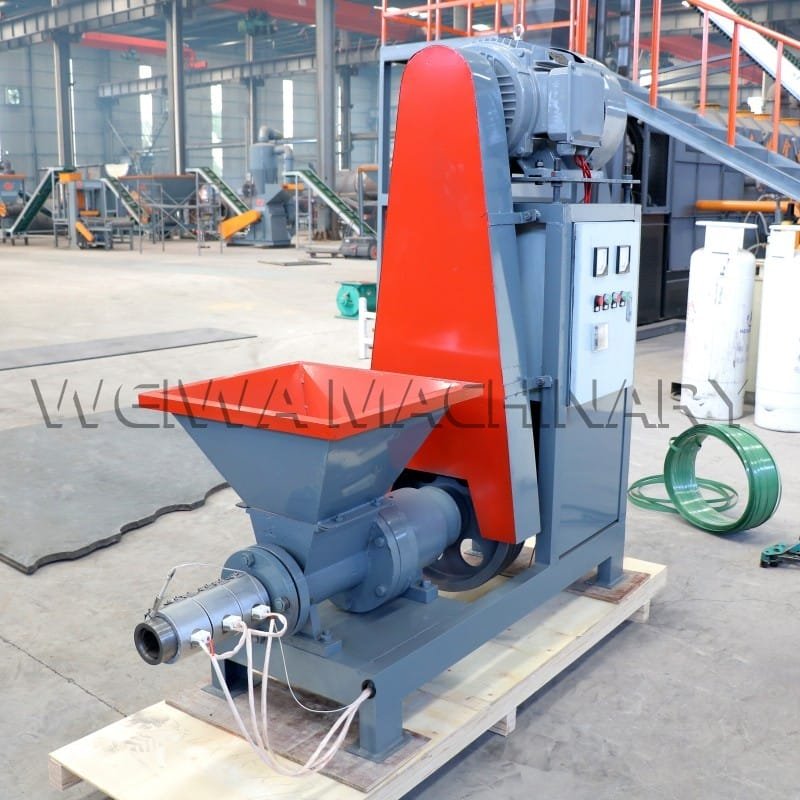
Why Bhutan Needs a Machine d'extrusion de sciure?
Bhutan maintains high forest coverage and a strong agro-forestry tradition, but that abundance creates a parallel stream of underused residue. Sawmills around Phuentsholing, Paro, and Samdrup Jongkhar generate sawdust, planer shavings, and offcut blocks. Farmers in Punakha and Wangdue Phodrang collect rice husk, maize stalk, and mustard stem. Cardamom processors discard soft woody waste. Without a biomass briquette machine in Bhutan, most of this material is either openly burned near riverbanks or slowly rots in yard corners, releasing methane and fine smoke. The Royal Government of Bhutan has repeatedly supported alternatives to firewood dependence, and community groups such as the National Women’s Association of Bhutan have already piloted small briquette presses to turn sawmill dust into cooking fuel. Industrial-scale adoption still depends on reliable equipment that can run at altitude, handle variable moisture, and produce uniform rods for carbonization.
Forest Residue and Sawdust Waste in Bhutan
The Bhutanese timber sector seasons and planes imported logs as well as domestic pine and broadleaf species. Planing machines throw out a steady stream of fluffy sawdust with particle size usually below 2 MM, ideal for a sawdust briquetting machine after light screening. Bamboo dust from construction offcuts, coffee husk from emerging specialty farms, and citrus pruning wood from orchards add further feedstock diversity. A biomass extruder does not require one fixed raw material. It requires particle size control and moisture discipline. When those two parameters are managed, sawdust extruder output stays stable even if the feedstock mix changes weekly.
Charcoal Demand and Firewood Pressure
High-altitude districts rely on solid fuel for space heating from late October to early April. Traditional firewood has a low calorific density, high smoke load, and forces households to store bulky logs. A biomass briquette machine in Bhutan compresses the same energy content into one sixth of the volume. Après la carbonisation, the charcoal stick burns longer, emits less particulate, and stacks neatly in woven sacks. Hotels in Thimphu, bakeries in Gelephu, and poultry farms in Sarpang all consume charcoal or charbriquette blends. Producing that charcoal domestically with a sawdust extruder reduces cross-border fuel imports and keeps the value chain inside Bhutanese villages.
What Weiwa Shipped to the Bhutan Client?
The dispatched line was configured for a 500 à 700 kg per hour briquette capacity, scalable to 1 ton per hour after a second extruder is added. Weiwa engineers reviewed the client’s moisture profile, available electrical phase, and workshop elevation before confirming the layout. The final bill of materials reflected a balance between throughput and mountain-road transport weight.
Sawdust Extruder and Biomass Extruder Configuration
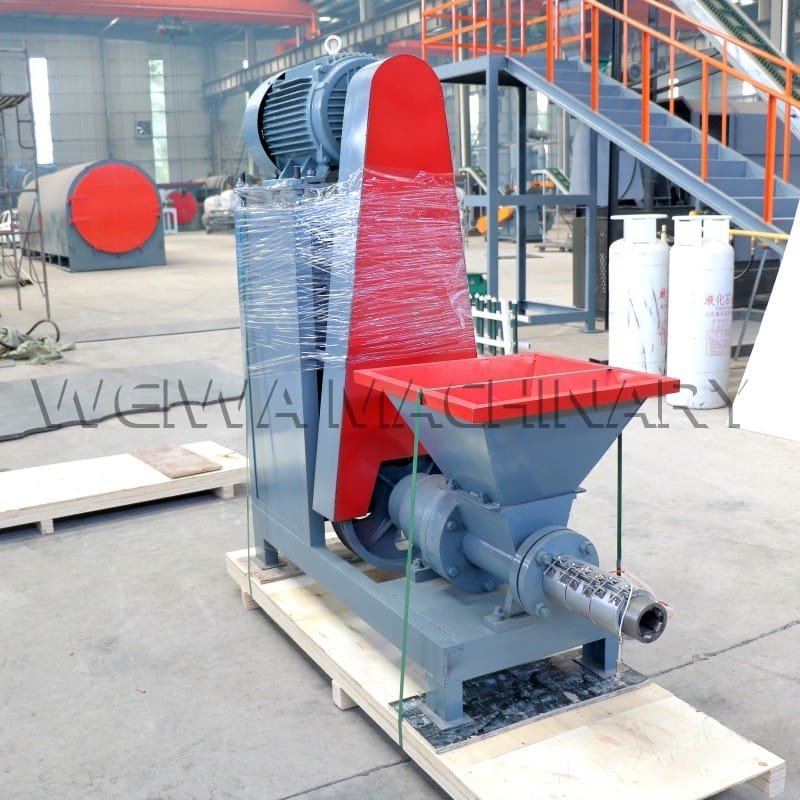
The heart of the line was a screw-type sawdust extruder with a 22 kW motor, adjustable heating ring, and interchangeable die mold. The same unit is listed on our product page as a sawdust extrude machine. In Bhutan’s case, we installed a hexagonal die with a 15 mm central hole and an outer diameter of 50 MM. The biomass extruder barrel uses a hardened inner sleeve rated for more than 1,000 tons of sawdust briquettes before sleeve replacement. Temperature at the compression zone is held near 280 à 320 degrees Celsius by a closed-loop indicator, so natural lignin softens without scorching the fiber. No starch, mélasse, or chemical binder is added. The client requested a spare screw propeller and a spare heating coil, both packed in the same fumigated crate.
Full Charcoal Production Line Layout
Before the biomass briquette machine, un 600 mm wood crusher with a 4 mm screen reduced branches, bamboo offcuts, and pallet waste to uniform flakes. A bucket elevator moved crushed material into a three-pass airflow dryer heated by a biomass burner, lowering moisture from 35 percent to under 12 pour cent. A screw conveyor with variable frequency drive fed the sawdust extruder at a steady rate, avoiding surge loads. Après extrusion, green briquettes cooled on a 6 meter belt and then loaded into a movable carbonization furnace. The furnace used a horizontal retort design so the Bhutan team could pyrolyze one batch while loading the next. Flue gas from carbonization was routed back to the dryer burner, cutting auxiliary fuel use.
Factory acceptance testing ran for two days. Weiwa operators ran the sawdust briquetting machine under no-load for 30 minutes, then under load with a 60/40 sawdust and rice-husk blend. Output rods showed clean surface gloss, no axial cracking, and consistent 50 mm diamètre. Load current stayed within 85 percent of rated value. Only after this did the packing team wrap the machines in PE film, secure corners with plywood, and close the fumigated wooden boxes.
How a Sawdust Briquetting Machine Works in Cold Mountain Conditions?
Bhutanese workshops often sit at 1,500 à 2,500 meters above sea level. Ambient temperature in winter drops to single digits Celsius. A biomass briquette machine in Bhutan must therefore tolerate cold start, low humidity, and voltage fluctuation. Weiwa’s sawdust extruder uses a preheat cycle of eight minutes before feeding. The heating ring warms the barrel independently of the main motor. Once barrel temperature crosses 260 degrés Celsius, the feeder starts. This sequence prevents wet sawdust from clogging the compression cone during a cold morning start.
Crushing and Drying Before Extrusion
Particle size decides friction. If the crusher screen is too coarse, the sawdust briquetting machine receives chunks that scratch the inner sleeve. If the screen is too fine, the material fluidizes and bridges inside the hopper. For Bhutan’s mixed pine and bamboo waste, un 4 mm screen delivered the best compromise. Drying is even more decisive. Moisture above 12 percent dilutes lignin activation and produces spongy rods. Moisture below 6 percent generates excess dust and raises screw wear. The airflow dryer on this line used a PLC moisture feedback loop, automatically speeding or slowing the inlet screw based on outlet sensor readings.
Lignin Binding Under Heat and Pressure
Wood and straw contain lignin, a thermoplastic polymer locked inside cell walls. The biomass extruder does not glue particles with additive. It liberates internal lignin. As sawdust moves along the screw channel, pressure climbs to roughly 25 à 35 MPa while temperature crosses 300 degrés Celsius. Lignin softens, flows between cellulose fibers, and re-solidifies when the rod exits the die and cools. This is why a sawdust extruder can make waterproof, high-density fuel without cement or clay. The mechanism is the same whether the feedstock is sawdust, bagasse, or coffee husk, provided moisture and size are controlled.
Charcoal Making Science for the Bhutan Site
Extruded biomass rods are not charcoal yet. They are semi-carbonized fuel with volatile content around 70 pour cent. Carbonization removes volatiles and leaves fixed carbon, raising energy density and killing the smoke stage during final combustion. The Bhutan client chose a batch retort because it suited a 5-day workweek production rhythm and allowed manual inspection of each batch.
From Biomass Rod to Carbonized Charcoal
The retort heats rods indirectly. Outside flame warms the steel chamber; rods never touch flame. Internal temperature rises in stages: 120 degrees Celsius drives residual water, 250 degrees initiates tar release, 450 degrees completes volatile evacuation, et 600 degrees stabilizes fixed carbon structure. Total cycle runs six to seven hours. After cooling under nitrogen blanket, the charcoal sticks show metallic ringing sound when tapped, black fracture surface, and fixed carbon above 65 pour cent. A biomass briquette machine in Bhutan therefore acts as the front end of a two-step energy upgrade: densification first, carbonization second.
Calorific Value and Ash Control
Weiwa measured calorific value of carbonized sawdust briquettes at 4,800 à 5,200 kcal per kg, more than 20 percent higher than seasoned firewood. Ash content stayed near 3 percent because the feedstock was screened free of soil and sand before drying. For Bhutan’s hospitality buyers, this means a 25 kg sack of machine-made charcoal replaces almost 70 kg of split pine firewood. Transport cost per kcal falls sharply, a key advantage on winding mountain roads.
Logistics from Weiwa Factory to Bhutan
The line left the Weiwa workshop in Zhengzhou, Henan, on a flatbed truck to Shanghai port. From Shanghai, the crates sailed to Kolkata, then rail to Siliguri, then road via Phuentsholing border gate into Bhutan. Total transit took 26 days. Each crate carried a phytosanitary mark, CE technical file, multilingual manual in English and Nepali script, and a spare-parts list mapped to exploded drawings. The sawdust extruder screw was removed and cushioned separately to avoid deformation from ocean humidity. On arrival, the Bhutan team sent photos of crate condition; all seals were intact.
Weiwa assigns one project engineer per export line. For this Bhutan order, the engineer ran a WhatsApp video call during uncrating, walked local mechanics through base-leveling, belt alignment, and electrical grounding, and stayed online for the first trial run. The first 200 kg of briquettes were made from planer sawdust donated by a nearby sawmill. The client reported stable screw current and uniform hexagonal rods within the first two hours.
Why Bhutan Buyers Choose Weiwa Machinery?
A biomass briquette machine in Bhutan is only useful if spare parts, meurt, and technical advice are reachable within days, not months. Weiwa keeps s
crew propellers, heating coils, and inner sleeves in stock for every sawdust extruder model we have shipped since 2014. Our sawdust briquetting machine range covers 180 kg per hour portable units up to 1.2 ton per hour industrial lines. We design layouts around the client’s raw material rather than forcing the client to adapt material to a fixed machine. For Bhutan, that meant adding a bamboo-specific screen set and a low-temperature preheat curve.
Weiwa also documents each shipment with load-test video, packing list, and customs-friendly invoice description. Buyers in landlocked countries face more border checks than coastal clients, so document clarity directly affects delivery speed. The same discipline applies to our biomass extruder exports to Nepal, Laos, and Ethiopia.
À propos Machinerie Weiwa
Weiwa Machinery is a Chinese manufacturer of charcoal and biomass densification equipment with more than a decade of export experience. Our core products include the sawdust extrude machine, sawdust briquetting machine, machine à briquettes de biomasse, biomass extruder, broyeur de bois, rotary dryer, and carbonization furnace. We have supplied lines to over 130 countries including Indonesia, Inde, Malaisie, Vietnam, Turquie, Pologne, Afrique du Sud, and Bhutan. Every machine is run under load before packing. We provide free production-line design based on raw material sample, niveau d'humidité, et capacité cible.
If you plan to start a biomass briquette machine project in Bhutan or anywhere in the Himalaya region, our team can propose a layout, calculate dryer capacity, and quote a sawdust extruder matched to your electricity supply. Reach us directly:
Mobile / WhatsApp: +8613838093177
E-mail: info@cjlmachinegroup.com
Weiwa Machinery welcomes factory visits and third-party inspection. The charcoal line we just shipped to Bhutan is now part of a growing network of small-scale, forest-positive fuel plants proving that sawdust waste can become premium charcoal without cutting one extra tree.


 Wechat

 +8615937143060
