


East Africa is witnessing a quiet but powerful shift in how cooking and industrial fuel are produced. En Ouganda, where traditional wood charcoal has long dominated both urban kitchens and rural enterprises, entrepreneurs are beginning to adopt biomass briquetting and carbonization technology. As a direct manufacturer of charcoal making machine and sawdust extruder machine systems, Weiwa Machinery recently completed the export, installation support, and trial run of a complete sawdust-to-charcoal line for a client in Kampala.
Why Uganda Is Turning to Sawdust Extruder Machines and Charcoal Making Machines?
Uganda has a well developed timber and furniture sector concentrated around Kampala, Jinja, Mbale, and Mbarara. These industries generate thousands of tons of sawdust and wood offcuts every month. En même temps, demand for charcoal in Ugandan cities continues to rise because of population growth and limited access to reliable cooking gas. The combination of abundant sawmill waste and high charcoal prices creates an ideal environment for a sawdust extruder machine that can compress biomass into dense briquettes which are later carbonized by a charcoal making machine.
Traditional earth kilns used for charcoal burn whole logs and cause significant deforestation. En revanche, a modern charcoal making machine paired with a screw type sawdust extruder machine for sale uses only waste biomass such as sawdust, cosse de riz, cocotte, tige de coton, and groundnut shell. No binder chemicals are required because the natural lignin in the heated biomass acts as the adhesive. For Ugandan investors this means lower raw material cost, reduced environmental impact, and a product that burns longer with less smoke.
Local Biomass Resources Suitable for Sawdust Extruder in Uganda
The most commonly available feedstock for a sawdust extruder in Uganda includes pine and hardwood sawdust from local sawmills, rice husk from eastern Uganda milling clusters, coffee husk from central and western coffee growing regions, and sugarcane bagasse near sugar processing zones. All of these materials can be processed by our sawdust extruder machine provided the particle size is below five millimeters and the moisture content after drying is reduced to eight to twelve percent. Maize cob and banana stem fiber may also be blended in small proportions but require careful pre crushing and moisture control.
Overview of the Charcoal Production Line We Shipped to Uganda
The shipment to our Ugandan client consisted of a Weiwa screw type sawdust extruder machine, a rotary drum dryer, a bucket elevator, a charcoal making machine in the form of a horizontal carbonization furnace, and spare propeller sets. Before departure from our factory each unit was test run using local Chinese sawdust simulating Ugandan moisture levels. Voltage was configured for three phase four hundred volts fifty hertz to match Uganda industrial power standards. Control panels were labeled in English and an illustrated operation manual was supplied. The entire order was packed in fumigated wooden crates suitable for ocean freight to Mombasa and overland trucking to Kampala.
Upon arrival the customer unloaded the equipment with our remote guidance. After positioning the machines and checking electrical connections the team performed a two day commissioning which included dryer calibration and extruder heating coil warm up. On the third day a full production trial was carried out using kiln dried sawdust sourced from a nearby furniture workshop in Kawempe.
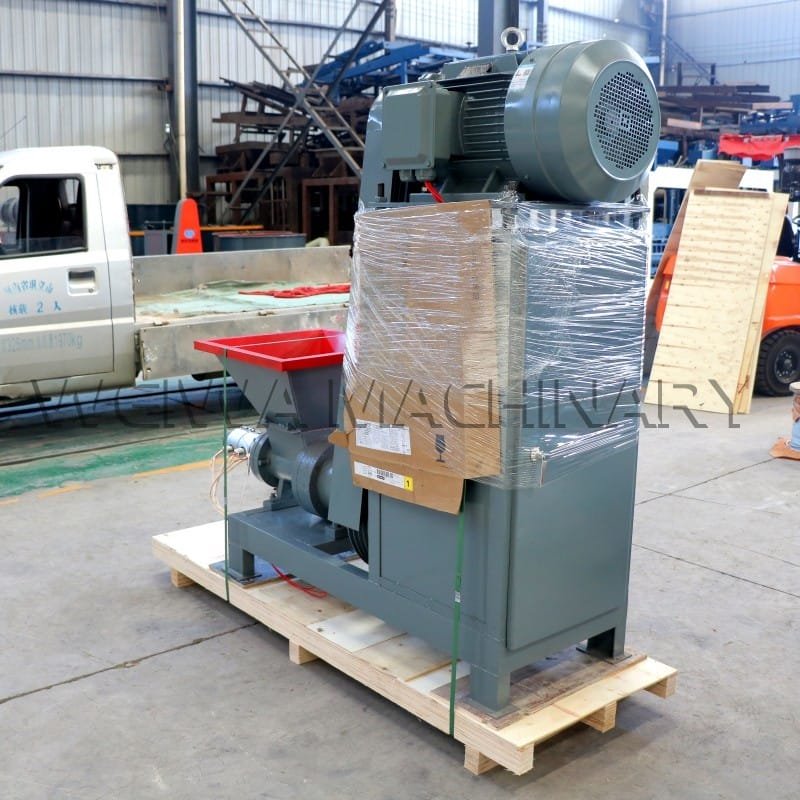
Step by Step Process of Making Charcoal with a Sawdust Extruder Machine
The complete workflow when using a charcoal making machine together with a sawdust extruder machine for sale is straightforward. First raw biomass is passed through a hammer mill if the particle size exceeds five millimeters. Second the material enters the rotary drum dryer which reduces moisture to below twelve percent. Third the dried material is fed continuously into the sawdust extruder machine where a high temperature heating ring softens lignin and a screw shaft compresses the mass into hollow hexagonal or quadrangular briquettes. Fourth the extruded briquettes are loaded into the charcoal making machine carbonization furnace where they undergo pyrolysis at four hundred to six hundred degrees Celsius in a low oxygen environment. The final output is high density charcoal with uniform shape and improved calorific value compared to traditional wood charcoal.
Trial Run Results of Our Sawdust Extruder Machine in Uganda
During the Kampala trial the model WBJ IV sawdust extruder machine produced between three hundred fifty and four hundred kilograms of half inch hexagonal briquettes per hour when running with properly dried sawdust. The briquette density measured approximately one point one to one point two grams per cubic centimeter. After carbonization in the charcoal making machine the yield from briquette to charcoal was thirty three percent which is typical for screw extruded briquettes. The client reported that the finished charcoal ignited easily, produced minimal smoke, and showed noticeably longer burn time than locally available kiln charcoal.
One important observation was that Ugandan rainy season humidity can push undried sawdust moisture above twenty percent. In such cases the rotary dryer must be operated longer or at higher temperature setting. Our technician advised the client to store dried material in a covered silo before extrusion which stabilized output. The sawdust extruder in Uganda performed reliably on local grid power and the heating coils reached operating temperature within fifteen minutes. The customer also tested rice husk blended at twenty percent with sawdust and found acceptable briquette formation though slightly lower throughput which is normal.
Operator Feedback on the Charcoal Making Machine and Extruder
The Ugandan production team noted that the most critical maintenance item on a sawdust extruder machine is the screw propeller which experiences abrasive wear. We had supplied two spare propellers and a mold sleeve so the customer can perform changeovers without halting production for more than two hours. The charcoal making machine carbonization furnace was praised for its simple manual draft control and consistent temperature holding capability. Overall the client estimated a payback period of under fourteen months based on current Kampala retail charcoal prices and their planned daily output of approximately one point five tons of briquettes feeding the carbonizer.
Sawdust Extruder Price Considerations for Uganda Buyers
When researching sawdust extruder price online buyers will see a wide range because capacity, motor power, included dryers, and carbonization method all affect cost. A small single head sawdust extruder machine for sale with one hundred to two hundred kilograms per hour capacity typically falls in an entry level price bracket suitable for pilot businesses. Medium models such as the one shipped to Uganda with three hundred fifty to four hundred kilograms per hour capacity represent the most popular choice for startups supplying urban markets. Large continuous lines exceeding eight hundred kilograms per hour are recommended for established factories or cooperatives serving multiple distribution channels.
Weiwa Machinery quotes sawdust extruder price on a FOB or CIF basis depending on customer preference and can include a matching charcoal making machine, séchoir, and conveyor in a turnkey package. Ugandan importers should also consider import duty under the East African Community common external tariff, clearing fees at Port of Mombasa or Port of Dar es Salaam, and inland trucking to Kampala or other towns. Our sales team provides proforma invoices detailing HS codes to help with customs clearance.
What Affects the Cost of a Sawdust Extruder in Uganda?
Key factors influencing sawdust extruder price are machine model, screw diameter, installed power usually eleven to thirty seven kilowatts, whether an auto cutting device is fitted, the inclusion of a pre drying system, and whether the charcoal making machine is a batch kiln or a continuous carbonization plant. Diesel engine driven versions are available for off grid locations though they carry a different price structure and higher ongoing fuel cost. Buyers comparing a sawdust extruder in Uganda should ask suppliers for test videos, propeller wear data, and local voltage compatibility rather than focusing on price alone because downtime and poor briquette quality can erase any upfront savings.
Market Outlook for Charcoal Making Machine and Sawdust Extruder Machine for Sale in Uganda
Several trends support long term demand for charcoal making machine and sawdust extruder machine for sale installations in Uganda. Urbanization is pushing more households toward packaged clean burning fuels. Institutional buyers such as schools bakeries and small factories are exploring briquetted charcoal as an alternative to expensive imported LPG. Government and NGO programs promoting clean cooking technologies create funding or subsidy opportunities for biomass enterprises. Additionally Ugandas proximity to Kenya Tanzania and South Sudan opens export possibilities for high grade charcoal briquettes produced with a certified sawdust extruder machine and modern charcoal making machine.
Entrepreneurs evaluating a sawdust extruder in Uganda should begin with a feedstock audit to confirm steady supply of sawdust or other biomass at predictable moisture levels. They should plan factory space for the dryer which is typically the largest footprint item and ensure three phase power is available. Engaging a manufacturer like Weiwa Machinery that provides layout drawings, remote commissioning, and spare parts shipping to Uganda simplifies the setup process and reduces risk.
Why Choose Weiwa Machinery as Your Charcoal Making Machine and Sawdust Extruder Machine Supplier?
Weiwa Machinery has been specializing in biomass briquetting and carbonization equipment for many years. Notre Machine d'extrudeuse à bois de sciure designs are refined through field feedback from customers in Asia, Afrique, et Amérique Latine. Each machine à fabriquer du charbon de bois we supply is matched to the extruder capacity to optimize carbonization yield. We do not simply sell machines—we provide free production line design based on your raw material type and target hourly output, supply English operation manuals and troubleshooting videos, and keep commonly used wearing parts such as screws, sleeves, and heaters in stock for fast dispatch to Uganda and other East African destinations.
Whether you are looking for a compact sawdust extruder machine for sale to start a small briquette business in Kampala or a full scale plant with continuous charcoal making machine carbonizers, our engineering team can tailor the solution. We welcome factory visits in China and are happy to arrange live machine demonstrations via video call before you decide. If you would like to discuss sawdust extruder price, request a quotation for a sawdust extruder in Uganda, or receive a customized layout for your workshop, please contact us using the details below.
Contact Machinerie Weiwa
Mobile / WhatsApp: +8613838093177
E-mail: info@cjlmachinegroup.com
Site web: https://cjljx.com
You are welcome to visit our factory. We can design a free production plan according to your raw material and capacity requirement.


 Wechat

 +8615937143060
