


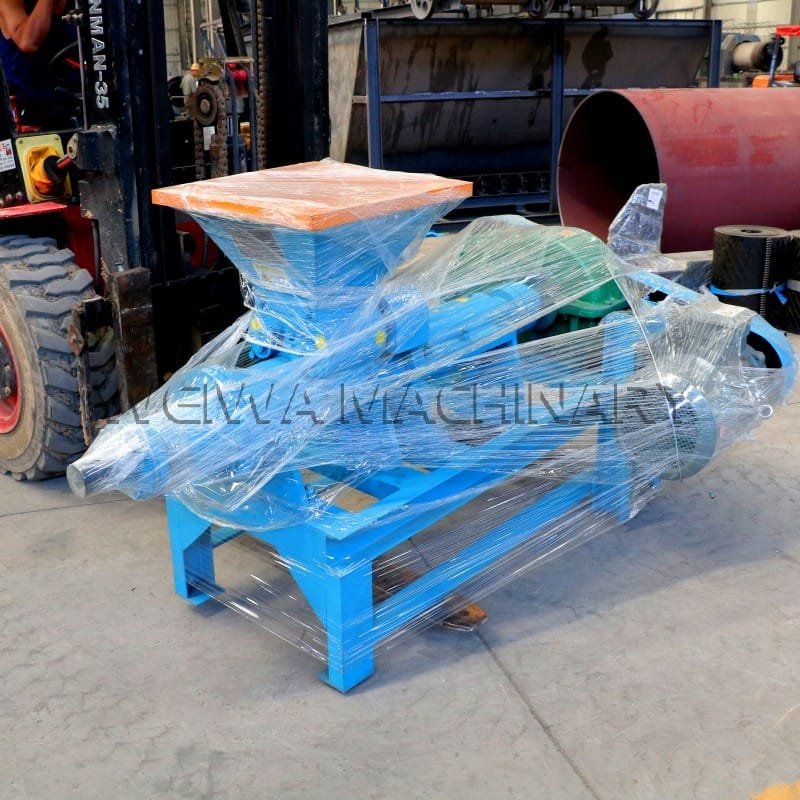
Shipment Scene of Machine à extrude au charbon de bois en Ouganda
Earlier this month, our workshop in Gongyi, Henan province completed final inspection and loading of a complete machine d'extrusion de charbon de bois production line bound for Kampala, Ouganda. This shipment was commissioned by a Ugandan agro-industrial client who had previously inquired about Prix de la machine à fabriquer du charbon de bois et rod briquette making machine in Uganda market availability. Before the container was sealed, our quality control team performed a full run-test using charcoal powder sieved below three millimeters mixed with starch binder prepared by our grinding wheel mixer.
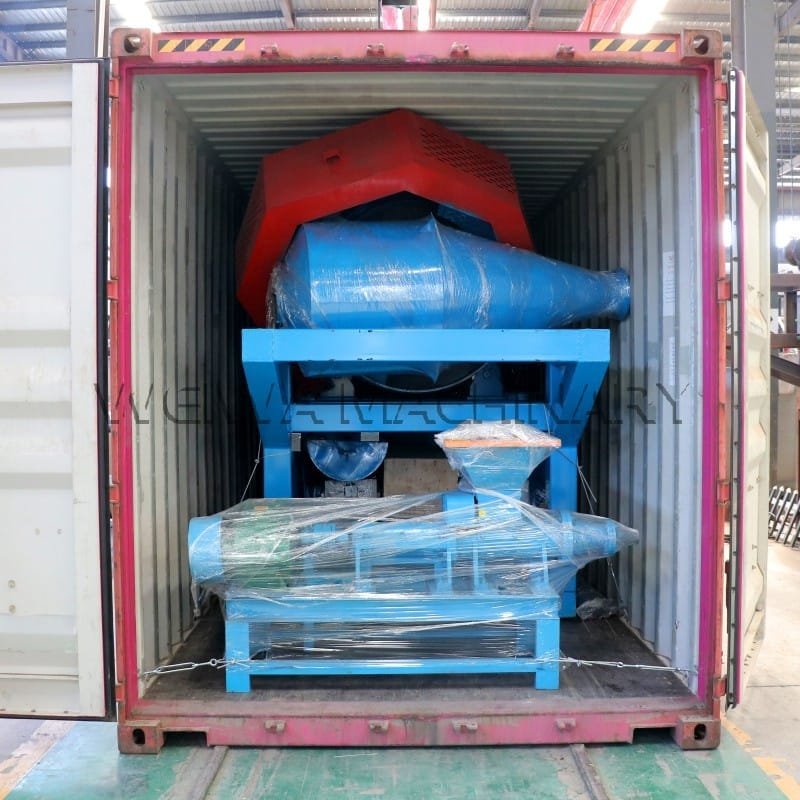
The packing process began with thick plastic film wrapping around the main extrusion unit and the 100 percent copper coil motor to guard against moisture during ocean transit. After shrink-wrapping, the machine was lifted into a customized wooden export case reinforced with steel strapping. Auxiliary units including the charcoal crusher and rotary dryer were palletized separately but loaded in the same forty-foot high cube container to optimize freight cost for our Ugandan partner. Our logistics coordinator shared real-time photographs of the loading sequence with the client via WhatsApp, a standard practice at Weiwa Machinery that builds transparency when customers evaluate charcoal extrude machine price in Uganda offers from different suppliers.
Freight routing was arranged from Qingdao Port to Mombasa, Kenya, then overland trucking to Kampala, with an estimated door-to-site transit of twenty-eight to thirty-two days. All documentation including commercial invoice, packing list, certificate of origin, and bill of lading were emailed in advance so the client could begin customs clearance preparations. This end-to-end logistics support is part of why many East African buyers choose Weiwa when comparing Prix de la machine à fabriquer du charbon de bois across Chinese manufacturers.
What Is a Charcoal Extrude Machine and How Does It Work?
UN machine d'extrusion de charbon de bois, also known in the industry as a charcoal briquette molding machine or rod briquette press, is designed to compress finely pulverized charcoal dust, poudre de charbon de bois, poudre de charbon de coco, poudre de charbon de riz enveloppe, or coal powder into solid rods or sticks. These rods are smokeless when burned and serve as an eco-friendly alternative to naturally harvested firewood, which is increasingly scarce in Uganda and neighboring East African countries.
Mechanical Transmission and Extrusion Principle
The drive system starts with a heavy-duty electric motor wound with 100 percent copper coils, which transfers torque through a V-belt triangle drive to a hardened gear reduction box. The output shaft of the gearbox connects via a floating coupling to the propulsion shaft. Mounted on this shaft is a high-manganese alloy screw propeller that rotates inside a hardened barrel. As the prepared charcoal and binder mixture is fed into the inlet hopper, the rotating propeller forces the material forward under gradually increasing pressure until it is pushed through a forming die head — commonly called the mold. The die determines the cross-sectional shape of the final rod, which can be cylindrical, carré, hexagonal, or round depending on the interchangeable mold installed.
Friction generated during high-pressure extrusion raises the temperature of the material core, activating partial binding even before the molded rod cools. National certified carbon steel forms the machine base and frame, ensuring structural stability under continuous operation. The gearbox is sealed for lifetime lubrication, and the contact parts — propeller and mold — are manufactured from high manganese alloy steel and #45 steel respectively to withstand abrasive charcoal powder.
Raw Material Preparation Before Extrusion
For optimal rod formation, raw charcoal must be crushed to a particle size finer than three millimeters. If your incoming material already meets this specification, a separate crushing stage may be omitted. The powdered charcoal is then blended with a binder — commonly cassava starch or corn starch mixed with warm water — in a grinding wheel mixer or paddle mixer until homogeneous. Proper binder ratio and moisture content between ten to twelve percent are critical; too much moisture causes weak rods that crack during drying, while too little prevents proper compaction. Après mélange, the material is fed steadily into the extrude machine hopper to maintain uniform discharge pressure.
Mold Shapes and Customization for Uganda Market
We recommend Ugandan customers select machines supplied with at least two interchangeable molds. The most popular configurations are a fifty-millimeter diameter cylindrical rod for household cooking charcoal and a hexagonal rod preferred by some commercial barbecue markets. Square and custom-profile dies are available on request. Being able to switch mold shapes lets producers adapt to shifting local demand, improving return on investment when assessing rod briquette making machine in Uganda options.
Pre-Shipment Trial Run and Observed Performance
Before the Uganda-bound unit left our factory, our technicians ran a three-hour continuous trial using charcoal powder sourced from a local kiln, sieved to two-millimeter fineness, and bound with eight percent starch solution. The extrude machine was set to its standard eighteen-point-five kilowatt motor configuration with a twenty-two-kilowatt option available for higher throughput models.
Trial Run Data and Rod Quality
Pendant le procès, the machine produced uniform-density rods at a rate of approximately two hundred twenty to two hundred sixty kilograms per hour depending on mold orifice size. The rod surface was smooth with no visible cracking. Propeller speed was adjusted mid-run to demonstrate to our quality inspector how the machine compensates for slightly different moisture levels in the feedstock. Discharge temperature measured at the die exit was within the expected range of one hundred sixty to one hundred eighty degrees Celsius, confirming proper friction-induced binding.
After cooling, sample rods were subjected to a manual drop test from one meter onto a concrete surface; none fractured, indicating adequate green strength prior to the subsequent drying phase. Our client in Uganda will pair this extrude machine with a mesh belt dryer or sun-dry the rods in a covered ventilated area, depending on local weather conditions. The consistent trial outcome reassures buyers who are researching Prix de la machine à fabriquer du charbon de bois that Weiwa machines are tested — not just assembled — before export.
Why Trial Testing Matters When Comparing Charcoal Extrude Machine Price in Uganda?
It is common for inexperienced suppliers to quote a low ex-works price but skip factory testing. Undetected misalignment of the propulsion shaft or a poorly heat-treated propeller leads to premature wear, reduced output, and unexpected downtime after arrival. À Weiwa Machinery, every machine d'extrusion de charbon de bois undergoes no-load running, vibration check, and full-load trial with actual material. This reduces the total cost of ownership even if the initial charcoal extrude machine price in Uganda appears marginally higher than untested alternatives.
Typical Charcoal Making Machine Price Range and What Influences It
Prospective Ugandan buyers often ask about Prix de la machine à fabriquer du charbon de bois and how it correlates with capacity and build quality. For a standalone screw-type rod briquette making machine in Uganda market configuration, prices generally vary based on hourly output, motor power, gearbox grade, propeller metallurgy, and whether ancillary equipment such as crusher, mixer, and dryer are included in the package.
Smaller capacity models producing one hundred fifty to two hundred kilograms per hour typically represent the entry-level investment bracket. Mid-range machines with reinforced gearboxes and twenty-two-kilowatt motors pushing two hundred fifty to three hundred kilograms per hour command a moderate premium. Complete lines — integrating a hammer mill, wheel mixer, extrude machine, and dryer — are quoted as turnkey packages with volume-based discounts. When you receive a formal quotation from Weiwa Machinery, it will clearly state what is included in the Prix de la machine à fabriquer du charbon de bois, packaging method, estimated freight to Mombasa, and optional spare parts kits recommended for the first year of operation.
Voltage customization is another factor. Uganda primarily uses two-hundred-thirty-volt single-phase for small shops and four-hundred-volt three-phase fifty-hertz for industrial premises. Our machines are configurable to match Ugandan electrical standards, and diesel-engine-driven versions are offered for off-grid production sites where three-phase power is unreliable.
Drying and Post-Extrusion Handling of Rod Briquettes
Freshly extruded charcoal rods contain residual moisture from the binder solution and must be dried to below six percent before they can be carbonized or sold as semi-finished briquettes. Many of our Uganda clients use solar drying tunnels or simple shaded racks during the dry season. For year-round production, we supply mesh belt dryers or tunnel-type hot air dryers fired by a small biomass burner, which can be fed with broken charcoal pieces or sawdust.
Well-dried rods are then ready for carbonization in a batch or continuous charcoal making furnace. The complete workflow — crush, mix, extrude, dry, carbonize — transforms low-value charcoal fines and agricultural waste into high-density smokeless charcoal sticks. This circular approach is gaining traction among Ugandan entrepreneurs who previously imported finished charcoal or relied on logging-derived traditional charcoal.
Pourquoi choisir Machinerie Weiwa for Your Rod Briquette Making Machine in Uganda?
Weiwa Machinery has been specializing in biomass briquetting and carbonization equipment for more than thirty years. Our experienced engineering team provides pre-sales services that include customized production line proposals, factory layout planning, and raw material feasibility evaluation. We help you calculate space requirements, power demand, and estimated payback based on local raw material cost and selling price of finished briquettes.
After delivery, our after-sales support covers detailed English operation manuals, instructional videos, remote troubleshooting via video call, and on-site installation and commissioning by dispatched technicians when required. Spare parts such as replacement propellers, barrels, and die heads are stocked and can be shipped express to Uganda. When you discuss charcoal extrude machine price in Uganda with our sales team, you are not only buying a machine — you are gaining a technical partner committed to keeping your production line running.
If you are considering a rod briquette making machine in Uganda or wish to receive an updated Prix de la machine à fabriquer du charbon de bois list tailored to your capacity needs, please contact us today. Our consultants are available by phone, WhatsApp, and email to answer technical questions and prepare a formal quotation with shipping estimate to Kampala or any other Ugandan port of entry.
Contact Weiwa Machinery:
Foule / WhatsApp: +86 138 3809 3177
E-mail: info@cjlmachinegroup.com
À propos des machines de Weiwa: Founded over 30 years ago, Weiwa Machinery is a professional manufacturer of charcoal briquette molding machines, charcoal extrude machines, Machines de briquette Sage, et fours de carbonisation. Backed by an experienced R&D and technical team, we provide customized solutions, plant layout design, and on-site installation guidance. Our equipment is exported to more than 130 countries including Uganda, Kenya, Tanzanie, Nigeria, Indonésie, Inde, et le Viêt Nam. Weiwa Machinery has become the trusted first choice for over 2 million customers worldwide who seek durable, high-output biomass processing machinery with reliable after-sales support.


 Wechat

 +8615937143060
