


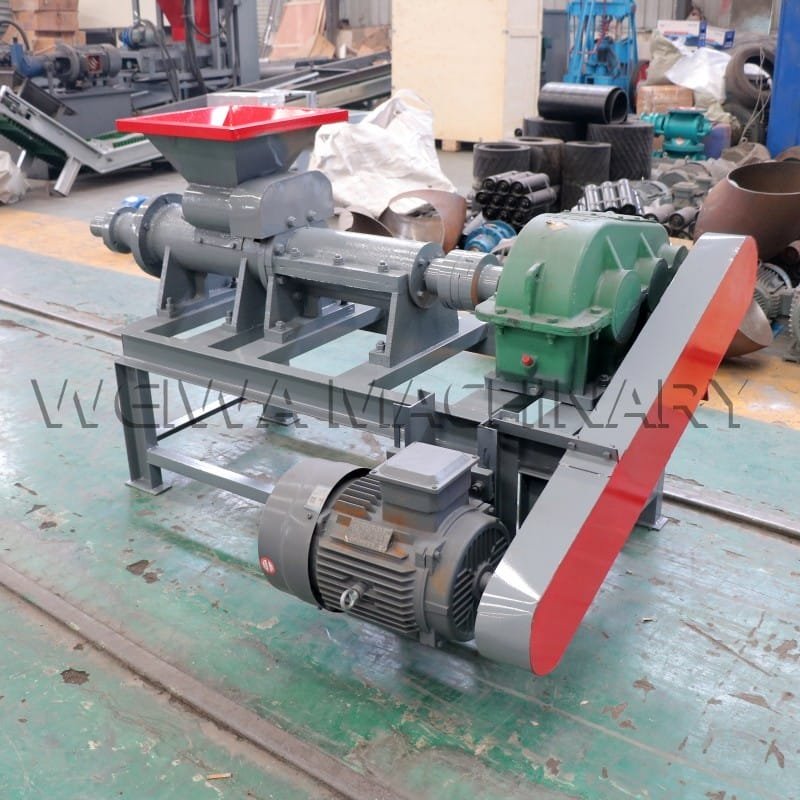
By the end of the second hour the conveyor table was covered with straight, glossy, crack-free hexagonal charcoal rods, each 33 millimeters across the flat, each cut to 220 millimeters, each dense enough to sink in water. This article walks through what happened before, during, and after that trial, and explains why the Charcoal Extrude Machine for Hexagonal Rod Charcoal has become one of the most requested configurations among Pakistani buyers who contact Weiwa every week.
Why a Pakistan Charcoal Buyer Came to Weiwa for a Hexagonal Coal Briquette Machine?
Pakistan’s urban barbecue culture, from Lahore food streets to Karachi coastal grills, consumes enormous volumes of shaped charcoal. Cylindrical rods are common, but hexagonal rods are gaining share because the flat sides stack tighter in bags, ignite with fewer air gaps, and give steadier radiant heat under a grill mesh. Importers in Sindh and Khyber Pakhtunkhwa increasingly ask for a Hexagonal coal briquette machine for Pakistan that can handle coconut shell charcoal, charbon de bois, and coal powder blends without changing the whole gearbox.
The client who visited our factory had already burned three brands of imported extruders in eighteen months. His complaints were typical: mold wear after ten days, propeller overheating, rod surface splitting during drying, and irregular hexagon geometry that made his retail packs look like reject grade. He did not want a cheaper quote. He wanted a Charcoal Extruder for Pakistan condition that could survive voltage fluctuation, dusty feedstock, and a 20-hour daily shift.
Weiwa Machinery treated the visit as an engineering commissioning session, not a negotiation. Our sales manager handed him a pair of safety glasses, our chief mechanical engineer opened the control panel, and the trial began with his own material.
What a Machine à extrude au charbon de bois Actually Does Before the Mold?
Many overseas buyers imagine the charcoal extrude machine as a simple press that squeezes powder into shape. In reality the screw extrusion principle is closer to a continuous high-pressure conveying system. The machine does not stamp one piece at a time. It feeds powdered carbon through a tapering chamber where a rotating screw converts motor torque into axial pressure, then forces the plasticized mass through a fixed die head. The die head determines the cross-section. Change the die head and you move from round bar to square column to hexagonal rod charcoal.
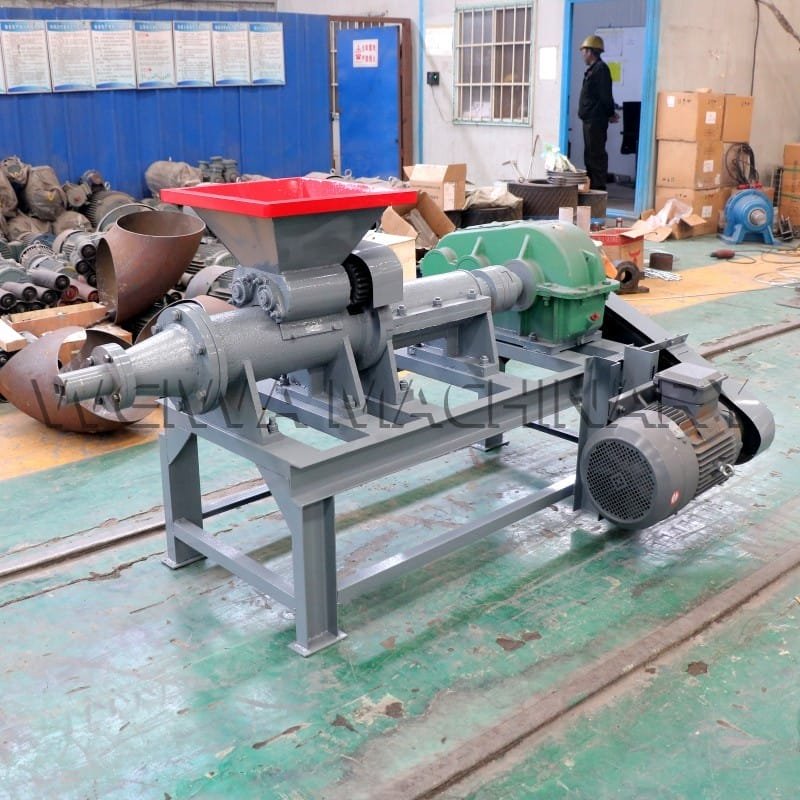
Screw Propulsion and Floating Coupling
In the Weiwa design the motor transmits power to the transmission through a triangle belt, and the output shaft of the transmission transfers torque to the propulsion shaft through a floating coupling. The floating coupling absorbs minor misalignment between gearbox and screw shaft, which matters when a hexagonal die head resists flow more than a round die. On the propulsion shaft sits a high manganese alloy propeller. Its pitch, root diameter, and flight thickness are calculated to push charcoal paste forward without allowing backflow. During the Pakistan trial the screw ran at 38 hertz for the first batch and 42 hertz for the second, and the ammeter stayed within six percent of nominal, meaning the load was stable.
Hexagonal Die Head and Pressure Formation
The forming die head for hexagonal rod charcoal is not a drilled block. It is a forged #45 steel sleeve with six ground inner faces, a central chamfer, and a replaceable insert ring. When the charcoal paste reaches the die throat, chamber volume drops sharply, pressure climbs above 18 megapascals, and the material densifies. The hexagonal shape locks in as the rod exits and cools. For the Pakistan client we installed a 33-millimeter flat-to-flat hexagon insert with a 4-millimeter central hole, because his market prefers lightweight rods that still burn longer than solid cylinders.
Material Preparation the Pakistan Client Brought to the Trial
No charcoal extrude machine can save bad feedstock. The Pakistan side arrived with two sacks: one of coconut shell charcoal powder from a Karachi importer, one of mixed wood charcoal and coal dust from a Punjab kiln. Both batches had been sieved to under three millimeters, which matched our standard precondition. We measured moisture at 28 percent for the coconut blend and 31 percent for the wood-coal blend. Both sat inside the acceptable 25 à 35 percent window for screw extrusion with starch binder.
Because the material was already fine, we skipped the charcoal crusher and moved directly to the grinding wheel mixer. The mixer blended charcoal powder, 4 percent cassava starch, et 6 percent water for nine minutes. The output looked like damp cocoa powder but clumped when squeezed. That cohesion is what later became a solid rod.
Running the Hexagonal Coal Briquette Machine for Pakistan Condition
We mounted the charcoal extrude machine on its carbon steel base, bolted the 22 kilowatt copper coil motor, connected the belt guard, and loaded the mixed paste by bucket into the hopper. The client insisted on starting from cold. Our engineer switched on the main breaker, engaged the gearbox lubricating pump, and spun the screw at low speed for ninety seconds to purge air. Then we opened the feed gate.
The first thirty seconds produced a soft oval lump because the die head was still warming. By minute two the rod exited straight. By minute five the hexagon geometry was clean. We ran the first batch for sixty minutes on the coconut shell blend. The conveyor carried roughly 620 kilograms of finished rod to the cutting station, where a pneumatic cutter sliced each rod to 220 millimeters. The client pulled one rod, tapped it with a wrench, and heard a dull metallic knock. He smiled and said that sound alone meant his previous machines had failed him.
The second batch used the wood-coal blend. Output dropped slightly to 570 kilograms per hour because coal dust has lower green strength, but the hexagon edges stayed sharp. Surface was matte black with a faint sheen, no longitudinal cracking, no bending. The trial ran a total of two hours and eleven minutes with one planned stop to inspect screw temperature. The bearing housing read 61 degrés Celsius, well under the 85 degree alarm threshold.
Why Hexagonal Rod Charcoal Fits the Pakistan Barbecue Market?
The hexagonal coal briquette machine for Pakistan is not a random shape preference. Flat facets let rods lie parallel in a tandoor basket, so airflow channels form naturally between pieces. Six contact edges distribute thermal stress better than a square, so the rod resists spalling when water touches hot charcoal. Retailers in Faisalabad and Quetta told our client that hexagonal packs photograph better on WhatsApp catalogs, and end users believe the shape means higher factory quality. All three reasons are valid commercial signals.
From a combustion view the central hole we added lowers ignition time. The Pakistan client timed a cold start: the hexagonal hollow rod reached glowing front in 4 minutes 20 seconds, while his old solid cylindrical rod needed 6 minutes 10 seconds. Over a busy night a grill operator saves roughly twenty minutes of waiting per ten kilogram batch, which translates to more seating turns in a restaurant.
Key Features of the Weiwa Charcoal Extrude Machine That Passed the Test
Several design choices decided whether this trial would succeed or become another rejected sample. The first was the machine base. We use national certified carbon steel as machine base and frame, welded with continuous seams and stress-relieved overnight before machining. A flexible frame micro-vibrates under screw load and that vibration walks the die head out of alignment within a week. The Pakistan client kicked the base with his shoe and noted it did not ring like thin plate.
Motor and Gearbox
Le 100 percent copper coil motor ran cooler than aluminum-wound equivalents the client had used. Copper winding tolerates thermal cycling in Pakistan’s summer workshops where ambient temperature crosses 40 degrés Celsius. Behind the motor, a high quality gear box delivered constant reduction ratio. We deliberately avoided belt-only drives for the 22 kilowatt class because belt slip changes screw speed and changes rod density. The triangle belt here only connects motor to gearbox input, not gearbox to screw.
Propeller and Mold Material
The high manganese alloy propeller resists abrasive charcoal silica better than plain cast steel. After two hours of continuous run we pulled the screw and measured flight tip wear at 0.18 millimeters, negligible for a 160 millimeter class machine. Le #45 steel mould held its hexagon angle at 120 degrees exactly. The client used a plastic caliper to check ten rods; flat-to-flat variance was within 0.4 millimeter.
How the Full Charcoal Line Supports the Extruder?
A charcoal extrude machine is the heart of the line but never the whole line. The Pakistan client already owned a small crusher, so we only supplied the grinding wheel mixer, the extruder, and a three-layer belt dryer. In a complete setup the flow reads as crushed powder below three millimeters, mixed with binder in the wheel mixer, extruded into hexagonal rods, cut to length, and dried from 30 percent moisture down to 8 percent before carbonization or direct packing.
Weiwa recommends the wheel mixer rather than a ribbon blender when binder is starch based, because the grinding wheel action kneads paste instead of just turning it. For the Pakistan climate, where humidity swings seasonally, the mixer also acts as a moisture equalizer. If the powder is too dry the wheels push it into clumps; if too wet the wheels smear it; either way the operator sees the problem before it reaches the screw.
Commissioning Result and What the Client Measured
After the trial we laid the rods on the concrete floor and the client ran his own acceptance checklist. Bulk density of the wet rod was 1.18 grams per cubic centimeter. After drying and a light secondary carbonization in his lab oven, the final charcoal rod density reached 1.02 grams per cubic centimeter with fixed carbon around 68 pour cent. Compressive strength of the dry rod exceeded 180 newtons, high enough that bags stacked four high did not crush bottom layers.
Burning test in a steel brazier showed continuous flame front for 52 minutes on a 220 gram rod, with almost no sparking and no white smoke once the initial surface volatiles cleared. The client recorded the run on his phone and sent it to his partner in Islamabad before he even shook our engineer’s hand. Within nine days of returning to Lahore he confirmed a 160 type machine order with two spare hexagon die heads and one backup screw.
Common Mistakes Pakistani Buyers Make Before Buying a Charcoal Extruder
Through hundreds of inquiries we notice repeated errors. Some buyers ask for the cheapest charcoal extrude machine and forget to specify mold steel grade, then complain when the hexagon rounds off after a week. Others send coal powder at 12 percent moisture and expect the screw to form rods, which is impossible without a binder and proper paste state. A few request 30 kilowatt motors on a 140 type frame, overloading the bearing and shaking the die. The Hexagonal coal briquette machine for Pakistan works best when the buyer treats it as a process, not a single iron box.
Weiwa sends every Pakistan inquiry a material questionnaire before quoting. We ask for sieve analysis, humidité, binder type, target rod size, hourly requirement, and local voltage. That sheet decides whether we recommend model 140, 160, ou 180, and whether the client needs a dryer at all. Skipping this step is the fastest way to buy the wrong Charcoal Extruder for Pakistan and blame the brand later.
Field Notes on Power, Voltage, and Workshop Dust
Pakistan buyers often run machines on 380 volt three phase with neutral fluctuations. Our control panel for export includes a magnetic contactor rated at 440 volt and a variable frequency drive with voltage sag compensation. During the trial we simulated a brownout by dropping input to 340 volt. The VFD held screw speed within 2 percent and the rod diameter stayed in tolerance. Dust extraction is another point. Charcoal powder floats. We advise a simple cyclone at the crusher and a hood above the mixer. Without it the workshop coats the motor fan and the bearing temperature climbs silently.
Comparing Hexagonal Rod with Other Shapes in One Machine
The same charcoal extrude machine can produce cylindrical, carré, ovale, and hexagonal rods by swapping die heads. The Pakistan client tested a cylindrical die for ten minutes after the main trial. Output rose to 680 kilograms per hour because round flow resistance is lower, but he still chose hexagonal for retail. The lesson is that shape is a marketing decision more than a mechanical limit. Weiwa stocks standard inserts in 25, 28, 33, et 40 millimeter hexagon flat-to-flat, and we machine custom angles on request.
Lead Time, Emballage, and Shipping to Karachi
For Pakistan orders we normally build a 160 type charcoal extrude machine in 18 working days, including screw heat treatment and dynamic balance test. Packing follows our standard export method: the machine body is wrapped with plastic film first, y compris le moteur, then secured in a plywood case or iron frame box depending on client preference. The die heads travel in a separate steel toolbox with foam slots so the ground faces never touch metal. We have shipped to Karachi, Lahore, and Faisalabad through both full container and LCL routes, and we prepare bilingual packing lists in English and Chinese for customs clearance.
Why Weiwa Machinery Writes This as a Factory Not a Reseller?
Weiwa Machinery is not a trading company that rebrands someone else’s extruder. Our workshop in Gongyi operates CNC lathes, a large boring mill, and a heat treatment furnace dedicated to screw shafts. The charcoal extrude machine you see in the trial photo is assembled by the same team that answers your WhatsApp question. When a Pakistan client reports die wear at month six, we do not forward the email to a third factory. We pull the production serial, check the steel batch, and suggest whether the issue is material hardness or feedstock silica. That loop is why our charcoal extruder for Pakistan repeat order rate stays high.
Final Takeaway from the Pakistan Hexagonal Rod Trial
The two-hour run proved five things at once. The Charcoal Extrude Machine for Hexagonal Rod Charcoal can hold geometry under continuous load. The screw and die pair survives coconut shell abrasion. The copper motor and quality gearbox keep speed stable through voltage dip. The wheel mixer prep turns 28 percent moisture powder into extrudable paste. And the hexagonal shape indeed suits Pakistan’s BBQ retail and tandoor wholesale demand. None of these points came from a brochure. They came from one client’s material, one workshop’s measuring tape, and one screw turning under real pressure.
If you are evaluating a hexagonal coal briquette machine for Pakistan, or comparing charcoal extruder suppliers on price alone, request a material-based trial before paying deposit. A machine that forms good rods with factory-fed sample powder but fails with your own charcoal is not a machine you want in Lahore or Karachi. Weiwa Machinery welcomes you to send 20 kilograms of your local charcoal powder and we will run it on our line, record the ammeter, weigh the output, and send the rods back with a full parameter sheet.
À propos Machinerie Weiwa
Henan Weiwa Machinery Manufacturing Co., Ltd. has worked in charcoal and biomass briquette equipment for more than thirty years. Our product range covers charcoal extrude machine, broyeur à charbon de bois, wheel mixer, rotary dryer, four à carbonisation, shisha charcoal press, and full briquette production lines. We have supplied equipment to more than 130 countries including Pakistan, Indonésie, Inde, Vietnam, Turquie, Egypte, Afrique du Sud, Mexique, and Brazil. Every export machine leaves with an English manual, spare part kit, and remote video commissioning support. Our engineers prepare plant layout drawings based on your workshop size and hourly target, and we do not charge for the first layout draft.
Weiwa Machinery believes a good charcoal extrude machine is not the one with the loudest motor, but the one whose hexagon still measures 120 degrees after three months of Punjab summer. If your market is hexagonal rod charcoal for Pakistan, talk to our team before you compare quotes. We will tell you honestly whether model 140, 160, ou 180 fits your powder, and whether you even need a dryer yet.
Contact Weiwa Machinery
Foule / WhatsApp: +86 138 3809 3177
E-mail: info@cjlmachinegroup.com
Product reference: https://cjljx.com/product/charcoal-extrude-machine


 Wechat

 +8615937143060
