


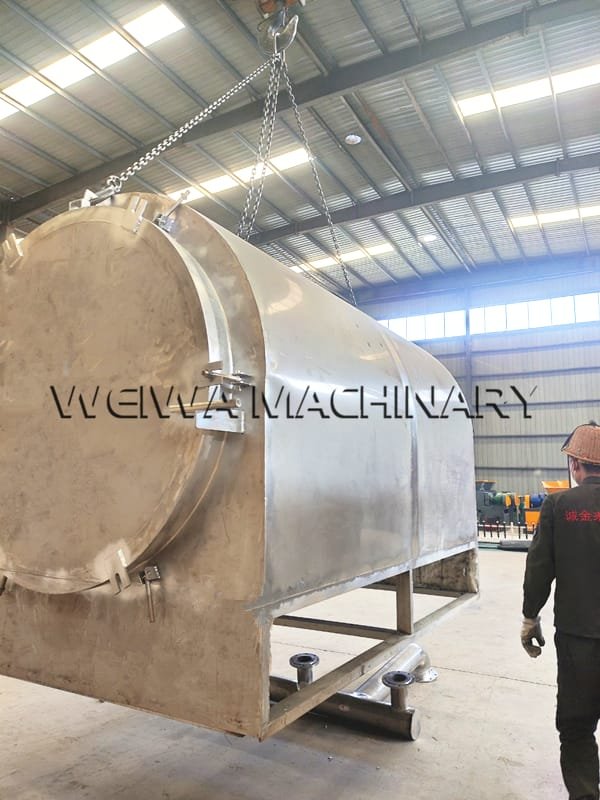
Workshop Dispatch Scene of the Horizontal Carbonization Furnace
The final inspection took place on a Monday morning. The furnace shell, lined with refractory castable and mineral wool insulation, had already passed hydrostatic checking on the door seal and the combustible gas return pipe. Weiwa technicians walked around the barrel, tapped the graphite-packed flange, and confirmed the rail trolley slid in and out without resistance. A charcoal maker lives or dies by its door seal. If oxygen leaks into the chamber during pyrolysis, the batch scorches instead of carbonizing. That is why the last step before painting is never visual alone. It is a soap-bubble test on every bolted joint.
Once the quality team signed the release form, the logistics crew brought the container trailer to the loading bay. The horizontal carbonization furnace was laid horizontally on a fabricated cradle, not standing upright, because the trolley rail and the discharge end must stay aligned during transit. Steel bands crossed the cradle at four points. Pine spacers sat between band and paint. Desiccant bags went inside the chamber to absorb humidity during the 12-day ocean leg.
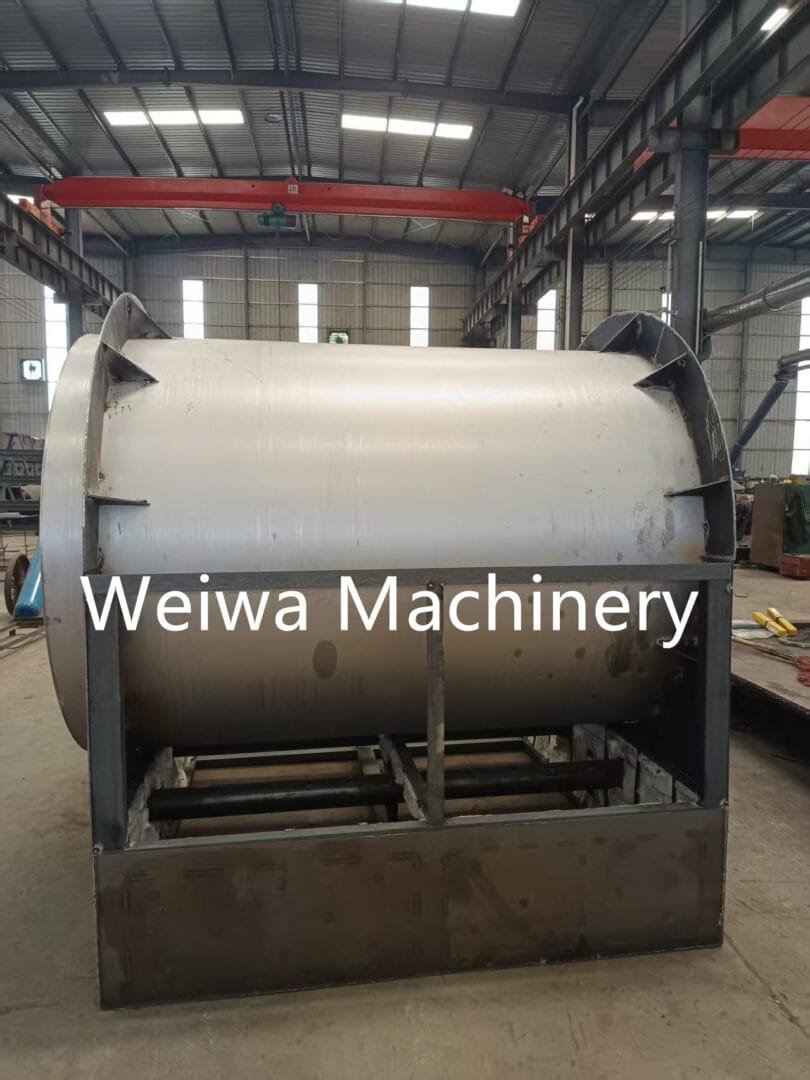
Container Loading and Steel Frame Protection
Loading a horizontal carbonization furnace is different from loading a vertical charcoal kiln. The barrel length often reaches 2.9 à 5.9 meters depending on model, so the unit consumes most of the container’s diagonal clearance. The Weiwa team calculates the center of gravity before the fork truck touches the skid. The heavy end, usually the sealed discharge door with the graphite packing, faces the container wall that meets the ship’s bulkhead. Shock plates are welded to the cradle feet. Rubber pads sit under the feet. The idea is simple: the furnace must arrive in Malaysia with zero deformation on the flange face, because a warped flange means smoke leakage on the first batch.
Photographs from the dispatch show the barrel still in primer grey, the trolley rail greased, and the control cabinet boxed separately on top of the skid. The control cabinet never rides inside the furnace chamber. Vibration and condensation would destroy the PID temperature controller. Malaysian clients who skip this rule and self-pack often regret it when the thermocouple reading drifts by 40 degrees Celsius after arrival.
How the Horizontal Carbonization Furnace Reaches a Malaysian Site?
The container leaves Qingdao port, transits Singapore Strait, and berths at Port Klang. From there a Malaysian freight forwarder moves it by flatbed truck to the client’s yard in Selangor or Johor. The buyer prepares a concrete pad of roughly 6 par 3 meters, un 15 kVA power supply, and a water source for the cooling stage. The horizontal carbonization furnace in Malaysia does not need a tall crane on site. Four workers and a forklift can slide the skid off the container and onto the pad within half a day.
Port Handling and Ocean Freight to Port Klang
Weiwa books FCL rather than LCL for every horizontal carbonization furnace. Less-than-container-load shipping forces the barrel to share space with unrelated cargo, and terminal handlers stack boxes by weight, not by care. A charcoal maker is a precision thermal vessel. One corner impact during transshipment in Singapore can crack the inner carbon steel plate. Full container load removes that risk. The bill of lading lists the consignee, the notify party, and the HS code. The Malaysian importer clears customs with the commercial invoice, packing list, and CE declaration supplied by Weiwa.
Transit time from Qingdao to Port Klang runs 9 à 14 days depending on the carrier. During the monsoon window from November to February, Weiwa adds extra wrap because salt spray accelerates rust on unpainted bolt holes. The Malaysia client is advised to unwrap the unit within 48 hours of arrival, wipe the flange faces with diesel, and store the graphite packing indoors until installation day.
Why Malaysian Operators Choose a Horizontal Charcoal Kiln?
Malaysia produces massive volumes of biomass that traditional earth pits cannot process cleanly. A horizontal charcoal kiln gives three advantages over a vertical pit or a brick mound. D'abord, loading is mechanical. Workers push a trolley filled with coconut shell baskets into the barrel instead of climbing into a hot vertical shaft. Deuxième, heat distribution is linear. The flame travels along the barrel length, so a 3-meter batch carbonizes more evenly than a 3-meter-deep vertical pile. Troisième, discharge is clean. The trolley rolls out, cools under a shed, and the next basket loads while the chamber is still warm.
For a Malaysian operator processing 1 à 2 tons of raw coconut shell per day, the horizontal carbonization furnace in Malaysia fits a mid-size plot. It does not demand the 35 par 15 meter footprint of a continuous line. It also accepts irregular feedstock. Coquille de noyau de palmier, sawmill offcut, and bamboo stake can share one batch if moisture is below 15 pour cent. That flexibility is why a charcoal maker outperforms a rigid continuous reactor for first-time biomass entrepreneurs in Southeast Asia.
Biomass Feedstock Reality in Malaysia for Charcoal Making Machine
No charcoal making machine sells in Malaysia without a feedstock conversation. The peninsula and East Malaysia hold different waste streams. Peninsular clients near Kuantan and Mersing collect coconut shell from copra mills. Clients near Johor Bahru collect palm kernel shell from palm oil refineries. Sawmills around Raub and Kota Tinggi supply meranti and keruing offcuts. Sabah and Sarawak add sengon wood and rubber wood plantation thinning.
Coconut Shell and Palm Kernel Shell Availability
Coconut shell is the premium feedstock for a horizontal carbonization furnace. It has low ash, high fixed carbon after pyrolysis, and natural density that survives the trolley shake. One metric ton of air-dried coconut shell yields roughly 280 à 320 kilograms of charcoal. Palm kernel shell is cheaper and more abundant, but it carries more ash and a shorter burning tail. A smart Malaysian operator blends 70 percent coconut shell with 30 percent palm kernel shell to balance cost and quality. The charcoal maker does not care about the blend as long as the moisture stays under 15 percent and the particle size stays between 20 et 120 millimeters.
Wood Waste from Sawmills in Peninsular Malaysia
Sawmill slabs and edgings are the hidden winner. Many furniture clusters in Muar and Jitra dump sanding dust and offcuts. The offcuts, cut to 40-centimeter lengths, load directly into the horizontal carbonization furnace basket. The dust goes to a separate briquette line, not the kiln, because fines choke the gas return pipe. A charcoal kiln running on mixed hardwood offcut typically produces charcoal with fixed carbon around 68 à 74 pour cent, enough for hookah grade after sieving and enough for industrial reducing agent after crushing.
Carbonization Process Inside the Horizontal Furnace
The science of a horizontal carbonization furnace is oxygen-limited pyrolysis. The chamber is sealed. The trolley carries the biomass in. An external burner heats the barrel wall to 400 à 600 degrés Celsius. À l'intérieur, the wood does not burn. It decomposes. Volatile compounds leave as smoke. The smoke is not vented to the sky. It passes through a tar trap and returns as combustible gas to heat the burner. This gas recycling is the reason a charcoal maker can run on half the firewood of a traditional kiln.
Préchauffage, Pyrolysis and Cooling Stages
Stage one is preheating. The sealed chamber rises from ambient to 180 degrés Celsius. Free water leaves as steam. Stage two is active pyrolysis. Between 270 et 450 degrés Celsius, hemicellulose and cellulose break down. The chamber pressure stays slightly positive to block air ingress. Stage three is high-temperature soak at 500 à 600 degrés Celsius, where lignin aromatizes into fixed carbon. Stage four is the cooling window. The trolley rolls out to a shaded yard. Forced air is avoided. Natural convective cooling over 6 à 8 hours prevents the charcoal from reigniting. A horizontal carbonization furnace in Malaysia running coconut shell completes one batch in 18 à 22 hours including cooling.
The combustible gas return system deserves a sentence of its own. When the pyrolysis smoke ignites at the burner, the furnace begins to heat itself. From that moment the operator reduces external fuel. In tropical Malaysia where firewood is not always dry, this self-heating loop protects batch consistency during the rainy season.
Quality Traits of Charcoal Produced in Malaysia
Malaysian buyers grade charcoal on four numbers. Fixed carbon above 70 percent signals good heat value. Ash below 4 percent signals clean combustion. Moisture below 6 percent after cooling signals safe storage. Volatile matter between 12 et 18 percent signals the batch was not overcooked into brittle carbon dust. A well-tuned horizontal carbonization furnace hits these ranges on coconut shell without additives.
Color is not a spec but it predicts one. Uniform silvery grey with no orange edge means the oxygen seal held. Black with blue sheen means the soak temperature ran low. Orange and yellow streaks mean air leaked at the door. The Weiwa technician trains the Malaysian operator to read the first basket before trusting the thermocouple. A charcoal maker is only as honest as the person reading the discharge.
Commissioning and Operator Training After Arrival
After the container opens in Malaysia, Weiwa schedules a video commissioning or an on-site visit depending on the contract. The first day is mechanical: align the rail, torque the flange bolts to 85 Newton meters, connect the gas return pipe, and pressure-test the door with a soap gun. The second day is thermal: fire an empty chamber to 200 degrés Celsius, watch the PID curve, and confirm the thermocouple lag is under 5 degrees. The third day is a real batch with 200 kilograms of coconut shell.
Training covers safety before output. The Malaysian worker learns that a horizontal carbonization furnace is never opened during stage two. The relief valve must stay unobstructed. The tar trap drains weekly. The graphite packing is replaced every 12 months or after 60 batches. A charcoal kiln abused on maintenance becomes a smoke chimney within a season. The same unit maintained on schedule runs 8 années.
Machinerie Weiwa as the Manufacturer Behind the Furnace
Machinerie Weiwa, headquartered in Gongyi, Henan, has built biomass processing equipment since 1990. The product range covers the horizontal carbonization furnace, four à carbonisation continue, machine à fabriquer du charbon de bois, briquette press, rotary dryer, and crusher. Sur 30 années, Weiwa has shipped to Malaysia, Indonésie, Vietnam, Nigeria, Kenya, Chili, and Russia. The Malaysia unit dispatched this month follows the same drawing as the 2024 unit running in a coconut processing yard near Butterworth, which has completed more than 240 batches on palm kernel shell without a flange rebuild.
Weiwa does not sell a barrel and disappear. Every horizontal carbonization furnace leaves with a multilingual manual, a spare graphite ring kit, a PID parameter sheet, and a direct line to the workshop engineer. Malaysian clients reach the same number for a quote, a part, or a video call during a midnight batch alarm.
If you are evaluating a charcoal maker for a coconut shell yard in Selangor, a palm kernel shell plot in Johor, or a sawmill offcut line in Pahang, the horizontal carbonization furnace in Malaysia is no longer a concept. It is a wrapped barrel on a container skid with a destination sticker. The difference between a profitable charcoal kiln and a rusting barrel is the seal, the gas loop, and the operator who respects stage two. Weiwa builds the first two. The shipment this week proves the third can be taught.
Contact Weiwa Machinery
Foule / WhatsApp: +8613838093177
E-mail: info@cjlmachinegroup.com


 Wechat

 +8615937143060
