


Ball Charcoal Briquettes Machine Shipped to Mali – Making Charcoal Balls and Production Line Guide
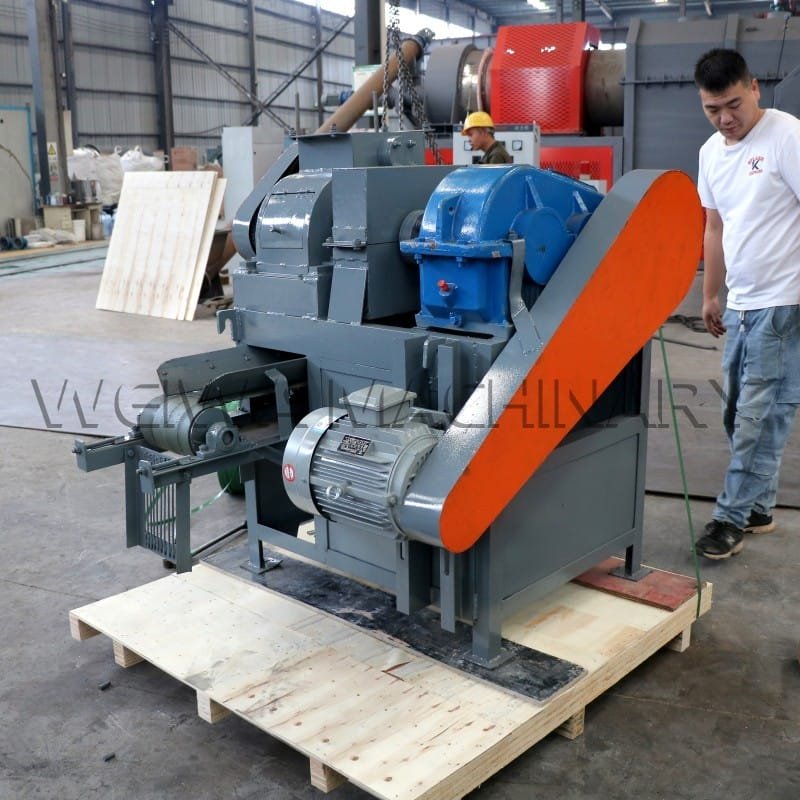
Recently at Weiwa Machinery’s factory workshop, another machine à briquettes de charbon de bois a été soigneusement inspecté, trial-run, rust-proofed, and loaded into a full container bound for Bamako, Mali. Ce presse à boules de charbon de bois will help our Mali client turn locally sourced charcoal powder into uniform, briquettes à haute densité faire des boules de charbon de bois for BBQ fuel, residential heating, and small-scale commercial distribution.
Factory Shipment Scene – Machine de briquettes à charbon de bois Ready for Mali
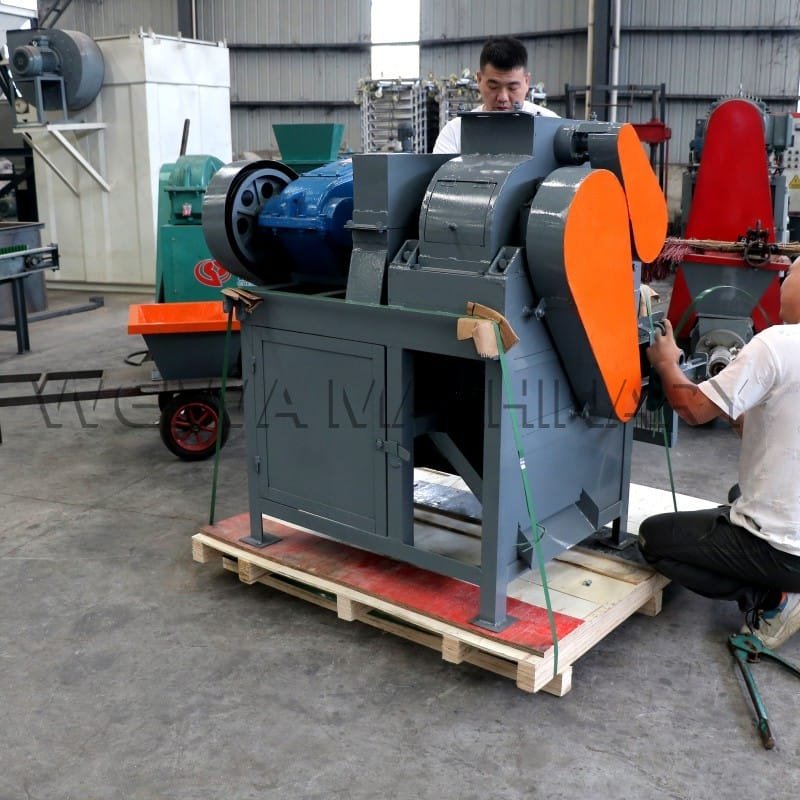
The day before departure, our quality-control engineers ran a no-load test and a load test on the twin-roller presse à boules de charbon de bois, checking roller alignment, pressure spring tension, reduction gear lubrication, and the even feeding performance of the forced screw feeder. Once the pressing molds—customized to produce 40 mm round ball shapes—were confirmed to form perfectly dense boules de charbon de bois, the main unit was coated with anti-rust oil and wrapped in waterproof plastic film.
For overseas container shipment, the heavy-duty frame of the machine à briquettes de charbon de bois was secured to the container floor with steel wire ropes and wooden bracing to prevent shifting during ocean transit. Accessory components including the double-shaft mixer, spare rollers, and common wearing parts were packed in reinforced plywood cases clearly labeled in English and French, which is appreciated by many of our West African customers. Photographs of the loaded container, packing list, commercial invoice, and certificate of origin were emailed to our Mali client so customs clearance could be prepared in advance.
This is not the first time Weiwa Machinery has exported a machine à briquettes de charbon de bois to the African continent. Over the past decades we have delivered presse à boules de charbon de bois units and complete briquette production lines to Nigeria, Tanzanie, Kenya, Ethiopie, Ghana, and now increasingly to Mali, where demand for efficient fuel briquetting solutions is rising year by year.
Why Making Charcoal Balls in Mali Is a Growing Business Opportunity?
Mali’s Traditional Charcoal Market and Its Limitations
In Mali, charcoal produced from wood and agro-residues remains one of the most commonly used domestic fuels for cooking and heating, especially in urban centers such as Bamako, Sikasso, and Mopti. Cependant, traditional lump charcoal suffers from several drawbacks: irregular size, high breakage rate during transport, incomplete combustion, and significant storage loss in the form of fine powder. Much of this charcoal dust accumulates at wholesalers, retailers, and production yards—material that is often discarded or burned inefficiently.
How a Charcoal Ball Press Machine Adds Value to Local Resources?
UN machine à briquettes de charbon de bois allows entrepreneurs to collect that underutilized charcoal fines, mix them with a small amount of binder and water, and reform them into uniformly shaped boules de charbon de bois. The resulting briquettes have higher bulk density, longer burning time, lower smoke emission, and are easier to package and sell at a premium compared with loose powder. For Malian small-business owners, making charcoal balls in Mali means converting waste into profit while contributing to more sustainable fuel use.
De plus, le machine à briquettes de charbon de bois we supplied is equipped with manganese steel rollers resistant to abrasion from charcoal and coal powder, and the pressure setting can be adjusted to suit different raw material compositions. Whether the feedstock is pure charcoal dust, a blend of charcoal and coal powder, or biomass-derived carbonized powder, le presse à boules de charbon de bois maintains stable ball formation once the moisture content is controlled in the recommended 8–12% range.
Market Potential of Charcoal Briquettes Across West Africa
Beyond Mali, neighboring countries such as Senegal, Burkina Faso, Côte d'Ivoire, and Nigeria show similar patterns: growing urban populations, increasing demand for cleaner cooking fuels, and abundant agricultural residues that can be carbonized and briquetted. A well-operated machine à briquettes de charbon de bois line can therefore serve not only the domestic Mali market but also cross-border trade opportunities. Investors who start early with a reliable machine à briquettes de charbon de bois and consistent product quality are well-positioned to build recognizable local brands around faire des boules de charbon de bois for BBQ, street food vending, boulangeries, and institutional kitchens.
Understanding the Ball Charcoal Briquettes Machine and Complete Briquetting Line
What Is a Charcoal Ball Press Machine?
Le presse à boules de charbon de bois, sometimes called a roller-type briquette press, uses two counter-rotating rollers embedded with matching indentations—typically spherical, ovale, pillow, carré, or egg-shaped—to compress powdered material into solid briquettes. Material is gravity-fed or screw-fed into the nip area of the rollers; as the rollers turn, compression pressure gradually increases, peaks at the roller centerline, and then releases so the formed boules de charbon de bois drop out of the discharge chute.
Key features of the Weiwa machine à briquettes de charbon de bois include a reinforced base frame, high-torque electric motor with V-belt drive, hardened alloy rollers, an adjustable hydraulic or mechanical pressure system, and an emergency-stop equipped control cabinet. Models range from small 1–2 t/h entry-level units up to large 10–20 t/h industrial models for customers planning higher-volume making charcoal balls in Mali or other African markets.
Raw Materials Suitable for the Charcoal Briquette Machine
Le machine à briquettes de charbon de bois we export is designed to press multiple types of fine powders, provided particle size is generally below 3–5 mm. Common feedstocks include charcoal powder from wood, coque de coco, or bamboo; coal or coke breeze; metallurgical dust such as iron oxide scale, poudre d'oxyde de magnésium, and non-ferrous metal powders; and certain mineral powders like gypsum or desulfurization ash after proper pre-conditioning. For BBQ-grade boules de charbon de bois, charcoal powder blended with a natural binder such as cassava starch or molasses yields excellent shape retention and clean combustion.
Typical Charcoal Briquette Production Line Process Flow
Alors que le presse à boules de charbon de bois is the core forming equipment, a complete line usually involves upstream and downstream units to ensure consistent quality when faire des boules de charbon de bois at commercial scale:
1. Écrasement: Large charcoal lumps or carbonized biomass chunks are reduced to powder by a hammer crusher or tooth-roll crusher. Uniform fineness improves roller filling and ball strength.
2. Mélange: Charcoal powder is conveyed to a double-shaft paddle mixer where a predetermined amount of water and binder solution is added. Thorough blending ensures even moisture distribution, which is critical for the machine à briquettes de charbon de bois to produce non-cracked briquettes.
3. Alimentation & Briquette: The mixed material enters a surge silo above the presse à boules de charbon de bois. The forced feeder pushes material into roller molds at a steady rate. Operators monitor ammeter readings to avoid overfeeding or underfeeding, both of which can cause misshapen boules de charbon de bois or roller damage.
4. Séchage: Freshly pressed briquettes contain residual moisture and require drying—either in a mesh belt dryer, rotary dryer, or sun-drying bed—to reach a safe storage moisture level below 5–6%. Proper drying prevents mold growth and preserves compressive strength during packaging and transport.
5. Refroidissement & Emballage: Cooled briquettes can be weighed and packed in polyethylene bags, cartons, or bulk sacks depending on the target market segment. Attractive packaging mentioning “premium BBQ charcoal balls” ou “eco-friendly briquette fuel” helps differentiate the product in Mali’s retail outlets.
Common Briquette Shapes and Customization Options
Although spherical boules de charbon de bois are the most popular shape for BBQ use, le machine à briquettes de charbon de bois can be equipped with interchangeable roller molds to produce oval, pillow, carré, or custom logos embossed on the briquette face. Our Mali customer selected standard 40 mm round balls, but we routinely supply molds sized 25 mm à 60 mm upon request. Customization extends to motor power (electric or diesel engine option for areas with unstable electricity), reducer ratio, and control panel language (English, Français, Spanish, Russian etc.).
Operating Tips for the Charcoal Ball Press Machine in Tropical Climates
Moisture Control When Making Charcoal Balls
In West Africa’s warm climate, raw material moisture can fluctuate. Before feeding the machine à briquettes de charbon de bois, always test moisture with a simple hand-squeeze method or portable meter. Too wet → balls stick in the mold and deform; too dry → poor cohesion and crumbly boules de charbon de bois. The ideal zone for most charcoal powder blends is 8–11% before pressing.
Binder Selection and Ratio
A common question from new investors making charcoal balls in Mali is whether binder is necessary. For pure fine charcoal dust, a binder improves green strength and reduces breakage. Food-grade starch (corn, cassava, potato) at 3–6% by weight is widely used and burns clean. Clay or lime can be added in small percentages for industrial fuel briquettes but may affect taste and smoke profile for BBQ use. Le presse à boules de charbon de bois itself does not require binder mechanically, but the recipe influences final product acceptance in the marketplace.
Routine Maintenance of the Ball Charcoal Briquettes Machine
To extend service life of the presse à boules de charbon de bois, operators should lubricate bearings and open gears per the maintenance schedule, periodically check roller socket depth for wear, and keep the feeding hopper free of oversized debris or metal scraps that could jam the rollers. After each production run, a brief cleaning cycle with dry sand or rice hulls helps remove residual powder from mold pockets. Our after-sales engineers provide detailed operation manuals, illustrated parts diagrams, and video guidance for all Weiwa machine à briquettes de charbon de bois buyers.
Why Choose Weiwa Machinery’s Charcoal Briquette Machine for Your Mali Project?
Weiwa Machinery brings more than thirty years of experience in designing, fabrication, and exporting briquetting equipment. Every machine à briquettes de charbon de bois leaving our workshop undergoes a multi-point inspection covering dimensional accuracy, dynamic balance of rollers, electrical safety, and pressure uniformity across the mold surface. We offer customized layout drawings and site-planning suggestions so customers know exactly how to arrange the machine à briquettes de charbon de bois line within their available factory space—whether a 50 m² workshop or a full-scale plant.
Our professional after-sales team supports installation guidance via video call, email, and on-site service when project scale justifies it. Spare rollers, springs, seals, and electronic components are kept in stock for fast dispatch. For clients interested in making charcoal balls in Mali or elsewhere in Africa, we also advise on local binder sourcing, dryer type selection (mesh belt vs rotary vs sun drying tunnel), and basic ROI calculation based on assumed raw material cost and selling price per kilogram of finished boules de charbon de bois.
Conclusion
The container now en route to Mali carrying our latest machine à briquettes de charbon de bois represents more than just metal and motors—it represents a tangible step toward turning charcoal waste into income, creating local jobs, and supplying cleaner-burning fuel to Malian households and businesses. If you are exploring the feasibility of making charcoal balls in Mali, or need a dependable machine à briquettes de charbon de bois and complete production line design, the Weiwa team is ready to assist with technical consultation, factory layout drawings, and a tailored quotation.
Contact Weiwa Machinery for a Free Quote
Machinerie Weiwa – 30+ Years Experience in Briquetting Equipment
Conception personnalisée & Factory Layout | Équipe après-vente professionnelle | Global Export to 130+ Countries
Foule / WhatsApp: +86 138 3809 3177
E-mail: info@cjlmachinegroup.com
Product Reference: Ball Charcoal Briquettes Machine – Weiwa Machinery


 Wechat

 +8615937143060
