


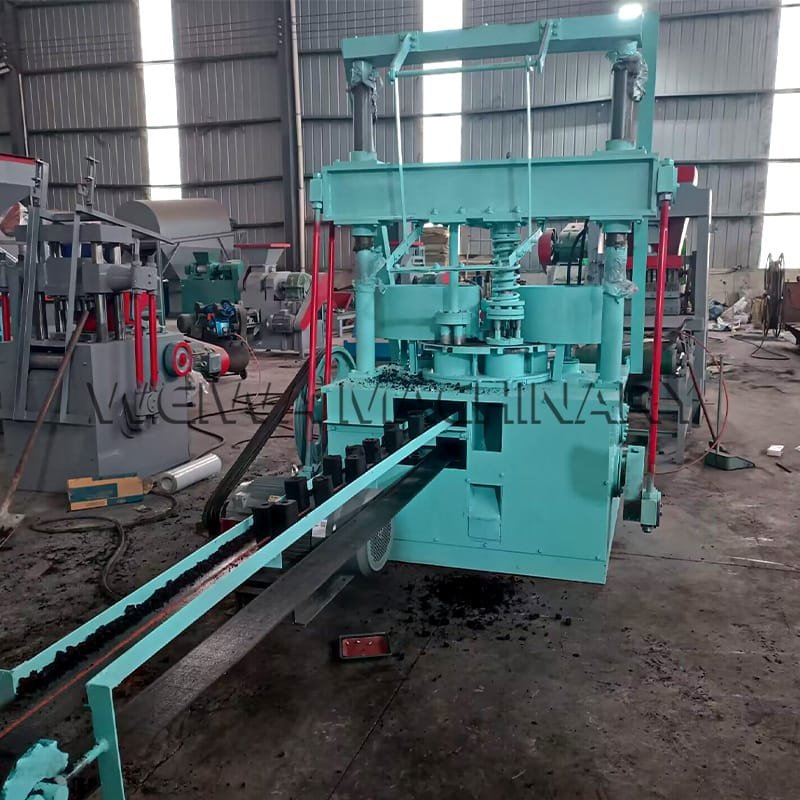
Why the India Client Asked for a Pre-Shipment Machine Verification?
Demand for clean, low-smoke household and small-restaurant fuel across India has shifted from seasonal to structural. Traditional loose coal dust and irregular hand-pressed lumps are being replaced by uniform honeycomb briquettes that fit standard stoves, brûler plus longtemps, and generate less airborne particulate. The India client already understood the product; what he needed was proof that a China-sourced honeycomb briquette charcoal machine could replicate the diameter, hole pattern, edge sharpness, and compressive hardness his retail customers in Punjab and Maharashtra had approved in earlier imported samples.
Weiwa Machinery treats pre-shipment verification as a normal part of exporting a honeycomb punching machine. For this project, the client sent his preferred blend ratio—70% hardwood charcoal powder, 25% bituminous coal fines, 5% starch binder—and a target of 140 mm diameter with 12 vertical holes. Our job was to mount the requested mold, tune the feeder and punch cam, and run a 40-minute continuous trial while the client measured every tenth piece.
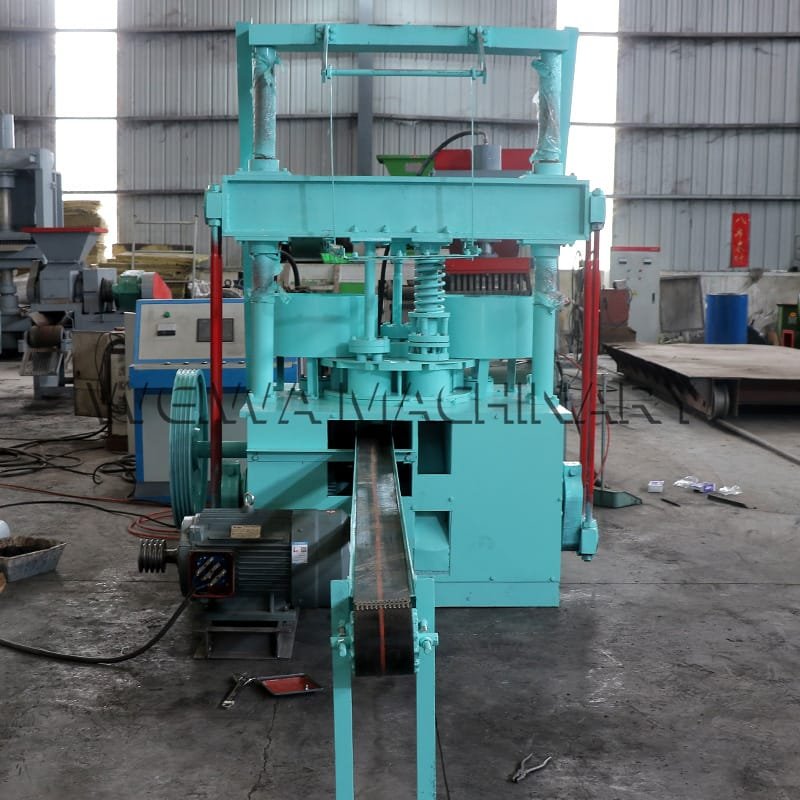
What the Client Brought to the Table?
The India buyer did not arrive with guesses. He carried a polybag of local charcoal powder sifted to under 1 MM, a small carton of competitor briquettes purchased from a Delhi wholesaler, a vernier caliper, a kitchen scale, and a printed stove drawing showing the exact chamber height. That level of preparation changed the conversation from sales to engineering. Instead of explaining what a honeycomb briquette charcoal machine might do, we aligned the coal briquettes making machine to his stove geometry within the first 90 minutes.
Machine Model Selected for the Trial
For this inspection we installed a WHC-140 honeycomb charcoal coal briquette forming machine, the same mid-scale unit many India and Africa clients choose when daily output sits between 20,000 et 25,000 pieces. The WHC-140 runs on a 7.5 kW motor, accepts 100–140 mm molds, keeps briquette height adjustable from 60 mm à 80 MM, and maintains 35–45 strokes per minute depending on material density and feed consistency. The frame uses a reinforced cast base, the punch shaft runs through a sealed bearing housing, and the mold disc rotates on an indexed turntable so each cavity receives equal fill before the upper punch descends.
How a Machine à charbon de bois pour briquettes en nid d'abeille Actually Forms Fuel?
The physics behind a honeycomb punching machine is simpler than the result looks. Powdered carbonaceous material is not glued into shape; it is mechanically locked. When coal dust or charcoal powder enters the hopper, a rotating agitator breaks bridges and pushes the mix toward a metering auger. The auger drops a controlled volume into each revolving mold cup. A spring-loaded tamper pre-compresses the fill, then the main crank drives the punch head down with several tons of linear force. The powder yields, air escapes through the vent holes around the mold, and the particles cold-weld through van der Waals contact plus minor plastic deformation of the binder film.
When the punch retracts, the ejector pin lifts the finished honeycomb briquette clear of the cup. A scraper sweeps it onto the discharge chute. The entire cycle repeats 40 times a minute. What the eye reads as a decorative honeycomb pattern is really a combustion engineering feature: the central holes act as primary air channels, pulling oxygen into the core so the piece ignites from inside out and holds a stable flame front instead of smoldering at the edges.
Why the Honeycomb Geometry Beats Solid Blocks?
A solid charcoal block of 140 mm diameter takes a long time to reach inner ignition temperature. The outer shell carbonizes while the center stays inert, wasting fuel and raising carbon monoxide risk in poorly vented kitchens. The honeycomb charcoal coal briquette forming machine solves this by giving the briquette 9, 12, 16, ou 19 vertical perforations. Those channels lower the effective thermal mass per cubic centimeter and let radiant heat travel inward. In our burn corner, un 140 mm by 75 mm sample reached full flame in 3–5 minutes on a bed of glowing embers and sustained usable heat for 95–115 minutes in a controlled stove, leaving light grey ash with no tar droplets.
Role of Binder and Moisture in a Coal Briquettes Making Machine
No honeycomb briquette charcoal machine can compensate for a bad recipe. The India client’s blend sat at 18% moisture after pre-drying, which is slightly high but workable if the starch binder is cooked. We advised 2.2% cooked tapioca starch rather than raw cassava flour, because gelatinized starch films redistribute during compression and survive the first 60 seconds of ignition. Clay or bentonite works for pure coal briquettes but dulls the gloss and scent of premium charcoal honeycomb products, so we kept it out of this trial. The mixer ran 8 minutes, the punch pressure was set to the third cam notch, and the discharge pieces showed zero lamination lines—a common defect when moisture exceeds 22% or the binder clumps.
Step-by-Step Record of the India Client Inspection Day
We document every export trial so the same settings can be reproduced after installation overseas. The India visit followed our standard Weiwa verification flow.
Arrival and Safety Briefing
The client landed at Zhengzhou airport on a Tuesday morning, transferred to the factory, and spent the first hour reviewing the general layout: raw material prep zone, machine assembly bay, trial yard, sample drying rack, and packaging corner. We explained the emergency stop locations, the lockout-tagout procedure on the main breaker, and the reason we never run the honeycomb punching machine without the transparent guard over the punch cam. The client noted that his own workers in Ludhiana would need the same guard fabricated locally, and we shared the CAD outline.
Mold Mounting and Alignment Check
Because the client requested 140 mm diameter with 12 holes, we mounted the WHC-140 high-manganese steel mold, torqued the clamping ring to 180 Nm, and rotated the turntable by hand to confirm each cavity seated under the feed throat. Misalignment here is the usual cause of half-filled honeycomb briquettes, so we dropped a few grams of colored sand into the hopper and cycled the machine manually to watch fill symmetry. Every cavity received an even cone. Only then did we close the guard and switch to motor drive.
First Warm-Up Run Without Load
With empty molds, the honeycomb briquette charcoal machine ran 10 minutes to warm the gearbox oil and seat the punch seals. The client stood at the control box and watched the ammeter. Draw stayed between 5.8 et 6.3 kW, confirming the 7.5 kW motor had healthy headroom. No abnormal knock from the crankshaft, no heat rise on the bearing caps beyond 41°C ambient-plus-9.
Material Loading and Live Sampling
We charged 80 kg of the client’s blend into the hopper and started the live run. The coal briquettes making machine immediately settled into 38 pieces per minute. Every 10th piece went to a separate tray. After 40 minutes the client had 24 sampled briquettes plus a bucket of 1,500 continuous-output pieces for visual grading. Measured diameter held 139.6–140.3 mm. Height sat at 74–76 mm. Hole count was 12 every time. Edge breakage rate across the bucket was 0.4%, well under the 2% acceptance line we quote for export orders.
Hardness and Drop Test
The client placed a sample on the concrete floor from waist height three times. It chipped at one corner on the third drop but did not fracture—acceptable for bagged retail transport. A second sample was pressed edge-on in a workshop vice until crack; it took roughly 78 kg before the first hairline split, matching the 60–90 kg pressure-resistance band of a properly compressed honeycomb briquette charcoal machine output.
Combustion Observation in the Burn Corner
We lit two samples in a small Indian-style stove the client had described. Both caught within 4 minutes, burned with a steady blue-orange front, and produced thin straight smoke for under 90 seconds before going to clean heat. The client filmed the burn on his phone and compared it side by side with the Delhi competitor piece, which took 7 minutes to ignite and left black soot on the pot rim. That comparison ended the technical discussion. The rest of the meeting moved to logistics.
Sample Gallery and What Each Piece Tells You
Physical samples communicate more than specifications. The India client left with six labeled categories, and we kept identical sets for our QC archive.
Sample A: Standard 140 mm 12-Hole Retail Briquette
This is the hero piece. Charcoal-dominant blend, 75 mm hauteur, 2.2% amidon, dried 36 hours at ambient Zhengzhou humidity. Surface is semi-matte with a faint radial sheen from mold polish. Hole walls are smooth, not torn. This is what a honeycomb charcoal coal briquette forming machine should produce when the recipe and moisture are right.
Sample B: Coal-Heavy Economy Variant
Same mold, but 55% fines de charbon, 40% charbon de bois, 5% amidon, no pre-drying beyond 15% humidité. The piece is darker, heavier, and ignites slower. We include it to show the India client that a coal briquettes making machine does not automatically make premium BBQ charcoal—it makes whatever the formula supports. His market in rural Maharashtra preferred this cheaper unit for boiling water, while urban Punjab paid more for Sample A.
Sample C: High-Pressure Trial at Notch Five
We raised punch cam pressure to the maximum recommended setting and reran 200 pieces. Density climbed, ignition delayed by 40 seconds, but total burn time extended past 130 minutes. The client decided against max pressure for retail bags because the extra hardness made breakage near zero yet slowed ignition—a tradeoff worth knowing before scaling.
Sample D: Wrong-Fill Defect Demonstration
Intentionally, we starved the auger for one minute to show what a honeycomb briquette charcoal machine produces under poor feed: shallow top, convex base, one sealed hole. The client photographed it next to the good samples so his own operators in India would recognize the symptom and check the agitator scraper rather than blame the mold.
Sample E: Alternative 120 mm 9-Hole Prototype
Swapping molds took 22 minutes including turntable re-zeroing. Le 120 mm 9-hole piece suits smaller single-burner stoves common in South Indian hostels. The honeycomb punching machine handled the change without motor load change because diameter drop offset height increase. This proved to the client that one coal briquettes making machine can serve two regional SKUs with a spare mold inventory instead of two full lines.
Sample F: Long-Storage Piece After 21 Days
One tray of Sample A sat in the warehouse 21 days uncovered. Humidity in Zhengzhou rose after rain, yet the briquettes only gained 1.3% weight and showed no mold. The starch film plus high compression density resisted reabsorption better than the client expected. He marked this as the deciding point for sea freight confidence.
Technical Parameters Confirmed During the India Trial
The numbers below are not catalog estimates; they are what the WHC-140 honeycomb briquette charcoal machine delivered with the India client’s own material on the trial day.
Motor power 7.5 kW, 415 V / 50 Hz three-phase to match India grid. Rated stroke 35–45 per minute, observed average 38. Diameter range 100–140 mm, trial locked at 140 MM. Height range 60–80 mm, trial locked at 75 MM. Hole pattern 12 vertical, 6 mm hole diameter. Installed mold material high-manganese steel, wear after 1,520 cycles negligible. Machine dimensions 1320 par 1260 par 1850 MM, net weight 1400 kg. Binding agent cooked tapioca starch 2.2%. Raw blend moisture 18%. Output piece moisture after punching 16.5%. Continuous run time 40 minutes, no thermal trip. Ambient shop temperature 32°C, gearbox surface 47°C. Noise at 1 meter 81 dB with guard closed.
Raw Material Flexibility of the Honeycomb Punching Machine
One reason the honeycomb briquette charcoal machine sells well into India is material latitude. The same hopper takes hardwood charcoal powder, fusain à coco, sawdust carbon, bituminous coal dust, anthracite fines, coke breeze, and pre-crushed biomass char. Particle size should stay under 1 mm for clean hole walls. Oversize grains ride up the punch and scar the mold. The India client plans to blend coconut shell charcoal from Kerala with coal fines from Jharkhand, a mix our coal briquettes making machine has already proven in earlier Sri Lanka and Uganda shipments.
Moisture and Binder Rules Worth Printing on the Workshop Wall
Keep total mix moisture between 14% et 19% for charcoal-led recipes, 16% à 20% for coal-led recipes. Starch binder 1.5%–3% by weight, always gelatinized. Clay binder 4%–8% only for smokeless coal lumps, never for BBQ charcoal honeycomb. Pre-mix dry powders 3 minutes before adding liquid binder, then wet-mix 5–8 minutes. If the briquette surface sweats within 30 seconds of ejection, moisture is too high. If edges crumble, binder is too low or pressure too soft. The honeycomb charcoal coal briquette forming machine cannot fix a kitchen-scale recipe error; it only amplifies a good one.
Why India Buyers Prefer a Physical Verification Before Crating?
Sea freight from Qingdao to Nhava Sheva runs several weeks. A wrong mold pitch or a mis-set punch height is cheap to fix in Zhengzhou and expensive to fix in Ludhiana. The India client told us frankly that two previous suppliers had shipped honeycomb punching machines with beautiful videos and wrong voltage plates. Weiwa Machinery avoids that gap by inviting the buyer, or his hired inspector, to stand next to the running unit. The coal briquettes making machine in this blog is now crated with the same mold we ran together, the same cam notch setting etched on the adjustment plate, and a USB stick containing the 40-minute trial video, the burner footage, and the raw material sheet signed by both sides.
Documentation Package We Hand Over
Alongside the machine, the India client received a multilingual manual, a mold care sheet, a spare-parts list with OEM codes, un 415 V wiring diagram, a pre-shipment inspection report with photos, and a one-year warranty certificate excluding consumable molds. We also logged the exact auger speed, feeder gate opening in millimeters, and punch cam notch so his local electrician can reproduce the run without guessing.
Common Misconceptions About Honeycomb Briquette Charcoal Machines
Many first-time India inquiries assume the honeycomb briquette charcoal machine is a press that melts charcoal. It is not. No heat is applied during forming. The piece is green-compressed and only hardens its surface bind during drying. Others believe more holes always mean better burn; in truth, hole count must match stove draft. A 19-hole piece in a low-draft clay stove can choke and smoke. The honeycomb charcoal coal briquette forming machine is a geometry tool, not a magic box, and the India trial proved that matching geometry to stove beats maximizing hole count.
Is Higher Pressure Always Better
Non. The coal briquettes making machine reaches a density plateau around 1.05–1.15 g/cm³ for charcoal blends. Beyond that, ignition suffers and mold wear accelerates. The India client’s retail brand needed fast ignition and moderate burn length, so we tuned for 1.02 g/cm³ rather than squeezing to 1.14. A honeycomb punching machine set by a technician who never burns the output will almost always over-press.
From Inspection to Installation in India
After the trial, the WHC-140 was dismantled to main modules: base with gearbox, turntable with mold, punch head assembly, hopper and auger, control box. Each module went into a plywood case with desiccant, the mold in a separate foam-lined box. We scheduled a WhatsApp video call for the India side commissioning: leveling the base, filling the gearbox with 46# anti-wear oil, jogging the motor to confirm rotation, then the first 10-minute no-load run, then the first material run with 20 kg. The client’s local team can reach us on the same number used during the factory visit, so the honeycomb briquette charcoal machine does not become a stranded asset if a sensor acts up in month two.
Spare Parts the India Client Chose to Stock
He did not overbuy. One spare high-manganese mold, two punch heads, a set of feeder scraper blades, three auger flights, one contactor, and a relay kit. That basket covers 90% of field issues on a honeycomb punching machine running single-shift. Wear parts on the coal briquettes making machine are predictable; the mold typically serves 300,000–500,000 strokes before hole wall tolerance drifts, which at 38 pieces per minute is roughly four months of full-time retail production.
Business Case the India Client Modelled
We are not consultants, but the numbers the client shared are useful for any reader evaluating a honeycomb briquette charcoal machine. Raw charcoal powder purchased near Karur at 22 INR per kg, coal fines at 9 INR per kg, starch at 40 INR per kg cooked yield. Blend cost roughly 18.5 INR per kg. One 140 mm by 75 mm briquette weighs about 0.82 kg green, sells retail at 34–38 INR in his channel. Machine output 38 pieces per minute equals about 2,280 pieces per hour, roughly 1,870 kg per hour of finished goods. Even at 60% effective daily runtime, the honeycomb charcoal coal briquette forming machine clears its imported cost inside seven to ten months, before counting the second 120 mm SKU from the spare mold.
Where the Honeycomb Product Fits in India Fuel Retail?
Urban tandoor shops want 140 mm 12-hole charcoal-dominant pieces. Hostels and roadside tea stalls accept 120 mm 9-hole coal-lean pieces. Rural households still buy 100 mm 9-hole economy lumps. One honeycomb briquette charcoal machine, two molds, and a small mixer cover all three. The India client’s plan to run charcoal-dominant in winter and coal-lean in summer is exactly the flexibility a coal briquettes making machine is built for.
Quality Controls Weiwa Applies Before Any Export
Every honeycomb punching machine leaving Zhengzhou passes a 30-minute no-load electrical test, a 20-minute loaded trial on factory blend, a dimensional check on the first 50 pieces, a paint and rust-proofing check, and a bolt-torque audit. The India unit additionally passed the client’s own caliper test and his drop test. We engrave the trial date and inspector initials on the machine nameplate so future service engineers see the baseline.
Customization Options on the Same Platform
The honeycomb briquette charcoal machine platform accepts 100, 120, 140, 160, 180, et 220 mm mold families. Hole counts from 9 à 21. Voltage 220 V single-phase, 380 V, 415 V, ou 440 V. Motor brand default Siemens-compatible China tier-1, upgradeable to WEG or ABB. Frame color, logo plate language, and control box layout can match the buyer’s local branding. The India client kept Weiwa grey with English-Hindi dual labels, a smart choice for resale credibility.
Field Notes on Combustion Quality
A honeycomb charcoal coal briquette forming machine is only as good as the flame it eventually serves. Across the trial bucket, fixed-carbon pieces gave a calm orange flame with a short blue base. Coal-heavy pieces gave a taller yellow flame with slightly more ash. Neither smoked past the first 90 seconds because moisture was controlled and binder was cooked. The client’s Delhi competitor sample, by contrast, smoked for 4 minutes and left a tar ring—almost certainly raw binder and 24%+ humidité. That single side-by-side justified the entire inspection trip.
Fumée, Cendre, and Stove Compatibility
Indian chulha upgrades and commercial tandoor burners both assume a honeycomb piece that seats flat and leaves vertical channels open. If the honeycomb briquette charcoal machine closes one hole due to worn punch pins, the flame front tilts and the user blames the fuel, not the mold. We showed the India client how to spin the mold disc by hand once per shift and feel for drag—a 20-second check that protects his brand more than any warranty clause.
Logistics and Packaging Decisions for the India Shipment
The WHC-140 honeycomb punching machine packed into one 20-foot container with room for the mixer, a small dryer, et 800 kg of trial samples the client wanted to retail-test before local production. We wrapped the control box in anti-static film, greased the punch shaft, and bolted the mold inside its own case to avoid transit scoring. The coal briquettes making machine base rode on timber dunnage with twist locks. Documentation included commercial invoice, packing list, CO, and FORM E for tariff preference where applicable.
Commissioning Support After Arrival
Weiwa Machinery offers three layers: PDF manual, WhatsApp video walkthrough, and optional on-site engineer dispatch for large India installations. The client chose the first two plus a single paid engineer visit at the four-week mark to train his second-shift operator. That model keeps the honeycomb briquette charcoal machine productive without embedding a foreign technician for a month.
Lessons the India Visit Gave Back to Our Workshop
Standing next to a real India buyer sharpened small details. The feeder gate marking was in millimeters but not inches, so we added a dual scale. The control box start button was green on green panel, so we swapped to yellow legend. The mold clamp ring needed a 12-point socket not common in Indian toolkits, so future WHC-140 honeycomb charcoal coal briquette forming machine units ship with the socket in the spare kit. None of these change the machine’s power, but all of them change the owner’s day-one mood.
Why Sample Retention Matters?
We kept Sample A, B, C, and F in the Zhengzhou archive with the trial date tagged. If the India client calls in March complaining that his local pieces ignite slow, we pull the archived sample, compare density, and trace whether his moisture crept up or his starch supplier changed. A honeycomb punching machine does not forget its baseline; most disputes come from recipe drift, and the archived briquette is the fastest arbitrator.
Is the Honeycomb Briquette Charcoal Machine Right for Your India Project?
If you already sell loose charcoal or coal powder, adding a honeycomb briquette charcoal machine converts a low-margin bulk commodity into a bagged, branded, stove-ready product. If you run a tandoor supply chain, the WHC-140 or WHC-120 coal briquettes making machine stabilizes your incoming fuel shape so every restaurant gets the same burn time. If you are a first-time entrepreneur, start with one mold, one recipe, and a 40-minute factory trial exactly like the India client did—do not import blind.
Questions to Answer Before You Order
What stove diameter do your buyers use? What raw material is cheapest within 200 km of your site? What moisture can your sun-dry season deliver? What hole count did your local stove maker approve? A honeycomb charcoal coal briquette forming machine answers none of these; it only executes the answers. The India client arrived with all four solved, which is why his verification took one day instead of three.
À propos Machinerie Weiwa
Weiwa Machinery is a Zhengzhou-based manufacturer of solid-fuel processing equipment, focused on honeycomb briquette charcoal machines, charcoal and coal briquette forming machines, honeycomb punching machines, fours de carbonisation, broyeurs, and mixers for global buyers. We export to India, Russie, Sri Lanka, Ouganda, Nigeria, Indonésie, Mexique, and Kazakhstan, and we treat every export unit as a reference site, not a transaction. Each honeycomb briquette charcoal machine we build is run, sampled, and documented before crating. Our team replies on phone, WhatsApp, and email with the same engineers who stood beside the running machine, not a separate sales layer.
If you are evaluating a coal briquettes making machine for the India market, send your raw material photo, your stove drawing, and your target piece size. We will mount the matching mold, run your blend, and hand you the samples before you pay the balance. That is how the India client in this blog started, and that is how we prefer every honeycomb punching machine project to begin.
Contact Weiwa Machinery
Foule / WhatsApp: +8613838093177
E-mail: info@cjlmachinegroup.com


 Wechat

 +8615937143060
