


Why Botswana Buyers Are Moving Away from Traditional Charcoal Kiln Setups?
Botswana sits on a strange charcoal map. The country imports a portion of household BBQ charcoal from neighboring Zambia and South Africa, while local sawmills in Francistown, Selebi-Phikwe, and the eastern agricultural belt generate thousands of tonnes of offcut wood every year that is either burned openly or left to rot. A traditional charcoal kiln built from soil and brick still works, but it leaks tar aerosol, loses 40 à 50 percent of the fixed carbon to complete combustion, and forces the operator to guess temperature from smoke color.
The buyer who ordered this horizontal carbonization furnace in Botswana told our sales engineer that his biggest pain was not yield, it was consistency. Supermarket buyers in Gaborone want bags of lump charcoal with the same size, same ash content, same snap. A charcoal maker built on pit methods cannot promise that. A sealed horizontal chamber with rail-loaded baskets can.
Feedstock Reality in Botswana
Unlike coastal Kenya or Lagos where coconut shell is everywhere, Botswana operators work mostly with terrestrial hardwoods. Acacia tortilis, mopane, leadwood offcuts from furniture shops, and dismantled pallets dominate the inbound yard. All of these are denser than softwood, which means they need a slower ramp to 600 degrees Celsius and a longer holding window. The horizontal carbonization furnace handles this because the charge lies flat on a trolley instead of stacking vertically, so heat climbs through the bed evenly instead of scorching the bottom log while the top one stays brown.
Shipment Day at the Weiwa Machinery Plant
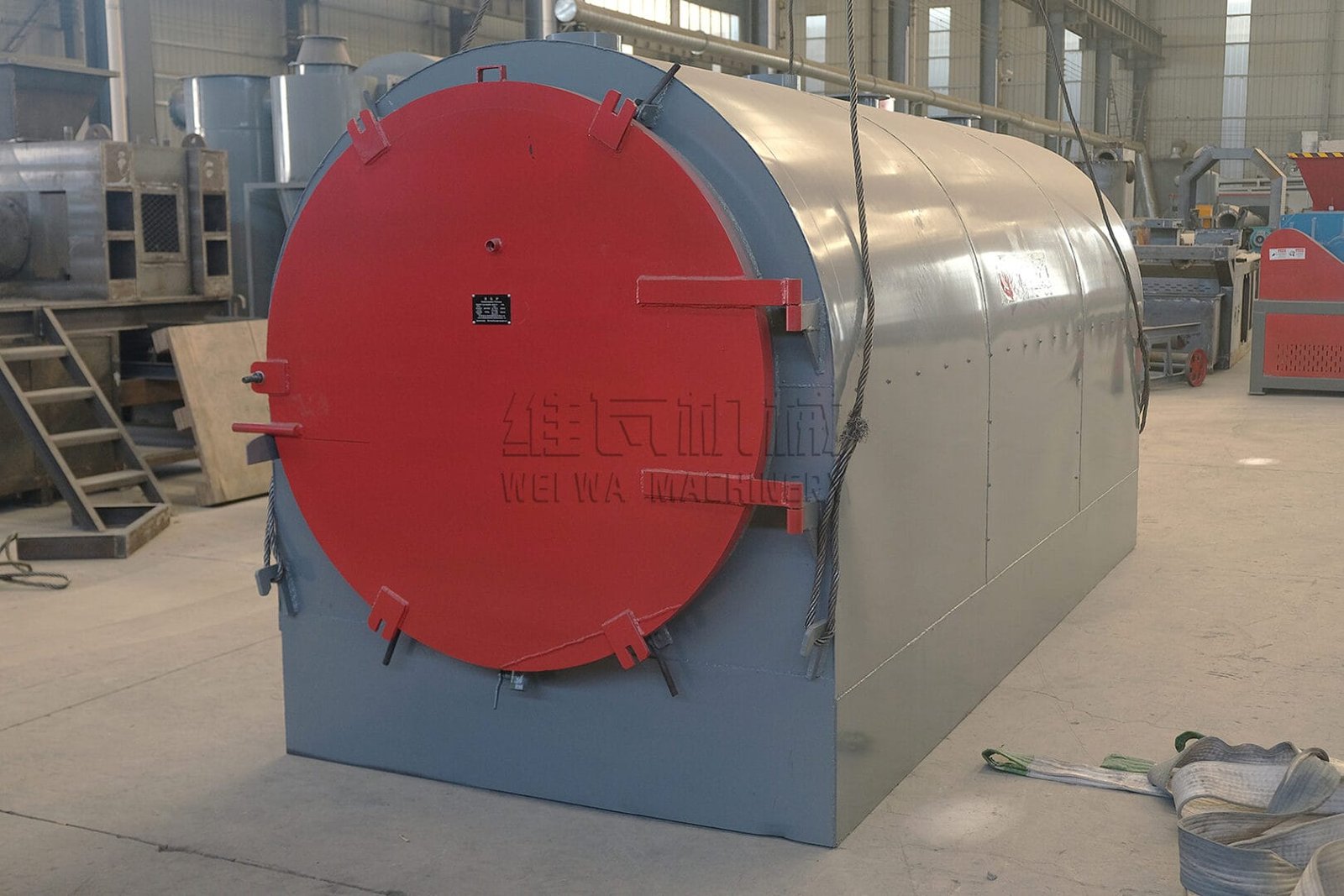
On the morning of the load-out, le 1900 mm diameter horizontal carbonization furnace was sitting on the final QA bay. Our welders had already pressure-tested the door seal at 1.2 bar. The double-layer shell with ceramic fiber and rock wool was checked with a surface thermometer, the gas recovery pipe was flushed, and the stainless chimney damper was cycled ten times to confirm it did not bind.
The furnace body is not the only thing that ships. For Botswana, the crate included:
The main horizontal carbonization furnace barrel with rail-mounted trolley, the external combustion hearth, the gas separation tank, the tar condenser, the water-seal safety outlet, the electric control cabinet with dual temperature probes, one spare high-temperature door gasket, a full set of Chinese and English manuals, and a Foundation DWG printed on moisture-proof paper. We also slipped in a small bag of sample charcoal from a previous trial run on acacia so the client could feel the density before his own first batch.
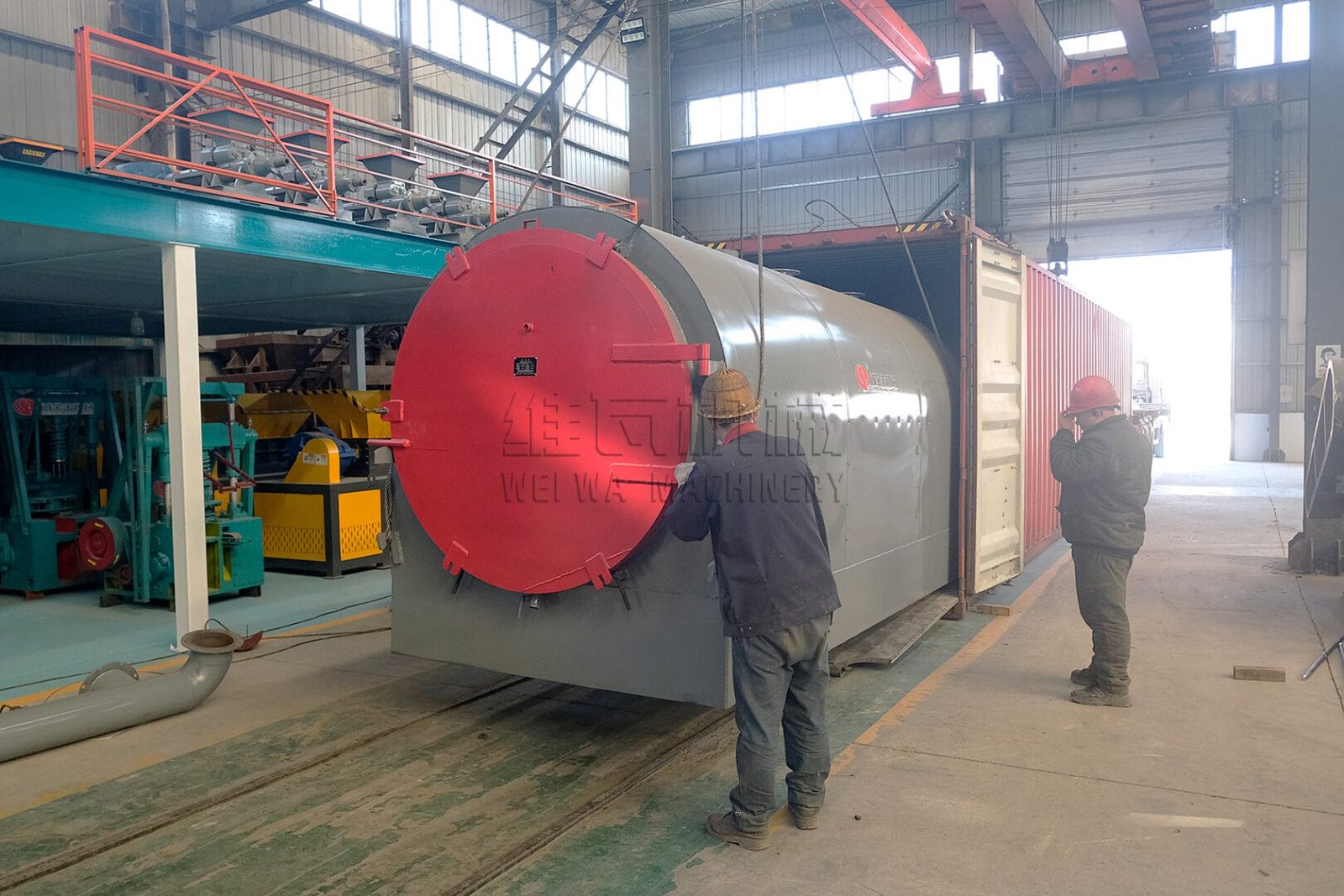
Container Loading and Export Paperwork
The unit went into a 40-foot high-cube container with the trolley braced to the front bulkhead. We used laminated poplar spacers rather than raw timber so the fumigation certificate stays clean for Botswana Customs. Commercial invoice, packing list, certificate of origin, and Bill of Lading were issued under INCOTERMS CIF Walvis Bay, with road freight forwarded to Gaborone because direct Johannesburg transit was cheaper for this particular buyer.
WhatsApp messages from the client came in while the container was being stuffed. He wanted to know if the furnace would survive a pothole on the A1 highway between Ramatlabama and Gaborone. The barrel is 12 mm Q345R boiler plate, the same grade used in low-pressure steam drums, so the answer was yes, but we still told him to uncouple the control cabinet and carry it inside the cab, because vibration hates LCD screens more than steel hates bumps.
How a Four à carbonisation horizontale Turns Wood into Charcoal
The science of charcoal has not changed since the Iron Age, only the containment. Wood is roughly 50 percent carbon, 40 percent oxygen and hydrogen, et 10 percent ash-forming minerals. When you heat wood in air, the oxygen combines with carbon and you get fire and ash. When you heat wood in a low-oxygen sealed chamber, the oxygen stays outside, the volatile fraction leaves as gas, and the solid residue rich in fixed carbon stays behind as charcoal.
A horizontal carbonization furnace runs this reaction in four overlapping stages.
Stage One Drying Below 180 Degrees Celsius
Free water and bound moisture leave the wood. In Botswana, where air-dried acacia can still hold 12 à 18 percent moisture at the core, this stage cannot be rushed. The external hearth warms the barrel wall, the wall radiates into the trolley load, and vapor escapes through the early vent. No real charcoal forms yet, but the bed temperature equalizes.
Stage Two Torrefaction 180 à 280 Degrees Celsius
The wood begins to brown. Hemicellulose breaks first. A faint sweet smoke appears. At this point the horizontal carbonization furnace in Botswana will still need external fuel, usually offcut wood or a small LPG ring, because the off-gassed volatiles are not yet rich enough to sustain combustion on their own.
Stage Three Active Pyrolysis 280 à 500 Degrees Celsius
This is where the magic happens. Cellulose and lignin crack. The gas stream now carries carbon monoxide, hydrogène, méthane, and light tars. The Weiwa gas recovery line pulls this mixture into a separator, drops the heavy tar into a condensate drum, and pushes the clean flammable fraction back to the hearth burner. Within twenty minutes of crossing 320 degrees, the external fire can be throttled down because the furnace is now heating itself.
Stage Four Calcination and Soaking 500 à 620 Degrees Celsius
The load turns from brown to black, then to a metallic gray sheen. Fixed carbon stabilizes around 75 à 88 percent depending on feedstock. For Botswana mopane, our trial data from a sister unit in Namibia showed 31 percent yield by weight from bone-dry input, which is almost double the 16 à 18 percent a good earth kiln delivers.
Why the Horizontal Layout Beats a Vertical Charcoal Kiln for Botswana Yards?
A vertical charcoal kiln is taller than a truck, needs a crane to load, and dumps the finished charcoal out the bottom where it can reignite if your water curtain is weak. The horizontal carbonization furnace lies low. A forklift slides the trolley in, the door seals, the cycle runs, and after cooling the same forklift pulls the trolley out onto a mesh floor where the charcoal breathes down to ambient.
For a Botswanan operator renting a 15 par 30 meter yard behind a hardware store, height is a permit issue. Low profile means no scaffolding, no elevated platform, no municipal argument about building lines. It also means one worker can inspect the door gasket at eye level instead of climbing a ladder with a wrench in his teeth.
Gas Recycling Is the Real Money Saver
Traditional charcoal kiln operators buy firewood to make charcoal from firewood. That math is brutal. The Weiwa charcoal making machine closes the loop. Roughly 65 à 72 percent of the heat needed after 350 degrees comes from the wood’s own off-gas. In Botswana, where a cubic meter of split acacia trades around local informal rates that still add up over a season, recovering gas is not an eco badge, it is the difference between margin and misery.
Charcoal Quality Specs That Botswana Buyers Ask For
When the container reaches Gaborone, the client will not be selling to roadside braai stands alone. He has a letter of intent from a chain of safari lodges near Maun that specifies fixed carbon above 70 pour cent, moisture below 5 pour cent, ash below 3 pour cent, and lumps between 40 et 120 MM. The horizontal carbonization furnace hits those numbers because soak time and cooling rate are controllable.
If you open the door too early, you reintroduce oxygen and the charcoal surface oxidizes to ash. If you cool too fast with a water spray, the lump cracks. The Weiwa procedure for Botswana calls for a 90-minute passive cool to 90 degrees, then a forced-air pull to 45 degrees before trolley extraction. That single rule lifted our Kenyan client’s premium-grade ratio from 54 percent to 81 percent in two months.
Site Preparation Advice for a Horizontal Carbonization Furnace in Botswana
Before the container arrives, the buyer needs three things ready. A level concrete pad of at least 4 par 6 meters rated for 6 tonnes point load. A 3-meter apron in front of the door for trolley travel. And a 15 kVA single-phase supply with a proper earth spike, because the control cabinet runs on 220 volts and hates floating neutral.
Rain is not heavy in Botswana but it is seasonal, so we advise a simple corrugated roof on posts, no walls needed, just keep the electrical cabinet dry. The furnace barrel itself can sit in the sun for ten years. The door seal cannot swim.
Raw Material Prep That Pays Back
Operators who dump green wood straight from the bush into the trolley blame the machine for low yield. They are really blaming moisture. Wood stacked under a tarp for three weeks in Serowe winter will still read 20 percent moisture at the core. A simple 3-meter solar tunnel dryer or a waste-heat hood off the furnace stack cuts that to 8 pour cent. À 8 percent input moisture, the same horizontal carbonization furnace in Botswana returns one extra 50 kg bag per batch, every batch, all year.
Comparing the Charcoal Maker Models Weiwa Offers
The unit on the truck to Botswana is the HC-1900, un 1.9 meter diameter barrel with a 2.2 meter useful length, roughly 2.8 à 3.2 tonnes of wood per batch depending on stacking density. Smaller buyers start with the HC-1300 at 500 kg per batch. Continuous rotary clients who mostly process sawdust and rice husk go to the rotary carbonizer instead. The horizontal carbonization furnace is the right call when the feedstock is chunky, when the yard is small, and when the buyer refuses to babysit a screw feeder.
A charcoal maker is not a single machine, it is a system decision. If you mostly press briquettes, buy a briquette press. If you mostly char whole logs, buy this. Many of our African clients run both side by side, one line for lump charcoal to lodges, one line for briquette fines to the residential bag market.
Environmental Context for Botswana
Botswana’s Department of Environmental Affairs has been tightening smoke nuisance rules around peri-urban Gaborone and Lobatse. A traditional charcoal kiln with an open mouth and a tar ditch will draw a compliance letter sooner or later. The horizontal carbonization furnace routes all pyrolysis gas either to the burner or to the water seal. The stack on a properly tuned unit reads as heat shimmer, not black smoke. Our Namibian and South African units have passed local air checks with particulate readings under 30 mg per cubic meter, which is the kind of number that keeps a Botswana environmental officer uninterested.
Water and Tar Handling
The condensate drum fills with a dark mix of wood vinegar and tar. Do not pour it on the ground. Botswanan operators can settle it in a twin pit system, let the aqueous layer go to a reed bed, and collect the tar fraction for sale to a binder plant or simply burn it in the next startup fire. Weiwa drawings show the pit layout, but the client chooses the final disposal path under local law.
Commissioning Sequence After Arrival
When the container clears Ramatlabama, the commissioning runs in five moves. Position the barrel on the pad and grout the feet. Lay the rail pair and check trolley roll with a spirit level. Mount the gas separator and condenser with the supplied gaskets. Wire the control cabinet to the supply and confirm both thermocouples read within two degrees of each other. Then run an empty heat cycle to 200 degrees and back, no wood, just to prove the door seal holds.
Only on day two does the first half trolley of acacia go in. Half load first, because a nervous operator who sees his first gas flame return to the hearth will either panic or fall in love with the machine. We want the second one.
Typical First-Batch Numbers
From cold start to door-open, un 3 tonne acacia batch in a Botswana winter takes about 14 heures. Summer drops that to 11. External fuel used before gas self-sustain is roughly 90 kg of offcut wood or 14 kg of LPG. After cross 350 degrees, the burner ticks over on recovered gas. Final charcoal weight around 850 à 920 kg from 3 tonnes input, moisture corrected. That is the number the lodge buyer cares about, not the brochure number.
Spare Parts and After-Sales for Africa
Weiwa Machinery stocks door gaskets, thermocouples, pressure gauges, and condenser baffles in the main Zhengzhou warehouse and ships them by air to Gaborone within three working days. The barrel itself carries a 12-month structural warranty, electricals 6 months, and our engineers stay on WhatsApp through the first three batches. For this Botswana client, Mob or WhatsApp +8613838093177 is the direct line. Email info@cjlmachinegroup.com gets a quoted response inside one business day.
Bigger service contracts are possible. If the client runs three furnaces inside a year, we send an engineer on a 10-day commissioning visit, visa and flight shared. Two Botswana neighbors can even split that visit.
Business Case for One Furnace in Gaborone
Assume one HC-1900 running six batches a week, 48 weeks a year, 900 kg average charcoal per batch. That is 259 tonnes of charcoal annually. At a conservative ex-yard price for premium lodge-grade lump in Botswana, the gross tops the equipment cost before the ninth month closes. Even at half utilization, the payback lands inside 18 months because the input wood is mostly offcut bought cheap or collected free from joineries.
The charcoal kiln he used before could not scale like this. Every extra tonne meant digging another pit, hiring another crew, losing another 40 percent to the wind. The horizontal carbonization furnace turns charcoal from a bush craft into a weekly production schedule.
What Makes Weiwa Horizontal Carbonization Furnace Different?
Many factories weld a barrel and call it a carbonizer. The gap is in the details that fail at month six. Our door uses a cam-lock ring with 8 bolts and a woven ceramic gasket rated to 800 degrees, not flat asbestos rope. Our gas separator uses a baffle-plus-water design so tar does not migrate back into the burner and clog the nozzle. Our control cabinet has two independent temperature loops, so if one probe lies, the door does not explode and the batch does not scorch.
We also refuse to oversell capacity. UN 1.9 meter furnace is a 3 tonne wood machine, not a 5 tonne miracle. Botswana buyers remember honesty longer than they remember brochures.
Custom Options for the Region
This Botswana unit shipped with a 304 stainless inner skin option declined, the client chose the standard boiler-plate inner to save cost, but took the upgraded external paint, a UV-stable enamel because the Kalahari sun eats normal coatings in two seasons. Other regional options include a dual-fuel hearth for LPG plus wood, a second condensate drum for higher tar load, and a trolley splitter so one barrel serves two smaller baskets for mixed feedstock trials.
Field Notes on Charcoal Maker Adoption Across Southern Africa
Depuis 2021 Weiwa has placed horizontal carbonization furnaces in South Africa, Zambie, Tanzanie, and Namibia. The Botswana unit is the first direct container to Gaborone, but we have retrofitted two imported second-hand units near Francistown already. The pattern is consistent. Month one is doubt. Month two is yield shock. Month three is a second furnace inquiry. The charcoal making machine does not need selling after it runs once.
In Zambia the same model runs on maize cob and termite-infested timber. In Namibia it runs on invader bush cleared for rangeland restoration, which is a beautiful loop, clear the bush to save the grass, char the bush to save the fire, sell the charcoal to save the balance sheet.
Common Mistakes First-Time Botswana Operators Make
The first mistake is overloading the trolley. Wood must breathe sideways. Stack to the top and the center stays brown while the edges turn to ash. Second mistake is skipping the moisture check. Third is opening the door at 120 degrees because the client is impatient to see black gold. The charcoal reignites, the lump crumbles, and the yield drops 10 points. Fourth is ignoring the water seal level. If the seal dries, the furnace is just a sealed bonfire with no exit for pressure.
None of these are machine faults. They are learning taxes. The horizontal carbonization furnace in Botswana will still be standing after the operator stops paying them.
Looking at the Road from Zhengzhou to Gaborone
There is something grounding about a 5.5 tonne steel barrel leaving a Henan workshop and ending up behind a hardware shop in Tlokweng. The distance is not just geographic. It is the distance between guessing and measuring, between smoke and steam, between a charcoal kiln that the wind controls and a horizontal carbonization furnace that the operator controls.
By the time this container clears Walvis Bay, the Botswanan client will have his concrete pad poured, his forklift booked, and his first acacia pile stacked on pallets. When the door seals for batch one, the old kiln behind his yard will probably still be there, but it will be retired, a museum piece of his first season, the way every serious charcoal maker eventually retires their first pit.
À propos Machinerie Weiwa
Machinerie Weiwa, également connu sous le nom de CJL Machine Group, is a Henan-based manufacturer of biomass carbonization and charcoal production equipment. The product range covers horizontal carbonization furnaces, continuous carbonization plants, charcoal briquette presses, broyeurs, séchoirs, and feeding systems. Machines are exported to more than 30 countries across Africa, Asie du Sud-Est, le Moyen-Orient, et Amérique Latine. Every furnace is built to order, pressure-tested, and shipped with bilingual manuals and remote commissioning support.
For quotations, trial-run videos, or a custom plant layout for a horizontal carbonization furnace in Botswana or any other market, reach the sales desk directly:
Foule / WhatsApp: +8613838093177
E-mail: info@cjlmachinegroup.com
Site web: https://cjljx.com
The furnace on this truck is already at sea in the spreadsheet. The next one can carry your name on the crate.


 Wechat

 +8615937143060
