


Why Brazil Chooses a Four à carbonisation horizontale?
Brazil remains one of the largest charcoal consuming markets in the world. Part of the demand comes from steel and ferroalloy plants, part from barbecue culture, and part from rural households that still rely on solid fuel. Yet the country also generates massive volumes of forestry residue, fallen timber, and agro-waste that traditionally rot, burn uncontrolled, or occupy sawmill yards. A horizontal carbonization furnace converts that low-value biomass into uniform charcoal while occupying less vertical height than a vertical kiln and allowing cart-based loading.
For medium-scale Brazilian operators, the horizontal layout solves three local problems at once. D'abord, loading long wood logs and bamboo stalks is easier when the chamber sits close to the ground on rails. Deuxième, the gradual indirect heating curve protects dense hardwood from surface scorching. Troisième, the compact footprint fits beside existing sawmills where land is already tight. When the Brazilian client first contacted Weiwa Machinery, the brief was simple: a charcoal making machine for Brazil that could run on eucalyptus, deliver repeatable charcoal, and not fail during the rainy season.
What Makes This Charcoal Making Machine Different?
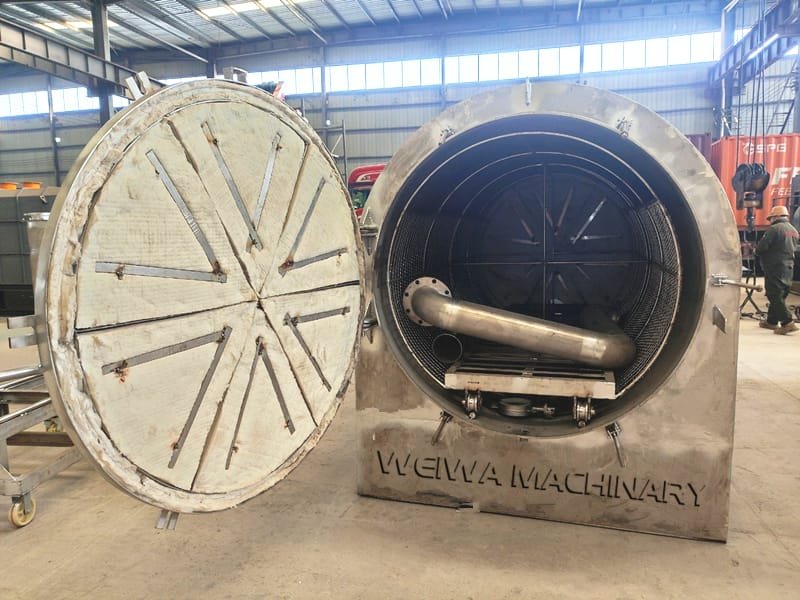
The unit shipped to Brazil is the Weiwa barrel-style horizontal carbonization furnace with rail-mounted chamber, indirect heating jacket, and a closed-loop gas purification unit. The barrel chamber is built from heat-resistant boiler steel with internal refractory lining. Carts roll in on rails, are pushed into the chamber, and remain stationary while the surrounding combustion jacket raises the temperature. Indirect heating means the flame never touches the wood, so the charcoal keeps a cleaner fracture and higher fixed-carbon ratio.
Pendant la carbonisation, volatile gases leave the wood and pass through a tar separator, a condensate collector, and a purification box. The recovered combustible gas is then pumped back into the main burner. Internal temperature stabilizes near 600 ° C. The operator does not need to purchase large volumes of diesel once the furnace reaches pyrolysis temperature, because the furnace partly fuels itself. For a Brazilian buyer facing volatile fuel prices, this self-sustaining loop is often the deciding factor when comparing a horizontal carbonization furnace with a conventional brick kiln.
The PLC panel was upgraded for this order. Brazilian operators wanted Portuguese labels, a pre-set recipe for eucalyptus, and alarm delays tolerant to voltage dips. Weiwa engineers added surge protection, tropical-grade insulation, and reinforced rollers able to carry saturated hardwood carts without deformation. A charcoal making machine for Brazil cannot be a copied version of a unit sent to a dry inland market; the humidity, the wood species, and the electrical grid all change the design margin.
Shipment Preparation and Container Loading at Weiwa Factory
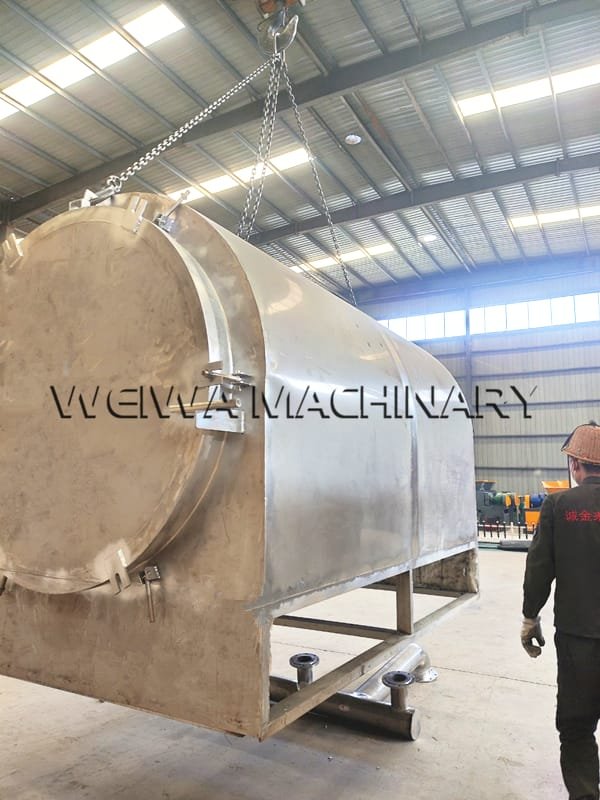
Before leaving the Weiwa factory in Zhengzhou, the horizontal carbonization furnace passed a 72-hour continuous dry run using local poplar and sawdust briquettes. We measured chamber temperature uniformity at nine probe points, recorded gas return pressure, and verified that tar did not block the recycling line. After the test, the furnace was cooled, disassembled into transport modules, and given two coats of anti-corrosion primer because ocean freight from China to Santos can expose steel to salt spray for up to 40 days.
Loading day started at 7:30 am. The rail base was strapped to the container floor with welded lugs and ratchet belts. The barrel chamber was wrapped in woven foam and fixed with wooden bracing. The gas purification tanks, PLC cabinet, and spare roller sets were packed in plywood crates with silica gel bags. A full set of drawings, Portuguese operation manual, and trial report were placed in a waterproof envelope taped inside the container door. The Brazilian client received the packing list, bill of lading, and HS code classification before the vessel departed.
Weiwa Machinery has shipped carbonization equipment to more than 40 pays, yet every Brazil order receives extra attention on customs vocabulary. Brazilian import inspectors frequently ask for NCM codes, origin certificates, and technical memos proving the charcoal making machine is not a combustion stove but a pyrolysis processor. Our export team prepared the Spanish-Portuguese bilingual commercial invoice and pre-aligned with the client’s Santos broker so the clearance window stayed under six working days.
On-Site Installation of the Horizontal Carbonization Furnace in Brazil
The container arrived at a semi-urban charcoal yard outside Curitiba. The site already had a roofed working area, a small tractor, and stacked eucalyptus offcuts delivered from a nearby furniture factory. Weiwa sent two technicians for nine days. Day one was foundation checking. The rail track had to be leveled within 3 mm over the full chamber length; otherwise the loading carts would drift and scrape the refractory lining.
Day two and three focused on placing the barrel chamber onto the rail cradle, connecting the indirect heating jacket, and mounting the purification towers. Day four wired the PLC, installed the pressure gauges, and tested the induced draft fan. Day five filled the combustion jacket with thermal oil substitute and ran a no-load heating cycle to 200 ° C. Day six was dedicated to safety: emergency stop, gas leak simulation, and cart push-pull drill with local workers.
By day seven the horizontal carbonization furnace stood complete. The Brazilian team was surprised by the low height. A vertical kiln would have needed a gantry crane; the horizontal unit allowed them to load carts with a hand-pushed trolley. Space saved at the front of the chamber became a covered wood stacking zone, which mattered because rain in the region can stall outdoor carbonization for days.
First Trial Run and Carbonization Data from Brazil
The first official trial used 320 kg of mixed eucalyptus offcut and broken furniture wood at 12–18 % moisture after one week of roofed drying. Carts were loaded to 80 % volume to allow gas movement. The burner lit at 8:14 am using diesel assistance. Chamber wall temperature crossed 300 °C at 10:02 am, 500 °C at 11:40 am, and stabilized at 590–610 °C from 12:30 pm to 5:00 pm.
Total trial cycle was 9 heures et 12 minutes including cool-down. Final charcoal weight was 104 kg. Apparent yield from raw woody biomass was 32.5 %, which is healthy for eucalyptus with this moisture level. Fixed carbon measured by the client’s local lab reached 71.8 %. Ash stayed under 3.1 %. Volatile matter dropped to 18.4 %. The charcoal broke with a metallic ring sound, had no white un-carbonized core, and showed the deep black-blue sheen Brazilian buyers associate with premium churrasco charcoal.
After the first cart unloaded, the gas return line kept the burner alive for 3 heures et 20 minutes without extra diesel. The client calculated that compared to their old earth pit method, the horizontal carbonization furnace cut wood consumption per bag of charcoal by roughly 38 % and removed the smoke plume that had previously drawn complaints from neighboring farms.
Charcoal Quality and Yield Observed During Brazilian Trial
Brazilian charcoal buyers grade mainly by size consistency, fixed carbon, and spark behavior. The trial batches were screened into three fractions: lumps above 40 MM, medium 20–40 mm, and fines below 20 MM. Lumps made up 61 % of output, medium 27 %, fines 12 %. For barbecue resellers, lump dominance is a pricing advantage. The client immediately bagged 40 kg and sent samples to two São Paulo distributors who confirmed the charcoal lit faster and sparked less than the kiln product they currently stocked.
One detail worth noting is how the horizontal carbonization furnace handled irregular shapes. Eucalyptus branches with side forks often break or jam in vertical retorts. In the rail cart, they simply lay in the basket, and indirect heat reached all surfaces because the cart itself was perforated and the gas circulated around it. The result was fewer rejected loads and less manual sorting after discharge.
When the same feedstock was later tested with sawmill sawdust briquettes mixed at 20 %, yield rose to 34.9 % and fixed carbon improved to 73.5 %. The charcoal making machine for Brazil therefore proved flexible: pure wood one day, wood-plus-briquette the next, without changing the chamber or the burner setup.
Gas Recycling and Fuel Savings in Tropical Conditions
Tropical humidity changes how a carbonization furnace behaves. Wet wood releases more vapor, dilutes the combustible gas, and can delay the self-sustaining phase. The Weiwa gas purification system on this unit used a larger condensate tank than the standard export model. Tar separation happened in two stages, and the cleaned gas entered a buffer tank that smoothed pressure swings when the fan cycled.
During the Brazil trial, the self-fueling phase began 2 heures et 48 minutes after ignition, 22 minutes earlier than the factory dry-run baseline in China. The reason was simple: eucalyptus resin content is higher than poplar, so initial volatiles were richer. Once the buffer tank pressurized, the main diesel nozzle was throttled to 30 %. Over the full 9-hour run, diesel consumption was 11.2 liters against 18.5 liters projected for a non-recycling furnace of the same size.
Smoke at the chimney stayed within the client’s municipal limit. The site manager noted that the only visible emission was heat shimmer; there was no black smoke even during the high-gas-release window between 9:30 et 10:30 am. For a charcoal making machine in Brazil, where rural fire regulations are tightening, this single feature often determines whether a license gets renewed.
Operator Training and Daily Maintenance in the Brazil Plant
Weiwa technicians spent the last two days training three local operators. The training did not focus on theory alone. Workers practiced loading a cart wrongly on purpose to feel how imbalance affects rail push force. They simulated a tar block warning and cleaned the separator under supervision. They learned to read the PLC trend line so they could tell the difference between normal volatile spike and dangerous over-pressure.
Daily maintenance for the horizontal carbonization furnace is intentionally light. Rollers need grease every 80 operating hours. Refractory lining inspection happens every 60 cycles. The gas purification tank drains condensate every shift. The PLC logs fault history, so the Brazilian owner can send a screenshot to Weiwa support and receive a diagnosis without a site visit. This remote capability matters because many charcoal yards in Brazil sit two hours from the nearest industrial city.
The client also received a Portuguese checklist for rainy-season operation: cover the wood staging area, pre-dry feedstock to under 20 %, keep the combustion jacket relief valve clear, and never seal the chamber door until the cart is fully inside. These small habits extended the interval between major services and kept the first month of commercial runs free of unplanned stops.
How a Charcoal Making Machine for Brazil Handles Local Feedstock?
Brazil is not a single forestry market. The south uses eucalyptus and pine. The center-west uses cerrado hardwood. The northeast mixes mango, cashew, and coconut shell. The horizontal carbonization furnace shipped by Weiwa was tuned for the southern eucalyptus profile, but the same chassis accepts recipe changes for coconut shell and bamboo.
In a follow-up video call, the client tested 150 kg of coconut shell halves sourced from a Bahia supplier. The shell needed a slower ramp because it reflects heat, but the rail cart still distributed temperature evenly. Final fixed carbon reached 75.2 %, and the client reported the shell charcoal sold at a 14 % premium over wood charcoal in the local shisha market. This confirms that a horizontal carbonization furnace is not locked to one feedstock; it is a platform that adapts through PLC recipes and cart loading patterns.
Bambou, which grows aggressively in parts of Minas Gerais, was discussed as the next trial. Bamboo carbonizes faster but can collapse if piled too tight. The Weiwa team advised a basket insert with vertical dividers, which the Brazilian workshop fabricated locally for under 80 dollars. That is the kind of practical adaptation a charcoal making machine for Brazil encourages: the core furnace stays standard, the accessories evolve with the crop.
Weiwa Machinery After-Sales Support for Brazil and Latin America
Shipping a horizontal carbonization furnace is only half the contract. Weiwa Machinery backs the equipment with Portuguese and Spanish documentation, spare-part kits stocked in China with air-shipping options, and remote PLC diagnostics. For the Brazil client, the first spare-part kit included an extra induced draft fan impeller, two pressure sensors, a roller bearing set, and a tar separator gasket pack. The kit fit inside a 60 cm plywood box and cleared customs as a separate low-value parcel to avoid holding up production.
Response time during the commissioning week was same-day via WhatsApp and email. After the technicians returned to China, the client sent a 20-second video of a door seal smoking slightly; the engineer identified it as a misaligned gasket within two hours and guided the local welder to fix it. This style of support is why many repeat buyers in Latin America stay with Weiwa when expanding from one charcoal making machine to a full line with dryer, broyeur, and briquette press.
Weiwa Machinery also issues a quarterly firmware update for the PLC panel. The Brazil unit received an update that added a Portuguese maintenance timer and a recipe lock so untrained staff cannot accidentally switch from eucalyptus mode to coconut shell mode mid-cycle. Small software touches like this reduce human error and protect the refractory life of the horizontal carbonization furnace.
Field Lessons for Buyers Evaluating a Horizontal Carbonization Furnace
Buyers often compare only price and hourly capacity. The Brazil case shows three less obvious variables. D'abord, rail height and cart design decide whether you need a crane. Deuxième, gas recycling efficiency decides your diesel bill for the next five years. Troisième, PLC tolerance to unstable voltage decides whether your furnace runs through a summer storm or trips every afternoon.
A charcoal making machine for Brazil should also arrive with the right paperwork. Request the NCM code in advance, ask for the Portuguese manual before shipment, and confirm the supplier has already exported to Latin America. Weiwa Machinery prepares these documents as part of the standard quote, not as a paid extra, because the company has handled enough Santos and Manaus entries to know where projects stall.
Enfin, judge the supplier by the trial report, not the brochure. The brochure says 600 ° C. The trial report says how long it took to reach 600 °C with your wood, at your moisture, in your humidity. The Brazil client now keeps the Weiwa trial sheet framed in the office. It records 32.5 % rendement, 71.8 % fixed carbon, 11.2 liters diesel, and zero black smoke. That sheet is what convinced his brother-in-law to order a second horizontal carbonization furnace three months later.
Why Weiwa Machinery Keeps Refining the Horizontal Model?
The horizontal carbonization furnace is not a new invention, but the way Weiwa packages it keeps improving. The Brazil unit gained tropical insulation, bigger condensate tank, surge-protected PLC, and Portuguese UI. The next unit for a Peruvian client will add a biomass pellet auxiliary burner. The unit after that, destined for a Ghana wood yard, will use a reinforced cart for green wood above 25 % humidité.
Weiwa Machinery treats each export not as a shipment but as a field laboratory. The Brazil trial proved that indirect heating plus gas recycling plus rail loading is not just cleaner, it is commercially faster. The client recovered the extra cost of the upgraded purification system in 7 months by selling premium lump charcoal at a higher grade and cutting diesel by a third.
For any producer weighing a charcoal making machine for Brazil against an old kiln or a cheap imported retort, the math now has a field number attached. 320 kg wood in, 104 kg charcoal out, 9 hours cycle, self-fueling after 2 heures 48 minutes, fixed carbon near 72 %. Those are not catalog claims. They are Santos-to-Curitiba reality.
À propos Machinerie Weiwa
Weiwa Machinery is a Chinese manufacturer of biomass carbonization and briquetting equipment, exporting horizontal carbonization furnaces, Machines de fabrication de charbon de bois, rotary kilns, sawdust dryers, and briquette presses to more than 40 pays. The company focuses on practical adaptations for tropical, high-humidity, and off-grid markets, with Portuguese and Spanish support for Latin America. Over two million customers worldwide have used Weiwa-produced machinery in forestry, agriculture, and solid-fuel processing lines.
Contact Weiwa Machinery for quotation, trial report, and shipment timeline:
- Mobile / WhatsApp: +8613838093177
- E-mail: info@cjlmachinegroup.com
If you are planning a charcoal making machine for Brazil project and want a horizontal carbonization furnace tuned to eucalyptus, coque de coco, or bamboo, the Weiwa engineering team can share the Brazil trial dataset, recommend chamber size, and prepare a container packing plan before you pay a deposit.


 Wechat

 +8615937143060
