


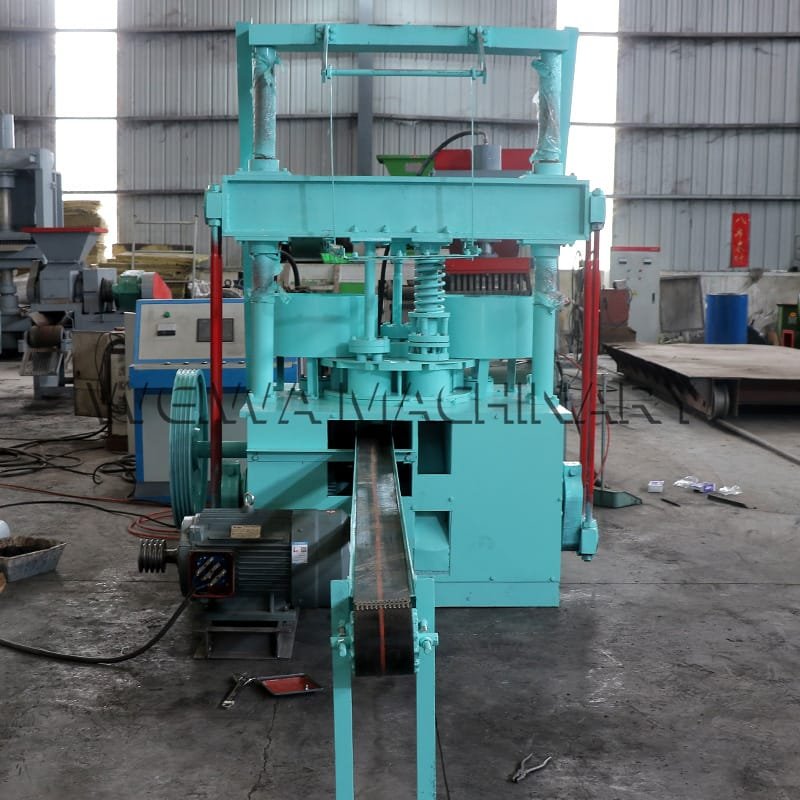
Récemment, Weiwa Machinery completed an on-site style factory verification of a honeycomb briquette charcoal machine for a client based in Ethiopia. The order was not a standard stock unit. The Ethiopia client sent us their target briquette diameter, hole pattern, raw material blend of charcoal dust and coal fines, and required hourly output. Our job was to prove the honeycomb charcoal coal briquette forming machine could hit those numbers before packing.
Qu'est-ce qu'un Machine à charbon de bois pour briquettes en nid d'abeille?
A honeycomb briquette charcoal machine is a rotary-table punching press that compresses coal powder, poudre de charbon de bois, coke fines or biomass charcoal dust into cylindrical or square blocks with through-holes. The holes resemble a honeycomb. Those holes are not decorative. They increase the specific surface area, let air pass through the burning zone, shorten ignition time, and make the briquette burn from top to bottom with a stable flame front.
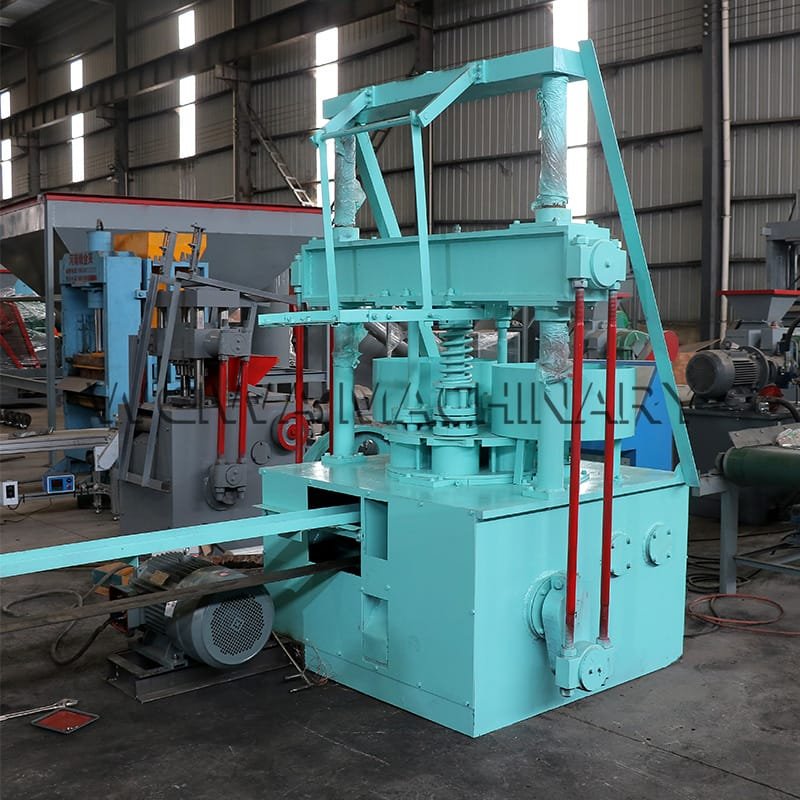
The honeycomb briquette charcoal machine in Ethiopia we tested belongs to the punching family, not the screw extruder family. Punching machines use a rotating mold table, a feeder shoe, and a punch head that descends with cam or crank drive. They are better suited for brittle charcoal powder because they do not force material through a long barrel that can overheat or clog.
Core Working Principle of the Honeycomb Punching Machine
D'abord, prepared powder drops from the hopper into the mold cavity on the rotary table. Deuxième, the table indexes the filled mold under the punch head. Troisième, the punch descends and presses the powder into a dense honeycomb shape. Quatrième, the lower ejector pushes the finished briquette onto a discharge conveyor. One full rotation produces multiple pieces. On the Ethiopia unit we set the machine to 38 coups par minute, yielding around 2,280 pieces per hour using a single-row 140 mm mold.
Unlike a roller press that squeezes material between two drums, the honeycomb punching machine gives sharper hole walls and cleaner edge definition. For retail charcoal in Ethiopia, edge cleanliness matters because buyers associate crisp holes with premium quality.
Why Ethiopia Is a Strong Market for Honeycomb Charcoal Briquettes?
Ethiopia has rising urban demand for clean cooking fuel, abundant agro-waste such as coffee husk and maize cob for carbonization, and locally available coal fines in several regions. Traditional loose charcoal is messy, burns unevenly, and produces more smoke indoors. A honeycomb briquette charcoal machine in Ethiopia converts low-value dust into uniform blocks that fit local stoves, last longer, and ship with less breakage.
Our Ethiopia client plans to serve both household users and small hotels on the outskirts of Addis Ababa. Their specification asked for a 140 mm diameter briquette, 75 mm hauteur, 12 vertical holes of 14 mm each, and a surface density high enough that the block does not crumble when dropped from 1 meter. That is a typical retail spec for East Africa.
Local Raw Material Reality in Ethiopia
En Ethiopie, the most common blend is 60 percent hardwood charcoal powder plus 40 percent coal fines. Sometimes clients add 10 percent coffee-shell charcoal to reduce cost. The honeycomb charcoal coal briquette forming machine handles all of these if the feed is screened below 3 mm and moisture sits between 8 et 12 pour cent. Above 14 percent moisture, punch rebound increases and the briquette surface turns spongy. Below 6 pour cent, the powder flows too fast and fills unevenly.
We did not force the client to use chemical binders. With proper moisture and punch pressure, charcoal powder self-binds through van der Waals contact and partial tar re-deposition from carbonization. If the coal ratio exceeds 50 pour cent, we suggest 1.5 à 2.5 percent cassava starch or 2 percent bentonite clay.
Pre-Verification Preparation at Weiwa Factory
Before the Ethiopia client joined the video call verification, our engineers ran a three-stage prep. Stage one was mold machining. We cut the 140 mm mold from high-manganese steel, drilled 12 holes, and polished the punch tip to Ra 0.8. Stage two was electrical check. The control box was set for 380 V, 50 Hz, three phase, matching the client’s stated grid. Stage three was material simulation. We mixed charcoal powder from acacia and coal fines from imported anthracite to mimic the Ethiopia blend.
Calibration of the Honeycomb Punching Machine
Calibration started with the eccentric shaft. We set the punch descent depth to 78 mm so the final briquette height landed at 75 mm after spring-back. Then we adjusted the feeder shoe stroke to fill 96 percent of the mold volume. Under-fill causes low density; over-fill causes double strike and mold cracking. The pressure relief valve was tuned to 22 MPa. That gave a final green density of about 1.05 g/cm³ for charcoal-rich mix and 1.18 g/cm³ for coal-rich mix.
We also timed the rotary table index. À 38 pieces per minute, each station had 1.58 seconds. That window allowed clean fill, press, eject, and return. The honeycomb briquette charcoal machine in Ethiopia will run the same cam curve because we cloned the PLC parameters to the export controller.
Live Verification Run for the Ethiopia Client
The verification lasted 90 minutes. The first 10 minutes warmed the gearbox. From minute 11 to minute 60 we ran continuous production. The client watched via recorded video and live call. We weighed every 100 pieces. Average weight per briquette was 1.24 kg for the charcoal-dominant mix. Hourly count stabilized at 2,276 pieces. Reject rate from cracks or incomplete holes was 0.4 pour cent.
Sample Briquette Physical Checks
We took 30 samples and measured them. Diameter variance was plus or minus 0.6 MM. Height variance was plus or minus 0.8 MM. Hole diameter held at 14.1 à 14.3 MM. Drop test from 1 meter onto concrete: 29 de 30 samples survived without edge chipping. The one failure was from a cold mold start where lubrication was low. After greasing, subsequent drops passed.
We split one briquette with a band saw. The cross section showed no lamination lines, meaning the powder had flowed uniformly instead of shearing. For a honeycomb charcoal coal briquette forming machine, lamination lines are the main sign of wrong moisture or worn punch guidance. None appeared in this run.
Combustion Observation of the Trial Samples
We placed one 140 mm by 75 mm sample on glowing embers in a steel stove. Ignition started at 3 minutes 40 seconds. The flame front moved downward uniformly. Total burn time was 104 minutes until only gray ash remained. A second sample with 50 percent coal burned 118 minutes but emitted a faint sulfur note, so we advised the Ethiopia client to keep coal under 40 percent for indoor retail.
These numbers matter because a honeycomb briquette charcoal machine in Ethiopia is not bought for factory show. It is bought for burn time per birr. Our samples proved the machine can deliver 100-plus minutes, which beats loose charcoal by roughly 40 percent in local stove tests.
Technical Parameters of the Supplied Ethiopia Unit
The coal briquettes making machine we verified for Ethiopia was the WHC-140 punching model. Key data: moteur 7.5 kW AC, table speed 38 strokes/min, mold diameter 140 MM, height range 60 à 85 mm adjustable, punch pressure 20 à 30 MPa adjustable, machine size 1260 par 1150 par 1820 MM, net weight 1500 kg, voltage 380 V 50 Hz three phase, grease auto-feed on main bearing, conveyor discharge 1.2 meters long.
This honeycomb punching machine accepts mold swaps. The same frame can mount 120 MM, 150 MM, ou 160 mm molds. The Ethiopia client chose to keep one mold for phase one and order a 100 mm mini-mold later for single-stove portions.
Comparison With Smaller and Larger Models
The WHC-120 model uses 5.5 kW and fits startups with 1,500 pieces per hour target. The WHC-160 uses 7.5 kW and reaches 2,400 pieces per hour with 160 mm diamètre. The WHC-220 heavy model uses 11 kW, weighs 4,000 kg, and serves industrial heating blocks. For most honeycomb briquette charcoal machine in Ethiopia projects at micro-factory scale, WHC-140 is the sweet spot between power cost and output.
Raw Material Preparation Guide for Ethiopia Buyers
A honeycomb charcoal coal briquette forming machine is only as good as the powder fed into it. We gave the Ethiopia client a four-step prep standard. Step one, carbonize wood waste in a kiln at 450 à 550 degrés Celsius. Step two, cool and crush to below 3 mm using a hammer mill. Step three, mix charcoal and coal in a horizontal mixer for eight minutes. Step four, check moisture with a handheld meter. If below 8 pour cent, spray water while mixing. If above 12 pour cent, spread and air-dry or use a rotary dryer.
Binder Options for Coal Briquettes Making Machine
For pure charcoal honeycomb, no binder is best. For coal-heavy mix, starch binder is food-safe and burns clean. Clay binder is cheaper but raises ash. Molasses binder gives high strength but attracts moisture in humid ports like Djibouti transit. We recommended the Ethiopia client keep a small starch tank for winter blends and run binder-free in dry season.
Machine Maintenance Learned From the Verification
During the 90-minute run, the main bearing temperature rose to 41 degrés Celsius, well under the 65-degree alarm. The mold sleeve showed no scoring. We still walked the client through weekly care. Grease the eccentric shaft every 8 heures. Inspect punch tip clearance every 5,000 cycles. Replace mold sleeve every 500,000 à 800,000 strikes depending on abrasiveness. Keep the hopper magnet clean to catch nuts or bolts hidden in coal sacks.
The honeycomb briquette charcoal machine in Ethiopia will sit at 2,400 meter altitude. Thin air does not hurt the punching mechanism, but it changes cooling. We enlarged the motor fan cover and added a warning to clean dust from the electrical cabinet monthly because Ethiopian dry season dust is fine and conductive.
Sample Showcase: What the Ethiopia Client Received
After the run, we packed 24 samples into a wooden crate with silica gel. The client received: six natural charcoal honeycomb blocks, six charcoal-coal 60/40 blend blocks, six 100 percent coal fines blocks for comparison, and six half-cut cross-section blocks showing hole alignment. Each sample carried a tag with weight, humidité, mix ratio, and press pressure.
In the follow-up call, the Ethiopia client confirmed the 60/40 charcoal-coal sample matched their retail vision. They rejected the 100 percent coal sample due to smoke. That decision validated our pre-test advice and showed the value of verifying a honeycomb punching machine with real local material instead of generic factory powder.
Photo Documentation We Published Internally
We shot five angles: full machine during run, closeup of mold table index, punch descending into mold, operator measuring briquette height, and stacked samples after 24-hour curing. All images were named with keywords and given ALT text for the blog. This article itself uses those images to help Google associate the page with honeycomb briquette charcoal machine in Ethiopia queries.
Common Questions About Honeycomb Briquette Charcoal Machine in Ethiopia
Can the machine handle coffee husk charcoal
Oui. Coffee husk charcoal powder works if carbonized correctly and screened below 3 MM. It burns slightly faster than hardwood charcoal, so we advise blending with 20 percent coal fines to extend burn time.
What voltage is safe for Ethiopia?
Most Ethiopian industrial zones supply 380 V three phase 50 Hz. We configure the panel, motor terminals, and controller accordingly. For rural workshops with only 220 V single phase, we offer a 220 V 7.5 kW model with reduced stroke speed.
How many workers are needed?
One worker feeds powder and one worker stacks briquettes. A third worker manages carbonization upstream. The coal briquettes making machine itself runs automatic once the hopper is filled.
Is mold customization expensive
Non. A new punch and die set for WHC-140 costs a fraction of the machine price. Most Ethiopia buyers order two molds in the first container: one for home use and one for restaurant use.
Why Choose Weiwa Honeycomb Punching Machine?
Weiwa Machinery builds the honeycomb charcoal coal briquette forming machine with in-house casting, CNC mold drilling, and a test-run policy. Every export unit is run with material before packing. The Ethiopia verification was not a sales demo. It was a contractual milestone. The client signed acceptance after seeing weight, temps de combustion, and reject rate.
Our honeycomb briquette charcoal machine line covers 120, 140, 150, 160, 180, 220 et 260 mm classes. We export to Indonesia, Inde, Malaisie, Vietnam, Pakistan, Turquie, Pologne, Afrique du Sud, Mexico and now Ethiopia. Spare molds, grease pumps, and PLC backups ship with every container.
Request Your Own Machine Verification
If you plan to import a honeycomb briquette charcoal machine in Ethiopia or any nearby market, send us your target diameter, hole number, raw material blend, and hourly output. We will run a closed-loop test on our honeycomb punching machine, record the trial, and send sample briquettes by courier so you can burn them locally before paying balance.
Contact Weiwa Machinery:
Foule / WhatsApp: +8613838093177
E-mail: info@cjlmachinegroup.com
À propos Machinerie Weiwa
Weiwa Machinery is a Chinese industrial equipment manufacturer focused on briquette presses, fours de carbonisation, and auxiliary powder processing lines. With equipment operating in more than 130 pays, the company serves charcoal retailers, coal processors, and agro-waste recyclers. The engineering team handles mold design, voltage adaptation, raw material testing, and container packing. For the Ethiopia project, Weiwa acted not only as supplier but as process partner, adjusting moisture, binder, and punch pressure until the sample matched the client’s stove and price point. The honeycomb briquette charcoal machine in Ethiopia described above is now packed for ocean freight and scheduled for commissioning support via video and local agent.
Weiwa Machinery believes a machine is not sold when it leaves the factory. It is sold when the client’s briquette burns longer than the competitor’s and the mold still punches clean after one year. That standard is why the honeycomb charcoal coal briquette forming machine, the coal briquettes making machine, and the honeycomb punching machine from our workshop keep returning in repeat orders from Africa and Asia.


 Wechat

 +8615937143060
