


In today’s global pursuit of cleaner, affordable energy solutions, honeycomb briquettes have emerged as a practical answer for households and small industries seeking alternatives to traditional firewood or fossil fuels. À Weiwa Machinery, we specialize in manufacturing high-performance honeycomb briquettes machines designed to meet diverse regional needs, including those of our valued client in Cameroon. Récemment, we conducted an on-site trial of our honeycomb briquette charcoal machine in Cameroon, demonstrating not only the machine’s robust capabilities but also its potential to transform local fuel production.
Understanding Honeycomb Briquettes Machine Technologie
To appreciate the value of our honeycomb briquettes machine, it helps to first understand what makes these briquettes unique. Unlike loose charcoal or wood chips, honeycomb briquettes are compacted blocks with a distinct hexagonal or circular “honeycomb” pattern of holes running through their center. This design is not just aesthetic—it serves critical functional purposes. The hollow structure increases surface area, allowing for more efficient combustion and better airflow, which results in faster ignition, temps de combustion plus long, and reduced smoke emissions compared to solid fuel blocks.
The core of producing such briquettes lies in the honeycomb briquette mold making machine and honeycomb punching machine integrated into our systems. These components work in tandem: matière première (typically charcoal dust, sciure, résidus agricoles, or coal powder mixed with a binder) est introduit dans la machine, compressed under high pressure by the mold, and then punched to form the characteristic porous structure. The honey comb machine ensures uniformity in size and shape, which is vital for consistent burning performance and ease of packaging or stacking.
À Weiwa Machinery, our honeycomb briquettes machines are engineered with precision to handle varying raw material consistencies, a crucial feature for clients like those in Cameroon where biomass resources may differ by region. We prioritize durability, using high-grade steel for molds and punches to withstand prolonged use, and incorporate user-friendly controls to simplify operation for both skilled technicians and new users.
Why Cameroon Our Focus for Sustainable Fuel Solutions?
Cameroon, with its rich biodiversity and abundant agricultural and forestry waste, holds immense potential for honeycomb briquette production. Cependant, many communities still rely on inefficient, carbon-intensive fuels, contributing to deforestation and indoor air pollution. Our decision to conduct a trial of the honeycomb briquette charcoal machine in Cameroon stems from a commitment to supporting local entrepreneurs and environmental goals. By providing accessible, équipement fiable, we aim to empower Cameroonian businesses to convert waste into valuable fuel, creating economic opportunities while reducing ecological harm.
During our pre-trial discussions with the client, we learned of their need for a machine that could process locally sourced charcoal dust and rice husk blends—a common residue in Cameroonian agro-processing. This feedback guided our setup, ensuring the honeycomb briquettes machine was calibrated to handle this specific mix, a testament to our flexible approach to customer-centric engineering.
Behind the Scenes of the Live Trial in Cameroon
The trial took place at our client’s facility in Yaoundé, where we assembled the honeycomb briquette machine with support from our local technical team. From unboxing to full operation, the process was transparent, allowing the client to observe every stage and ask questions—a key part of our “learn-by-doing” philosophy.
Preparing Raw Materials for Optimal Results
Before powering up the honeycomb briquette mold making machine, we focused on raw material preparation. The client had collected charcoal dust from nearby grilling stations and rice husks from rice mills, both materials with high lignin content ideal for binding. We advised on sieving to remove large particles and adjusting moisture levels to around 10-12%, as excess moisture can hinder compression. Using a simple mixer, we blended the dust and husks with a natural starch-based binder, ensuring even distribution without clumping. This step highlighted a common misconception: many assume briquette quality depends solely on the machine, but proper material prep is equally critical.
Operating the Honeycomb Punching Machine and Mold System
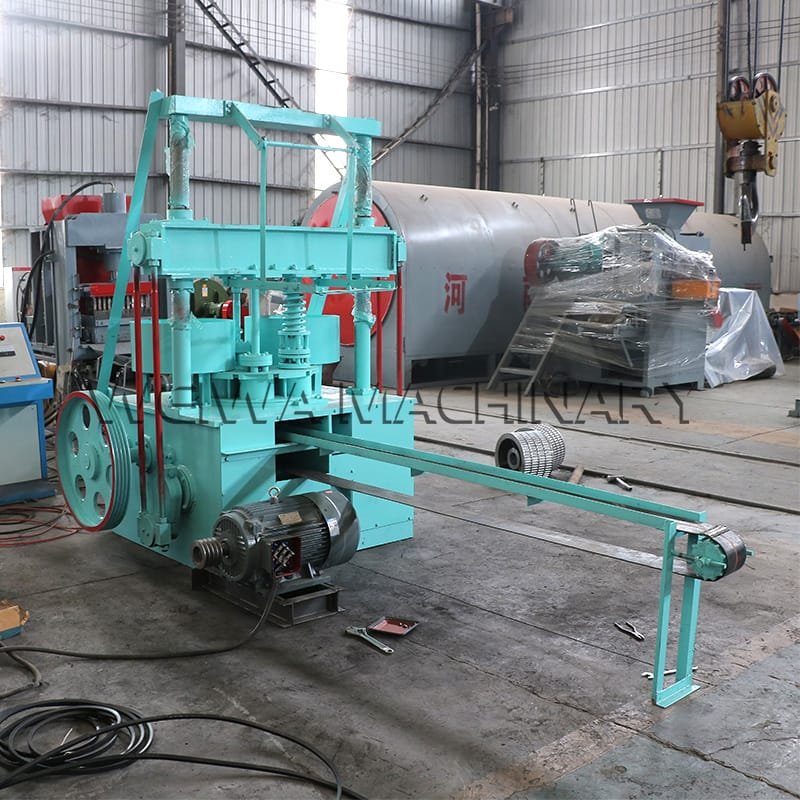
With materials ready, we initiated the honeycomb briquettes machine. The motor hummed to life, feeding the mixture into the compression chamber. The mold, crafted to produce standard 100mm diameter briquettes with 12mm holes, pressed the material into dense logs. Suivant, the honeycomb punching machine activated, driving a piston through the logs to create the signature porous core. Watching the first briquette emerge was a milestone—it was uniform, firm, and free of cracks, a sign of balanced pressure and material compatibility.
Our engineers monitored parameters like compression force and cycle time, making minor adjustments to align with the client’s desired output speed (we targeted 300 briquettes par heure). The honey comb machine’s automated feeder ensured continuous operation, minimizing downtime—a feature our client noted as vital for scaling production.
Showcasing the Samples Produced in Cameroon
The highlight of the trial was examining the finished honeycomb briquettes. We produced three batches using slightly varied material ratios to demonstrate versatility:
- Batch 1: 80% poussière de charbon de bois + 20% cosse de riz – These briquettes were dense and dark, with a smooth outer surface. When lit, they ignited quickly, burning steadily for over 90 minutes with minimal smoke—ideal for urban households using small stoves.
- Batch 2: 60% poussière de charbon de bois + 40% cosse de riz – Slightly lighter in color, these had a rougher texture but burned longer (110 minutes) due to increased husk content, which enhanced porosity. They performed well in open-air cooking, common in rural Cameroonian settings.
- Batch 3: 70% poussière de charbon de bois + 25% cosse de riz + 5% sciure – The addition of sawdust improved binding, resulting in briquettes that held shape even when dropped. Their burn time was moderate (95 minutes), but they excelled in low-draft stoves, a challenge in areas with limited ventilation.
Our client tested the samples in their own stoves, reporting that all batches outperformed the loose charcoal they previously used. “The honeycomb shape makes them easier to stack, and they don’t crumble like homemade briquettes,” they shared. This feedback reinforced our belief in the machine’s adaptability to real-world usage scenarios.
The Science That Makes Honeycomb Briquettes Efficient
Beyond the trial, understanding the engineering principles behind our honeycomb briquettes machine deepens appreciation for its efficiency. The mold’s design leverages principles of particle rearrangement: under high pressure, fine particles interlock tightly, creating a solid matrix. The punching action introduces controlled voids, which act as channels for oxygen during combustion. This dual-phase process—compression followed by perforation—is what sets honeycomb briquettes apart from other solid fuels.
De plus, the honeycomb briquette charcoal machine in Cameroon was equipped with a heat-treatment module (optional for some models) to enhance carbonization of the outer layer, further reducing volatile matter and improving calorific value. This aligns with global trends toward low-emission fuels, making the technology relevant not just in Cameroon but in markets worldwide prioritizing sustainability.
Why Choose Weiwa Machinery for Your Honeycomb Briquettes Needs?
Our trial in Cameroon was more than a demonstration; it was a collaboration. We listened to our client’s challenges, adapted our honeycomb briquette mold making machine to their materials, and delivered tangible results. Voici ce qui nous distingue:
- Customization Expertise: We tailor machines to local raw materials, whether it’s Cameroonian rice husks or Indonesian coconut shells.
- Durability and Support: Our machines come with a 12-month warranty and lifetime technical assistance, including remote troubleshooting and spare parts supply.
- Sustainability Focus: We design equipment to maximize resource efficiency, helping clients reduce waste and carbon footprints.
For entrepreneurs in Cameroon and beyond, investing in a honeycomb punching machine from Weiwa Machinery means gaining a tool that’s not just a machine, but a gateway to sustainable business growth.
À propos Machinerie Weiwa
Fondée en 1990, Weiwa Machinery has grown into a leading manufacturer of biomass and charcoal processing equipment, with a presence in over 30 pays. Specializing in honeycomb briquettes machines, we combine innovative engineering with a customer-first approach. Our R&D team continuously refines designs to meet evolving market needs, while our production facilities adhere to ISO standards for quality assurance. Whether you’re a startup in Cameroon or an established enterprise elsewhere, Weiwa Machinery is committed to empowering your journey toward cleaner, profitable fuel solutions.
Explore our range of honeycomb briquettes machines today and join the movement toward a greener future—one briquette at a time.


 Wechat

 +8615937143060
