


Qu'est-ce qu'un Machine d'extrudeuse de charbon de bois Also Called Coal Rod Machine?
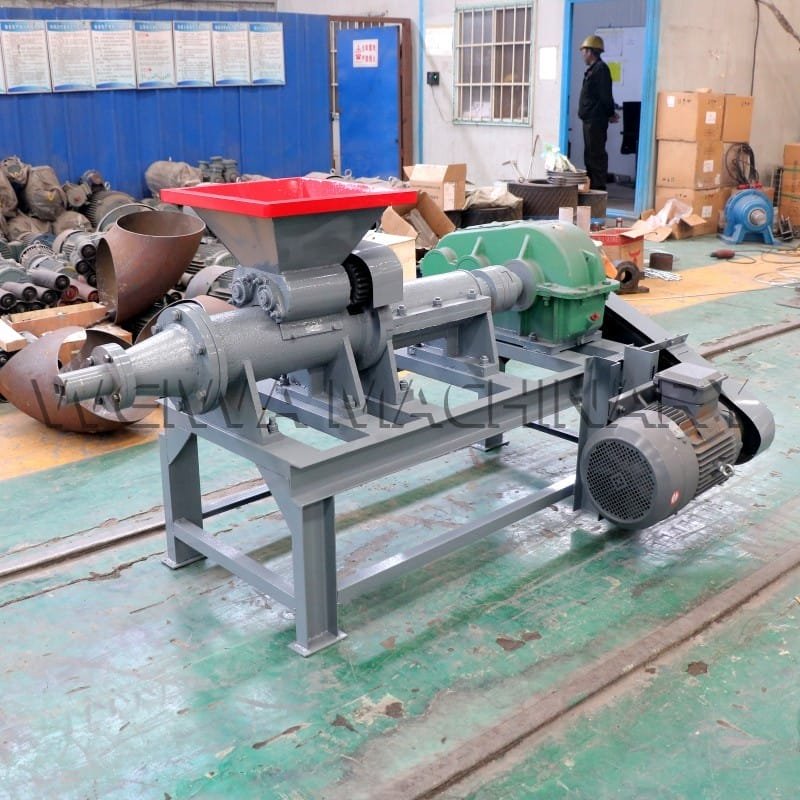
UN machine à extrudeuse au charbon de bois, widely known in the industry as a machine à tige de charbon, machine à briquettes de charbon de bois, or screw-type briquetting press, is a mechanical device designed to compress finely pulverized charcoal powder, poussière de charbon, poudre de charbon de coco, poudre de charbon de riz enveloppe, or biomass carbon powder into dense, uniformly shaped rods or briquettes under high pressure. The extruded “coal rod” can be cylindrical, carré, hexagonal, hollow, or solid depending on the mold installed. These rods are subsequently carbonized or used directly as high-efficiency fuel. Le machine à fabriquer du charbon de bois family typically includes this extruder as the core molding unit.
Key Components of Weiwa Charcoal Extruder Machine
The Weiwa machine à extrudeuse au charbon de bois is engineered with a heavy-duty carbon steel base and frame certified to national standards. It features a 100 percent copper coil electric motor, a high-quality hardened gearbox for torque conversion, a wear-resistant high manganese alloy screw propeller, and interchangeable #45 steel dies. The motor drives the triangular belt which transfers power to the gearbox; the gearbox output shaft connects via a floating coupling to the propulsion shaft. As the screw rotates, material is compressed and heated by friction, then forced through the forming die head to produce high-density coal rods.
How Does a Charcoal Extruder Machine?
Étape 1 – Raw Material Preparation
Before entering the machine à briquettes de charbon de bois, raw materials such as wood charcoal, fusain à coco, or coal powder must be crushed to less than 3–5 mm using a charcoal crusher. Proper particle size ensures even extrusion and minimizes nozzle blockage.
Étape 2 – Mixing with Binder
The ground powder is conveyed to a wheel grinding mixer where it is blended with water and a small percentage of natural binder—commonly starch—to reach an optimal moisture content of approximately 8 à 12 pour cent. Uniform mixing is critical for rod strength and surface smoothness.
Étape 3 – Screw Extrusion and Molding
Mixed material feeds into the hopper of the machine à extrudeuse au charbon de bois. Inside the barrel, the rotating screw propeller pushes material forward while the tapering chamber creates progressively higher pressure. Under this intense compression and frictional heat, the material plasticizes and is squeezed through the selected mold—round, hexagonal, or square—forming continuous rods.
Étape 4 – Cutting and Drying
An automatic or manual cutter slices the extruded rods to the desired length. The freshly formed rods then pass through a mesh belt dryer or are naturally air-dried until moisture is sufficiently reduced, after which they can be packaged or further carbonized into finished charcoal briquettes.
Complete Charcoal Briquette Production Line Configuration
A commercial machine à fabriquer du charbon de bois line usually consists of four to five integrated units. D'abord, un broyeur à charbon de bois pulverizes raw charred biomass or coal into fine powder. Deuxième, un wheel mixer or double-shaft mixer homogenizes the powder with binder. Third comes the core machine à extrudeuse au charbon de bois (machine à tige de charbon) which shapes the material. Quatrième, un belt conveyor transfers extruded rods to a séchoir—either batch-type or continuous tunnel dryer. Enfin, a weighing and packing machine prepares finished briquettes for the market. Weiwa Machinery can customize layout drawings based on your workshop dimensions, target hourly capacity (from 200 kg/h up to 2000 kg / h), and local power specifications (220V/380V/415V/440V, 50Hz or 60Hz).
Why the Philippines Is a Strategic Market for Charcoal Extruder Machine and Coal Rod Machine?
Le Philippines is among the fastest-growing markets for machine d'extrudeuse de charbon de bois aux Philippines investments thanks to several converging factors. Abundant agricultural residues—particularly coconut shells from Luzon and Mindanao, rice husks from Central Luzon, and sawdust from furniture hubs—provide low-cost feedstock for briquette production. Rising LPG and firewood prices push households, restaurants, and small factories to seek affordable, longer-burning alternatives such as densified charcoal briquettes produced by a coal rod machine in Philippines. En plus, the Philippine government’s increasing emphasis on renewable energy, waste-to-energy initiatives, and reduced deforestation aligns perfectly with the circular-economy model enabled by a machine à briquettes de charbon de bois that recycles carbon dust into salable fuel. Entrepreneurs in Metro Manila, Cebu, and Davao are already establishing briquette micro-enterprises that export to neighboring ASEAN markets, creating a multiplier effect for demand in Machines de fabrication de charbon de bois.
Philippine BBQ and Hospitality Industry Demand
The iconic Filipino barbecue culture—isaw, pork barbecue, chicken inato—consumes vast quantities of charcoal. Uniform, sans fumée, high-calorific briquettes made by a properly tuned machine à extrudeuse au charbon de bois command premium pricing versus irregular traditional lump charcoal. Many Philippine buyers who initially import one machine à tige de charbon later scale up to a full automatic machine à briquettes de charbon de bois line, which is exactly the trajectory of the client we recently shipped to.
Shipment Spotlight Charcoal Extruder Machine to Philippines
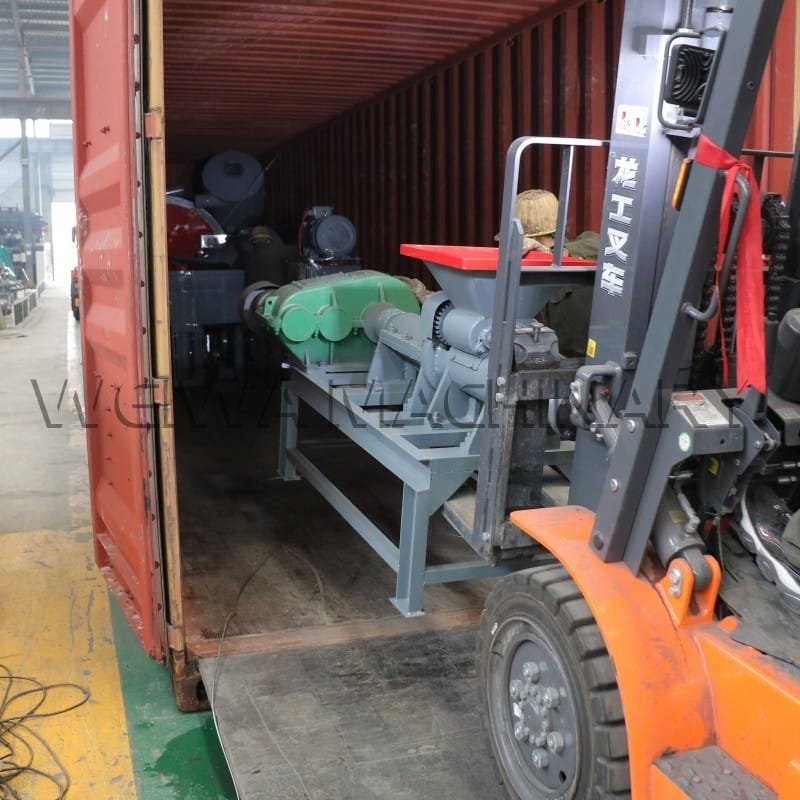
Prior to dispatch, our Philippine client visited the Weiwa factory for a live demonstration of the machine à extrudeuse au charbon de bois with interchangeable hexagonal and cylindrical molds. They verified extrusion pressure, cutter accuracy, and the finish quality of trial briquettes made from locally sourced coconut shell charcoal powder. Satisfied with performance and build quality, they confirmed the order which included the crusher, mixer, machine à briquettes de charbon de bois (extrudeuse) with auto-cutter, séchoir, and spare propellers. Each unit was wrapped in waterproof plastic film, then securely loaded into fumigation-certified wooden cases with shock-absorbing braces. The container departed for the Port of Manila with full export documentation and English-operation manuals. Our after-sales engineer remains on-call via WhatsApp for remote commissioning guidance and on-site training if required.
Why Choose Weiwa Machinery for Your Charcoal Making Machine Project?
Weiwa Machinery apporte plus que 30 years of industrial experience in designing, fabrication, and exporting complete machines à briquettes de charbon de bois, fours de carbonisation, and related biomass equipment. Advantages that set us apart include:
Conception personnalisée & Planification de la mise en page – Our engineering team provides CAD workshop layout drawings free of charge so you can prepare your site before equipment arrival.
Durable Wear Parts – High manganese alloy screws and quenched steel dies extend service intervals even under continuous three-shift operation typical of busy Philippine briquette plants.
Équipe après-vente professionnelle – Multilingual support staff offer video troubleshooting, spare parts express shipping, and optional on-site installation for qualified bulk orders.
Proven Global Track Record – Weiwa machines operate in over 130 countries including Indonesia, Inde, Malaisie, Vietnam, Thaïlande, Pakistan, Turquie, Egypte, Tanzanie, and of course the Philippines. More than two million end-users worldwide rely on fuel shaped by Weiwa machines d'extrudeuse de charbon de bois.
Get a Quote for Charcoal Extruder Machine or Coal Rod Machine
If you are evaluating a machine à fabriquer du charbon de bois, coal rod machine in Philippines, or a complete machine à briquettes de charbon de bois ligne de production, contact Weiwa Machinery today for a tailored proposal including technical datasheets, layout drawing, and FOB/CIF quotation.
Contact Weiwa Machinery:
Foule / WhatsApp: +86 138 3809 3177
E-mail: info@cjlmachinegroup.com
Product Page: Charcoal Extrude Machine – Weiwa Machinery
Welcome to visit our factory! We look forward to supporting your sustainable fuel business.


 Wechat

 +8615937143060
