


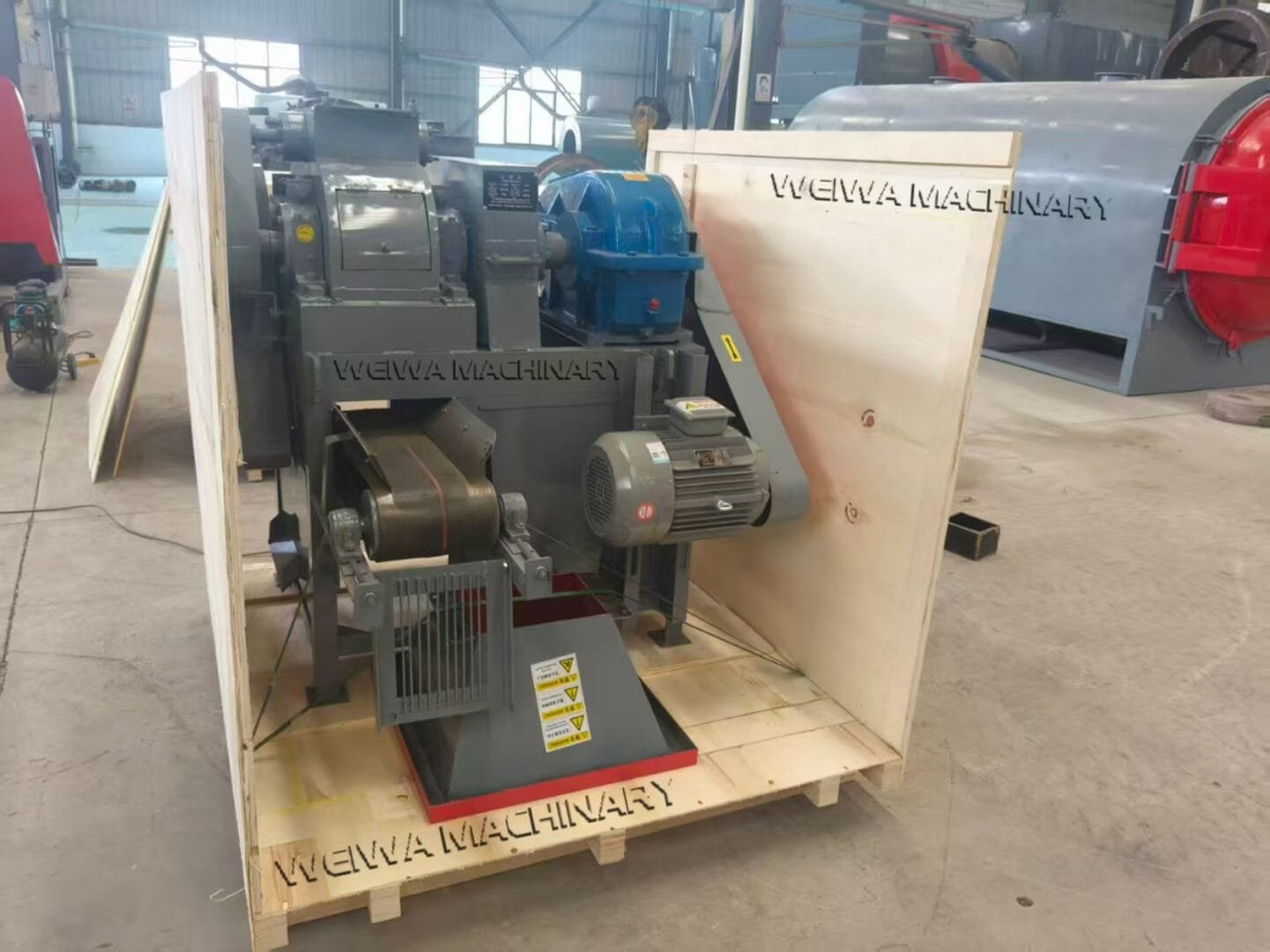
Inside the Weiwa Factory Shipment for Kenya
The machine leaving our factory was a roller-type charcoal briquette machine with a 290 mm roller diameter, forced screw feeder, gearbox drive, and hydraulic pressure adjustment. The Kenyan client asked for 30 mm ball size, which is practical for portable stoves and quick-ignition BBQ use. We did not ship only the press. The order included a hammer crusher, twin-shaft mixer, buffer silo, mesh belt dryer, spare roller skin, scraper blades, and a control cabinet labeled in English.
Before packing, the ball charcoal briquettes machine ran for two hours under load using simulated charcoal powder mixed with cassava starch binder. Our technicians checked roller alignment, bearing temperature, gap consistency, and discharge shape. Any ball with a tail, crack, or soft center was a rejection signal. Only after the sample balls passed compressive checks did we dismantle the movable parts, grease the open shafts, wrap the rollers in anti-rust paper, and secure the main frame on wooden blocks inside the container.
We chose nude packing for the main frame and wooden case packing for the electrical cabinet, rollers, and small parts. This balances ocean freight cost with damage protection. The Kenya client will receive the machine at Mombasa, clear customs, and truck it to their site. Our team already shared the foundation drawing, civil works notes, and utility requirements so the buyer’s local contractor can prepare the shed before the container arrives.
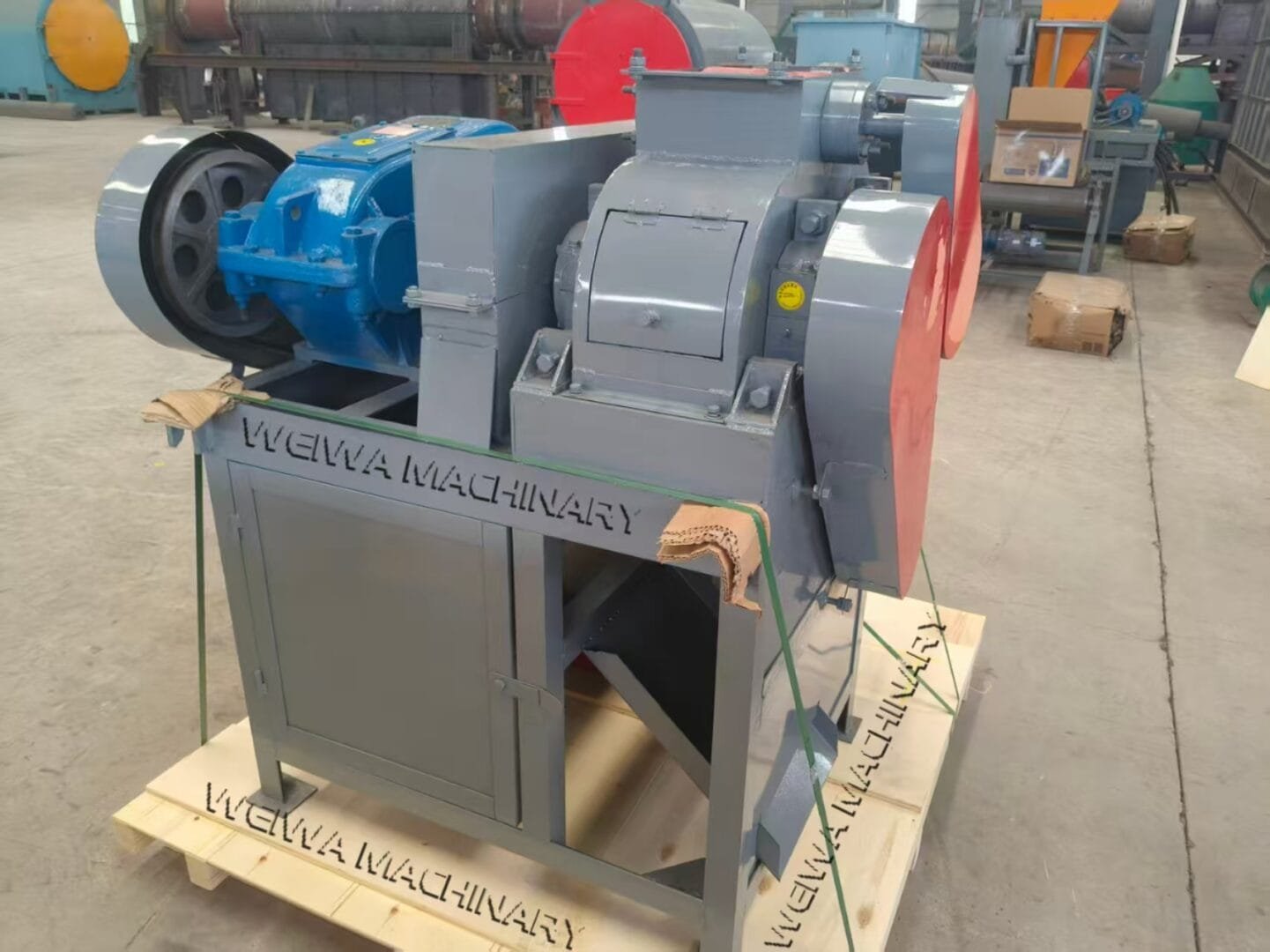
What the Charcoal Ball Press Machine Actually Does?
A charcoal ball press machine is a double-roller compactor. Charcoal powder under 3 mm feeds from a hopper into a forced agitator, then drops between two counter-rotating rollers. Each roller carries half-sphere mold pockets. When the rollers close, the powder is squeezed at high pressure into a complete ball. Pressure comes from hydraulic cylinders or spring assemblies. The ball exits at the bottom, drops to a conveyor, and moves to the drying section.
Roller Pressure and Mold Shapes
The roller is the heart of the ball charcoal briquettes machine. We manufacture roller skins from high manganese steel or alloy forged steel. Pocket shape decides the final product. Sphere, oval, pillow, مربع, and bread shapes are all possible. For Kenya we recommended sphere balls because they roll evenly in packaging, stack better in baskets, and ignite from all sides. Roller changeover takes a few hours, so one charcoal briquette machine can serve multiple product lines if the buyer swaps sleeves.
Pressure setting is not fixed. Making charcoal balls with starch binder needs lower pressure than dry charcoal fines without binder. Our control panel lets the operator adjust hydraulic pressure, roller speed, and feeder frequency. This matters in Kenya where humidity changes between coastal Mombasa and upcountry Nairobi can shift the moisture of charcoal dust by several percent.
Complete Line for Making Charcoal Balls in Kenya
A single charcoal ball press machine cannot run a business alone. Commercial making of charcoal balls in Kenya needs upstream and downstream support. The full line we recommend starts with crushing and ends with cooled, screened, packable balls.
Crushing Mixing Pressing Drying
Lump charcoal or oversized briquette reject is first crushed below 3 ل 5 mm in a hammer mill. Uniform size prevents weak spots in the ball. The powder then enters a twin-shaft mixer with measured water and binder. Starch, دبس السكر, bentonite, or gum arabic can be used. Kenya buyers often test cassava starch because it is locally available and food-safe.
After conditioning to 8 ل 12 percent moisture, the mix sits in a silo for five to ten minutes to let binder activate. Then the ball charcoal briquettes machine presses it. Fresh balls still carry bound water, so they go to a mesh belt dryer. Final moisture should fall below five percent. Over-dried balls become brittle; under-dried balls mold in storage. The last step is screening, cooling, and bagging.
For a small Kenya startup, this line can run at one ton per hour. For a Nairobi supplier serving hotels, two to three tons per hour is realistic with one press and two mixers. Weiwa Machinery designs the layout so the client can start with crusher, خلاط, and press, then add dryer and auto-packager later.
Why Making Charcoal Balls in Kenya Has Real Potential?
Kenya cooks with charcoal at home, in roadside grills, in school kitchens, and in mid-size restaurants. Traditional lump charcoal is uneven. Vendors break it with stones, and buyers pay for weight that includes dust and moisture. A uniform charcoal ball solves that. It burns longer, breaks less in transport, and looks like a finished branded product.
Urban demand is steady. Nairobi, Mombasa, Kisumu, Nakuru, and Eldoret all have BBQ culture and institutional feeding programs. Rural areas sit next to sawmills, sugarcane farms, and maize mills where bagasse, نشارة الخشب, and cob waste are often dumped. A charcoal briquette machine near those sites can buy waste cheap and sell fuel expensive.
Making charcoal balls in Kenya also fits the wider East African trend. أوغندا, تنزانيا, رواندا, and South Sudan watch Kenyan clean-cooking pilots closely. A Kenyan micro-factory that proves the model can later supply neighbors or franchise the setup. Weiwa Machinery has already exported to more than 130 بلدان, and Kenya is one of the markets where repeat orders come from the same buyer after six months of operation.
Nairobi Mombasa and Upcountry Demand
Nairobi buyers care about clean ignition and low smoke because many kitchens are semi-enclosed. Mombasa buyers value higher humidity resistance, so drying must be thorough. Upcountry towns near Naivasha or Thika may use solar-assisted drying to cut power cost. The same charcoal ball press machine serves all three, but the line configuration changes. That is why we never send a standard photo-machine. We ask about local power, raw material moisture, and target ball size before production.
Raw Materials Kenyan Buyers Can Use Today
The ball charcoal briquettes machine is not limited to charcoal dust. It presses coal powder, coke fines, iron oxide powder, جبس, and many mineral powders. But for the Kenya fuel market, the smartest feedstocks are local.
Charcoal Dust Sawdust and Bagasse
Charcoal dust from existing charcoal sellers is the easiest starting point. Sawdust from furniture clusters in Nairobi and Mombasa can be carbonized first, then crushed. Sugarcane bagasse from western Kenya can be dried, carbonized, and blended with charcoal fines to lower cost. Maize cobs, coconut shell charcoal from the coast, and even paper-mill sludge in controlled ratios can enter the mix.
The rule is simple. Particle size under 3 مم, moisture under 12 percent before pressing, and binder evenly distributed. If those three conditions are met, the charcoal briquette machine will form strong balls. If not, the operator will see tails, cracks, or powder return. Our Kenya client received a mixing recipe sheet with three binder options and a moisture check method using a simple handheld meter.
How Weiwa Customizes a Charcoal Briquette Machine?
Weiwa Machinery does not sell a generic press and wish the client luck. The Kenya order required small but important changes. The feeder agitator speed was tuned for fluffy sawdust-charcoal blend. The roller pocket depth was set for 30 mm balls with slightly domed surface to reduce contact breakage. The control cabinet got extra ventilation space because coastal humidity can condense inside electrical boxes. Emergency stop buttons were placed on both sides of the charcoal ball press machine to match occupational safety habits the buyer already teaches staff.
We also sent a roller-gap adjustment toolkit and one spare scraper set. Remote workshops in Kenya may wait weeks for imported spares, so we treat consumables as part of the first shipment. The client received a roller changeover video, a mixer bearing lubrication chart, and a dryer belt tension guide. None of this is marketing decoration. It is what keeps a ball charcoal briquettes machine running after the Chinese engineer flies home.
After-Sales Support from Weiwa Machinery
Weiwa Machinery has more than thirty years of experience in briquette presses, كسارات, مجففات, and carbonization equipment. Our export team handles English communication, container booking, and destination-port documents. Our engineering team handles drawings, customization, and commissioning guidance. Our after-sales team handles spare parts, video troubleshooting, and roller resurfacing advice.
For the Kenya client, commissioning will happen in two stages. أولاً, local electricians connect the main power with our electrical diagram. ثانية, our engineer joins a WhatsApp video call to witness the first trial run, check amperage, and adjust pressure live. If the client later visits China, we invite them to the factory for hands-on training. Many Kenya buyers send one operator to our workshop for five days. That operator returns home able to train the rest of the staff.
Customization is not only mechanical. We also provide site layout planning. The Kenya buyer sent us a 12 meter by 8 meter shed sketch. We returned a scaled drawing showing crusher position, mixer height, silo footprint, press centerline, dryer length, and walking aisle. Good layout reduces belt length, dust crossing, and worker fatigue. A charcoal briquette machine runs better when the whole line breathes.
Talk to Weiwa Machinery About Your Briquette Project
If you plan to start making charcoal balls in Kenya, the first step is not buying steel. It is answering five questions. What raw material will you use? What ball size does your market prefer? What is your daily target in tons? What power supply do you have? What is your budget range for phase one? With those answers, Weiwa Machinery can propose a ball charcoal briquettes machine model, a line diagram, and a spare parts list.
We welcome factory visits. We welcome WhatsApp photos of your charcoal dust. We welcome PDF layouts of your land. Our job is not to ship the heaviest machine, but to ship the right charcoal ball press machine for your reality. Kenya is not China, and a Kenya workshop is not a Shandong showroom. The press must survive dust, voltage dips, rainy-season moisture, and operators learning on week one.
The container now sailing toward Mombasa carries more than rollers and motors. It carries a business model. Charcoal dust becomes uniform balls. Waste becomes shelf product. A small Kenyan team becomes a fuel supplier. That is the quiet value of a charcoal briquette machine done properly.
عن آلات ويوا
Weiwa Machinery is a Chinese manufacturer with over thirty years of experience in briquette presses, خطوط إنتاج الفحم, أفران الكربنة, كسارات, الخلاطات, والمجففات. Our equipment runs in Indonesia, الهند, ماليزيا, فيتنام, باكستان, ديك رومى, بولندا, جنوب أفريقيا, المكسيك, and more than 130 countries in total. We support clients with customized roller design, رسومات تخطيط النبات, خطط الأساس, توريد قطع الغيار, and remote commissioning.
Our strength is not only the machine. It is the bridge between a factory in China and a workshop in Kenya. We answer technical questions in plain language. We send drawings before payment. We pack for long sea freight. We stay reachable after the container lands.
If you want to evaluate a ball charcoal briquettes machine for making charcoal balls in Kenya, write to us with your raw material photo and daily target. We will reply with a model suggestion, a line sketch, and a honest price range.
Contact Weiwa Machinery
متحرك / واتساب: +8613838093177
بريد إلكتروني: info@cjlmachinegroup.com
Product reference: https://cjljx.com/product/ball-charcoal-briquettes-machine
Weiwa Machinery looks forward to helping your Kenya briquette project move from dust to durable charcoal balls.


 WeChat

 +8615937143060
