


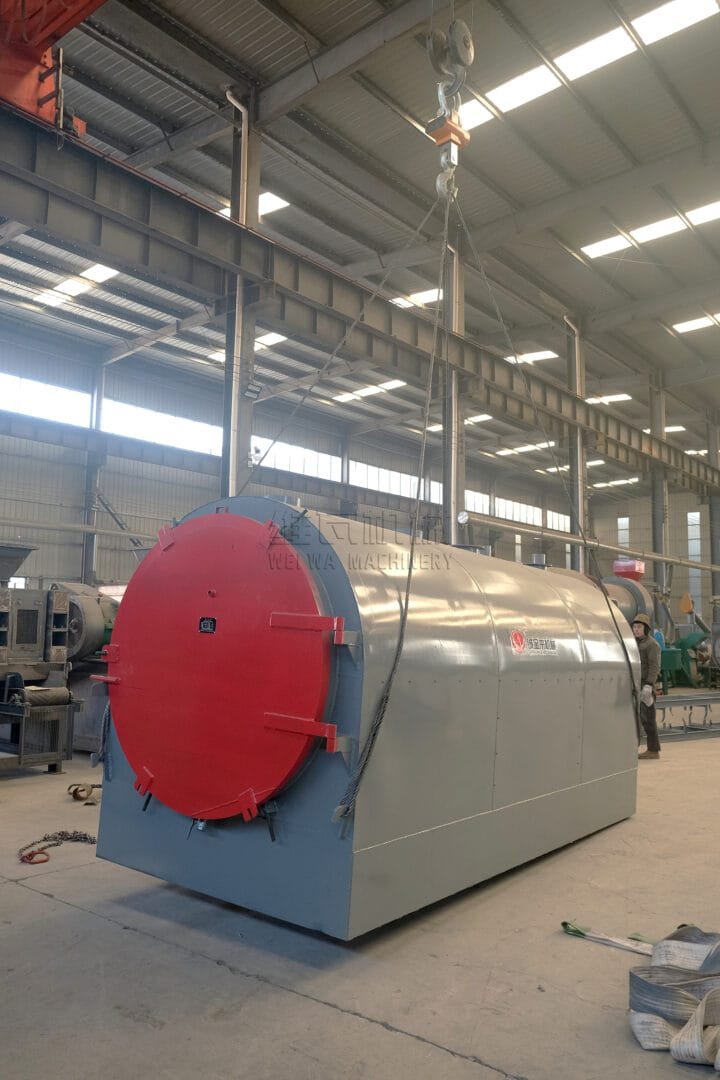
A horizontal carbonization furnace is not a renamed drum kiln. It is a barrel-style chamber mounted on rails, fed by carts, heated indirectly, and equipped with a tar condenser and combustible gas return line. In the Kenya context, those details matter because the buyer is not chasing laboratory purity. He is chasing predictable charcoal yield, less smoke complaint from neighbors, and a machine that does not rust out in one rainy season.
Kenya Charcoal Market and the Case for Modern Carbonization
Kenya consumes charcoal at a scale that surprises outside observers. Urban kitchens, roadside grills, المخابز, and small metal workshops all rely on solid fuel. Traditional earth mound and brick kilns still dominate informal supply, but they waste raw wood, emit heavy smoke, and give charcoal yields that swing between 22 percent and 33 percent depending on operator skill. A charcoal making machine for Kenya has to beat those numbers while staying affordable to finance.
Traditional Kiln Pain Points in Kenya
When our Kenya client described his old process, the list was familiar. Wood logs were stacked, covered with soil, ignited from the top, and left for nine to fourteen days. Rain could halt the burn. Air leaks produced ash instead of charcoal. Good sections of the pile reached 38 percent yield, bad sections dropped to 19 بالمائة. Smoke drifted into the neighbor’s maize plot. The county council had already fined two operators in his district for open burning. None of this is unique to him. It is the baseline that a horizontal carbonization furnace in Kenya is expected to replace.
Why Horizontal Carbonization Furnace in Kenya Gains Interest?
The horizontal layout solves three local problems at once. أولاً, the chamber height stays low, so loading wood logs or coconut shells with a simple cart is easier than lifting baskets into a vertical pit. ثانية, the rail-mounted barrel can be rolled out after cooling, which shortens turnaround and reduces heat stress on the seals. ثالث, indirect heating plus flue gas recovery means the furnace does not depend on a continuous external firewood feed once the pyrolysis gas ignites. For a Kenya buyer paying diesel generator rates during daytime, that self-sustaining cycle is the single biggest operating cost cutter.
What Makes a فرن الكربنة الأفقي Different?
The model we shipped belongs to the same family described on our horizontal carbonization furnace product page. Its core is a cylindrical steel barrel lying parallel to the ground, sealed at both ends, mounted on two rail beds, and connected to a condensation tower and a gas burner manifold. Raw biomass sits inside the barrel on a perforated tray. Heat comes from burners outside the barrel, not from burning the material directly. As wood temperature climbs past 180 درجة مئوية, volatiles escape, pass through the condenser, drop tar and condensate, and the cleaned gas returns to the burners.
Rail-Mounted Barrel Chamber and Indirect Heating
Indirect heating is the reason charcoal fixed carbon stays high. Because the flame never touches the wood, the material carbonizes in a low-oxygen atmosphere created by its own off-gassing. The rail mount is not a cosmetic feature. In the Kenya yard, the client rolls the loaded barrel in, closes the door, locks the flange, runs the cycle, then rolls the same barrel out to a shaded cooling bay. His workers do not climb on hot steel. One worker estimated the loading time dropped from four hours with sacks to seventy minutes with carts.
Flue Gas Recovery and 600 °C Self-Sustaining Cycle
Our furnace targets an internal barrel temperature near 600 °C during the stable carbonization phase. The tar separator catches brown liquor that would otherwise clog the burner nozzles. The combustible gas, mostly methane, هيدروجين, and carbon monoxide, is reheated and pushed back to the combustion chamber. Once the return gas ignites, the client recorded burner diesel consumption falling from 11 liters per cycle to around 3.5 liters per cycle in dry-weather testing. That number will move with wood moisture, but the direction is consistent across our Ethiopia, تنزانيا, and Kenya commissions.
Shipment Scene from Weiwa Machinery to Mombasa
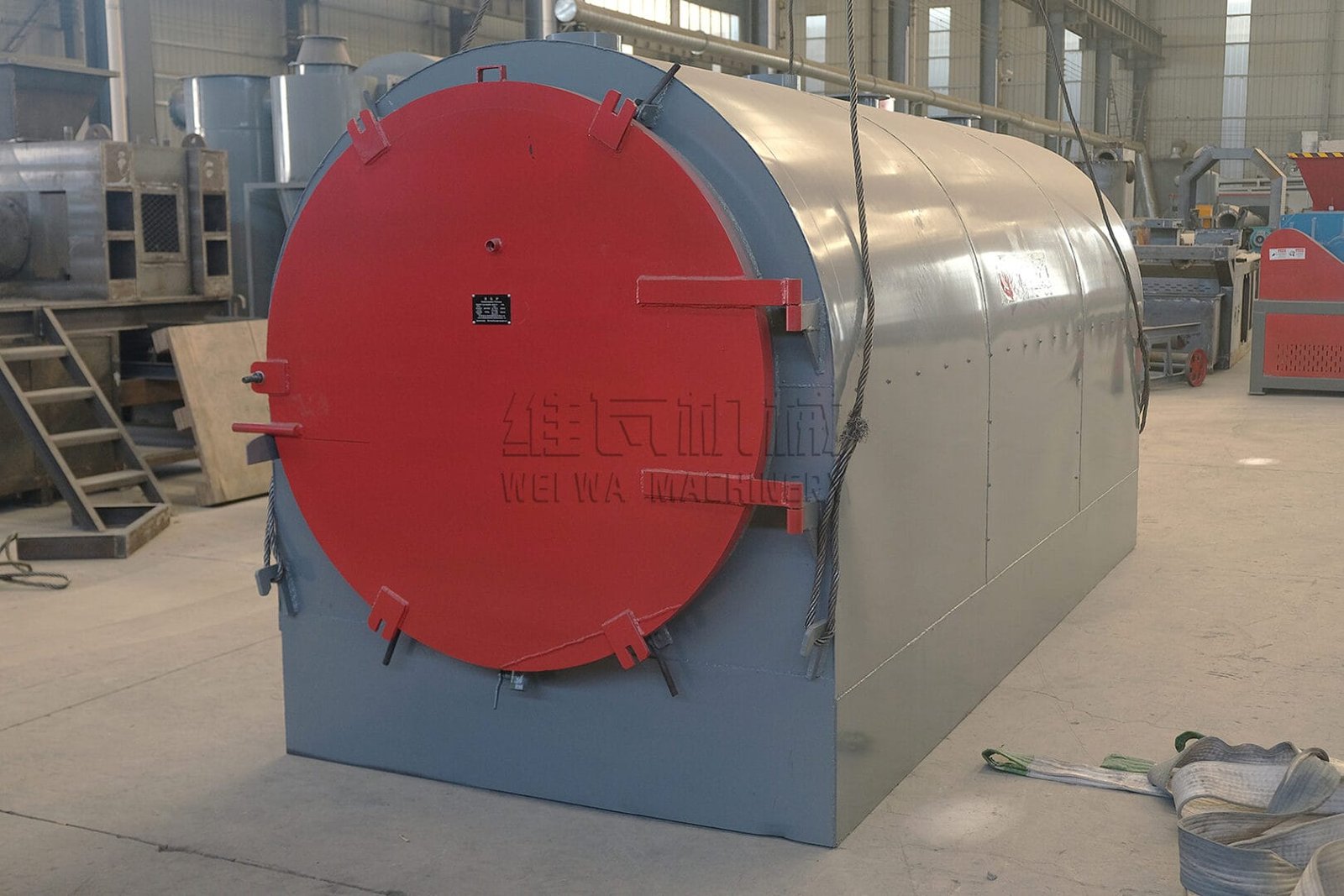
In the workshop, the furnace barrel was sandblasted, coated with two layers of high-temperature resistant paint, and wrapped with rock wool plus aluminum cladding. The rail frame was bolted to a skid. The condenser, tar tank, burner set, control box, thermocouple probes, and spare seals were packed in plywood cases marked with the Kenya consignee code. Our quality inspector checked flange flatness with a feeler gauge, then stamped the test report.
Photographs from the loading day show a 40-foot high-cube container with the barrel lying diagonally to keep center of gravity low. Cart wheels, spare gaskets, and a Swahili-English operation manual were placed in the same container. The client asked for the manual to include a moisture table, so we added a one-page chart mapping wood moisture to expected carbonization time. The container closed at 14:20 local Gongyi time and was trucked to Shanghai Port the same evening.
Weiwa Machinery has handled Kenya shipments through Mombasa for several years. For this client, we prepared the commercial invoice, packing list, certificate of origin, and HS code 8417.80.90 مقدماً. The buyer’s clearing agent in Mombasa confirmed that the furnace body and the auxiliary condenser would be declared separately to avoid a single overweight line item. That small paperwork detail prevented a two-day hold at the inland depot.
On-Site Trial Run Results in Kenya
Two weeks after arrival, our engineer joined the client on a Friday morning. The furnace was installed on a compacted murram pad, leveled with steel shims, and connected to a 380 V three-phase line through a voltage stabilizer. The first trial used eucalyptus logs with 14 percent moisture. The second trial used coconut shells with 9 percent moisture. The third trial mixed sawdust briquettes and maize cob to simulate off-season feed.
Raw Material Preparation and Moisture Control
Kenya buyers often underestimate moisture. Green wood cut during the long rains can read 35 percent moisture on a pin meter. That wood is not ready for a carbonization furnace. It wastes heat boiling water inside the fiber. We advised the client to stack split wood under a iron-sheet roof for eleven days before trial three. The result was a shorter ramp phase. Ramp from ambient to 200 °C took 2 ساعات 40 minutes on dry eucalyptus and 4 ساعات 10 minutes on semi-dry mixed feed. Moisture control, not furnace brand, was the largest variable in cycle time.
Carbonization Curve and Charcoal Yield
In trial one, 1,200 kg of eucalyptus at 14 percent moisture produced 408 kg of charcoal after cooling. That is a 34 percent yield. Traditional kiln baseline for the same wood in his district was 27 بالمائة. Trial two with coconut shells returned 31 percent yield, which is normal because shell density differs. Trial three with briquette mix returned 36 percent yield because briquettes had low internal moisture and uniform size.
Fixed carbon tested by a Nairobi lab came back at 78.4 percent for eucalyptus charcoal and 82.1 percent for coconut shell charcoal. Both numbers clear the 75 percent threshold that institutional buyers in Kenya use when sourcing restaurant grill charcoal. The client’s existing kiln charcoal tested at 61 percent fixed carbon six months earlier, which tells you why his premium buyers kept bargaining him down.
Smoke Reduction and Fuel Saving Data
Smoke was the client’s political risk. County officers had visited his yard twice. During the horizontal furnace trial, the stack at the condenser exit was visibly thin and grey, not black. A simple smoke opacity card held behind the exhaust showed less than 15 percent opacity after the gas burner stabilized. Diesel use per cycle dropped from the 11 liters mentioned earlier to 3.2 ل 3.8 liters across three cycles. Firewood supplement, which he used to feed a separate heating pit, was eliminated entirely.
He calculated his cost per 50 kg bag of charcoal. Old kiln: 1,050 KES in wood waste, 320 KES in labor, 410 KES in firewood and diesel, total 1,780 KES. Horizontal furnace: 980 KES in wood waste, 260 KES in labor, 140 KES in diesel and power, 90 KES in seal depreciation, total 1,470 KES. Margin per bag rose by roughly 310 KES. At his planned 60 bags per week, that is about 18,600 KES weekly, أو 962,000 KES yearly, before counting yield improvement. The furnace pays back faster than he modeled.
Charcoal Making Machine for Kenya Buyers Selection Guide
Many Kenya inquiries ask for a charcoal making machine for Kenya as if it were one SKU. It is not. The right choice depends on raw material shape, land slope, power reliability, and whether the buyer wants batch or continuous operation. The horizontal carbonization furnace fits batch producers who value low height, simple cart feeding, and easy maintenance. Continuous rotary kilns fit large plantations with steady sawdust flow. Vertical hoist furnaces fit tight urban plots. None is universally superior.
Matching Capacity to Biomass Supply
Our Kenya client first asked for a 3-ton-per-day model. We talked him down to a 1.2-ton barrel because his weekly wood collection truck brought 8 ل 9 tons of split logs, not 21 طن. A 3-ton furnace sitting half full every cycle loses heat through the empty steel volume. Matching barrel volume to actual feed avoids false economies. For a startup in Kisumu or Nakuru, one 1.2-ton horizontal carbonization furnace plus a small briquette press is usually the sane first step.
قوة, Labor and Maintenance in Rural Kenya
Rural Kenya yards often see voltage drop at night. The furnace control box needs stable 380 V or a stabilizer. Labor is available but turnover is high, so we kept the control logic mechanical plus digital: a thermostat dial, a thermocouple readout, and three indicator lamps. No touchscreen menu jungle. Maintenance is gasket inspection every 40 cycles, tar tank drain every 5 cycles, and burner nozzle cleaning every 10 cycles. The client trained two workers in one afternoon because the steps are physical, not software skills.
Weiwa Machinery After-Sales Support for Kenya Clients
Weiwa Machinery does not treat shipment as the end of the transaction. For this Kenya order, the package included one remote commissioning video call, one on-site engineer visit of seven days, a spare parts kit with gaskets and thermocouples, and a WhatsApp response window where our sales engineer replies in English or Chinese within a few hours. The client also received a Swahili glossary sheet for the six most common fault lights. When the door seal showed slight compression marks after cycle six, we sent two replacement gaskets by air cargo before he even asked.
Spare parts availability is the quiet killer of imported machinery in Africa. We keep barrel seals, pressure gauges, and burner sets in stock for the horizontal carbonization furnace line so that a Mombasa or Nairobi buyer can receive common parts in five to nine days rather than waiting for a full container reload from China. That logistics buffer is part of why repeat orders from Kenya and Tanzania keep coming.
The trial run proved what the design already suggested. A horizontal carbonization furnace in Kenya can lift charcoal yield from the high twenties to the mid thirties, cut smoke complaints, recycle its own gas, and still be operated by workers who have never touched a PLC. It is not magic. It is indirect heating, rail ergonomics, and condensate recovery applied to a market that has relied on dirt and fire for too long.
For buyers comparing a charcoal making machine for Kenya, the question is rarely whether modern carbonization works. The question is whether the supplier ships a furnace that survives a rural yard, speaks a control language your workers understand, and answers the phone when a gasket fails in March. Weiwa Machinery aimed this shipment at exactly that standard.
If you are planning a charcoal project in Kenya, أوغندا, تنزانيا, or Zambia, the same horizontal carbonization furnace platform can be sized to your wood volume, your moisture profile, and your power supply. The first step is not signing a proforma. The first step is sending us a photo of your raw material and a rough weekly tonnage. From there, the engineering is straightforward.
حول آلات ويوا
آلات ويوا, formally Henan Weiwa Machinery Equipment Co., المحدودة., is a Gongyi-based manufacturer of biomass and charcoal production equipment with decades of accumulated workshop experience. The company designs and builds horizontal carbonization furnaces, أنظمة الكربنة المستمرة, الآلة briquette, كسارات, مجففات, and turnkey charcoal lines. Products are exported to more than forty countries across Africa, جنوب شرق آسيا, وأمريكا اللاتينية. The horizontal carbonization furnace described in this blog is one of the company’s most shipped models to East Africa because it balances yield, footprint, and maintenance simplicity for small- to medium-scale producers.
Weiwa Machinery has served more than two million customers worldwide through direct export and distributor channels, with a service philosophy built around pre-shipment testing, clear operation manuals, spare parts stocking, and engineer visits when the client’s yard is too far from a service city. The Kenya shipment documented above is a typical example of that workflow: specification check, workshop test, container loading, Mombasa clearance support, on-site trial, and post-commissioning follow-up.
اتصال آلات ويوا
الغوغاء: +8613838093177
Whatsapp: +8613838093177
بريد إلكتروني: info@cjlmachinegroup.com
Product reference: https://cjljx.com/products/tanhua/horizontal-carbonization-furnace


 WeChat

 +8615937143060
