


Earlier this season, a honeycomb briquette charcoal machine from Weiwa Machinery completed on-site installation and commissioning at a customer workshop in Chile. The visit was not a standard delivery. The Chilean buyer requested a full mechanical run, raw material adaptation, and a physical sample showcase before signing off the coal briquettes making machine.
Why Chile Is a Reasonable Market for آلة تصنيع الفحم الحجري على شكل قرص العسل?
Chile has a stable barbecue culture, a growing interest in controlled-combustion household fuel, and several regions where charcoal powder, غبار الفحم, and biomass residue are available at low cost. Importers in Chile do not only ask for a machine. They ask for a honeycomb briquette charcoal machine in Chile that can run on local voltage, handle local powder humidity, and output a briquette shape their end users already recognize. That is exactly the brief our engineering team prepared for.
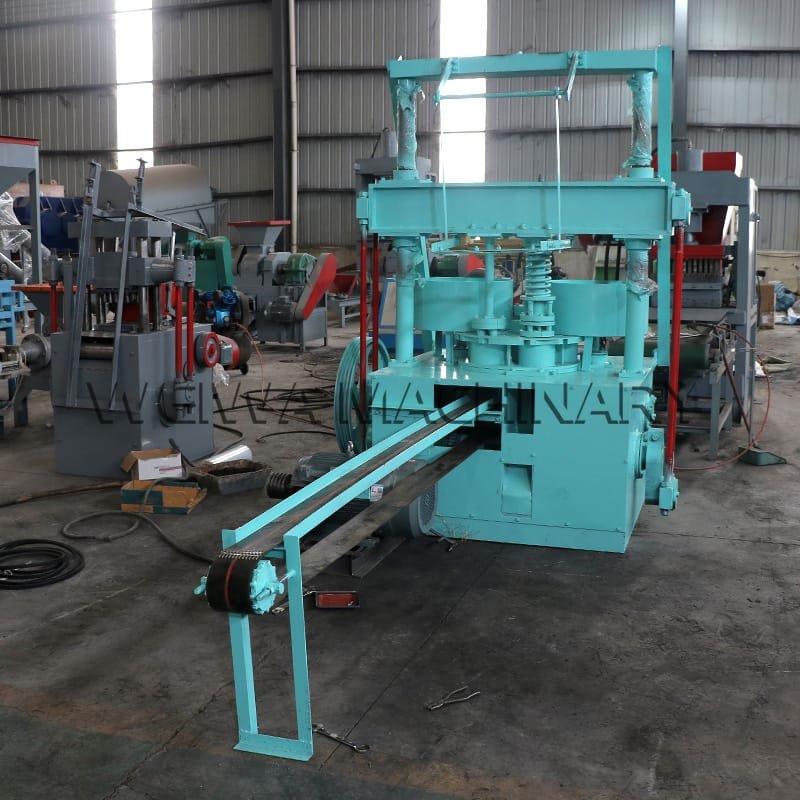
The selected unit was a rotary-table punching model, the same family as our BLMQ series. It is sometimes called a honeycomb charcoal coal briquette forming machine, sometimes a coal briquettes making machine, and in shop-floor language simply a honeycomb punching machine. All three names describe the same mechanical principle: powdered fuel is fed into mold barrels, compressed by a descending ram, and ejected as a round disc with through-holes.
What Makes Honeycomb Shape Different from Ordinary Briquettes?
A honeycomb briquette is not a solid puck. It is a cylindrical or round disc with multiple straight holes passing from top face to bottom face. Those holes act as air channels. When the briquette is placed on a grate, oxygen travels through the columns, ignition starts from the top, and the combustion front moves downward in a stable manner. Compared with lump charcoal or hand-pressed cakes, honeycomb briquettes give faster lighting, steadier heat, less choking smoke at startup, and predictable burn duration.
For the Chile customer, this science point mattered. They were not buying a black box. They wanted to see proof that hole count, hole diameter, compression pressure, and moisture window together decide whether the final piece burns clean or cracks in the stove.
Arrival and Unpacking of the Honeycomb Briquette Charcoal Machine
The machine arrived in a 20-foot container together with a screw feeder, a small double-shaft mixer, spare punch heads, and three mold sets of 100 مم, 140 مم, و 160 قطر مم. Wooden crating followed our export standard for LCL and FCL hybrid shipments. After customs clearance in Chile, our technician and the local electrician positioned the honeycomb briquette charcoal machine on a flat concrete base, checked anchor bolts, and confirmed the rotary table was level within two millimeters.
Before any charcoal touched the hopper, we ran a no-load cycle. The motor, pulley, gear transmission, and camshaft drove the turntable smoothly. The punch ram descended and retracted without knocking. The ejector pins pushed imaginary blanks onto the discharge board cleanly. Only after thirty minutes of dry running did we move to material preparation.
Raw Material Profile Used in the Chile Trial
The customer supplied a blend of 70 percent charcoal powder from hardwood waste and 30 percent coal dust recovered from a local heating facility. Bulk density was around 0.42 tons per cubic meter. Moisture after natural shelter drying was 11 بالمائة, inside the 8 ل 12 percent window our honeycomb briquette charcoal machine expects. We added a starch-based binder at 4 percent dry weight and mixed for six minutes until the mass felt like damp bread crumbs rather than paste.
This step is where many first-time buyers fail. If moisture is too low, the powder will not hold the hole walls. If moisture is too high, the punch sticks and the honeycomb holes close. The Chile operator watched the mixer closely and learned to judge readiness by hand squeeze rather than timer alone.
First Live Run of the Honeycomb Charcoal Coal Briquette Forming Machine
We loaded the blended material into the hopper. The auger distributed it evenly into four mold barrels on the rotary table. At each index station, the cam lowered the punch head, pressed the powder into a 140 mm disc with 19 holes, and the bottom ejector pushed the piece onto the exit tray. The first ten pieces looked rough because the feed auger speed was slightly high. We slowed the inverter to 38 hertz and the shape stabilized.
Production settled at 44 pieces per minute, equal to roughly 2640 finished briquettes per hour. The Chile client recorded motor current, belt tension, and punch temperature. Nothing exceeded design limits. The honeycomb briquette charcoal machine kept cycling while our engineer explained each adjustment aloud so the local team could repeat it later without us.
Close Look at the Sample Briquettes
After twenty minutes of continuous running, we pulled a tray of fresh samples for inspection. Diameter held 140 mm plus or minus 1 مم. Height was 72 مم. Average weight 1.82 kilograms. ال 19 holes were fully penetrated, not blind. Surface had no radial cracks. We let a portion air-dry for 48 hours and then performed a one-meter drop test onto concrete. Edges chipped slightly, body stayed whole. That is the level of transport resistance a commercial coal briquettes making machine should deliver.
Combustion check came next. A dried sample was placed on a small mesh stove with a few wood chips underneath. Thanks to the honeycomb holes, the piece took fire in about three and a half minutes and held a steady flame for 78 minutes until only pale ash remained. The Chile owner compared it with his imported Brazilian lump charcoal and noted the honeycomb disc gave fewer flare-ups and easier restart the next morning by adding one more disc on top.
How the Honeycomb Punching Machine Actually Forms the Block?
Understanding the mechanism helps buyers trust the equipment. A honeycomb punching machine is built around five cooperating sections. The frame carries the load. The transmission section converts motor rotation into intermittent turntable motion. The feeding section meters powder into mold barrels. The punching section contains the ram and the multi-pin punch head that carves the holes. The discharge section uses ejector pins and a short belt to move finished goods away.
When people search honeycomb punching machine, they sometimes imagine a hydraulic press. Our Chile unit is mechanically cam-driven, not hydraulic, which suits continuous production better. Cams give fixed stroke, repeatable pressure, and lower heat buildup over an eight-hour shift. Hydraulic versions exist in our catalog for very large 220 mm blocks, but for 100 ل 160 mm commercial discs, the rotary cam machine is the workhorse.
Mold Change and Local Customization
One selling point of this honeycomb briquette charcoal machine is mold swap. The Chile client originally wanted 140 mm with 19 holes, common in Colombian and Peruvian shops. We also showed them 100 mm with 12 holes for quick-lighting restaurant use, و 160 mm with 21 holes for overnight heating. Changing a mold takes roughly twenty minutes: remove punch head, lift turntable insert, fit new barrel set, re-align ejector pins, test with five blank cycles.
Because the customer in Chile mentioned future export to Bolivia and Peru, mold flexibility directly protects their investment. One coal briquettes making machine becomes three product lines.
Field Commissioning Checklist We Followed in Chile
Commissioning is not pressing start. It is a sequence. We confirmed voltage at 415 V three-phase 50 Hz, matched the motor nameplate, verified emergency stop wiring, greased cam bearings, set auger inverter to 40 hertz baseline, calibrated hopper level, ran empty ten cycles, ran material ten cycles, measured first samples, adjusted moisture and binder, ran thirty stable minutes, dried samples, burned one sample, trained two operators, and handed over the Spanish manual.
The Chile team asked intelligent questions. How long do punch pins last. حول 600 ل 900 operating hours depending on abrasive content of coal dust. How to clean the mold. Compressed air plus soft wire brush, never a steel chisel. What to do if holes look shallow. Raise binder by half a percent or lower auger speed, not punch pressure, because over-pressure cracks the rim. These are the details that separate a honeycomb charcoal coal briquette forming machine that survives five years from one that jams in month two.
Sample Gallery Notes from the Workshop
We photographed four groups. Group A was fresh out of the machine, showing hole sharpness. Group B was after 48-hour shade drying, showing weight loss from 1.82 kg to 1.69 كجم. Group C was post-drop-test pieces, showing chip pattern. Group D was half-burned discs, showing how the honeycomb holes kept airflow until the last quarter of the block. Those images now sit in the customer’s own WhatsApp catalogue. For our website, we reused two with permission and alt tags describing the honeycomb briquette charcoal machine sample rather than generic names.
Why Honeycomb Briquette Charcoal Machine Fits Small Factories?
A full charcoal plant needs crusher, مجفف, خلاط, الآلة briquette, curing yard, and packer. But the honeycomb briquette charcoal machine is often the heart. It does not need a giant foundation. أ 7.5 kW model runs on normal workshop power. One operator feeds bags, one watches discharge, and a third handles drying. Output of 2.5 ل 3 tons per day already supports a neighborhood supply business in Chile, Ecuador, or Peru.
Customers searching honeycomb briquette charcoal machine in Chile usually compare against imported hexagonal briquette presses. The honeycomb disc wins on familiarity. Older generation stoves across Latin America were built for round beehive coal. Switching those users to hex logs means changing the stove. Switching them to honeycomb discs means keeping the stove and upgrading the fuel.
Environmental Angle That Chile Buyers Appreciate
Charcoal powder and coal dust are waste streams. Left loose, they blow in wind and clog drains. Pressed into honeycomb briquettes, the same material becomes a stacked, low-dust, وقود عالي الكثافة. With proper binder, fines loss during transport drops. The Chile client liked that story because municipal inspectors in his region had already questioned open charcoal powder storage. A honeycomb punching machine is not only a production tool. It is a housekeeping upgrade.
Technical Reference of the Demonstrated Unit
The machine shown in Chile was our BLMQ-140 type. Motor power 7.5 كيلوواط, 415 V 50 Hz three-phase. Mold diameter range 100 ل 140 مم. Briquette height adjustable 60 ل 80 مم. Rotary table with four stations. Nominal speed 40 ل 45 pieces per minute. Overall size about 1.32 by 1.26 by 1.85 meters. وزن 1.4 طن. Matching feeder 1.1 كيلوواط. Matching mixer 2.2 كيلوواط. Total connected load under 12 كيلوواط, comfortable for most small industrial sheds.
For buyers who need bigger blocks, the same honeycomb briquette charcoal machine concept scales up to BLMQ-160 and BLMQ-220. Those use 11 ل 18.5 kW motors and produce 160 mm or 220 mm discs for industrial heating or foundry auxiliary fuel. The Chile customer already reserved space beside the BLMQ-140 for a future 160 mm line, which is why we left the conveyor height compatible.
Common Mistakes First-Time Chile Buyers Make
They buy the machine before testing local powder. They ignore moisture and blame the punch. They request 21 holes on 100 قطر مم, which leaves wall thickness too thin and holes merge. They run the cam at 50 hertz thinking faster is better, then wonder why ejector pins bend. They skip binder and expect lump charcoal behavior. Our job on site was to replace those habits with measured routine. By the second day, the Chile operator could tune auger speed from sample appearance alone.
Sample Showcase Data the Customer Accepted
قطر 140 مم, tolerance plus 1 minus 0. ارتفاع 72 مم. Dry weight 1.69 كجم. Hole count 19. Hole diameter 9 مم. Bulk density of finished disc 1.18 tons per cubic meter. Ignition time 210 seconds. Continuous burn 78 minutes on mesh stove with secondary air. Drop-test survival from 1 meter, one edge chip only. Those numbers went into the acceptance report. For a honeycomb charcoal coal briquette forming machine, this is a clean commissioning result.
The Chile owner then pressed 300 discs, dried them in his yard, bagged 10 kg per sack, and sold a trial batch to two barbecue restaurants in the nearby city. Both returned positive feedback on lighting speed. That field loop, from machine to sample to market, is the part no trade-show video can fake.
Operator Training We Left Behind
Training was half a day in Spanish. Topics covered safe lockout, daily grease points, auger speed logic, moisture hand test, binder ratio by scoop, mold swap, punch pin replacement, and fault reading. We also set a simple maintenance calendar. Grease cam shaft every 8 ساعات. Inspect ejector springs every 200 ساعات. Change auger flight wear strip every 600 ساعات. Keep one spare punch head on shelf. None of this is exotic, but without it the coal briquettes making machine drifts out of tolerance within months.
How This Machine Connects to a Full Briquette Line?
A standalone honeycomb briquette charcoal machine is enough for many startups. As volume grows, the Chile client will likely add a hammer mill for coarse charcoal, a rotary dryer if rainy season raises moisture above 12 بالمائة, and a semi-automatic bagging table. Because our BLMQ series shares belt heights with the rest of Weiwa’s line, expansion does not mean rebuilding the floor plan.
We also discussed a future carbonization furnace so the customer could make his own charcoal from wood waste instead of buying powder. That turns the honeycomb punching machine from a converter of purchased powder into the finishing end of a closed loop. For Chile, where forestry offcuts exist in the south, that loop is economically interesting.
Why Weiwa Machinery Treats Commissioning as Part of the Product?
We do not see the container leaving Zhengzhou as the end of the sale. The machine only earns its place when it cycles in your shed. That is why every honeycomb briquette charcoal machine we send to Latin America ships with a commissioning checklist, a Spanish or English manual, and an invitation to a video call during your first run. The Chile case was a physical visit because the client’s order included on-site training, but remote commissioning works for most small buyers too.
Our warehouse keeps wearing parts for BLMQ-120, 140, 160, و 220 in stock. Punch pins, ejector springs, mold barrels, augers, and gears ship by air if a client in Chile or Colombia stops production. A briquette machine is mechanical, and mechanical things wear. The difference between a good supplier and a forgotten one is how fast the spring arrives.
عن آلات ويوا
Weiwa Machinery is a Zhengzhou-based manufacturer with over 30 years of experience in briquette machinery and carbonization equipment. Our range covers honeycomb briquette charcoal machines, coal stick presses, ball charcoal presses, آلات فحم حجري نشارة الخشب, rotary dryers, أفران الكربنة, وأكمل خطوط الإنتاج. We have delivered equipment to more than 130 countries including Chile, Peru, Colombia, المكسيك, أندونيسيا, الهند, ديك رومى, جنوب أفريقيا, and Poland. Every export order includes factory testing, spare-part packing, layout drawing, and after-sales support in English or Spanish.
If you are evaluating a honeycomb briquette charcoal machine in Chile, comparing a honeycomb charcoal coal briquette forming machine with other press types, or simply want to know whether your local charcoal powder can become a 140 mm honeycomb disc, our engineering team can run a free material assessment. Send your powder sample or moisture data, tell us your voltage and target hourly output, and we will propose the right coal briquettes making machine model, mold configuration, and companion equipment.
Contact Weiwa Machinery
الغوغاء / واتساب: +8613838093177
بريد إلكتروني: info@cjlmachinegroup.com
Product reference: https://cjljx.com/product/honeycomb-charcoal-briquettes-machine


 WeChat

 +8615937143060
