


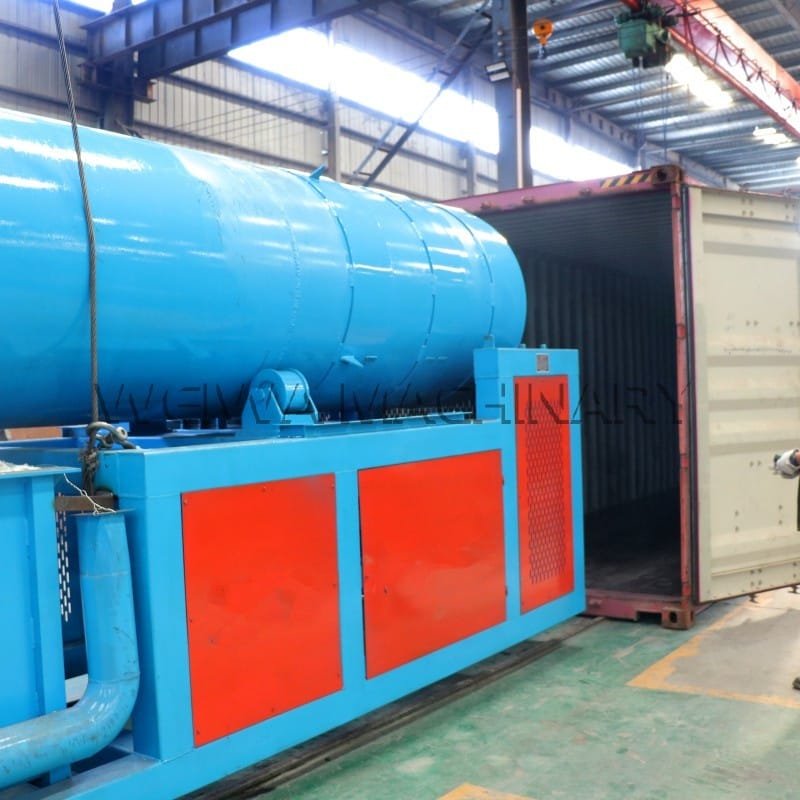
In the golden dawn of early February, the air at Weiwa Machinery’s manufacturing base carried a unique blend of excitement and purpose. Crates stacked high with precision-engineered components, workers moving with practiced coordination, and the distant hum of testing equipment set the stage for a moment that would bridge innovation with opportunity—the shipment of our continuous carbonization furnace to India. لآلات ويوا, this was not just a delivery; it was a testament to our commitment to empowering sustainable industries worldwide, and a first step into a market where biomass energy potential is as vast as its cultural richness.
Understanding فرن الكربنة المستمر A Foundation for Sustainable Charcoal Production
لتقدير أهمية هذه الشحنة, it helps to first demystify what a continuous carbonization furnace is and why it matters. At its core, a continuous carbonization furnace is an advanced thermal processing system designed to convert biomass materials—such as coconut shells, قشور الأرز, نشارة الخشب, or bamboo—into high-quality charcoal through controlled pyrolysis. Unlike traditional batch kilns, which require stopping and restarting for each load, continuous systems operate non-stop, feeding raw material in one end and collecting finished charcoal at the other. This uninterrupted workflow is a game-changer for scalability and efficiency.
The science behind carbonization lies in heating biomass in an oxygen-limited environment. As temperature rises (عادة بين 400 درجة مئوية و600 درجة مئوية), volatile compounds are driven off, leaving behind carbon-rich charcoal. Continuous furnaces optimize this process with automated temperature control, gas recycling, and exhaust treatment, ensuring consistent product quality while minimizing energy waste. For industries reliant on charcoal—from metallurgy and agriculture to water filtration and household cooking—this technology slashes production time, reduces labor costs, and cuts carbon emissions compared to conventional methods.
في الآلات Weiwa, we have spent over a decade refining our continuous carbonization furnace design. Our models feature modular configurations to suit diverse feedstocks, corrosion-resistant alloys for longevity, and intelligent monitoring systems that adjust parameters in real time. These innovations are not just technical feats; they address the pain points of small-scale producers and large enterprises alike, making sustainable charcoal production accessible and profitable.
The Indian Context Why Continuous Carbonization Furnace Fits Indias Needs
India stands at a crossroads of environmental urgency and economic growth, and continuous carbonization furnace aligns perfectly with both imperatives. As the world’s second-most populous nation, India faces mounting pressure to reduce reliance on fossil fuels and curb deforestation caused by traditional charcoal production. معًا, its abundant agricultural and forestry residues—coconut shells from Kerala, rice husks from Punjab, and bamboo from Northeast states—represent an untapped goldmine for biomass energy.
The Indian government has been proactive in promoting renewable energy through initiatives like the National Biomass Cookstoves Initiative and subsidies for green manufacturing technologies. فحم, valued for its high calorific value and low smoke emission, is gaining traction as a cleaner alternative to firewood and kerosene, especially in rural households and small-scale industries. لكن, outdated batch carbonization methods limit output and quality, creating a gap that continuous carbonization furnace is poised to fill.
For Indian entrepreneurs, the appeal of continuous carbonization furnace extends beyond sustainability. Its ability to produce uniform charcoal with minimal supervision translates to lower operational costs, while the option to sell byproducts like bio-oil and syngas adds revenue streams. In a market where demand for eco-friendly products is rising among urban consumers and export-oriented businesses, investing in advanced carbonization technology is not just a choice—it’s a strategic move.
From Factory to Port The Journey of Our Continuous Carbonization Furnace to India
The journey began months earlier, with our engineering team collaborating closely with Indian clients to customize the furnace specifications. We considered local feedstock characteristics—such as the high lignin content in coconut shells—and tailored the heating zones and residence time to maximize charcoal yield. Every component, from the screw feeder to the condenser unit, underwent rigorous quality checks to withstand the rigors of international transport and tropical climates.
On the day of shipment, the factory floor buzzed with activity. Cranes lifted heavy reactor modules onto flatbed trucks, while technicians double-checked packing lists to ensure no part was left behind. “This furnace is built to run 24/7,” said Li Qiang, our lead engineer, as he inspected the final crate. “We added extra insulation for India’s heat and reinforced the frame for uneven terrain at client sites.”
The convoy rolled out under clear skies, bound for the port of Qingdao before setting sail across the Indian Ocean. لآلات ويوا, logistics are as critical as manufacturing; we partner with certified freight forwarders to track shipments in real time, ensuring the furnace arrives intact and on schedule. This attention to detail reflects our belief that delivering reliable machinery is only half the story—ensuring it reaches customers ready to transform their operations is equally vital.
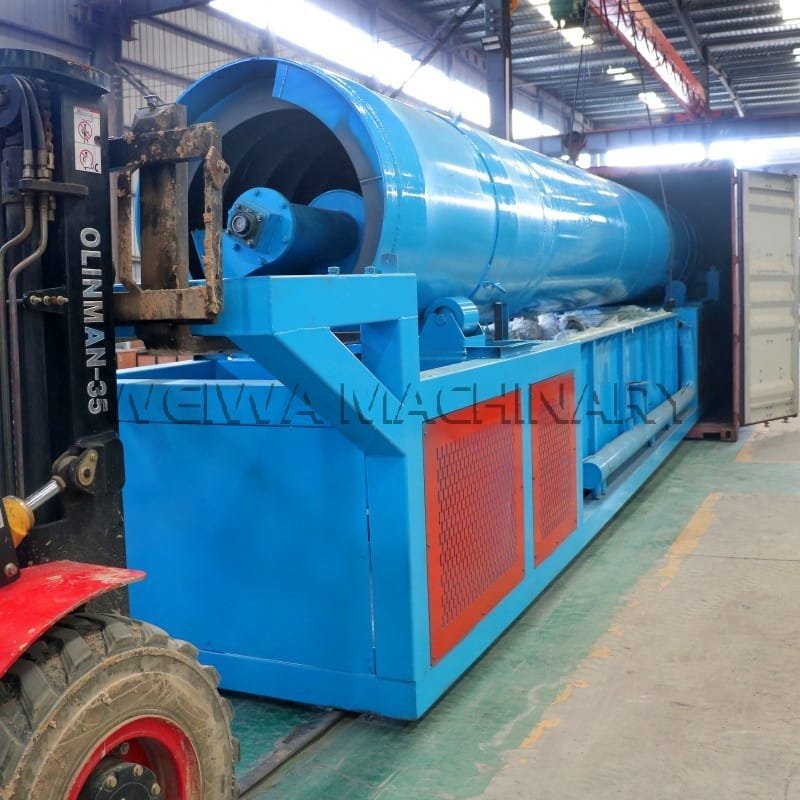
Unveiling Performance How Our Continuous Carbonization Furnace Excelled in Indian Trial Runs
A week after arrival, the furnace was installed at our client’s facility in Tamil Nadu, a state renowned for its coconut production. The trial run, conducted under the watchful eyes of local operators and our after-sales team, was a resounding success.
Seamless Integration with Local Feedstocks
The first test used coconut shells sourced from nearby farms. Loaded into the hopper, the shells moved smoothly through the drying zone, where excess moisture was evaporated, then into the carbonization chamber. Within hours, the first batch of charcoal emerged—uniform in size, jet-black in color, and emitting a faint, earthy aroma. Laboratory tests revealed a fixed carbon content of 85%, far exceeding the 60-70% typical of traditional methods. “The consistency is amazing,” remarked Ramesh, the client’s production manager. “Earlier, we’d get batches that were too brittle or smoky. الآن, every bag meets export standards.”
Efficiency That Redefines Productivity
Continuous operation proved its worth during a 72-hour stress test. The furnace processed 2.5 tons of coconut shells daily, producing 800 kg of premium charcoal—triple the output of the client’s old batch kiln. كان استهلاك الطاقة 30% lower, thanks to our closed-loop gas recycling system, which reuses combustible gases to fuel the furnace. Even more impressive was the labor reduction: أين 8 workers were needed for round-the-clock batch processing, the continuous system required just 2 operators for monitoring.
Environmental Wins Beyond Expectations
Emissions were another highlight. Our furnace’s scrubber system captured 95% of particulate matter and acidic gases, ensuring compliance with India’s Central Pollution Control Board norms. The byproduct bio-oil, collected during condensation, was tested as a substitute for diesel in generator sets—a bonus income stream the client had not initially anticipated. “We used to burn leftover shells, causing air pollution,” said Meena, a local farmer supplying the feedstock. “Now, they’re turned into charcoal and oil, helping our village breathe easier.”
Continuous Carbonization Furnace Price and Value Balancing Cost with Long Term Gains
A common question from potential clients is about continuous carbonization furnace price. While our systems carry a higher upfront cost than basic batch kilns, the long-term value proposition is compelling. Let’s break it down:
Traditional batch kilns require frequent downtime for loading, cooling, and unloading, limiting annual production. في المقابل, a continuous furnace operates year-round, amortizing its cost over higher output. For the Tamil Nadu client, the initial investment was recouped in 18 months through savings on labor, طاقة, and wasted feedstock. بالإضافة إلى ذلك, premium charcoal commands a 40-50% higher market price than irregularly shaped traditional charcoal, boosting profit margins further.
Weiwa Machinery also offers flexible financing options and after-sales support, including operator training and remote troubleshooting, to ease the transition. “Price is important, but reliability and support matter more,” noted the client. “Weiwa didn’t just sell us a machine—they partnered with us to build a sustainable business.”
The Bright Future of Continuous Carbonization Furnace in India
The success of this shipment signals a promising future for continuous carbonization furnace in India. With growing awareness of climate change and government incentives for green tech, we anticipate surging demand across sectors. Small and medium enterprises (الشركات الصغيرة والمتوسطة) in rural areas will adopt the technology to add value to agricultural waste, while larger corporations may integrate it into circular economy models.
Weiwa Machinery is already scaling up to meet this demand. We are establishing a regional service center in Mumbai to provide faster parts supply and technical assistance, and we’re developing localized variants of our furnace to handle region-specific feedstocks like cashew nut shells and sugarcane bagasse. Our goal is not just to sell machines but to foster a ecosystem where Indian businesses thrive on sustainable innovation.
As the sun set over the Tamil Nadu facility, casting a warm glow on the newly installed furnace, it was hard to miss the sense of possibility. This was more than a piece of equipment; it was a catalyst for change—transforming waste into wealth, pollution into progress, and local resources into global opportunities. لآلات ويوا, being part of India’s journey toward a greener future is both an honor and a responsibility.
عن آلات ويوا
تأسست في 1990, Weiwa Machinery is a leading manufacturer of biomass energy equipment, specializing in continuous carbonization furnaces, آلات صنع الفحم, and related systems. Guided by the mission to “turn waste into value,” we combine cutting-edge engineering with deep industry insights to deliver solutions that are efficient, متينة, and environmentally friendly. Our global footprint spans over 30 بلدان, supported by a team of 200+ experts dedicated to customer success. في ويوا, we don’t just build machines—we build partnerships that drive sustainable growth.


 WeChat

 +8615937143060
