


Cote d’Ivoire Charcoal Fuel Demand and Why Making Charcoal Balls Matters?
The Ivorian charcoal sector sits at the intersection of forestry residue, urban cooking culture, and small-scale industrial heating. Cocoa farms generate pruned branches. Palm oil processors discard shells. Sawmills leave offcuts. Coastal cities import broken charcoal from inland villages and repackage it. In every one of these steps, fine charcoal powder accumulates. Before briquetting technology became accessible, that powder was either dumped, burned in the open, or sold at a fraction of lump charcoal price.
A ball charcoal briquettes machine changes the math. When charcoal dust is mixed with a starch or molasses binder, conditioned to eight to twelve percent moisture, and pressed between twin alloy rollers, the output is a 30 ل 50 mm ball that survives road transport from Abidjan to Burkina Faso without turning back into dust. Making charcoal balls in Cote d’Ivoire is therefore not only an equipment decision but a supply chain decision. The producer controls shape, صلابة, ignition speed, والتعبئة, which means they control margin.
Weiwa Machinery has supplied briquette presses to Nigeria, Mali, كينيا, أثيوبيا, تنزانيا, and Ghana. The Cote d’Ivoire case is special because the client requested French-language manuals, 415V/50Hz control panel, and molds combining oval and pillow shapes in one roller set. That level of customization is normal for us, but it shows how mature the Ivorian buyer has become. They are not asking what a charcoal briquette machine is. They are asking how fast they can recover investment.
What Is a آلة Ball Charcoal Briquettes?
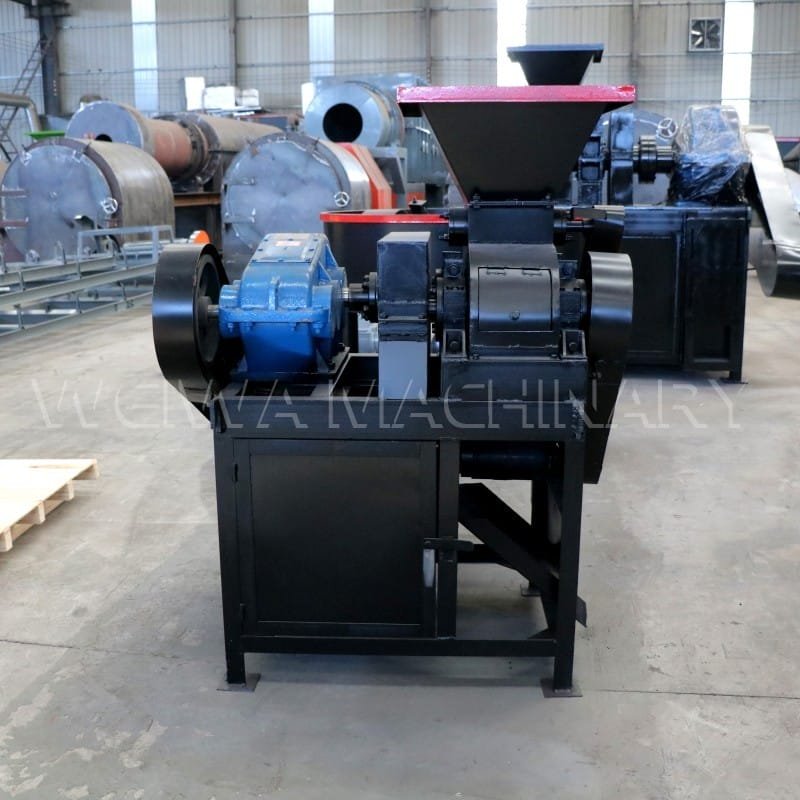
A ball charcoal briquettes machine is a twin-roller cold press designed to compress fine carbonaceous powder into dense geometric pieces without external heating. Unlike extrusion machines that push material through a heated die, the roller press uses two counter-rotating wheels with matching cavities. As mixed powder falls into the nip point, hydraulic or spring-loaded pressure forces it into the pocket, forming a ball that drops out the bottom with smooth surface and sharp edges.
Roller Press Working Principle
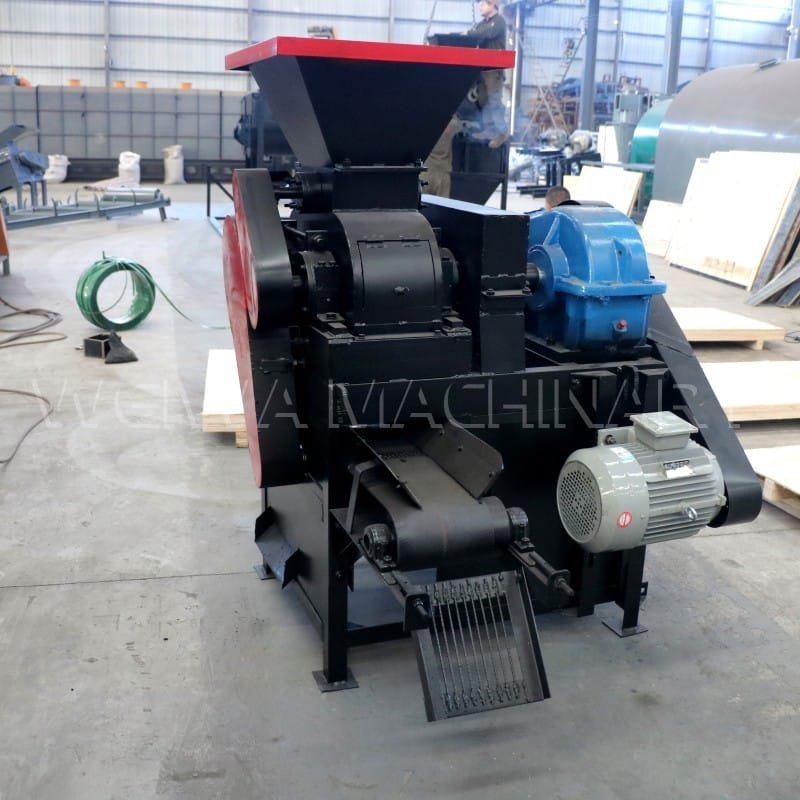
The core of any charcoal ball press machine is the roller pair. Each roller carries dozens of hemispherical or ellipsoidal pockets machined by CNC into manganese steel or alloy steel surfaces. The gap between rollers is adjustable. A variable-speed screw feeder delivers pre-mixed material uniformly to the center. When the rollers rotate, the pockets on opposite sides meet, close, and squeeze the powder. Pressure peaks at the closing moment, typically between 15 و 30 MPa depending on recipe. After the rollers separate, the formed ball is released. No glue gun, no kiln, no baking stage is required at the press itself, which is why the ball charcoal briquettes machine fits plants with unstable electricity better than many thermal alternatives.
Shapes Sizes and Mold Customization
Our Cote d’Ivoire client chose 38 mm oval balls for household BBQ and 45 mm pillow balls for restaurant braziers. Other common molds include round ball, شكل البيض, square coin, bread shape, and modified hexagon. The same charcoal briquette machine frame can accept different roller sleeves, so a buyer in Abidjan can switch from making charcoal balls for shisha cafes to square briquettes for industrial boilers by changing only the roller set. Weiwa provides CAD drawings of every mold before production so the client confirms volume per ball, compression ratio, and logo embossing if needed.
Final ball size usually ranges from 20 ل 80 مم. For BBQ retail in Cote d’Ivoire, 30 ل 50 mm is the sweet spot. Smaller balls ignite faster but cost more in binder. Larger balls burn longer but need higher press pressure. The ball charcoal briquettes machine we shipped used 360 mm diameter rollers with 2 ل 3 ton per hour nominal capacity, driven by an 11 kW motor, which matches a mid-size Ivorian workshop running one shift.
Full Charcoal Briquette Machine Production Line Explained
A single charcoal ball press machine is rarely enough. Commercial making charcoal balls in Cote d’Ivoire requires a connected line: receive dust, crush lumps, mix binder, press, dry, cool, and pack. Below is the exact flow we designed for the Abidjan client.
Crushing and Sieving Stage
Charcoal arrives as a mix of lumps, fines, and foreign stones. A hammer mill or jaw crusher reduces oversize pieces below 3 مم. A vibrating sieve removes grit that would scratch roller pockets. In Cote d’Ivoire, where feedstock often includes coconut shell charcoal and sawdust charcoal together, we added a magnetic separator before the crusher to protect the mill from nails and wire brought in by informal collectors.
Mixing Binder and Moisture Control
The heart of quality making charcoal balls is the mixer. Our twin-shaft paddle mixer blends charcoal powder with water and binder for four to six minutes. Starch binder is boiled separately and poured hot; molasses binder is diluted cold. Target moisture after mixing is nine percent. Too dry and the ball cracks; too wet and the press slips. The Cote d’Ivoire operator was trained to squeeze a handful of mix and drop it from waist height. If it holds shape and shows one or two surface cracks, moisture is correct. This simple field test travels better than a lab meter, though we still supply a halogen moisture tester with every charcoal briquette machine line.
Ball Press Forming Stage
The mixed material feeds the ball charcoal briquettes machine. Rollers run at fixed speed. A scraper keeps pockets clean. A return box collects misfed powder and sends it back to the mixer. For Cote d’Ivoire we set pressure via hydraulic station rather than spring pack, because the client expects to alternate pure charcoal recipes with charcoal-coal blends depending on season. Hydraulic pressure is turned by a knob; spring pressure requires shim change. The charcoal ball press machine produced 38 mm ovals at 42 balls per minute per row, two rows per roller, giving roughly 2.3 tons per hour of green balls.
Drying and Cooling Stage
Green balls leave the press at nine percent moisture and must drop to below four percent for shelf stability. The Abidjan line uses a three-layer mesh belt dryer heated by a biomass burner burning rejects. Drying takes ninety minutes at 140 درجة مئوية. After drying, a cooling conveyor brings balls to ambient temperature. We avoid sun drying for commercial lines because rain in Cote d’Ivoire coastal season is unpredictable and birds contaminate open beds. A mechanical dryer makes making charcoal balls in Cote d’Ivoire a twelve-month operation.
Weiwa Factory Shipment of Charcoal Ball Press Machine to Cote d’Ivoire
Two days before container closing, our QC team ran a live video call with the Ivorian buyer. We started the ball charcoal briquettes machine empty, then fed mixed charcoal to show ball formation, then deliberately increased binder by two percent to prove the press would not jam. Rollers were coated with anti-rust oil. Electric motor was wrapped in vapor corrosion inhibitor film. The twin-shaft mixer, belt conveyor, dryer fan, and control cabinet were packed in plywood cases labeled in French and English.
Container loading followed our standard West Africa protocol. Steel wire ropes fixed the press base to container floor. Wooden braces filled side gaps. Spare roller sleeve, scraper blade, and hydraulic seals were placed in a separate small case marked “wear parts priority”. Photographs of the sealed container, packing list, commercial invoice, and Certificate of Origin were emailed the same evening so the Cote d’Ivoire importer could begin customs pre-clearance through Abidjan port. Estimated sea transit to Ivory Coast was thirty one days. Installation guidance would be remote via WhatsApp video, with a French-speaking engineer on standby.
This is the part of the job many equipment websites skip. A charcoal briquette machine is not delivered, it is handed over. Our responsibility does not end when the truck leaves Gongyi. It ends when the Ivorian worker presses the start button and the first oval charcoal ball drops into the collection bin.
Market Potential of Making Charcoal Balls in Cote d’Ivoire
Cote d’Ivoire has over 27 million people, a growing middle class in Abidjan, and a street food economy that runs on fire. Grilled chicken, grilled fish, plantain, and attieke stalls use charcoal every evening. Supermarkets in Cocody and Marcory now sell bagged BBQ charcoal with brand labels, which did not exist ten years ago. This retail shift is the opening for making charcoal balls in Cote d’Ivoire at scale.
Urban BBQ and Street Food Sector
Street vendors want fuel that lights in five minutes, holds heat for forty minutes, and produces low smoke near customers. Lump charcoal from illegal kilns is cheap but inconsistent. Briquettes from a ball charcoal briquettes machine are uniform. A vendor paying a small premium gets predictable cooking time, which means predictable revenue per night. Distributors in Abidjan already told our client they would sign monthly supply contracts if ball diameter stayed within plus or minus two millimeters. That tolerance is easy for a charcoal ball press machine but impossible for hand-molded charcoal.
Coconut Shell and Sawdust Feedstock Advantage
Cote d’Ivoire produces both coconut along the Grand Lahou coast and sawdust from plywood mills near Abengourou. Either can be carbonized in a horizontal carbonization furnace, crushed, and fed to the charcoal briquette machine. Coconut shell charcoal gives high calorific value and low ash. Sawdust charcoal gives lighter balls and cheaper feedstock. A smart Ivorian producer blends both and tunes binder level per batch. The ball charcoal briquettes machine does not care about the botanical origin of the powder as long as particle size and moisture are correct.
Cross Border Trade to Mali Burkina Faso and Ghana
Abidjan is a deep-water port. From there, briquettes can move by truck to Bamako, Ouagadougou, and Accra faster than from inland charcoal towns. Making charcoal balls in Cote d’Ivoire therefore serves not only Ivorian stoves but the entire Sahel cooking fuel corridor. Our Mali blog case and Ghana inquiries confirm the same pattern: one coastal briquette line can supply three landlocked neighbors if packaging resists humidity. This is why the Cote d’Ivoire client asked for laminated PP bags with inner liner, not jute sacks.
How to Choose the Right Charcoal Briquette Machine for West Africa?
Buyers comparing a ball charcoal briquettes machine against an extruder or honeycomb punch often focus only on price per ton. That is a mistake. The correct selection starts from daily raw material availability. If a producer can collect only one ton of charcoal dust per day, أ 3 ton per hour press is wrong. It will idle, binders will over-hydrate, and rollers will glaze.
For Cote d’Ivoire we recommend starting with 1 ل 2 ton per hour charcoal ball press machine, 360 mm rollers, hydraulic pressure, 415V/50Hz panel, French labels, and alloy steel rollers with removable sleeves. Capacity can double later by adding a second press in parallel, not by replacing the first line. A charcoal briquette machine line should grow with the market, not ahead of it.
Second criterion is binder cost. Starch is cheap in Cote d’Ivoire but needs cooking. Molasses is sticky and needs dilution tanks. Lignosulfonate is stable but imported. The mixer design must match the binder. Third criterion is dryer fuel. If the plant has charcoal rejects, burn rejects. If not, a small biomass burner using sawdust works. The ball charcoal briquettes machine itself uses little power, but the dryer decides operating cost.
Why Global Buyers Choose Weiwa Machinery for Ball Press Lines?
Weiwa Machinery has more than thirty years of experience building briquette presses, أفران الكربنة, and mineral powder compactors. Our factory in Gongyi covers 112,000 متر مربع, with over two hundred machine tools and more than one hundred R&D staff. We are not a trading company reselling unknown brands. When we ship a ball charcoal briquettes machine to Cote d’Ivoire, the rollers are machined in our own shop, the hydraulic block is assembled on our bench, and the test run uses real charcoal powder, not sand.
Our after-sales team works in English and French for West Africa. We provide 3D plant layout drawings, خطط الأساس, electrical wiring diagrams, operation manuals, and remote commissioning. Wear parts are stocked and can be air-freighted to Abidjan within seventy two hours. For clients who want it, a senior engineer can fly to Cote d’Ivoire for on-site installation, usually seven to ten days including operator training. Making charcoal balls in Cote d’Ivoire is not a do-it-alone project when you work with Weiwa.
Customization is standard. We adjust roller pocket depth for softer sawdust charcoal. We widen the feeder for fluffy coconut shell powder. We add PLC touchscreens for clients planning to hire untrained labor. We paint the frame in the color the client sells under. None of this is extra science; it is respect for the fact that a charcoal briquette machine in Abidjan faces dust, humidity, and voltage dips that a machine in a German lab never sees.
اتصال آلات ويوا for Cote d’Ivoire Charcoal Project Quotation
If you are evaluating making charcoal balls in Cote d’Ivoire, or you already collect charcoal dust in Abidjan, San Pedro, or Bouake and want to format it with a charcoal ball press machine, we can send you a tailored proposal within two working days. Tell us your daily feedstock tonnage, moisture of incoming powder, target ball shape, available workshop size, and local voltage. We will return a full charcoal briquette machine line configuration with roller drawing, dryer length, foundation load, container count, and FOB Qingdao price.
Weiwa Machinery welcomes factory visits. You can stand next to a running ball charcoal briquettes machine, feel the roller vibration, inspect pocket finish under a magnifier, and watch green balls drop into the bin before you pay a deposit. For many of our African clients, that visit is the moment the project becomes real.
Contact us directly:
متحرك / واتساب: +8613838093177
بريد إلكتروني: info@cjlmachinegroup.com
Whether you need a single charcoal ball press machine or a full making charcoal balls in Cote d’Ivoire production line with carbonization furnace, خلاط, مجفف, and packing machine, Weiwa Machinery designs the flow, builds the steel, tests the rollers, and ships the containers. Thirty years of press building stand behind every ball that leaves your plant.

 WeChat

 +8615937143060
