


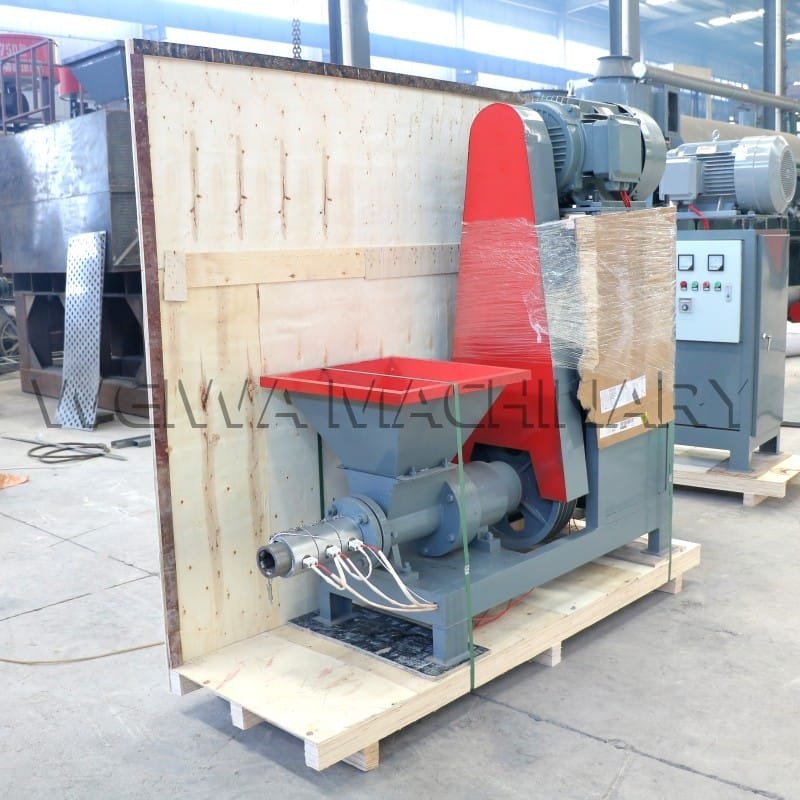
Why Iraq Is a Real Market for 木屑挤出机 申请?
Iraq has a growing woodworking sector, 家具车间, pallet repairs, construction formwork cutting, and agricultural processing zones. All of these activities create offcuts, 剃须, and fine dust. In many Iraqi cities, this material is burned openly, 被抛弃, or left to occupy valuable yard space. A sawdust extrude machine in Iraq changes that equation because it turns low-value residue into dense biomass sticks that can later be carbonized into charcoal.
The Iraqi client did not ask for a generic machine. He asked a very practical question: can I make charcoal sticks from the waste I already have? That question is exactly where Weiwa Machinery starts every project. We do not sell a single machine first. We design a line around moisture, 粒度, raw material mix, local labor skill, electricity condition, and the final charcoal product the market will accept.
What a Sawdust Extruder Actually Does Before Carbonization?
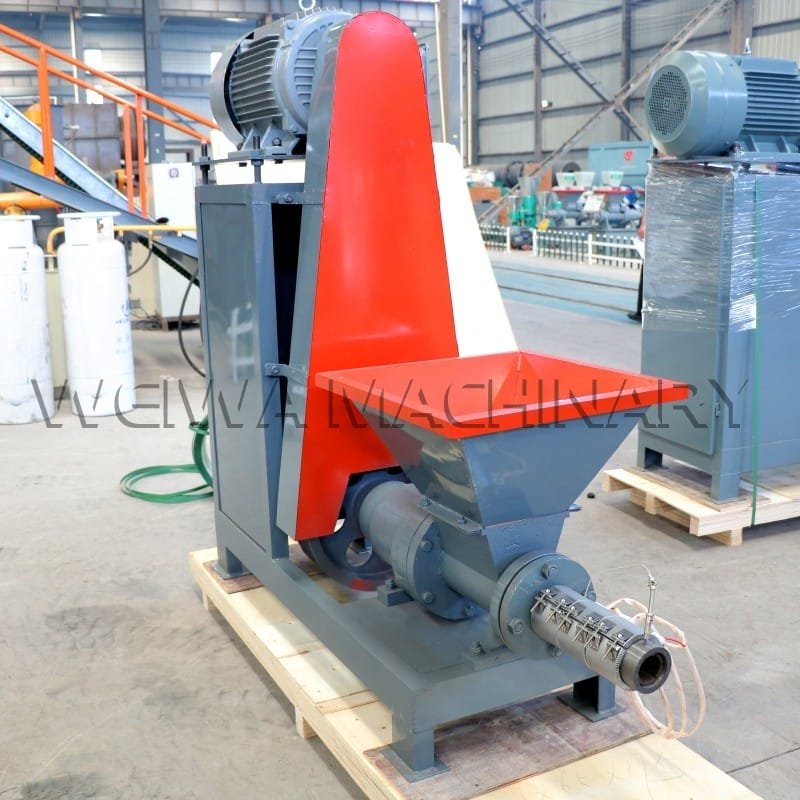
A sawdust extruder is the machine that compresses loose biomass into solid fuel rods. 木屑, 稻壳, 棉秆粉, 手掌记住, 竹尘, or wood shavings are fed into a hopper. A large screw pushes the material into a heating zone and a forming cylinder. 在高温和压力下, natural lignin inside the wood fibers softens and acts as a binder. The material exits through a die as a continuous stick, usually hollow square, 圆形的, 六角形, or pentagon.
Many buyers confuse the sawdust briquette machine with the charcoal stick extruding machine. The sawdust briquette machine makes biomass sticks from raw sawdust. Those sticks are brown, combustible, and already useful as heating fuel. But if the target is black BBQ charcoal or hookah charcoal, the biomass stick must later be carbonized in a kiln or furnace. Only after carbonization does the product become true charcoal.
Raw Material Rules We Applied for the Iraq Trial
Before the sawdust extruder can work well, the feedstock must meet basic rules. Particle size should be below around 5 毫米. Moisture should be close to 8 到 12 百分比. Long fibers, nails, 石头, and wet furniture offcuts must be removed. For the Iraqi customer, we recommended a small hammer mill, a screening step, and a batch dryer because furniture waste in Baghdad and Basra often contains varnish, 胶水, and higher moisture than pure pine sawdust.
The Production Line Weiwa Prepared for the Iraqi Customer
The trial line was not a single unit. It was a connected biomass charcoal preparation system. We prepared a crusher to reduce oversized offcuts, a mixer to blend sawdust with other residues, a dryer to bring moisture into the safe range, the sawdust extrude machine as the main forming machine, a cooling conveyor, stick cutting supports, and a carbonization kiln for the next stage.
For Iraqi conditions, we paid special attention to motor protection, dust collection, and die cooling. Ambient heat in Iraq can be intense, and dusty yards can shorten bearing life. The Weiwa sawdust extruder used a heavy-duty screw, a wear-resistant forming barrel, and a control panel that allowed the operator to watch temperature and current during the run.
Why the Sawdust Briquette Machine Stage Matters?
The sawdust briquette machine stage decides density, surface smoothness, 燃烧时间, and carbonization yield. If the stick is too soft, it breaks before carbonization. 如果水分太高, the stick cracks during drying. If the die temperature is wrong, lignin does not activate properly and the stick crumbles. During the Iraq trial, we ran three die temperatures and two feed speeds to find the most stable combination for local furniture sawdust mixed with date palm residue.
How the Iraq Factory Trial Was Organized?
Our technician joined the customer remotely and through shared video inspection, then validated the Chinese factory trial using the same Iraqi material profile. The idea was simple. If the sawdust extruder performs well in our workshop with the Iraqi material sample, the customer can expect predictable behavior after installation.
The trial began with material classification. The customer sent us samples of mixed furniture sawdust, palm frond powder, and carpenter shop dust. We tested each alone, then tested blends. After that, we adjusted the dryer time, 螺杆转速, heater ring temperature, and die orifice. Only after the stick quality was stable did we move to the carbonization discussion.
Stick Quality Targets in the Trial
For the Iraqi market, the stick did not need to be perfect laboratory biomass. It needed to survive handling, dry without splitting, carbonize evenly, and produce charcoal with low ash and good fracture resistance. We targeted stick density in the practical biomass briquette range, 下面的水分 10 percent after cooling, uniform diameter, 光滑的表面, and minimal internal voids.
Trial Results with the Sawdust Extrude Machine
The sawdust extrude machine in Iraq project produced encouraging results. With properly dried furniture sawdust, the extruder made continuous sticks with stable diameter and good surface hardness. When date palm residue was added, the stick became lighter and more fibrous, so we reduced palm content and increased pure wood dust to keep the lignin bonding strong.
Output depended on moisture and particle size. When the feed was well prepared, the line ran smoothly with low blockage. When the feed was too wet or too coarse, current rose and the operator had to slow the screw. This confirmed a key Weiwa principle: the sawdust extruder is only as good as the preprocessing before it.
Carbonization Behavior of the Extruded Sticks
成型后, the sticks were placed into a batch carbonization kiln. The biomass stick is not charcoal yet. It still contains volatile compounds, moisture traces, 和可燃气体. 碳化过程中, temperature rises slowly, smoke is released, and the stick turns from brown to deep black. The resulting charcoal stick is lighter, more brittle, and much higher in fixed carbon.
For the Iraqi customer, the most important outcome was carbonization uniformity. Sticks with the same density and moisture carbonized evenly. Sticks with hidden wet centers cracked or burned unevenly. The trial proved that investing in drying and screening before the sawdust briquette machine stage saves money later in the kiln.
Best Stick Shapes for the Iraqi Charcoal Market
Hexagonal hollow sticks are popular because they carbonize reasonably well and look familiar to many charcoal buyers. Round sticks are easier to form and good for heating fuel. Square sticks pack tightly and reduce airflow during carbonization, which can change the final charcoal character. Pentagon and edged shapes are more of a branding choice for premium retail charcoal.
For the Iraqi customer, we recommended starting with a proven hexagonal hollow die, then adding round sticks later for restaurants and heating shops. This kept spare parts simple and gave the customer one stable product before expanding the catalog.
活力, 劳动, and Operating Cost Reality in Iraq
A sawdust extrude machine in Iraq is not expensive to run if the material is prepared correctly. Electricity drives the screw, heater rings, 破碎机, 和烘干机. Labor is needed for feeding, monitoring temperature, cutting sticks, 堆叠, and loading the kiln. The biggest hidden cost is poor drying. Wet material slows the extruder, increases motor load, and creates sticks that fail in the carbonization stage.
Weiwa Machinery recommends small Iraqi workshops start with a compact line rather than a huge plant. A compact line is easier to learn, 更容易维护, and easier to finance. Once the local market accepts the charcoal stick, capacity can be expanded with a second extruder, bigger dryer, or additional kiln.
Maintenance Points That Protect the Sawdust Extruder
The screw and die are wear parts. Hardwood dust, 棕榈纤维, and glued furniture waste accelerate wear. Operators should check screw clearance daily, clean the hopper, monitor amperage, lubricate bearings, and replace the die before quality drops. The sawdust briquette machine rewards discipline. A careless operator can damage in one week what a careful operator protects for months.
Environmental and Business Case in Iraq
Iraq faces dust storms, fuel price pressure, and a need for local industry. Converting carpentry waste into charcoal sticks reduces open burning, creates local fuel inventory, and gives small factories a product they can sell regionally. Biomass charcoal is not a magic replacement for all fossil fuel, but it is a practical circular-economy product for workshops, farms, and trading companies.
The sawdust extruder also helps waste owners monetize material they currently pay to remove. In Baghdad, Erbil, Basra, Najaf, and Karbala, furniture clusters generate steady offcuts. A local entrepreneur with a reliable sawdust briquette machine can collect that waste cheaply, process it during the day, and carbonize in controlled batches.
How Weiwa Machinery Supports Iraqi Customers?
Weiwa Machinery does not only ship steel. We send a project mindset. For the Iraq enquiry, our team reviewed the customer’s raw material photos, estimated monthly waste volume, discussed available workshop space, checked voltage and container access, and proposed a line that matched the budget without overloading the operator.
After machine dispatch, 我们提供安装指导, spare die support, screw maintenance training, carbonization temperature curves, and marketing advice for local charcoal sales. The sawdust extrude machine in Iraq project is managed like a small factory startup, not just an equipment order.
Factory Trial Report Summary
Mixed furniture sawdust formed well after drying. Date palm residue required blending limits. Stick diameter stayed stable across the tested run. Carbonization samples showed acceptable blackening and structural integrity when pre-drying was correct. The customer understood that charcoal quality begins at the crusher and dryer, not only at the extruder die.
Should You Start with Sawdust Extruder or Charcoal Stick Extruding Machine?
If you already have sawdust, 刨花, 稻壳, 棉茎, or palm husk, start with a sawdust extruder and carbonization system. If you already have charcoal powder, 煤粉, or carbon dust and want to reshape it into retail sticks, then a charcoal stick extruding machine or charcoal briquette press is more relevant.
Many Iraqi traders confuse the two because both produce rod-shaped fuel. The safer first investment is the sawdust briquette machine line because the raw material is often already available inside the customer’s own workshop or nearby furniture market.
Technical Notes Buyers Should Request Before Ordering
Ask for screw material grade, die material, 电机功率, heater ring count, capacity at your moisture level, spare parts list, 电压兼容性, 基础图, feed size limit, 水分限制, stick diameter options, carbonization loss estimate, and local service language support. A serious sawdust extrude machine supplier answers these clearly instead of promising unrealistic output.
Capacity Numbers Must Be Honest
Many websites claim huge hourly output. In real Iraqi conditions, capacity depends on moisture, feed consistency, screen size, operator skill, and cooling. Weiwa Machinery prefers to quote realistic working capacity after material testing. A line that runs steadily for eight hours is better than a machine that clogs every thirty minutes.
Local Raw Materials That Work Well in Iraq
Furniture factory sawdust works well when dry. Wood pallet grindings work well after metal removal. Olive pruning wood from agricultural areas can be chipped and crushed. Rice husk from grain trading zones can be blended in small ratios. Date palm residue is abundant but fibrous, so it should be blended rather than used alone. Cotton stalk from farming regions can be shredded, but moisture and dirt must be controlled.
Carbonization Methods Suitable for Small Iraqi Plants
Batch kilns are easiest for beginners. They need more labor but lower capital. Continuous carbonization furnaces suit larger plants with stable feed and skilled staff. Brick kilns are common but harder to control. Steel Weiwa kilns give better process control and recovery. The right choice depends on daily stick output, land size, labor cost, and local emission expectations.
Quality Check After Carbonization
Good charcoal sticks should be black, not brown. They should resist crumbling in the hand but break with a clean fracture. They should burn with low visible smoke after ignition and leave relatively low ash compared with dirty fuel. If the stick smells strongly of tar, carbonization was too fast or temperature control was poor.
出口, 包装, and Retail Angle for Iraq Charcoal
Once the Iraqi customer stabilizes quality, the next step is packaging. Charcoal sticks can be packed in 5 公斤, 10 公斤, 或者 20 kg cartons for restaurants. Larger woven sacks work for heating fuel. Premium hookah charcoal requires stricter hardness, 低火花, low odor, 并且尺寸统一. The sawdust extruder only starts this chain, but it decides whether the downstream brand looks professional.
Why Weiwa Sawdust Extruder Design Fits Harsh Markets?
Weiwa Machinery builds the sawdust extruder with reinforced framing, industrial bearings, copper-coil motor options, adjustable heater rings, and replaceable screws. For Middle East buyers, we emphasize dust protection, spare die availability, and simple controls. The machine should be strong enough for factory use but simple enough for a trained operator to run daily.
Training Plan for the Iraqi Operator
Day one covers safety and material inspection. Day two covers crusher and dryer settings. Day three covers hopper feeding and screw speed. Day four covers die change and stick quality check. Day five covers carbonization basics and common faults. This approach turns a machine buyer into a charcoal producer.
Risk Factors Iraqi Investors Should Not Ignore
Wrong moisture is the biggest risk. Poor raw material sorting is the second. No spare die is the third. Underestimating carbonization time is the fourth. Believing that one machine makes finished black charcoal is the fifth. A sawdust briquette machine makes biomass sticks. Charcoal comes from correct carbonization afterward.
Future of Sawdust Extrude Machine in Iraq
As Iraq diversifies away from total dependence on imported fuel and scattered waste burning, localized charcoal production will grow. Furniture clusters, agricultural hubs, and trading companies can build small biomass plants. A sawdust extrude machine in Iraq is not a futuristic concept. It is a practical response to waste that already exists every day in carpentry yards and farming towns.
Weiwa Machinery Company Introduction
Weiwa Machinery is a manufacturer and exporter of biomass briquette machines, 木炭制造机, 碳化设备, 木材破碎机, 旋转式干燥机, 和完整的木炭生产线. Our machines have been shipped to more than 130 国家, including markets in Asia, 非洲, 欧洲, 中东, 和拉丁美洲. We help customers move from raw waste to marketable fuel through practical engineering, material testing, line design, 安装指导, 和售后支持.
For the Iraqi market, our role is clear. We do not only supply a sawdust extruder. We help local entrepreneurs build a stable charcoal stick business from furniture waste, agricultural residue, and wood processing dust. Whether you need a sawdust briquette machine, a charcoal stick extruding machine, 烘干机, 破碎机, or a full carbonization plant, Weiwa Machinery can design the line around your raw material and budget.
接触 WEIWA机械
If you want to start a sawdust extrude machine project in Iraq, send your raw material photos, 水分状况, available space, and target output. Our team will propose a practical line and explain the trial results in plain language.
暴民: +8613838093177
WhatsApp: +8613838093177
电子邮件: info@cjlmachinegroup.com
Weiwa Machinery welcomes Iraqi distributors, charcoal traders, furniture waste collectors, and factory owners to visit our workshop or start with a material test. The Iraq trial proved one thing again: good charcoal begins long before the kiln, and the sawdust extruder is where the real discipline starts.


 微信
微信

 +8615937143060
