


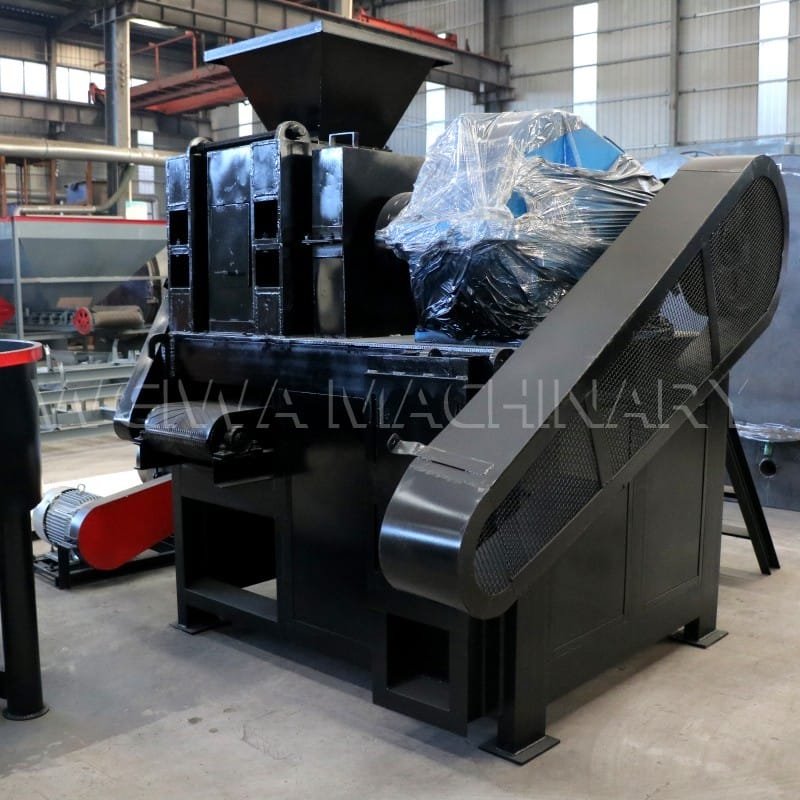
On-Site Shipment of the Máy ép bi than at Weiwa Machinery Factory
The recent export order for a Peruvian customer included one main ball charcoal briquettes machine with customized roller moulds for oval and pillow-shaped briquettes, a twin-shaft mixer for even blending of charcoal powder with binder, a crusher for pre-grinding oversized lumps, a storage silo, and a mesh belt dryer. Before packing, our quality-control team ran a no-load test and a load test using simulated charcoal powder to confirm pressure stability, roller alignment, and reducer performance. Each rotating part was lubricated, and anti-rust oil was applied to exposed machined surfaces.
For overseas shipments — especially to South America — we follow strict packing standards. The main máy ép bóng than frame was securely fixed on steel skids inside a 20ft container, with foam board and plastic film protecting the rollers from moisture during ocean transit. Accessories such as the mixer, small conveyor, and spare rollers were packed in fumigation-free wooden cases marked with clear part numbers. Photos and a packing list were shared with the Peruvian client so they could prepare for customs clearance at the Port of Callao. Watching a fully inspected Máy briquette than line leave our workshop reinforces why making charcoal balls in Peru is not only technically feasible but also highly profitable when supported by the right equipment.
Why the Demand for Making Charcoal Balls in Peru Is Growing Rapidly?
Peru has a well-established culture of using charcoal for grilling — from family asados to busy street-food vendors in Lima, Arequipa, and Cusco. Theo truyền thống, many small producers sell irregular lump charcoal or loosely compacted powder, which burns unevenly and creates excess ash. Across both household and commercial segments, there is a visible shift toward uniformly shaped, high-density briquettes produced by a máy ép bóng than. These pressed balls ignite more easily, burn longer, generate less smoke, and can be branded and packaged — adding value that raw charcoal cannot offer.
Beyond the food service sector, some Peruvian metallurgical workshops and small foundries use shaped coal or charcoal briquettes as auxiliary fuel. For entrepreneurs exploring making charcoal balls in Peru, the combination of abundant local biomass residues — such as hardwood charcoal dust from sawmills and coconut shell charcoal imported from neighboring regions — with an affordable, bền Máy than than Ball from Weiwa Machinery creates a compelling business case. Lower raw-material cost plus higher resale price per kilogram of finished briquettes means a reasonable payback period even for a modest-capacity Máy briquette than line.
Clean Cooking Initiatives and Local Market Opportunity
Government and NGO programs encouraging cleaner cooking alternatives indirectly support the adoption of modern Máy briquette than technology. Uniform briquettes reduce indoor smoke compared to open-fire wood burning, aligning with public health goals. For Peruvian startups and SMEs, investing in a máy ép bóng than to produce standardized BBQ charcoal balls positions them to serve supermarkets, wholesale distributors, and restaurant chains looking for consistent quality fuel. Our Peruvian client chose Weiwa’s ball charcoal briquettes machine precisely because it allows quick mould changes — one day producing 30 mm round balls for retail BBQ packs, the next day oval shapes for bulk industrial orders.
What Is a Ball Charcoal Briquettes Machine and How Does It Work?
A Máy than than Ball, also referred to as a máy ép bóng than or roller-type briquette press, uses two counter-rotating alloy steel rollers engraved with hemispherical or customized pockets. Charcoal or coal powder — typically under 3–5 mm in particle size and conditioned to an optimal moisture level — is fed into the hopper by a screw feeder that maintains constant material pressure. As the rollers close, mechanical pressure squeezes the powder into dense, identically shaped balls. When the pocket passes the roller centerline, pressure is released and the finished briquette drops onto a discharge conveyor.
The key advantage of a máy ép bóng than over simple manual moulding is consistent high pressure, which yields briquettes with higher density, better drop resistance, and slower, more uniform combustion. Weiwa’s Máy briquette than models range from small 290-type units suitable for pilot runs of making charcoal balls to large 850- or 1000-type high-output lines for full-scale factories. All can be equipped with a hydraulic auxiliary system for extra forming pressure when difficult powders are involved.
Common Shapes and Sizes Produced by the Charcoal Ball Press Machine
Thanks to CNC-engraved roller skins, a single ball charcoal briquettes machine can produce round balls (commonly 25–50 mm diameter), oval eggs, square pillows, or even logo-embossed custom shapes upon request. Peruvian buyers frequently ask for 30–40 mm round balls for retail BBQ kits and slightly larger oval pillows for wholesale catering suppliers. Changing the shape only requires swapping the roller pair — no modification to the main frame of the máy ép bóng than is necessary.
Complete Charcoal Briquette Production Line Workflow
While the máy ép bóng than is the core forming unit, a commercially viable plant for making charcoal balls normally integrates several complementary machines. Below is how a typical Weiwa-designed line operates from start to finish.
Bước chân 1 – Crushing Oversized Charcoal Lumps
Raw charcoal often arrives as broken lumps or agglomerated chunks. A hammer crusher or vertical compound crusher reduces them to below 3–5 mm so the ball charcoal briquettes machine rollers can compact the material properly. Inadequate crushing leads to poor filling of the roller pockets and weaker briquettes.
Bước chân 2 – Mixing Powder with Binder and Water
Charcoal powder alone has almost no natural cohesion. A twin-shaft paddle mixer blends the powder with an appropriate percentage of water and a binder — commonly starch paste, cassava flour, molasses, or specialized organic binders. Even distribution is critical: uneven binder causes some briquettes from the máy ép bóng than to crumble while others over-harden. The target moisture after mixing is usually in the range of 10–15 percent depending on the binder system chosen for making charcoal balls in Peru or other tropical climates.
Bước chân 3 – Storing and Metering the Mixed Material
A buffer silo with a variable-speed discharge screw ensures continuous, surge-free feeding to the Máy briquette than. Consistent feed rate stabilizes forming pressure and prevents roller overloading — a detail we always emphasize during remote commissioning of our ball charcoal briquettes machine exports.
Bước chân 4 – Forming Briquettes with the Charcoal Ball Press Machine
This is the defining stage. The pre-mixed material enters the hopper of the máy ép bóng than, is pushed into the roller pockets, and emerges as uniformly shaped, high-density balls. Operators can adjust screw-feed speed to match the rated capacity of the selected Máy than than Ball model, typically ranging from 1 t/h up to 20+ t/h for large plants.
Bước chân 5 – Drying the Freshly Pressed Briquettes
Newly formed briquettes still contain bound moisture from the binder solution and must be dried before storage or packaging. A mesh belt dryer or tunnel dryer gently removes moisture at controlled temperature, preserving briquette integrity. Proper drying is essential — insufficient drying causes mold growth in packaged making charcoal balls các sản phẩm, while overheating can cause surface cracking. Many of our Peruvian and Latin American clients opt for mesh belt dryers powered by waste-heat recovery from their own facilities.
Bước chân 6 – Cooling Screening and Packaging
After drying, a vibrating screen separates any broken pieces (which can be recycled back to the mixer) from qualified balls. The finished briquettes — now ready for market — are counted and sealed in bags or boxes bearing the customer’s brand. A complete Máy briquette than line from Weiwa Machinery can be semi-automatic or fully automatic depending on budget and expected daily throughput.
Key Features of Weiwa Machinery Ball Charcoal Briquettes Machine
With more than thirty years of experience in designing and manufacturing briquette equipment, Weiwa’s máy ép bóng than series is engineered for durability and ease of maintenance. The rollers are made from high-chromium alloy steel, quenched and tempered for extended service life even under continuous high-pressure operation. The gearbox adopts a nationally recognized reduction unit sized conservatively to absorb shock loads. Bearings are housed in heavy-duty blocks with grease-nipple access for straightforward daily maintenance — an important consideration for making charcoal balls in Peru where on-site technical support may be remote.
Electrically, each Máy than than Ball can be configured for 220V/380V/415V, 50Hz or 60Hz, matching local grid standards in South America. For locations with unstable power or off-grid operation, we also supply diesel-engine-driven versions of our máy ép bóng than. Control cabinets include overload protection, emergency stop, and optional PLC touchscreen interfaces for centralized monitoring of the entire Máy briquette than line.
Customization Layout Planning and After-Sales Support from Weiwa Machinery
We understand that no two briquette projects are identical. When you inquire about a ball charcoal briquettes machine for making charcoal balls in Peru or any other region, our engineering team reviews your expected daily output, raw material type, moisture condition, preferred briquette shape, and available workshop dimensions. We then provide free layout drawings showing equipment placement, utility connections, and material flow — helping you plan foundations and civil works before the container even arrives.
All Weiwa máy ép bóng than exports are covered by a standard warranty on main components, backed by a professional after-sales team offering installation videos, remote video guidance, and responsive email/WhatsApp technical support. Spare parts — including spare roller skins for your Máy briquette than — are stocked and can be shipped promptly to minimize downtime. With decades of export experience to over 130 quốc gia, we are familiar with South American import documentation and can advise on certificate requirements for smooth customs clearance.
Get a Tailored Quote for Your Charcoal Ball Press Machine Project
If you are considering making charcoal balls in Peru or expanding an existing charcoal processing business, Weiwa Machinery is ready to support you with a proven Máy than than Ball, complete production line design, and ongoing technical assistance. Contact us today to discuss your capacity requirements and receive a customized proposal for a máy ép bóng than or full Máy briquette than system tailored to your market.
Về Máy móc Weiwa: Weiwa Machinery has over 30 years of experience in manufacturing briquette and charcoal processing equipment. We offer customized design, factory layout planning, and a professional after-sales team to support global clients. Nhiều hơn 2 million customers worldwide trust WEIWA MACHINERY for reliable, high-performance solutions.
Contact us for a free quotation:
Đám đông / WhatsApp: +86 138 3809 3177
E-mail: info@cjlmachinegroup.com


 WeChat

 +8615937143060
