


Why Zimbabwe Needs Sawdust-Based Charcoal Briquette Production Lines?
Traditional charcoal production in Zimbabwe relies heavily on felling indigenous hardwoods such as miombo woodland species, then earth-mound or pit kiln carbonization. This method is inefficient, with typical charcoal yield below thirty percent, and it contributes to ongoing deforestation, soil erosion, and loss of biodiversity. Urban demand for cooking fuel continues to rise in cities like Harare, Bulawayo, and Mutare, while rural sawmills and furniture factories generate large quantities of waste sawdust that are often dumped or burned in open air—wasting both material and thermal potential.
A modern charcoal briquette machine in Zimbabwe that processes sieved sawdust into extruded briquette sticks, followed by controlled carbonization, offers three major advantages. First, it diverts wood-processing waste from landfills and turns it into a marketable energy product. Second, machine-made charcoal has higher density and calorific value—typically twenty percent more heat per kilogram compared to traditional lump charcoal. Third, a professionally engineered sawdust extrude production line reduces emissions during carbonization through recoverable flue-gas design and improves workplace safety compared to primitive kilns.
For Zimbabwean investors, the combination of abundant sawmill offcuts, rising urban charcoal prices, and government interest in sustainable energy makes the import of a reliable sawdust extruder in Zimbabwe an economically sound decision. Our Zimbabwean client approached Weiwa Machinery with exactly these motivations: to build a small-to-medium commercial plant capable of processing one to one-and-a-half metric tons of dry sawdust per hour.
Core Components of a Weiwa Sawdust Extrude Production Line
To serve the African market, Weiwa configures each sawdust charcoal making machine system according to local raw-material characteristics, available power supply, and target daily output. The Zimbabwe line consisted of the following interconnected units, each selected after reviewing samples of local pine and eucalyptus sawdust sent by the client.
Biomass Crusher and Sieve
Although most sawdust from planer mills already falls below five millimeters, coarse chips and bark fragments must be reduced to uniform particle size. Weiwa supplies hammer-mill crushers with adjustable screen mesh so that oversized particles are re-ground. Consistent size is essential because the sawdust extruder compresses material through a heated barrel and forming die; particles larger than five millimeters can cause uneven heating, blockages, or surface cracking in the extruded rod.
Sawdust Rotary Drum or Pipe Dryer
Moisture content is the single most critical parameter before extrusion. Ideal input moisture for a sawdust charcoal making machine using screw extrusion technology is eight to twelve percent. Green sawdust from the mill typically contains moisture between thirty and fifty percent. Our Zimbabwe client used a concurrent rotary drum dryer heated by a biomass burner firing off undersized briquette rejects. The dryer reduced moisture to ten percent ± one percent, which we verified with a portable moisture meter prior to each trial batch.
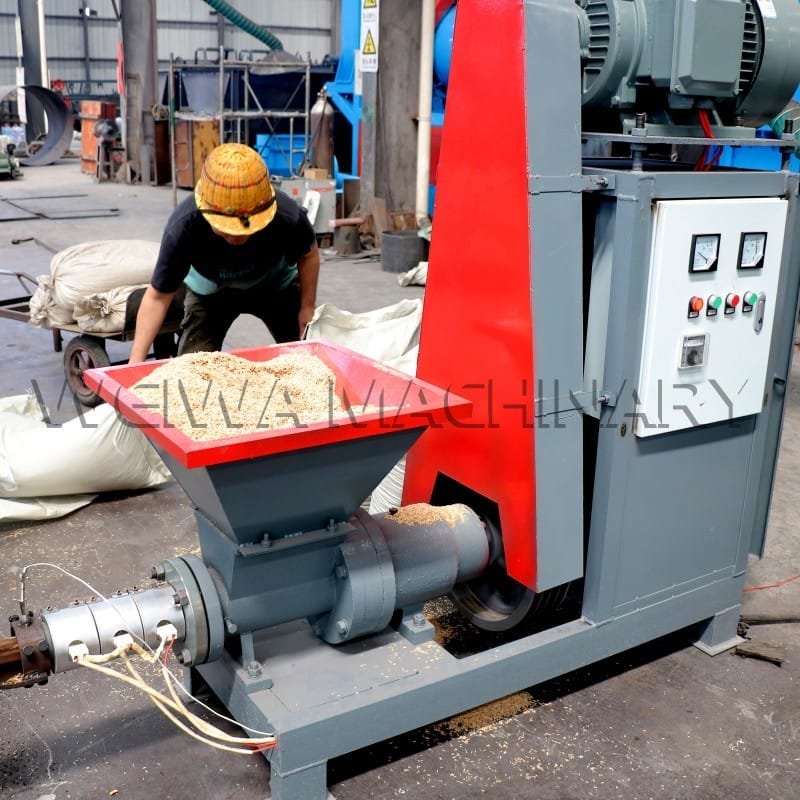
Người đùn cưa (Screw-Type Briquette Machine)
The heart of the sawdust extrude production line is the screw extruder. Inside the closed barrel, a high-strength alloy screw propels sawdust forward while a resistance heating ring raises the temperature to one hundred sixty–two hundred eighty degrees Celsius depending on feedstock type. At this temperature, the natural lignin in woody biomass softens and acts as a self-binder—no chemical additives are required. The screw compresses the material to densities of one point one to one point four grams per cubic centimeter, then forces it through a shaped die, normally producing a hollow hexagonal or quadrilateral rod forty-five to eighty millimeters in diameter with a fifteen to twenty millimeter central hole.
Weiwa extruders for Africa are fitted with thickened screw shafts and replaceable tungsten-carbide tips to withstand abrasive tropical hardwood dust. The model supplied to Zimbabwe featured a seventy-millimeter hexagonal die, auto-temperature controller, and a variable-frequency drive allowing the operator to fine-tune screw speed versus feed rate—a useful feature when switching between pine sawdust (lower lignin) and eucalyptus (higher lignin).
Continuous or Batch Carbonization Furnace
Extruded briquette sticks are then carbonized in an oxygen-limited environment. The Zimbabwe project utilized a three-layer horizontal carbonization furnace with internal baffles and a gas-recirculation system. As the briquettes heat, volatile matter escapes and is partially condensed or re-burned as supplementary fuel. Properly carbonized briquettes exhibit fixed carbon content above seventy percent, tro thấp, and a shiny black appearance. Các charcoal making machine in Zimbabwe context benefits from this type of furnace because it shortens carbonization time to four–six hours per batch and achieves charcoal yield of approximately ninety percent by weight of the extruded stick.
Cooling and Packaging Section
Sau khi cacbon hóa, charcoal is discharged into a water-cooled screw conveyor or allowed to air-cool in a shaded bay. Packaging can be manual into woven sacks or semi-automatic into printed polyethylene bags bearing the customer’s brand. Although simple, this last stage influences market perception—uniformly sized, clean charcoal packaged in clearly labeled bags commands premium pricing in Zimbabwean supermarkets and cross-border markets such as Mozambique or Zambia.
The Five-Step Sawdust-to-Charcoal Process Explained for African Producers
Understanding each stage helps operators optimize quality and troubleshoot common issues. Below we describe the complete workflow as executed during the Zimbabwe trial.
Step One – Raw Material Collection and Pre-Crushing
Sawdust, trấu gạo, Vỏ đậu phộng, Bụi tre, Cá bông, or sugarcane bagasse may be used alone or blended. For the Zimbabwe client, the dominant feedstock was a mix of seventy percent pine sawdust and thirty percent eucalyptus sawdust sourced from a local timber yard. Oversized chips were passed through the hammer mill and screened to below three to five millimeters. Uniform particle size promotes even heat transfer inside the extruder barrel.
Step Two – Drying to Target Moisture
The dried sawdust exiting the rotary dryer is checked continuously. If moisture exceeds twelve percent, extrusion will generate excess steam inside the die, causing blown-out ends or longitudinal cracks. If moisture drops below six percent, lignin plasticization is incomplete and the extruded rod may crumble. During the Zimbabwe commissioning, inlet sawdust at forty percent moisture required approximately seven minutes residence time in the drum dryer at two hundred twenty degrees Celsius gas temperature to reach the target ten percent.
Step Three – High-Pressure Extrusion Without Binders
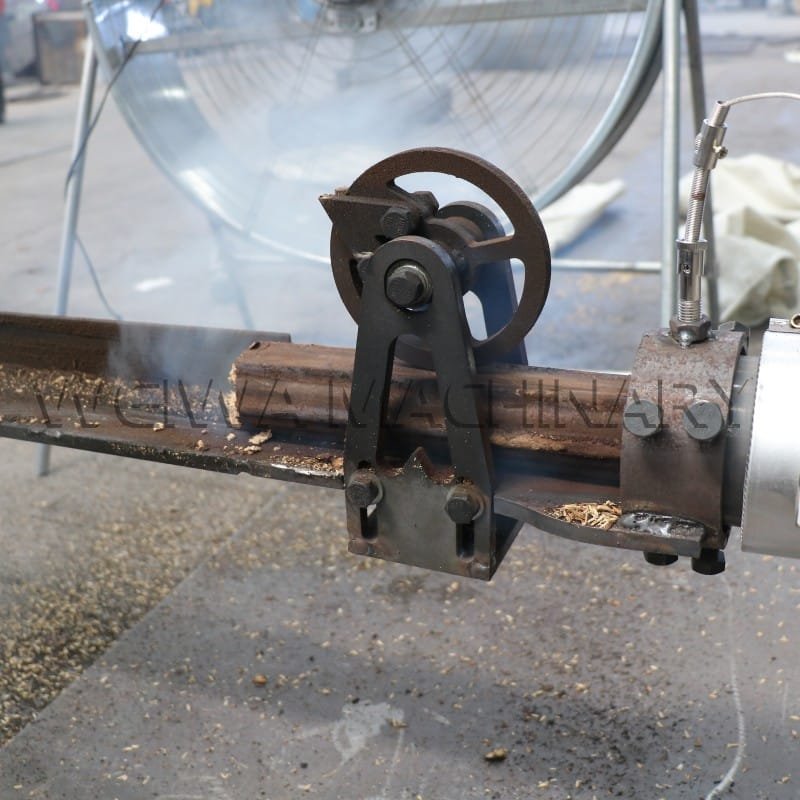
Dried sawdust feeds into the extruder hopper via a variable-speed screw conveyor. The heating coil wraps around the barrel’s final third and is thermostatically controlled. As material moves along the screw, friction and external heating soften lignin. The screw’s compression ratio—typically one-to-four or one-to-five—forces the biomass into the forming die where it exits as a continuous hollow rod, cut to length by an attached mechanical guillotine. The sawdust extruder in Zimbabwe ran at one thousand two hundred kilograms per hour during the trial with stable current draw and uniform rod color indicating thorough lignin activation.
Step Four – Carbonization of Extruded Briquette Sticks
Extruded sticks are loaded into the carbonization furnace on perforated trays or pushed through a continuous kiln on a chain conveyor. Temperature is ramped gradually to four hundred fifty–six hundred degrees Celsius depending on desired charcoal characteristics. In the absence of oxygen, volatiles are driven off leaving a fixed-carbon rich rod. Our trial in Zimbabwe confirmed that pre-extruded dense sticks carbonize more evenly and faster than loose sawdust packed in a pit, and produce less unburned residue. Flue gas was directed through a condensation unit; combustible components were reignited to preheat the dryer—improving overall thermal efficiency by an estimated eighteen percent.
Step Five – Cooling, Grading, and Pack Out
Finished charcoal is brittle until fully cooled. The Zimbabwe line allowed a minimum of thirty minutes ambient cooling before manual grading to remove fines. Acceptable briquettes were packed in twenty-kilogram woven sacks with inner poly liner. Rejected fragments—usually under five percent—were recycled as ignition aid in the dryer burner or sold as barbecue starter dust.
Zimbabwe Factory Trial Results and Performance Data
The on-site trial spanned three consecutive days, during which Weiwa technicians trained the client’s operators in startup, temperature tuning, die changing, and basic maintenance. Key observations from the Zimbabwe commissioning are summarized below.
The sawdust extruder processed an average of one thousand one hundred eighty kilograms of qualified sawdust per hour with power consumption of zero point zero five nine kilowatt-hours per kilogram, which is below the industry average for comparable screw extruders. Extruded rod density measured one point two eight grams per cubic centimeter, well within specification. Visual inspection showed smooth surfaces, sharp hexagonal edges, and consistent central holes—indicators of correct temperature and screw wear status.
Carbonization of the extruded sticks in the three-layer furnace yielded approximately ninety point two percent charcoal by weight relative to the dry extruded rod. Fixed carbon content after laboratory proximate analysis was seventy-three point six percent, moisture below three percent, and ash under four percent—meeting premium-grade charcoal benchmarks. The final charcoal briquette machine in Zimbabwe output exhibited breakage rate below five percent after a simulated one-meter drop test, confirming adequate bonding from the extrusion phase.
The Zimbabwean client noted that the simple control panel, localized English labeling, and availability of spare screws and heaters from Weiwa’s regional stock reduced their perceived operational risk. Following the trial, they placed a repeat order for a second extruder and a larger-capacity dryer to double plant throughput within six months.
Common Challenges When Running a Sawdust Charcoal Making Machine in Africa and How Weiwa Addresses Them
African operating environments can present unreliable three-phase power, high ambient humidity during rainy season, and variable raw-material quality. Weiwa sawdust extrude production line designs incorporate the following adaptations: variable frequency drives tolerate ± ten percent voltage fluctuation; stainless-steel dryer drums resist corrosion from humid air; modular frame construction allows containerized shipment and straightforward reassembly even on uneven concrete floors typical of small industrial yards in Zimbabwe.
Another frequent issue is improper moisture measurement leading to extruder jamming. We supply digital pin-type moisture meters and train staff to sample from three points in the storage silo. If sawdust is too wet, the heater amperage spikes and the rod surface blisters; if too dry, the rod emerges pale brown and fractures easily. Recognizing these visual cues is part of the operator certification we provide with every sawdust charcoal making machine export.
Environmental and Economic Impact of Charcoal Making Machine in Zimbabwe
By substituting even thirty percent of traditional kiln charcoal with briquetted sawdust charcoal, a medium-scale plant processing two tons of sawdust daily can save the equivalent of approximately forty to fifty mature trees per month from being cut solely for charcoal. The briquette product also burns longer and with less visible smoke, improving indoor air quality for end-users in high-density urban areas of Zimbabwe.
Economically, the client’s preliminary calculation indicated a payback period of under fourteen months assuming local wholesale charcoal prices and a conservative seventy percent utilization rate. Revenue can be further diversified by selling excess heat-dried sawdust as animal bedding or boiler fuel, and by offering toll-processing services to nearby sawmills that lack waste-handling solutions.
Why Choose Weiwa Machinery for Your Sawdust Extruder in Zimbabwe and Across Africa?
Weiwa Machinery has exported biomass briquetting and carbonization equipment to more than one hundred thirty countries including Indonesia, Ấn Độ, Malaysia, Việt Nam, Thổ Nhĩ Kỳ, Ba Lan, Ai Cập, Tanzania, and South Africa. Our engineering team customizes sawdust extrude production line layouts to match your workshop footprint, raw-material profile, and budget. Every charcoal making machine in Zimbabwe we ship is accompanied by:
– Detailed English operation and maintenance manuals
– Spare-part kits sized for the first year of operation
– Remote video commissioning plus optional on-site engineer dispatch
– Ongoing formulation advice when you wish to blend agricultural residues such as rice husk or sugarcane bagasse with wood sawdust
Our production facility is ISO-certified and all extruder screws undergo heat-treatment and dynamic balancing tests before leaving the factory. Whether you are a first-time entrepreneur exploring a sawdust extruder in Zimbabwe or an established charcoal trader upgrading to mechanized production, Weiwa provides the technical backing to ensure your investment performs.
Get in Touch With Máy móc Weiwa
If you are considering installing a charcoal briquette machine in Zimbabwe, Một sawdust charcoal making machine dây chuyền sản xuất, or simply want to know which capacity best fits your raw-material supply, contact our sales team today for a free customized proposal and ROI estimation.
Contact Weiwa Machinery:
Đám đông / WhatsApp: +86 138 3809 3177
E-mail: info@cjlmachinegroup.com
Website: https://cjljx.com
Về máy móc Weiwa
Máy móc Weiwa (Máy móc Wei Wa) is a professional manufacturer of biomass briquetting and charcoal production equipment, including sawdust extrude machines, sawdust charcoal making machines, MÁY BRIQUETE, carbonization furnaces, crushers, and dryers. With customers in over 130 countries—Indonesia, Ấn Độ, Malaysia, Việt Nam, Thổ Nhĩ Kỳ, Ai Cập, Tanzania, Nam Phi, and more—Weiwa provides turnkey sawdust-to-charcoal production line solutions, customized layout design, spare parts support, and overseas commissioning service. Our mission is to help global clients convert agricultural and forestry waste into high-value clean fuel efficiently and sustainably.


 WeChat

 +8615937143060
