


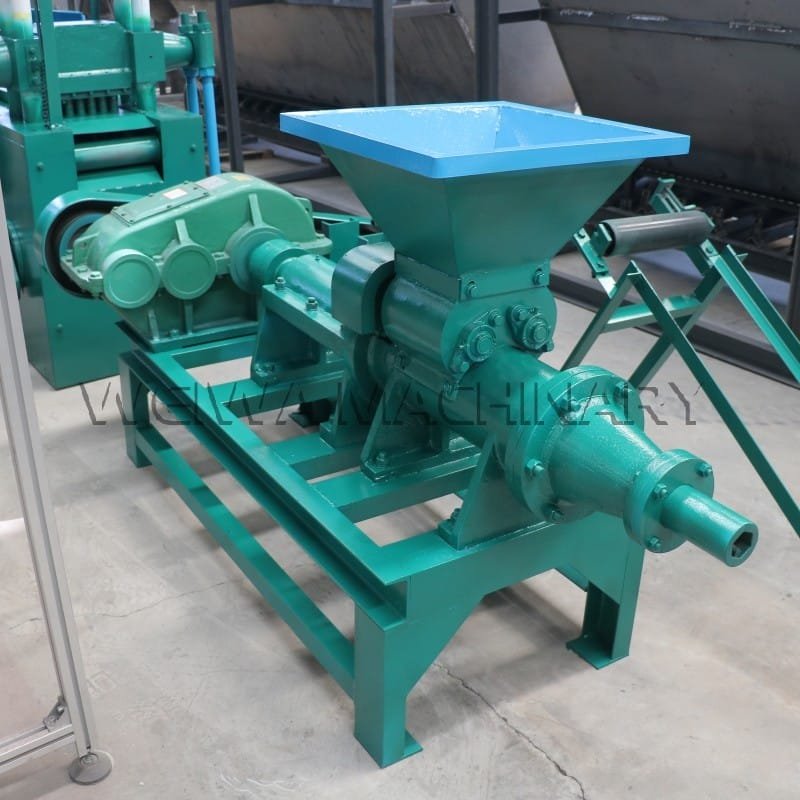
ล่าสุด, Weiwa Machinery completed the factory loading and shipment of a complete coal rod machine production line destined for Zimbabwe. This delivery marks another important step in supporting sustainable fuel development in Africa and reflects the growing demand for charcoal extruder machine in Zimbabwe and surrounding regions.
Shipment Site of the Coal Rod Machine Production Line to Zimbabwe
The production line shipped to Zimbabwe includes a charcoal crusher, wheel mixer, เครื่องอัดรีดถ่าน, and drying equipment. Before loading, our technical team conducted a full test run to ensure stable extrusion pressure, uniform rod shape, and continuous operation. Each unit was wrapped with protective plastic film and reinforced with wooden boxes suitable for long‑distance ocean and land transport. Photographs and videos of the test run were shared with the Zimbabwean client to confirm machine performance in advance.
At the loading site, forklifts and cranes worked in coordination to position the heavy equipment safely into the container. The coal rod machine, as the core unit of the line, was secured with steel brackets to prevent vibration damage. Our export packing standard follows international shipping requirements and is designed to protect precision components such as the gearbox, motor, and extrusion screw during transit to Zimbabwe and other African ports.
This shipment is not only a delivery of machines but also a transfer of technical support. Along with the equipment, we provided English operation manuals, electrical diagrams, spare parts lists, and a customized workshop layout drawing based on the client’s available space. For Zimbabwean users, understanding how to install and operate a charcoal extruder machine in Zimbabwe is critical to achieving stable output and reducing maintenance costs in the early stage of production.
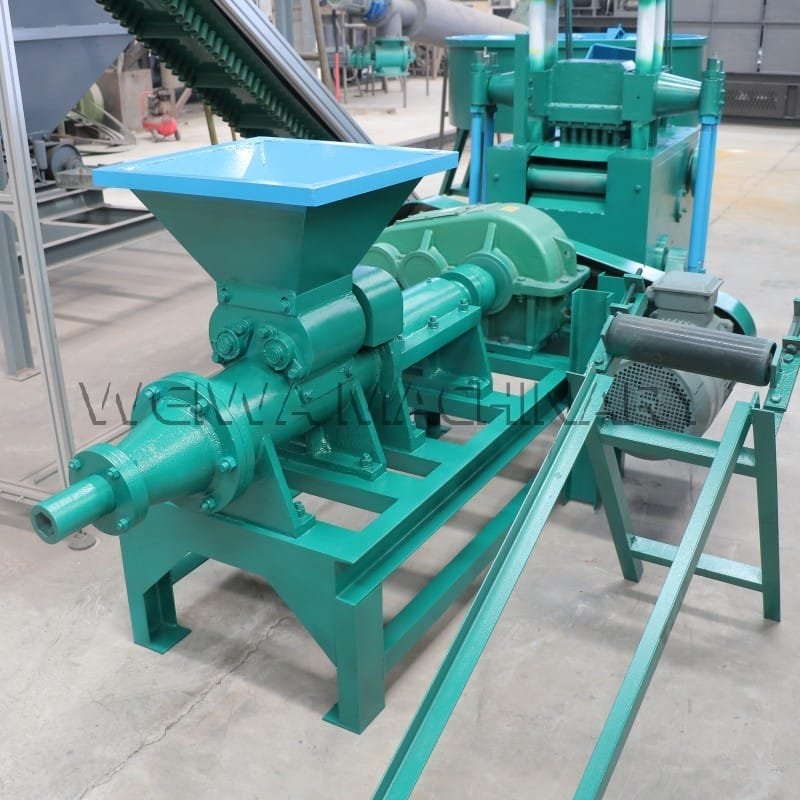
Pre‑Shipment Inspection and Quality Verification
Every charcoal extruder machine leaves the Weiwa factory after a strict quality inspection process. We check the propeller welding, mold concentricity, motor rotation direction, and lubrication system. For export orders such as this Zimbabwe coal rod machine line, we also simulate load testing using charcoal powder and coal dust to verify capacity and rod density. These steps ensure that the charcoal making machine performs consistently when it reaches the client’s site.
Export Packing and Logistics Considerations for Zimbabwe
Shipping machinery to Zimbabwe requires attention to humidity control, anti‑rust treatment, and container space utilization. We apply anti‑corrosion oil to exposed screw shafts and seal electrical control boxes with desiccant bags. Clear packing lists and marking labels help customs clearance and on‑site unloading. Our logistics team coordinates with freight forwarders experienced in African routes to minimize transit risks for charcoal briquette machine orders.
What Is a Coal Rod Machine and How Does It Work?
A coal rod machine is also widely known as a charcoal extruder machine. It is designed to compress charcoal powder, ผงถ่านหิน, or biomass charcoal dust into solid rods or sticks through high‑pressure screw extrusion. The raw material is first crushed into fine powder below a certain mesh size, mixed with a proper binder and water to reach suitable moisture content, and then fed into the hopper of the charcoal extruder machine. Inside the barrel, the rotating screw propels the material forward while generating high pressure and friction heat. The material is squeezed through a forming die head to produce continuous rods with uniform density.
The shape of the rods can be cylindrical, สี่เหลี่ยม, หกเหลี่ยม, or other customized profiles depending on the mold installed. A charcoal making machine production line usually integrates crushing, mixing, extrusion, and drying to transform loose powder into marketable fuel rods. In Zimbabwe, where both charcoal dust and coal powder are available from various sources, a coal rod machine provides an efficient way to upgrade waste materials into high‑value fuel products.
Main Components of a Charcoal Extruder Machine
The key components of a charcoal extruder machine include the feeding hopper, screw propeller, barrel, forming die, gearbox, motor, and frame. The screw propeller is usually made of high‑manganese alloy or surfaced with wear‑resistant material to withstand continuous abrasion. The gearbox ensures stable torque transmission under high load. The die head determines the rod shape and size. For different markets such as Zimbabwe, we adjust the screw pitch, compression ratio, and die resistance to match local raw material characteristics.
Raw Material Requirements for Coal Rod Machine Production
To achieve good extrusion results, the raw material for a coal rod machine should have appropriate fineness, ความชื้น, and binder ratio. Charcoal powder or coal dust is typically required to be under 3 mm after crushing. Moisture content is often controlled between 8% และ 12%. Too high moisture may cause blocking, while too low moisture can lead to cracking. A small percentage of binder such as starch or cassava flour is commonly added to improve green strength before drying. Understanding these parameters helps Zimbabwean users optimize the performance of their charcoal extruder machine in Zimbabwe.
Zimbabwe Market Potential for Charcoal Extruder Machine and Coal Rod Machine
Zimbabwe has a high demand for cooking fuel, especially in urban and peri‑urban areas where access to electricity and liquefied gas remains limited for many households. Traditional charcoal production relies heavily on forest wood and inefficient earth kilns, which lead to deforestation and inconsistent product quality. A charcoal making machine that converts waste charcoal dust, sawdust charcoal, and coal powder into uniform rods offers a cleaner and more economical alternative. This is why inquiries for charcoal extruder machine in Zimbabwe have increased steadily in recent years.
In Zimbabwe, สารตกค้างทางการเกษตร, sawmill waste, and charcoal trading byproducts are widely available. Many small and medium enterprises are looking for ways to add value to these materials instead of disposing of them. A coal rod machine production line enables entrepreneurs to produce dense, smokeless fuel rods that burn longer and are easier to transport and store. Compared with irregular lump charcoal, machine‑made rods from a charcoal briquette machine have consistent size, higher bulk density, and better combustion efficiency, which are preferred by both household users and commercial buyers such as restaurants and bakeries.
Energy Demand and Fuel Price Trends in Zimbabwe
Rising energy costs and fluctuating supply of imported fuels make local fuel production more attractive in Zimbabwe. Charcoal remains a major cooking fuel in many regions, and market prices tend to increase during peak demand seasons. By investing in a charcoal extruder machine and related equipment, local producers can reduce dependence on imported energy products and create stable local supply. The relatively low cost of raw materials such as charcoal dust and coal fines further improves the profit margin of a coal rod machine business.
Environmental Benefits of Charcoal Briquette Machine Adoption
Using a charcoal briquette machine to recycle charcoal waste helps reduce open burning of dust and residues, which lowers air pollution and health risks. It also decreases the need to cut fresh trees for charcoal making, supporting forest conservation goals in Zimbabwe. Machine‑extruded rods combust more completely with less smoke, aligning with global trends toward cleaner household energy. For project owners, promoting the environmental value of their products can strengthen relationships with communities and authorities, making the charcoal making machine not only a business tool but also a contributor to sustainability.
Entrepreneurial Opportunities with Coal Rod Machine in Zimbabwe
Entrepreneurs in Zimbabwe can start with a small‑scale coal rod machine line and expand as the market grows. Typical production capacities can be selected based on daily working hours, raw material availability, and sales channels. Some users begin by collecting charcoal dust from local traders and processing it into rods for nearby markets. Others integrate a full charcoal making machine line including carbonization to produce briquettes from sawdust or agricultural waste. With proper operation, the payback period of a well‑managed charcoal extruder machine in Zimbabwe project can be competitive, especially when raw materials are sourced at low cost and drying is optimized using local biomass fuel or solar assistance.
Technical Features of Weiwa Charcoal Extruder Machine for Zimbabwe Market
Weiwa charcoal extruder machines are built with a robust carbon steel frame and 100% copper coil motors to ensure durability under continuous operation. The gearbox is selected according to capacity and extrusion pressure requirements. The screw propeller and die are made of high‑wear‑resistant alloys to extend service life in abrasive environments such as charcoal and coal powder processing. For Zimbabwean clients, we offer customizable mold shapes and diameters to meet local market preferences for rod size.
Our machines can be configured with electric motors or diesel engines depending on local power conditions. In areas with unstable electricity, a diesel‑driven coal rod machine provides flexibility. The control panel includes clear indicators and emergency stop functions for safer operation. Feeding hoppers are designed to reduce spillage, and the barrel is equipped with a cooling or heating option based on material characteristics. These features help users in Zimbabwe maintain stable output from their charcoal briquette machine line.
Customization and Site Layout Design by Weiwa Machinery
Weiwa Machinery provides customization services for charcoal extruder machine production lines. Clients in Zimbabwe can request specific rod diameters, shapes, and production capacities. Before manufacturing, our engineering team prepares technical drawings including equipment layout, foundation references, and utility connections. This planning helps clients arrange workshops, power supply, and material flow in advance, reducing installation delays. Custom design is especially useful when space is limited or when integrating existing crushers and dryers into a new coal rod machine system.
After‑Sales Support and Operator Training
With more than thirty years of industry experience, Weiwa Machinery maintains a professional after‑sales team. For overseas clients including those in Zimbabwe, we offer remote technical guidance, operation training via video, and detailed maintenance schedules. Spare parts such as screws, dies, and belts are recommended based on expected wear. Proper training on feeding uniformity, moisture control, and die replacement can significantly improve the efficiency of a charcoal making machine and reduce unplanned downtime.
Production Line Workflow from Raw Material to Finished Rods
A complete coal rod machine production line generally follows four main steps. First, the raw charcoal or coal material is crushed into fine powder using a crusher or hammer mill. Second, the powder is mixed with binder and water in a wheel mixer or double‑shaft mixer until uniform plasticity is achieved. Third, the mixed material is fed into the charcoal extruder machine where it is compressed into rods through the die head. Fourth, the extruded green rods are dried using a mesh belt dryer, tunnel dryer, or natural sun drying depending on climate and scale. Each step influences the final quality of the product from the charcoal briquette machine.
In Zimbabwe, some users prefer to combine the coal rod machine with a carbonization furnace so that the extruded rods are further carbonized into high‑density charcoal sticks. This integrated approach increases calorific value and market price. Whether producing semi‑finished rods or fully carbonized briquettes, the core technology relies on stable extrusion from the charcoal extruder machine in Zimbabwe and proper drying control to avoid cracks and deformation.
Importance of Drying After Extrusion
Drying is a critical stage after the charcoal extruder machine forms the rods. Green rods contain moisture from the mixing stage and must be dried to a safe level before storage or carbonization. If drying is too fast, surface cracks may appear. If drying is insufficient, rods may deform or break during handling. In Zimbabwe, where sunshine is abundant in many regions, solar drying sheds can be a cost‑effective option for small‑scale charcoal making machine operations. For medium and large lines, mechanical dryers provide more consistent moisture removal and shorter cycle times.
Quality Control Points in Daily Production
Operators running a coal rod machine should monitor raw material fineness, ความชื้น, binder ratio, extrusion sound, rod surface smoothness, and drying temperature. Any change in raw material source may require minor adjustment of moisture or screw speed. Regularly checking the wear of the screw and die helps maintain dimensional accuracy of rods. Keeping a simple production log supports continuous improvement of the charcoal briquette machine process and is useful when scaling up the business in Zimbabwe.
Future Outlook of Charcoal Making Machine and Coal Rod Machine in Zimbabwe
The outlook for charcoal extruder machine and coal rod machine adoption in Zimbabwe is positive. Several factors support long‑term demand. Population growth and urbanization increase household fuel needs. Environmental awareness and regulation trends encourage cleaner fuel alternatives. Agricultural and forestry waste availability provides low‑cost inputs for a charcoal making machine line. Technological improvements in extrusion screws, wear‑resistant materials, and dryer efficiency continue to reduce operating costs and improve product quality.
As more Zimbabwean entrepreneurs recognize the value of recycling charcoal dust and coal fines, the market for charcoal briquette machine will likely expand beyond major cities to rural areas with abundant biomass resources. Strategic partnerships with experienced suppliers such as Weiwa Machinery can help new investors shorten the learning curve, select suitable equipment models, and establish reliable production routines. Early adopters who secure stable raw material channels and maintain consistent product quality may gain strong market positioning in the evolving fuel sector.
Regional Impact and Export Possibilities
Zimbabwe’s location and trade links also open possibilities for cross‑border supply of machine‑made briquettes to neighboring countries. If production scales up with high‑quality charcoal extruder machine in Zimbabwe lines, excess output could serve regional markets where clean cooking fuel is in short supply. Standardized rod sizes and good packaging enhance transportability. While export involves additional logistics and certification considerations, the foundation begins with a well‑designed coal rod machine production line and disciplined quality management.
Technology Evolution and User Education
Future charcoal extruder machines are expected to feature better energy efficiency, smarter control interfaces, and improved wear‑life components. อย่างไรก็ตาม, technology alone is not enough. User education on raw material preparation, moisture management, and preventive maintenance remains essential. Weiwa Machinery continues to refine its machine designs based on field feedback from Africa and other markets, ensuring that each charcoal making machine and coal rod machine delivers practical value under real working conditions in places like Zimbabwe.
Conclusion and Next Steps
The shipment of the coal rod machine production line to Zimbabwe represents both a business cooperation and a step toward sustainable fuel development. By understanding how a charcoal extruder machine works, recognizing the market potential of charcoal making machine and charcoal briquette machine in Zimbabwe, and applying correct operation practices, entrepreneurs can build resilient and profitable production ventures. Weiwa Machinery is committed to supporting clients with reliable equipment, customized design, and professional after‑sales service accumulated over more than thirty years of experience.
If you are planning to start or upgrade a coal rod machine project in Zimbabwe or elsewhere, we welcome you to contact our team for technical discussion, site layout planning, and equipment quotation. We believe that with the right machine and the right knowledge, charcoal extrusion technology can create lasting value for both business and community.
เกี่ยวกับ เครื่องจักร Weiwa
Weiwa Machinery has over thirty years of working experience in the manufacturing and export of charcoal extruder machine, coal rod machine, เครื่องทำถ่าน, charcoal briquette machine, and related production lines. We have a professional after‑sales team, provide customized services, and offer design drawings for site planning. Welcome to contact us to obtain an inquiry and discuss your project requirements.
ติดต่อเรา
ม็อบ: +8613838093177
Whatsapp: +8613838093177
E‑Mail: info@cjlmachineGroup.com


 Wechat

 +8615937143060
