


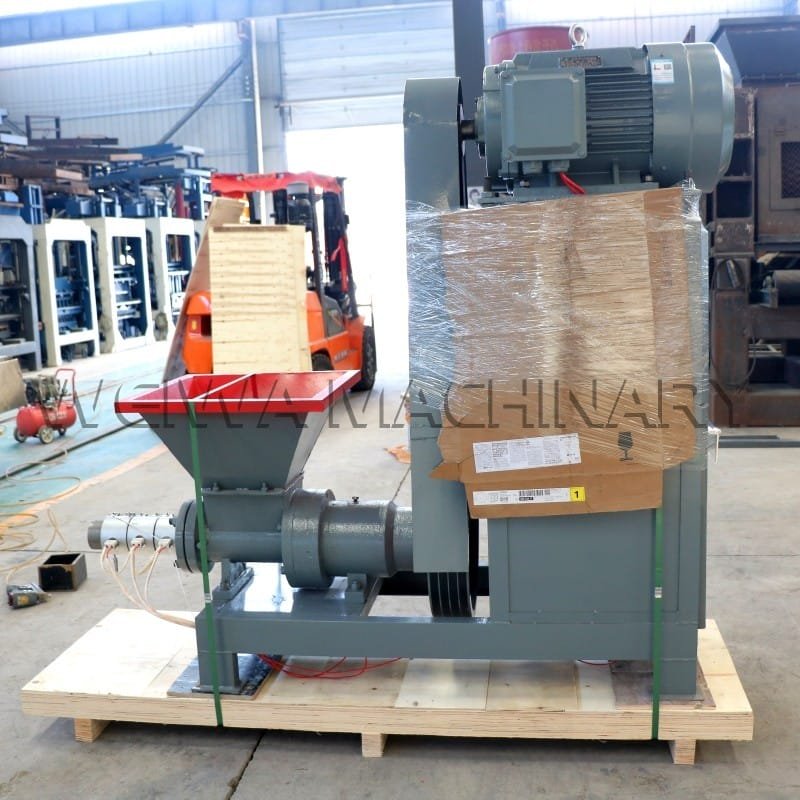
The order included a sawdust extrude machine, supporting components, spare parts, and documentation for sea freight. Kenyan buyers are no longer asking only about price. They ask about output consistency, moisture tolerance, die wear, carbonization compatibility, and after-sales support. That shift shows the local market is becoming more professional.
Dispatch Day at the Weiwa Machinery Factory
The loading process started early in the morning. Our production team inspected the machine body, checked the screw shaft, tested the electric control box, and confirmed the heating ring reached stable temperature during trial running. Before export packing, the extruder was run with qualified sawdust to verify pressure, surface finish, and briquette density.
Once the test run passed, the equipment entered the packing area. Wooden boxes were selected for vulnerable parts. Steel frames were used for heavy bodies. Export orders going to African ports often face long transit, multiple handling points, and humid container conditions, so protection matters as much as machine specification.
For the Kenya client, we prepared an English operation manual, a spare screw sleeve, heater spares, carbon brush spares where applicable, and a layout drawing for the proposed production shed. The buyer had limited factory space, so our engineering team adjusted the material flow so that crusher, เครื่องเป่า, extruder, cooling zone, and carbonization area could fit into a compact compound without creating safety bottlenecks.
When the forklift moved the final pallet into the container, the scene looked simple. Behind it were decades of manufacturing experience, repeated design adjustments, and a supply chain built for export standards. That is the part overseas buyers rarely see but always benefit from.
Why Sawdust Briquettes Matter for Kenya and Nearby Markets?
Kenya has a large informal and semi-formal energy sector. Households use charcoal for cooking. Bakeries use solid fuel for ovens. Hotels and restaurants look for cleaner alternatives to imported LPG. Tea factories, grain dryers, and brick kilns need affordable thermal energy. In this context, sawdust briquettes are not a hobby project. They are a commercial response to fuel cost and wood scarcity.
Sawdust is generated by furniture workshops, timber yards, plywood plants, pallet manufacturers, and carpentry clusters. In many towns, this material is treated as waste. When processed correctly, the same material becomes dense fuel with better transport efficiency than loose biomass. That is why sawdust briquettes are gaining attention from both small startups and medium-scale fuel suppliers.
The appeal is straightforward. Sawdust is often cheap or free if collected in volume. Briquetting reduces dust pollution. Finished sticks or blocks burn longer than loose wood waste. Carbonized briquettes can replace traditional charcoal in many applications. For a Kenyan entrepreneur, the business model can start from one machine and grow into a full production yard.
Making Charcoal Briquettes from Sawdust Explained
Many buyers confuse briquette making with charcoal making. They are connected but not identical. Making charcoal briquettes from sawdust usually involves two stages. The first stage is densification. The second stage is carbonization.
In densification, dried sawdust is compressed by a screw system under heat and pressure. Natural lignin softens and acts as binder. No chemical adhesive is required when moisture and particle size are controlled. The output is a solid briquette stick, often hollow, สี่เหลี่ยม, กลม, หกเหลี่ยม, or custom-shaped depending on the die.
In carbonization, those sticks are heated in a low-oxygen environment. Volatile components are driven off. The material turns into machine-made charcoal with higher fixed carbon, lower smoke, and better combustion stability. The final product can serve barbecue markets, household cooking, institutional kitchens, metalworking furnaces, and industrial boilers after further processing.
The key lesson for new investors is that the extruder alone does not make charcoal. It makes briquette blanks. Charcoal quality depends on raw material cleanliness, drying accuracy, extrusion temperature, cooling method, carbonization curve, and post-carbonization handling. A good machine helps, but the process discipline decides profit.
Raw Material Standard Buyers Should Respect
Sawdust should be below around 12 percent moisture before extrusion. Particle size should be fine and consistent, usually under 5 mm for smooth feeding. Foreign materials such as nails, stones, plastic, and wet bark cause jams, poor surface quality, and premature screw wear. African workshops that build a simple incoming-material screening rule usually achieve better output than those that chase the cheapest machine online.
Dryer Choice Changes Everything
Some buyers think the extruder is the whole project. In practice, the dryer often decides whether the project survives. If moisture stays high, the machine struggles, the briquette cracks, and the heater consumes excess power. For Kenya and similar climates, airflow dryers, rotary dryers, or combined systems can be selected based on hourly capacity, ความชื้น, and available space.
What a เครื่องกำจัดขี้เลื่อย Actually Does?
A sawdust extrude machine is the core forming unit in a biomass briquette line. It receives conditioned sawdust and pushes it through a heated barrel using a large screw. As material moves forward, pressure rises. Temperature softens natural binders. At the die outlet, the material exits as a continuous dense stick with a central hole or solid profile.
The machine is sometimes called a briquette extruder, screw briquette machine, biomass extruder, or charcoal stick machine. Regardless of name, its job is the same: convert loose forestry and agricultural residue into uniform, transport-friendly fuel stock.
Weiwa models are built for continuous operation. The screw and inner sleeve are the wear parts. Heating ring temperature must match material type. Feeding speed must match screw capacity. When these variables are balanced, the machine can produce steady briquettes hour after hour.
Output diameter commonly ranges from 45 mm to 80 มม., though smaller and larger tooling can be discussed. Shape options include square, หกเหลี่ยม, pentagonal, กลม, and edged profiles. The right shape depends on local customer preference, kiln geometry, and packaging method.
Why Lignin Matters More Than Glue?
Some first-time buyers ask which binder they should buy. For many sawdust types, the better answer is process control rather than chemicals. Under heat and pressure, lignin in biomass becomes plastic enough to bind particles. That is why drying, temperature setting, and screw compression ratio are engineering decisions, not optional tweaks.
If the raw material is very fibrous, such as maize stalks or cotton stalks, pre-crushing and moisture management become even more important. If the material is very light, such as rice husk, compression settings differ from dense hardwood sawdust. A good supplier does not sell the same setup to every country. The supplier asks what the client actually feeds into the hopper.
Market Potential of Sawdust Briquettes in Kenya
Kenya sits in a wider East African energy transition. Traditional charcoal production damages trees. Imported fuels add cost. Machine-made briquettes offer a middle path: use residue that already exists, upgrade it into higher-value fuel, and sell it to users who need heat every day.
Urban demand is clear. Nairobi, Mombasa, Kisumu, Nakuru, Eldoret, and Thika have food businesses, bakeries, roasting operations, and residential cooking needs. Rural demand is different but equally strong. Maize mills, coffee processors, tea dryers, and agro-processing units need thermal energy that does not depend entirely on firewood.
The export angle is also interesting. Neighboring markets such as Uganda, Tanzania, Rwanda, South Sudan, ชาวแซมเบีย, and the DRC face similar fuel gaps. A Kenyan fuel producer who stabilizes quality can eventually supply regional distributors, not just local households.
Barbecue and Hospitality Segment
East Africa has a growing hospitality and grilling culture. Buyers want charcoal that lights faster, smells cleaner, breaks less during transport, and burns longer. Machine-made charcoal from sawdust can meet those expectations if carbonization is done properly. Premium packaging plus consistent sizing can move the product from commodity sack to branded fuel brand.
Industrial and Institutional Segment
Bakeries, poultry farms, tobacco curing, brick firing, and small factories need heat. If briquettes are priced below imported diesel or LPG and perform reliably, procurement managers listen. The challenge is consistency. Industrial buyers do not forgive moisture spikes or ash surprises. That is why training and quality control matter more than marketing slogans.
Waste-to-Energy Narrative Attracts Partners
Investors and development partners like circular-economy stories. Sawdust briquettes convert wood waste into energy, reduce open burning, create jobs, and lower dependence on native forest charcoal. A Kenyan entrepreneur with a clean workshop, recorded output data, and a reliable machine can attract distributors, cooperatives, and even financing conversations that pure traders cannot access.
Coal Rod Machine vs Sawdust Extrude Machine
Some buyers search for coal rod machine instead of biomass briquette machine. The terms overlap in Chinese export markets but mean different things in practice. A coal rod machine usually forms coal powder or charcoal powder into rods using binder and pressure. A sawdust extrude machine forms raw biomass under heat and natural lignin binding.
If the client already has charcoal fines, a charcoal briquette press or coal rod machine may be the right choice. If the client has sawdust, แกลบ, ฝุ่นละอองไม้ไผ่, แกลบ, สารตกค้างอ้อย, or crop stalks, the sawdust extrude machine is usually the starting point.
Weiwa Machinery helps clients avoid the common mistake of buying the wrong first machine. A sawdust-rich workshop does not need a coal rod machine on day one. A charcoal-powder trading business may not need a full biomass extrusion line either. The correct front-end depends on material, not fashion.
Common Feedstocks Beyond Sawdust
The same technology family can handle wood chips after crushing, กิ่งก้าน, แกลบ, แกลบ, ชานอ้อย, เปลือกถั่วลิสง, ก้านฝ้าย, ก้านดอกทานตะวัน, ฝุ่นละอองไม้ไผ่, Palm Remember, soybean husk, and tea waste. The machine is not magic. Each feedstock has ideal moisture, ขนาดอนุภาค, and compression behavior. Our team reviews samples or photos before recommending die size and screw configuration.
From Factory Loadout to Kenyan Workshop
After container departure, the Kenyan buyer still has work to do. Foundation preparation, power supply, raw material storage, dust control, fire safety, and staff training all affect results. We send the client a layout drawing, but local civil works remain the buyer responsibility. Good projects succeed because the buyer treats the machine as a production system, not a single iron box.
Typical workflow looks like this in narrative form rather than bullets. Sawdust arrives from local workshops. Oversized chunks are removed. Material enters the dryer until moisture falls into the acceptable range. Dried material feeds the extruder. The screw compresses it into hot briquette sticks. Sticks cool and harden. Hardened sticks move to the carbonization furnace. Carbonized briquettes cool again, get graded, and finally pack for the market.
The Kenya client in this shipment already had contacts with furniture workshops. That gave him a steady sawdust source. His next bottleneck was drying during rainy season. Our suggestion was to size the dryer for worst-case humidity, not average weather, because average weather never appears when production targets matter most.

Why African Buyers Are Becoming More Demanding?
Ten years ago, many inquiries asked only for the cheapest machine. วันนี้, serious African buyers ask better questions. What is the screw material? How many hours before sleeve change? Do you provide layout drawing? Can you help size the dryer? What spare parts should I keep? How do I reduce crack rate? That maturity is healthy for the industry.
Weiwa Machinery welcomes that maturity. Cheap machines that fail after two months damage the whole market. A properly engineered sawdust extrude machine may cost more upfront, but it protects output, reduces downtime, and builds brand reputation for the fuel producer.
In Kenya, reputation spreads fast within trader networks. One client with bad briquettes loses shopkeepers. One client with clean, dense, long-burning charcoal gains reorders. The machine is the foundation, but serviceability and process knowledge decide whether the foundation holds.
Engineering Support That Travels With the Machine
Our export package is not limited to steel and motors. ก่อนจัดส่ง, we review capacity target, raw material type, moisture source, local voltage, container access, labor skill, and future expansion plan. This prevents the classic error of buying a machine for 500 kg/h when the raw material supply can only support 200 กก./ชม., or buying a 200 kg/h unit when demand already requires 800 กก./ชม..
After arrival, the buyer receives guidance on installation sequence, belt alignment, electrical connection scope, heater calibration, screw gap adjustment, and first-run material ratio. Remote video support handles most issues. For larger projects, on-site commissioning can be discussed depending on region, project scale, and service agreement.
Spare parts strategy is part of the conversation. Screw shaft, inner sleeve, heater ring, bearing, belt, and controller components should be stocked based on running hours. A fuel business that waits three weeks for one sleeve loses more money than the sleeve itself costs. We help clients build a sensible spare-parts list instead of an oversized warehouse.
Customization and Factory Layout Planning
No two biomass workshops are identical. One Kenyan site may have a narrow urban plot. Another may have five acres near a timber cluster. One buyer wants manual feeding. Another wants conveyor integration. One client sells only raw briquette sticks. Another wants full charcoal branding.
Weiwa Machinery provides customized service and design drawings for site planning. The drawing covers machine position, material flow, dryer location, dust collection space, cooling area, carbonization zone, finished-product storage, fire separation, and operator pathway. Good layout reduces labor, lowers accident risk, and improves daily output without changing the machine model.
For export clients, we also consider container loading dimensions. A beautiful factory layout means nothing if the equipment cannot enter the client country or fit through the workshop gate. Our export team checks overall dimensions, disassembly points, and crating method before production finishes.
Why Buyers Choose Weiwa Machinery?
Weiwa Machinery has more than thirty years of working experience in machinery manufacturing. That history matters because biomass briquette equipment is not a smartphone accessory. It operates under heat, friction, vibration, and dusty conditions every day. Experience teaches which steel grade, screw angle, heater placement, and frame thickness actually survive real workshops.
Our team handles not only sawdust extrude machines but also crushers, dryers, สายพานลำเลียง, เตาถ่าน, and complete biomass briquette production lines. This allows us to design the whole process instead of selling isolated boxes. A client who wants to turn sawdust into briquettes receives a system perspective, not just a machine quote.
We also maintain a professional after-sales team. Pre-sale consultation, production planning, การบรรจุ, shipping documents, installation guidance, operator training, troubleshooting, and spare-parts supply are handled by people who understand export machinery, not only domestic sales.
Customized service is not a slogan. It means we adjust capacity, voltage, รูปร่าง, die size, feeding method, dryer type, and workshop layout according to the client. Many African buyers start small and expand later. We design the first phase so the second phase does not require rebuilding everything.
Kenya Shipment as a Signal for the Region
Every shipment tells a story. This Kenya dispatch told us that East African buyers want local fuel independence. They want machines that run. They want drawings they can show to builders. They want spare parts they can reorder. They want a supplier who answers after the container arrives, not only before payment.
Sawdust briquettes will not replace all charcoal overnight. But across Kenya, Uganda, Tanzania, ชาวแซมเบีย, Nigeria, Ghana, แอฟริกาใต้, and other markets, the direction is visible. Waste biomass is becoming inventory. Loose dust is becoming branded fuel. Informal workshops are becoming registered fuel suppliers.
The entrepreneurs who win will not be the ones who bought the cheapest machine. They will be the ones who understood moisture, controlled feedstock, maintained the screw, trained operators, packaged consistently, and chose a manufacturer with real engineering depth.
Starting a Sawdust Briquette Business in Kenya
A new investor should begin with feedstock security. Without steady sawdust or biomass supply, even the best machine sits idle. The second step is moisture control. The third step is choosing the right extruder size. The fourth step is planning carbonization before selling promises. The fifth step is building distribution, because good fuel with no sales channel still loses money.
Many Kenyan entrepreneurs underestimate workshop discipline. Briquette making looks simple in a video. In reality, raw material changes with season. Humidity changes with rain. Power supply changes with location. Operator skill changes with training. The machine must be robust, but the business must be managed.
That is why Weiwa Machinery sends more than a price list. We send questions first. What is your monthly sawdust tonnage? What moisture level is typical? What shape does your market prefer? What local voltage do you use? Do you plan raw briquettes or carbonized charcoal? The answers shape the proposal more than the buyer initial budget line.
Small Startup Model
A small model can begin with a crusher if feedstock is coarse, an airflow dryer, one sawdust extrude machine, a cooling rack, and a batch carbonization unit. This model fits urban fringes where land is expensive and raw material comes from nearby carpentry clusters. Output may be modest, but cash flow can start quickly if the founder controls distribution.
Medium-Scale Fuel Supplier Model
A medium model adds higher-capacity drying, conveyor feeding, dual extruders, centralized dust removal, mechanical cooling, and a larger carbonization system. This model suits entrepreneurs supplying bakeries, institutions, and regional charcoal dealers. Branding, sieving, and uniform stick length become important because buyers compare products shelf to sack.
Full Production Line Model
A full line includes raw material receiving, screening, การบดขยี้, การทำให้แห้ง, extrusion, hardening, การทำให้เป็นคาร์บอน, ระบายความร้อน, grading, การบรรจุ, and storage. This model requires stronger capital, bigger land, and better management. But it can supply multiple cities and build a recognizable fuel brand across East Africa.
Common Mistakes First-Time Buyers Make
The first mistake is chasing the lowest price without checking screw material and after-sales support. The second mistake is ignoring the dryer. The third mistake is feeding wet or mixed waste into the hopper. The fourth mistake is expecting charcoal immediately from the extruder. The fifth mistake is scaling sales before stabilizing quality.
Another frequent issue is copying a YouTube layout from another continent. Climate differs. Raw material differs. Voltage differs. Labor cost differs. A Kenya workshop needs a Kenya-specific plan. Weiwa engineers prefer to adapt the design rather than copy a generic photo from another market.
Buyers also forget fire safety. Biomass dust, hot briquettes, and carbonization gases demand separation, ventilation, extinguishers, and trained staff. A profitable briquette business can be destroyed by one careless corner of the yard. Process safety is part of machine selection, not an extra chapter nobody reads.
Quality Indicators Buyers Should Check
Surface of the briquette should be smooth, not cracked or fluffy. Density should feel high for the size. Moisture of feedstock should be verified with a meter, not guessed. Output should remain stable after the machine warms up. Screw temperature should be controllable. Finished stick should not disintegrate during cooling.
หลังจากการทำให้เป็นคาร์บอน, good machine-made charcoal should be low in smoke during lighting, high in fixed carbon relative to feedstock, low in unburned wood core, and consistent in size. Ash level depends on raw material. Sawdust from clean hardwood behaves differently from mixed workshop sweepings.
We always tell clients to keep a sample board. Keep one briquette from week one, week four, and week twelve. Compare length, diameter, cracks, color, and burn time. If quality drifts, the process is changing somewhere. The machine is talking; the operator must learn to listen.
Sustainability Angle for Kenya and Africa
Machine-made briquettes support cleaner fuel access. They use residues that would otherwise rot, burn openly, or block workshops. They reduce pressure on natural forest charcoal when produced at scale with disciplined feedstock sourcing. They create local jobs in collection, การบดขยี้, การทำให้แห้ง, extrusion, การทำให้เป็นคาร์บอน, การบรรจุ, and distribution.
For development agencies and municipal programs, briquette enterprises can be part of waste management strategy. For private entrepreneurs, they can be part of energy business strategy. For women-led cooperatives, they can be part of rural enterprise development. The same machine serves many goals if the business model is clear.
Africa does not lack biomass. It lacks processing discipline, reliable equipment, and honest technical support. That gap is exactly where an experienced manufacturer adds value beyond the invoice.
Why This Kenya Order Matters to Us?
We do not measure success only by containers shipped. We measure it by whether the Kenyan client can still run the machine six months later, whether his briquettes find repeat buyers, and whether he expands the line with confidence.
The dispatch day ended with photographs, seal numbers, bill of lading data, and a short video sent to the client. But the real project starts after unloading. When the machine enters the Mombasa or Nairobi workshop, our engineers remain reachable. When the first batch cracks, we help diagnose moisture or temperature. When demand grows, we help plan phase two.
This is the difference between a machine seller and a machinery partner. Weiwa Machinery prefers the second role.
Technical Notes Buyers Often Overlook
Voltage and frequency must match the destination country. Kenya commonly uses 230V/50Hz single phase for small loads and 415V/50Hz three phase for industrial equipment, but the buyer should confirm local supply before production. Wrong electrical configuration causes delays, extra cost, and controller damage.
Foundation matters. A vibrating extruder on a weak concrete slab develops alignment problems. The base should match machine weight, vibration, and maintenance access. Our layout drawing marks foundation requirements, but local civil engineers must execute them correctly.
Feeding method affects screw life. Manual shovel feeding creates uneven load. Hopper with variable screw feeder creates steadier throughput. Steady feeding reduces surge current, lowers jam risk, and extends sleeve life. Small upgrades in feeding often deliver bigger gains than chasing a slightly larger motor.
Heater zones need monitoring. Too low temperature produces soft, low-density sticks. Too high temperature scorches material and wastes power. The correct band depends on feedstock, ความชื้น, ambient temperature, and screw compression ratio. Experienced operators learn the sound and smell of correct extrusion.
Expanding From Sawdust to Multiple Biomass Streams
Kenyan entrepreneurs often start with sawdust because furniture clusters generate it daily. Later, they discover rice husk from milling, coffee husk from processing, sugarcane bagasse from juice plants, maize cob residue, กะลา, ฝุ่นละอองไม้ไผ่, and forestry offcuts.
Each material changes the process. Rice husk is light and slippery. Bagasse holds more moisture. Coffee husk has its own ash behavior. Bamboo dust compacts differently from softwood sawdust. A flexible line can handle several streams, but die selection, dryer capacity, and screw configuration must be reviewed.
Weiwa Machinery helps clients build a material matrix. The matrix records moisture, ขนาดอนุภาค, bulk density, expected output, and carbonization result for each feedstock. Over time, the client becomes a fuel expert instead of a machine owner.
Carbonization Options After Extrusion
After the sawdust extrude machine produces briquette sticks, the client can choose batch kilns, movable steel kilns, vertical carbonization furnaces, or continuous systems for larger capacity. Batch methods are simpler and cheaper to start. Continuous systems require more engineering and higher throughput justification.
For Kenya beginners, batch or semi-batch carbonization often makes sense. It limits capital risk, allows process learning, and produces marketable charcoal without complex automation. As demand grows, the client can add controlled gas recovery, cooling chambers, and grading stations.
The mistake is buying the most advanced carbonization plant on day one. Technology should match management capacity. A simple system run well beats a complex system run poorly.
Branding Sawdust Briquettes in the Kenyan Market
Commodity fuel competes on price and always attracts copycats. Branded fuel competes on trust. Clean sacks, uniform stick length, moisture-controlled product, labeled weight, QR code for traceability, and consistent burn performance create repeat customers.
Weiwa Machinery cannot build the client brand, but our machine consistency makes branding possible. If every batch varies, no marketing helps. If output is stable, the entrepreneur can invest in packaging, distributor training, and customer education.
In East Africa, women-owned hotels, outdoor grilling venues, bakery chains, and eco-conscious households are willing to pay more for cleaner fuel. The premium is earned through reliability, not slogans.
Risk Management for New Biomass Fuel Businesses
Feedstock risk comes first. If the sawdust supplier switches to mixed construction waste, quality collapses. Supplier contracts, incoming inspection, and covered storage reduce this risk.
Power risk comes second. Unstable voltage shortens controller life. Voltage protectors, correct cable sizing, and stabilized control panels reduce breakdowns.
Market risk comes third. Selling only to one broker is dangerous. Successful producers build direct relationships with bakeries, charcoal shops, institutions, and bulk users.
Machine risk comes fourth. Buying from unknown traders with no spare parts pipeline creates long downtime. Choosing an established manufacturer with export experience reduces this risk substantially.
Compliance risk comes last but matters more over time. Local environmental rules, fire codes, and business licensing differ by county. A responsible entrepreneur engages authorities early instead of asking for forgiveness after neighbors complain about smoke.
How Weiwa Machinery Supports Export Clients?
Our export process begins with inquiry analysis. We identify whether the client needs a single machine, a small line, or a full plant. Then we propose capacity, machine models, dryer type, carbonization method, voltage configuration, and estimated footprint.
After order confirmation, production follows our workshop schedule. Key parts are inspected. Trial run uses material close to the client feedstock when samples are provided. Packing matches sea freight requirements. Documents include commercial invoice, packing list, bill of lading support, certificate requirements if needed, and operation files.
After shipment, our after-sales team supports commissioning remotely, reviews photos and videos from the site, advises on first-run adjustments, supplies wear parts, and helps the client plan capacity expansion. The relationship continues because biomass fuel production is a running business, not a one-time purchase.
Why 30 Plus Years Still Matters in 2026?
Machinery trends change. Online inquiries change. Social media changes. But physics does not change. Biomass still needs drying. Lignin still binds under heat and pressure. Screws still wear. Bearings still need alignment. Electrical panels still need protection.
Thirty plus years of manufacturing experience means we have seen bad sawdust, rainy-season moisture, weak foundations, wrong voltage, overloaded feeders, and unrealistic output claims. That history helps us protect new clients from expensive lessons.
Weiwa Machinery does not promise miracle machines. We promise practical machines, honest capacity ranges, export-grade packing, technical drawings, spare-part support, and engineering advice shaped by decades in the field.
Contact เครื่องจักร Weiwa for Quotation and Layout Design
If you want to turn sawdust into briquettes, build a charcoal briquette business in Kenya, or expand an existing biomass fuel workshop, Weiwa Machinery can help. We supply sawdust extrude machines, biomass briquette production lines, dryers, crushers, carbonization equipment, and complete project support.
Our team provides customized service and design drawings for site planning. Whether you have a small urban plot or a large agro-industrial yard, we can propose a layout that matches your raw material, budget, labor, and growth plan.
With more than thirty years of working experience and a professional after-sales team, Weiwa Machinery is ready to support your project from factory loadout to local production.
Contact us today for quotation, machine video, layout drawing, and spare-parts list.
Contact Weiwa Machinery
ม็อบ: +8613838093177
WhatsApp: +8613838093177
อีเมล: info@cjlmachineGroup.com
Welcome to visit our factory. Send your raw material photos, moisture level, target capacity, and local voltage. We will design a practical sawdust briquette solution for your market.


 Wechat

 +8615937143060
