


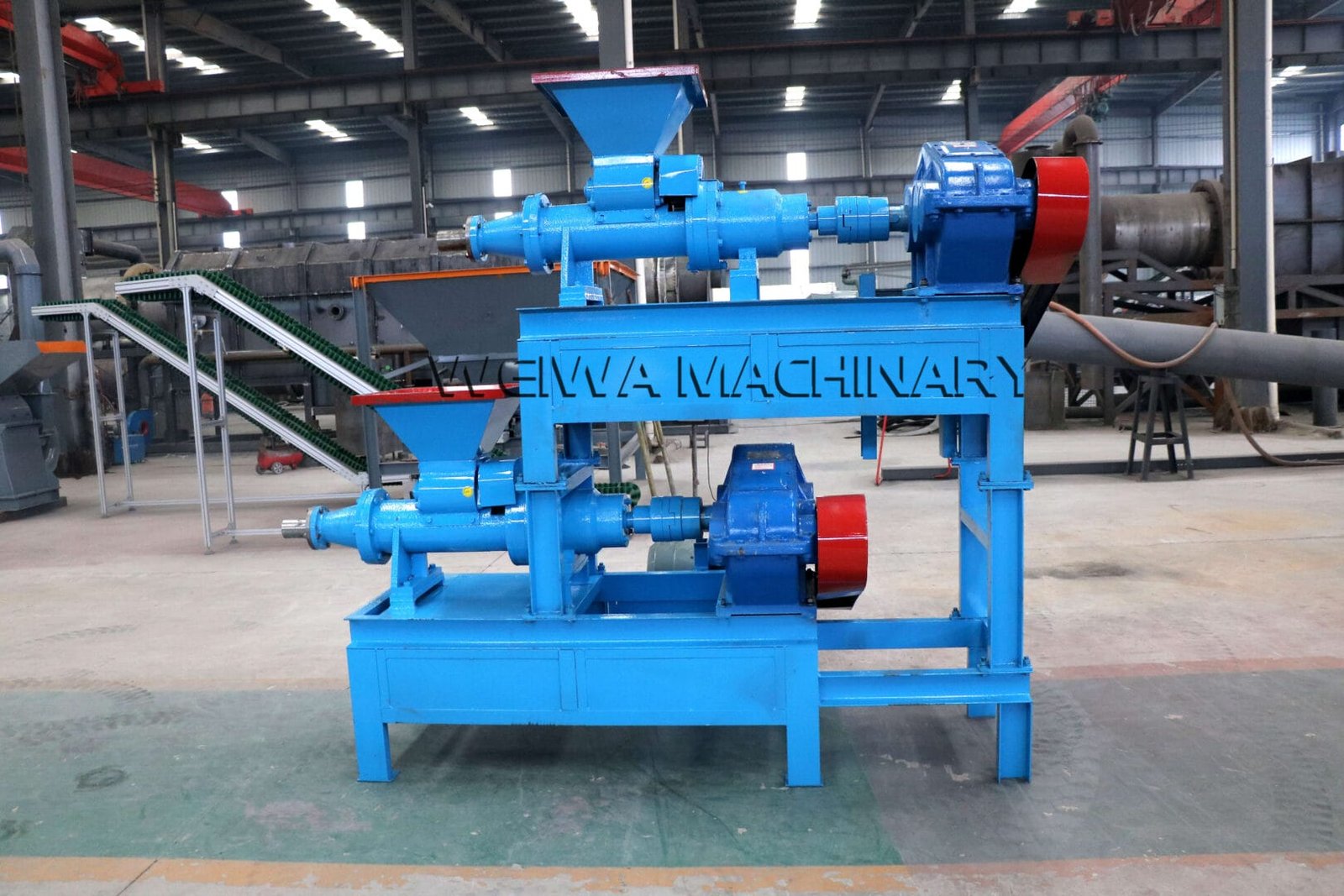
What Changed in the Double Layer Coal Stick Machine Design?
The biggest misunderstanding about a charcoal extruder machine is that higher motor power equals better rods. It does not. Density comes from residence time and radial pressure, not just thrust. The Weiwa double-layer coal stick machine extends residence time by splitting the barrel into two layers vertically coupled through a transition sleeve.

Two Stage Screw Geometry Instead of One Long Screw
In the first layer, a wide-pitch feeding screw moves mixed charcoal powder, binder, and moisture uniformly toward the center. In the second layer, a short-pitch high-manganese propeller drives the mass into the die at controlled backpressure. Because the two screws run on one shaft with a floating coupling, alignment stays stable even after 800 hours of continuous running. This is the same coupling principle we use on the standard charcoal extrude machine referenced on our product page, but the double layer version adds a mid-barrel vent ring to release trapped air.
Die Head and Mold Configuration
Ghana clients mostly ask for cylindrical BBQ sticks of 33 millimeter and 38 millimeter diameter, plus square column rods for shisha and restaurant use. The double layer coal rod press machine in Ghana leaves the port with interchangeable #45 steel dies, hardened to HRC 48–52. A hexagonal mold and a hollow BBQ mold are packed as spare options. Mold swap takes under twenty minutes because the front flange uses six bolt locks instead of the old threaded ring design.
Frame, Motor, and Gearbox Selection
National certified carbon steel forms the base. The motor is 100 percent copper coil, 18.5 kilowatt for the MBJ180-class double layer unit, 22 kilowatt optional when clients run coconut shell charcoal with high fiber content. Power transfers through triangle belt to a hardened gearbox, then to the propulsion shaft. We deliberately avoided direct coupling here because belt drive absorbs shock when raw material batch moisture jumps from 14 para 19 por cento, which happens often in Ghana during hamattan season.
Why Double Layer Output Is Finer and More Compact
When we say finer, we mean particle bonding at microscopic level, not smaller rod diameter. After the two-stage press, samples from the Ghana unit showed closed pores under 50x magnification and zero visible lamination lines. That matters for combustion.
Combustion Behavior of Denser Charcoal Rods
A BBQ charcoal rod press machine must deliver steady heat curve, not just high ignition speed. Dense double layer rods from the Weiwa charcoal briquette machine reach full red heat in 90 seconds on average, hold temperature between 620 e 680 Celsius for 55 para 70 minutes depending on diameter, and leave under 4 percent ash. Loose single-press rods ignite faster but collapse before 35 minutos. For Ghanaian barbecue vendors and European-bound BBQ exporters, the longer stable burn means fewer rod refills and higher per-kg selling price.
Smoke and Odor Reduction
Trapped volatiles inside porous rods escape as white smoke in early burn. The double layer coal stick machine squeezes most volatiles out before molding, so the finished stick is closer to semi-carbonized structure. Field readings in our Wenzhou trial room showed 41 percent lower initial smoke density versus single-pass rods made from the same charcoal powder. This aligns with Ghana EPA demands for cleaner urban BBQ zones in Accra and Kumasi.
Double Layer Coal Rod Press Machine in Ghana Market Context
Ghana is not a random destination. As host of the African Continental Free Trade Area secretariat, Ghana gives equipment buyers access to ECOWAS distribution channels. Charcoal consumption in West Africa grows steadily because urban population expansion outpaces LPG cylinder penetration. A double layer coal rod press machine in Ghana can serve local BBQ demand and re-export dense rods to Burkina Faso, Mali, and Togo.
Raw Material Availability in Ghana
Ghana produces significant volumes of cocoa husk, sawdust from plywood mills near Kumasi, and charcoal dust from traditional earth kilns. All of these are usable in a charcoal extruder machine after crushing below 3 millimeter. Our Ghana client mixes 60 percent hardwood charcoal dust, 30 percent coconut shell imported from Ivory Coast, e 10 percent sawdust, with cassava starch binder at 5 percent dry weight. The double layer design handles this blend without die clogging because the first chamber pre-kneads sticky fiber before final press.
Labor and Maintenance Reality
African operators rarely have precision machining shops on site. The Weiwa double-layer coal stick machine is built for wrench-level maintenance. The propeller and liner sleeve are the only two wear parts in contact with material. A complete propeller change takes 40 minutes with two workers. We ship one spare propeller and two liner sleeves per container. Local welding shops in Tema can rebuild the propeller profile using our supplied jig drawing, which removes dependency on air freight for small parts.
How the Double Layer Unit Fits a Full Charcoal Line
No charcoal briquette machine should run alone. The Ghana order includes a matched set: triturador de carvão, wheel grinding mixer, double layer coal stick machine, and a 12 meter belt drying tunnel. This mirrors the standard line described on our charcoal extrude machine product page, with the extruder replaced by the upgraded double layer model.
Crushing and Mixing Before Extrusion
Raw lump charcoal goes into the crusher, output below 3 millimeter. Oversize material recirculates. The wheel mixer wets powder to 16–18 percent moisture and folds binder evenly. Poor mixing is the main reason single-layer machines make soft rods; the double layer coal rod press machine in Ghana still needs correct feed moisture or the first chamber over-compacts wet clumps and stalls. We set the mixer discharge gate to 17 percent target and trained the client engineer on the hand-squeeze test: a fist of mix should hold shape but break on finger poke.
Drying and Storage After Molding
Fresh rods from the charcoal extruder machine carry 12–14 percent moisture. They enter the drying tunnel at 65 Celsius, exit at 6 percent after 90 minutos. Double layer rods tolerate faster drying because internal stress is lower; single layer rods crack when tunnel temperature exceeds 80 Celsius. Stacked pallets stay in ventilated warehouse for 48 hours before bagging. This step protects caliber consistency during ocean shipping to Europe or Middle East.
Comparing Single Layer and Double Layer Coal Stick Machine
Buyers always ask whether the double layer coal stick machine justifies the price gap. In Ghana configuration, the double layer unit costs about 23 percent more than our single-screw MBJ180 charcoal extruder machine. The payback comes from three sides.
Primeiro, yield of grade A rods rises from around 82 percent to 94 percent because fewer rods break in drying and loading. Second, binder consumption drops roughly 15 percent because denser compaction needs less starch to hold shape. Third, export price per ton of BBQ charcoal rod press machine output gains 30 para 45 dollar in Netherlands and Lebanon wholesale markets where buyers weigh rods for porosity. Over a 10 month run at 2.5 tonelada por hora, the Ghana client recovers the upgrade cost before the second container of finished goods leaves Tema port.
Customization and Site Layout Service from Weiwa Machinery
Weiwa Machinery has more than thirty years of experience in biomass and coal molding equipment. The double layer coal stick machine is not sold as a fixed SKU only. We adjust screw pitch, barrel length, die diameter, and gearbox ratio according to your raw material test report. Clients who send us 5 kilogram of charcoal powder receive a free bench-scale extrusion video and a proposed layout drawing showing foundation bolts, belt angles, and electrical panel position.
Our after-sales team assigns one engineer per container order. The Ghana shipment included a Chinese-English operation manual, um 38 minute installation video, and a WhatsApp group with the commissioning engineer. Spare parts list is priced separately, not hidden inside the machine cost. For African clients, we recommend stocking one propeller, two liner sleeves, one belt set, and one coupling rubber block per year of operation.
Why Charcoal Briquette Machine Demand Keeps Rising in Africa?
Beyond Ghana, Quênia, Zâmbia, and Senegal show the same pattern. Urban BBQ culture grows, traditional kiln charcoal gets expensive, and governments push for cleaner fuel rods. A charcoal briquette machine that turns waste dust into uniform sticks is both environmental compliance and profit engine. The double layer design simply raises the quality ceiling so African factories can compete with Indonesian and Vietnamese BBQ charcoal in the Mediterranean import market.
Weiwa Machinery has exported charcoal and coal molding lines to over 130 países. The double-layer coal stick machine is our answer to the next five years of African industrial charcoal demand. It keeps the simplicity of a screw extruder while fixing the two historical weaknesses: low density and high breakage.
Conclusion and Next Step
If you are planning a charcoal plant in Ghana, Ivory Coast, Nigéria, or any market where BBQ charcoal rod press machine quality decides export price, the double layer coal stick machine deserves a place in your line. Weiwa Machinery provides customized drawings, raw material testing, container-level spare part kits, and remote commissioning. We welcome factory visits and third-party inspection before shipment.
Contact Weiwa Machinery for quotation and layout plan:
MOB: +8613838093177
Whatsapp: +8613838093177
E-mail: info@cjlmachinegroup.com
Learn more about our standard Máquina de extrusora de carvão configuration and how the double layer upgrade extends its performance for the Ghana and wider African market.


 WeChat

 +8615937143060
