


Why Jamaica Needs Sawdust Extrude Machines for Charcoal Production?
Jamaica has a well-developed timber processing sector and active agricultural industries that generate large volumes of sawdust, Blachas de madeira, and sugarcane bagasse annually. Tradicionalmente, much of this biomass is either burned openly or left to decompose, creating both environmental concerns and wasted energy potential. Introducing a sawdust extrude machine in Jamaica allows local entrepreneurs to compress loose biomass into dense briquettes which are then carbonized into smokeless, high-heat charcoal. Compared with naturally harvested hardwood charcoal, machine-made charcoal from sawdust briquettes offers longer burning time, lower ash content, uniform shape, and reduced dependence on deforestation—factors that align well with Jamaica’s sustainable development goals and growing demand for BBQ and heating fuel across the island and wider Caribbean export markets.
Pre-Shipment Inspection and Loading of the Charcoal Line
Before departure from our Henan factory, each section of the charcoal production line underwent a no-load running test. The sawdust extrude machine was checked for screw propeller concentricity, heating coil temperature response, and forming sleeve alignment. The dryer was tested for drum rotation, induced draft fan balance, and thermal insulation integrity. All carbonization furnace welds were dye-penetrant inspected and the refractory lining thickness verified. After passing QC, machines were anti-rust sprayed, wrapped in stretch film, and loaded into a 40-foot high-cube container with shock-proof wooden bracing. Export documentation including commercial invoice, packing list, certificate of origin, and bill of lading were prepared to ensure smooth customs clearance at Kingston Port, Jamaica.

Customer Raw Material Condition in Jamaica
The Jamaican client plans to primarily use mixed hardwood sawdust from local sawmills with an incoming moisture content ranging between 35% e 50%. Particle size varies from fine dust to flakes up to 8 mm. Our technical team advised installing a preliminary vibrating screen to remove oversized chips and nails, followed by a hammer mill if necessary to bring particles under 5 mm—the optimal size for the screw extrusion chamber. The client confirmed that dried sawdust moisture after the rotary dryer can be stabilized at 8%–11%, which is the recommended range for producing solid, crack-free briquettes with our sawdust extrude machine in Jamaica applications.
Complete Process Flow of the Shipped Sawdust Charcoal Line
The production process is divided into four sequential stages, each engineered to maintain material continuity and product consistency.
Crushing and Screening
Raw woody biomass larger than 5 mm is fed into a wood crusher or hammer mill. The output sawdust passes through a vibrating screen to eliminate stones and metal debris. Uniform particle size is essential because oversized chips block the feeding hopper of the extruder while excessively fine dust reduces briquette structural strength due to inadequate lignin distribution.
Drying to Optimal Moisture
A rotary drum dryer or pipe-type airflow dryer heated by a biomass burner reduces moisture from above 40% down to 8%–12%. The drying temperature is typically maintained between 250°C and 350°C at the inlet and 80°C–100°C at the outlet to avoid scorching. Proper drying prevents steam explosion inside the briquetting chamber and ensures the lignin softens correctly during extrusion, which is critical for the performance of any sawdust extrude machine in Jamaica or other tropical climates where ambient humidity is high.
Briquetting with Sawdust Extrude Machine
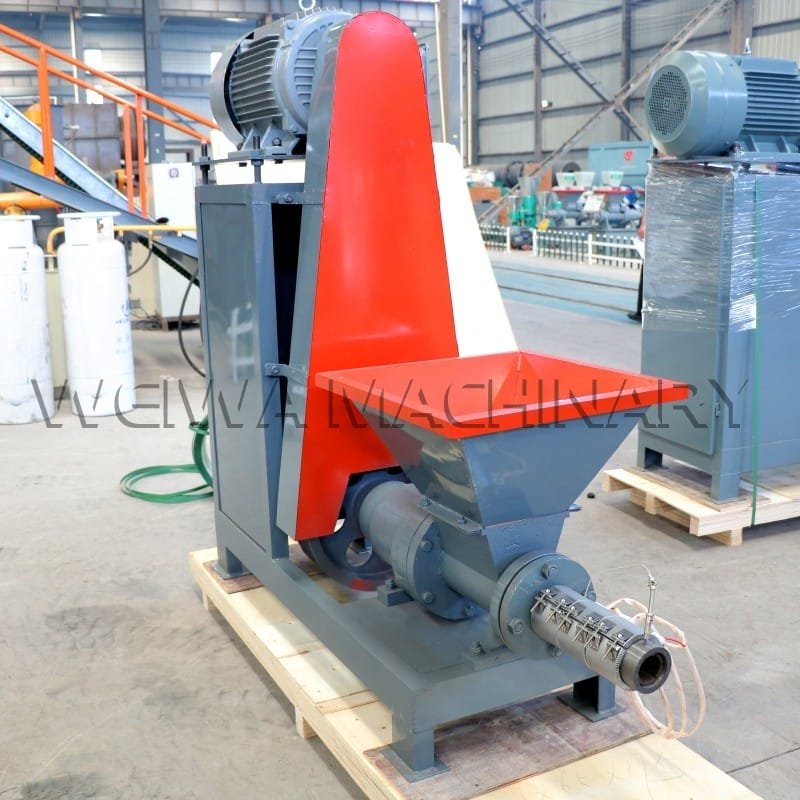
Dried sawdust is conveyed into the sawdust extrude machine where a high-torque screw shaft compresses it forward under pressures exceeding 80–100 MPa. A heating coil wrapped around the forming tube raises the material temperature to 160°C–220°C, softening the natural lignin which acts as an internal binder. The extruded briquette exits through a mold sleeve in a hollow hexagonal or square cross-section with a central hole of 15–20 mm to improve airflow during subsequent carbonization. Typical diameters are 50 mm or 70 mm depending on market preference. No chemical binders are required. The density of extruded briquettes normally reaches 1.0–1.3 g/cm³, allowing them to sink in water—a quick field test our Jamaican customer performed during the pre-commissioning video call.
Carbonization in Oxygen-Limited Furnace
The extruded briquettes are loaded into a horizontal or vertical carbonization furnace operating at 450°C–650°C under oxygen-restricted conditions. Volatile components such as tar, acetic acid, and wood vinegar are driven off and can be collected if a condensation system is installed. After a typical dwell time of 6–10 hours depending on load size, the resulting charcoal briquettes exhibit carbon content above 75%–85%, fixed carbon suitable for BBQ or industrial use, low smoke emission, and a glossy dark appearance. Yield from sawdust briquette to charcoal is generally 30%–33% by weight.
Cooling Packaging and Storage
Freshly carbonized charcoal is brittle and hot. It is discharged onto a belt cooling conveyor or placed in a shaded ventilated area for at least 4–6 hours before manual or automatic weighing and bagging. Packaged charcoal should be stored in a dry warehouse to prevent moisture reabsorption which lowers ignition performance.
Expected Trial Run Results in the Jamaican Workshop
Based on our commissioning experience with similar lines in tropical regions, the Jamaican customer can expect the following typical outcomes once the line is fully operational:
The sawdust extrude machine in Jamaica configuration supplied is rated at 300–400 kg/h of briquette output when fed with properly dried sawdust. With three shifts per day the line can produce approximately 2–2.5 tons of green briquettes daily, translating to roughly 600–800 kg of finished charcoal after carbonization. Briquette surface should appear dark brown with smooth texture; fractured cross-sections must show homogeneous compaction without loose centers. Charcoal produced from these briquettes ignites readily, burns with minimal visible smoke, and sustains high temperatures suitable for jerk pan cooking, household heating, and commercial BBQ—all popular uses across Jamaica.
Advantages of Weiwa Sawdust Extrude Machine for Caribbean Markets
Our sawdust extrude machine features a wear-resistant alloy screw propeller designed for extended service life even when processing high-silica biomass such as rice husk blends. The heating coil is externally adjustable via a temperature-control panel allowing operators to fine-tune based on seasonal humidity changes. The machine frame is reinforced to absorb vibration during continuous runs. Electrical motors are available in 220V/415V/440V 50Hz or 60Hz to match Jamaican industrial power standards. Spare parts including propeller tips, inner sleeves, and heating coils are standardized and can be air-freighted quickly to minimize downtime. These practical design considerations make our sawdust extrude machine in Jamaica installations straightforward to maintain for local technicians with basic mechanical training.
Environmental and Economic Impact in Jamaica Context
By utilizing sawmill waste and agricultural residues, a charcoal production line reduces open burning of biomass which contributes to localized air pollution. It also decreases reliance on old-growth forest harvesting for traditional charcoal kilns. Economically, the payback period for a medium-scale line in Jamaica—considering local sawdust purchase price, labor cost, charcoal retail price, and plant throughput—typically ranges between 12 e 18 meses. Several Caribbean clients have expanded from a single line to multi-line plants supplying wholesalers in Montego Bay, Kingston, and even re-exporting to neighboring islands. The versatility of the sawdust extrude machine in Jamaica means it can also process coconut coir pith and bagasse when blended with sawdust, giving producers flexibility during seasonal raw material fluctuations.
After-Sales Support from Weiwa Machinery
Weiwa Machinery provides detailed English operation manuals, wiring diagrams, and instructional videos with every shipment. Remote video guidance for installation, belt tension adjustment, dryer burner calibration, and first-batch briquette trial is included at no extra cost. Should the Jamaican customer require onsite engineer dispatch, we arrange international travel subject to mutual agreement. A standard 12-month warranty covers manufacturing defects on main frames and screws. Wear parts are available from stock with express shipping options.
Contact Weiwa Machinery for Sawdust Extrude Machine in Jamaica Inquiry
If you are exploring the feasibility of setting up a charcoal briquette production line in Jamaica or elsewhere in the Caribbean using a professional sawdust extrude machine in Jamaica, our sales engineers are ready to assist with customized layout design, capacity calculation, and ROI estimation based on your local raw material condition.
Sobre Máquinas de Weiwa
Henan Weiwa Machinery Manufacturing Co., Ltd. (Máquinas de Weiwa) is a professional manufacturer of charcoal making machines, biomass briquette equipment, and related auxiliary machinery with more than 15 years of export experience. We supply complete sawdust charcoal production lines, sawdust extrude machines, fornos de carbonização, trituradores, and dryers to customers in Asia, África, Europa, North and South America, and the Caribbean. Every machine is factory-tested prior to shipment and backed by comprehensive technical support.
MOB / Whatsapp: +86 138 3809 3177
E-mail: info@cjlmachinegroup.com
Site: https://cjljx.com


 WeChat

 +8615937143060
