


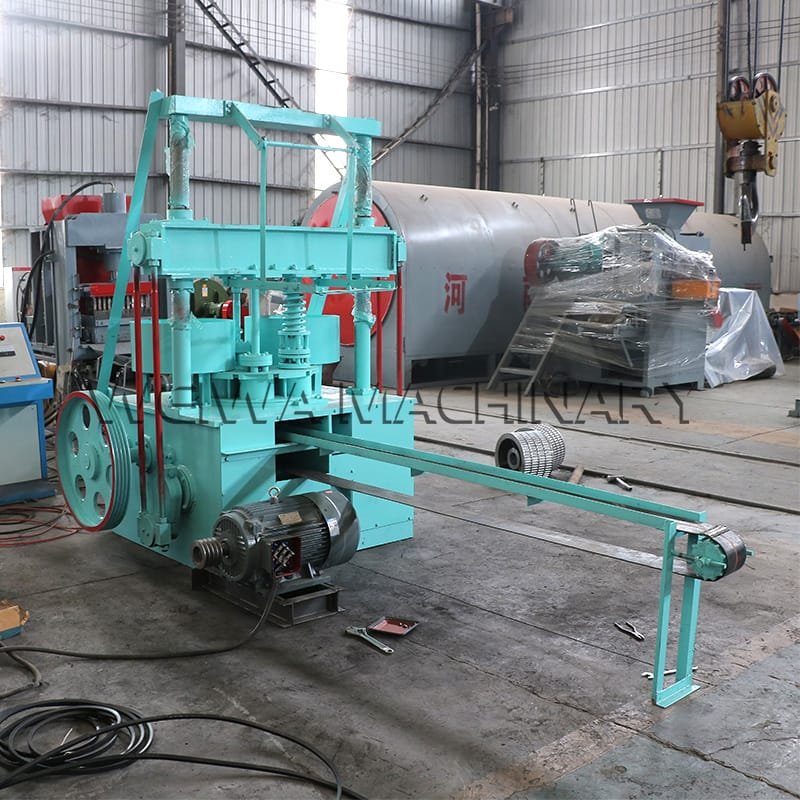
For Weiwa Machinery, every export unit passes through three gates before container loading: mechanical running test, briquette sample approval, and client-side remote verification. The Indonesia inspection was special because the client joined the session over video while our technicians ran the honeycomb charcoal coal briquette forming machine live, measured pressure, checked mold ejection, and burned one sample on site to show ignition behavior.
What a Honeycomb Briquette Charcoal Machine Actually Does?
A honeycomb briquette charcoal machine is a rotary-table punching press that compresses pulverized coal, pó de carvão, Coca -cola em pó, or blended biomass residue into solid fuel blocks with cylindrical holes passing through the body. Those holes give the product the honeycomb look and, more importantly, create secondary air channels so the briquette ignites faster and burns with higher completeness than lump coal or irregular hand-molded charcoal.
The Indonesian client’s raw mix was coal powder with 18 percent rice husk charcoal and 6 percent furnace slag. This is a very common recipe in Java and Sumatra small fuel workshops because coal powder is cheap, rice husk charcoal is locally available from rice mills, and slag improves hardness. The honeycomb briquette charcoal machine in Indonesia market must tolerate variable moisture and particle size, which is why mold barrel clearance, punch-head stroke, and feeder speed matter more than max rated capacity on paper.
Core Working Principle of the Honeycomb Punching Machine
Material is first crushed below 3 mm, blended with a binder solution, and conditioned to a working moisture of roughly 12 para 14 por cento. The conditioned powder drops into the feeding hopper of the honeycomb punching machine. A scraper pushes it into the mold barrel mounted on a rotating table. As the table indexes, a punch head descends and presses the charge into the cavity around the fixed core pins. The core pins form the holes. The finished piece is then ejected upward or sideways depending on model, cooled briefly, and counted.
During the Indonesia session we ran a Model 220 rotary honeycomb charcoal coal briquette forming machine fitted with a 100 mm diameter hexagon mold and 19-hole pin set. The client wanted hexagonal outer shape because it stacks tighter in 25 kg woven sacks and resists rolling on curved stove bottoms.
Why Honeycomb Shape Outperforms Ordinary Coal Briquettes?
An ordinary coal briquette without holes relies on the outer skin for oxygen contact. A honeycomb briquette exposes internal surface area. In our burn test the 100 mm hexagonal honeycomb piece reached visible flame in 3 minutos 40 seconds using a single newspaper starter, while a solid disc of identical weight took 6 minutos 10 seconds. Total burn time for the honeycomb sample was 78 minutes on a simple clay stove; the solid disc gave 71 minutes but with more uneven glow and higher ash clumping.
This is the exact reason the honeycomb briquette charcoal machine in Indonesia is shifting from a niche curiosity to a mainstream small-factory asset. Household users want faster cooking startup. Street-food vendors want predictable heat. Briquette traders want a product that survives sack dropping and truck vibration without turning to dust.
Indonesia Client Background and Machine Specification
The buyer operates a fuel supply micro-enterprise in Central Java and already resells imported BBQ charcoal. He came to Weiwa Machinery with two constraints: workshop power is 380V three-phase with unstable voltage dips, and labor skill is basic, so the coal briquettes making machine must be forgiving on setup. We proposed the honeycomb punching machine with a 15 kW main motor, variable-frequency conveyor feeder, and a simplified PLC panel showing only mold temperature, stroke count, and fault code.
Key agreed parameters:
Production speed 22 para 26 pieces per minute depending on fill density. Briquette diameter 100 mm. Altura 75 mm. Hole count 19. Hole diameter 8 mm. Outer shape hexagonal with chamfered edge. Target dry bulk density 1.05 para 1.15 g/cm³. Noise level below 82 dB at one meter. Color of finished sample dark graphite with no visible crack after 1.2 m drop test.
These numbers were not marketing claims. They were written into the inspection sheet the client signed digitally while watching the run.
Pre-Shipment Inspection Procedure at Weiwa Factory
We did not treat the Indonesia order as a box to ship. The honeycomb briquette charcoal machine was placed on the commissioning bay for two full days. Day one covered static checks. Day two covered dynamic trial and sample approval.
Day One Static Checks
Technicians verified rotary table level within 0.05 mm, mold barrel inner finish Ra below 0.8, punch-head clearance 0.08 mm on each side, hydraulic knock-out pressure 6.5 MPa, electrical insulation resistance above 50 Mohm, and emergency stop response under 0.4 seconds. The Indonesian client asked specifically about mold swap time because he plans to alternate 100 mm hexagon and 90 mm round flower-hole molds seasonally. We demonstrated a full mold group exchange in 38 minutes with two wrenches and a torque driver.
Day Two Dynamic Trial and Sample Capture
We started the honeycomb punching machine cold, ran 10 minutes at 40 percent speed to seat the binder film, then moved to 80 percent speed. Primeiro 50 pieces showed slightly rounded hole edges because moisture was 13.8 por cento, a touch high. We adjusted the binder spray by 4 percent and lowered feeder RPM by 6. The next 200 pieces were stable. The client selected 12 pieces randomly from the running belt. We measured diameter with caliper, height with gauge, hole straightness with pin gauge, and weight with platform scale. Average weight 740 g, standard deviation 9 g. Diameter variance plus minus 0.4 mm. Hole blockage zero across 12 samples.
One sample was burned live. Another was dropped from 1.2 m onto concrete three times. Another was soaked in water for 20 seconds and left to air dry to show structural recovery. The Indonesia buyer noted on the call that the dropped sample did not shed corner fragments, which mattered for his sack rejection rate.
Sample Showcase and Physical Quality Notes
The approved sample set from this honeycomb briquette charcoal machine inspection is now archived in our Indonesia project folder. Below is the plain-language description we shared with the client so his local staff can repeat the QC routine.
Surface condition smooth matte, no powdery bloom. Edge definition sharp hexagon with 1 mm chamfer. Hole walls vertical, not tapered. Top face slightly denser than bottom face, expected from punch direction. Color uniform dark grey, no white binder streaks. Ignition with newspaper plus 2 wood sticks under 4 minutos. Ash after full burn light grey, under 9 percent by weight. Smoke during first 90 seconds mild, then clears. Fragrance neutral, no tar smell because coal powder was low-volatile and rice husk charcoal was pre-carbonized at 480 ° c.
These are the qualities a honeycomb charcoal coal briquette forming machine must deliver repeatedly, not once. Our running log showed piece 1 and piece 400 had the same caliper reading on two of three axes, which tells the client the mold barrel is not drifting and the punch guidance is holding.
Raw Material Adaptability for Indonesia Workshops
One reason the honeycomb briquette charcoal machine in Indonesia sells well is feed flexibility. The same punching head can take coal powder, anthracite fines, charcoal dust from coconut shell, sawdust char, palm kernel shell char, and even municipal sludge char if dried correctly. The machine does not care about origin. It cares about particle distribution and plasticity.
For the Java client we recommended a simple rule: keep particles under 3 mm, keep moisture 11 para 14 por cento, keep binder 3 para 5 percent based on starch or molasses, and keep bulk fill density in the hopper above 0.55 g/cm³ so the scraper does not aerate the feed. When those four numbers are right, the coal briquettes making machine will hold speed without jamming.
Common Indonesian Feed Mixes We Have Tested
Pó de carvão 70, Carcoal de casca de arroz 25, cassava starch binder 5. Pó de carvão 55, Carcoal de concha de coco 35, molasses binder 4, lime 6. Anthracite fines 80, furnace slag 14, bentonite 6. Pó de carvão 60, sawdust char 30, tapioca starch 4, salt 6. Each mix behaves differently on the honeycomb punching machine. Rice husk char gives lighter color and faster ignition. Coconut shell char gives longer burn and darker skin. Slag improves drop strength but dulls punch pins faster, so we told the client to budget pin re-grinding every 120 operating hours.
Machine Structure and Maintenance Points
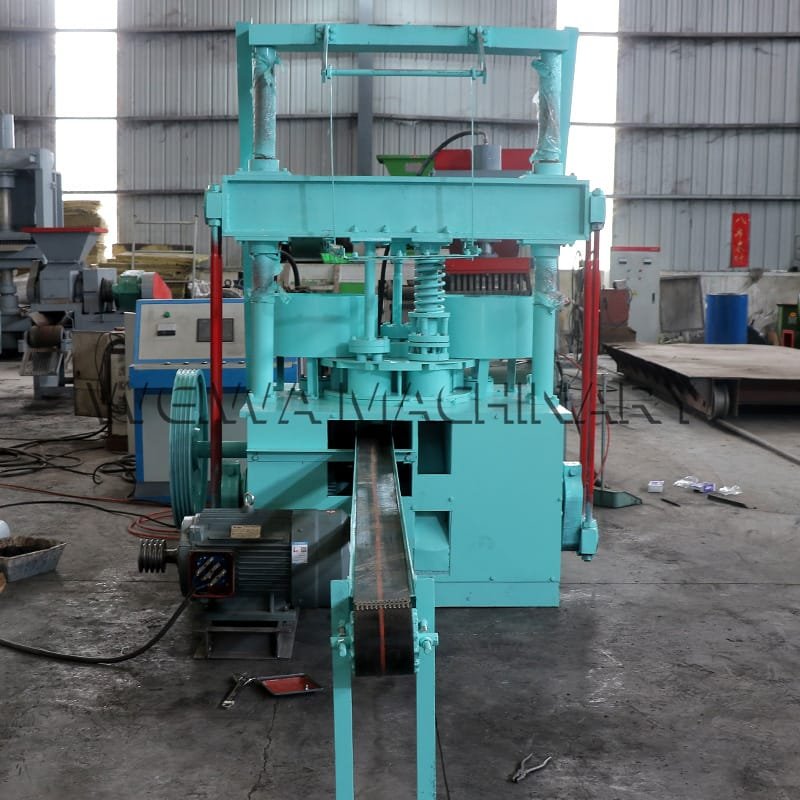
The honeycomb briquette charcoal machine inspected for Indonesia uses a cast base, welded steel upper frame, hardened rotary table, and interchangeable mold group. The punch cam is alloy steel with nitride treatment. The knockout pins are spring assisted. The feeder is a variable-speed chain scraper, not a vibrating tray, because vibration causes density waves in the final piece.
Maintenance items the client must respect: grease rotary table bearings every 200 horas, inspect punch-head clearance every 300 horas, clean mold barrel with nylon brush every shift, check VFD cooling fan monthly, and recalibrate binder dosing pump every 500 horas. None of these require a factory engineer. A basic mechanic can do them with the Weiwa manual and the spare kit we pack in the container.
Why Indonesian Buyers Compare Honeycomb Punching Machine with Roller Press?
Some fuel startups ask us whether a roller press is better than a honeycomb punching machine. The answer depends on product. Roller presses make pillow, oval, or square briquettes without through-holes. They run faster and cost less per ton on large scale. But they cannot make the classic honeycomb coal used in traditional Indonesian clay stoves and many BBQ setups. If the buyer’s market wants hexagon honeycomb with holes, only a honeycomb briquette charcoal machine will do.
For the Java client, end-user demand decided it. His retail buyers specifically asked for honeycomb charcoal coal briquette forming machine output because the holes let sauce vendors control flame height. A roller pillow briquette would roll off the stove grill. So the coal briquettes making machine type was never in doubt, only the mold size and automation level.
Commercial View for Indonesia Market Entry
Indonesia’s charcoal and coal briquette trade is fragmented. Thousands of small baggers resell imported product. Local production with a honeycomb briquette charcoal machine in Indonesia gives price control, fresher stock, and custom sizing for local stove brands. The client we inspected for projects payback in 7 para 9 months assuming 6 tons per day at 60 percent utilization and current Central Java retail spread.
Weiwa Machinery does not promise those numbers as guarantee. We give the spreadsheet, the power draw curve, the mold wear table, and the sample burn video. The Indonesia buyer then decides. In this case he decided to add a second 90 mm round mold and a small mesh dryer tunnel in phase two, three months after first container arrival.
Shipping Packing and Indonesia Port Handling
The honeycomb punching machine weighs 3,050 kg in Model 220 configuration. We packed the main body in waterproof stretch plus plywood skid. Mold group went in a separate sealed wooden crate with desiccant. Electrical panel was bubble wrapped and bolted inside the main frame to avoid shock. Spare pins, wrenches, and manual in English plus Indonesian glossary rode in a small metal box welded to the frame.
Destination is Semarang port. We reminded the client that Indonesian customs often asks for HS code 8474.80.90 for briquette forming presses, and that voltage label must show 380V 50Hz three-phase clearly or the local surveyor may delay unloading. These are small details but they decide whether a honeycomb briquette charcoal machine reaches the workshop in 10 days or 30.
Remote Inspection Trend Among Southeast Asia Buyers
Since 2024 more Indonesia, Vietnã, and Philippines buyers request live video inspection instead of flying to China. For this order we used a tripod camera on the commissioning bay, a macro camera on the caliper measurement, and a phone camera on the burn test. The client screenshot the sample, zoomed the holes, and asked us to stamp his company tag on the sample crate. That crate now travels with the container as physical proof to his local partners.
This workflow suits the honeycomb charcoal coal briquette forming machine because the product is visual. Density, hole straightness, and edge sharpness cannot be faked on camera. Either the coal briquettes making machine delivers or it does not.
Keyword Context Around Honeycomb Briquette Charcoal Machine in Indonesia
Search behavior in the region shows buyers type both the generic honeycomb briquette charcoal machine and the localized honeycomb briquette charcoal machine in Indonesia. They also search the functional phrase honeycomb charcoal coal briquette forming machine when they already know the hole structure. Others type coal briquettes making machine because they start from the output, not the shape. Experienced technicians search honeycomb punching machine to find spare pins and cam drawings. A blog that serves all five queries without repeating them mechanically will outlast pages that stack keywords in the first paragraph.
Throughout this article we kept those terms in natural positions: opening context, section headings, sample description, comparison paragraph, and closing CTA. No bold, no repeated spam, no hidden spans.
Sobre Máquinas de Weiwa
Weiwa Machinery is a Henan based industrial equipment manufacturer with over 30 years in briquette and charcoal machinery. We design honeycomb briquette charcoal machines, máquinas para fazer briquetes de carvão, máquinas de perfuração de favo de mel, fornos de carbonização, trituradores, misturadores, and full production lines. Our equipment runs in more than 130 países incluindo a Indonésia, Índia, Malásia, Vietnã, Filipinas, Peru, Polônia, África do Sul, and Mexico. We provide pre-sale material testing, mold customization, factory video inspection, embalagem de contêiner, English and Spanish manuals, spare parts kits, and remote commissioning support.
For the Indonesia client in this case, our job was not to sell one honeycomb charcoal coal briquette forming machine. Our job was to make sure the machine he receives in Semarang performs exactly like the sample he watched burn on a Tuesday morning in Gongyi. That is the standard we apply to every honeycomb punching machine leaving the workshop.
If you are evaluating a coal briquettes making machine for Indonesia or any market with coal dust, rice husk char, coconut shell char, or palm waste, send your raw material photo and target briquette drawing. We will run a bench test, record the trial, and quote a line matched to your power and labor condition.
Entre em contato com a Weiwa Machinery
Móvel / Whatsapp: +8613838093177
E-mail: info@cjlmachinegroup.com
Product reference: https://cjljx.com/product/honeycomb-charcoal-briquettes-machine


 WeChat

 +8615937143060
