


The horizontal carbonization furnace has become one of the most requested charcoal production machines for West Africa because it solves problems that traditional charcoal kiln methods cannot solve. It reduces smoke, recycles pyrolysis gas, improves batch consistency, and gives small to medium-scale producers in Ghana a measurable path from informal pit burning to controlled industrial carbonization.
Why Ghana Is a Strong Market for a Forno de carbonização horizontal?
Ghana has steady supplies of biomass. Cocoa farm prunings, coconut shells from the coast, hardwood offcuts from timber towns, sawdust from furniture clusters in Kumasi, palm kernel shells from oil mills, and agricultural residues from northern farms all represent potential charcoal feedstock. The problem is not raw material availability. The problem is process control.
Many Ghana charcoal makers still depend on earth pit burning or rudimentary brick kilns. Those methods are cheap to start but expensive to operate. Yield swings between batches. Smoke creates disputes with neighbors. Rainy season extends drying time. Dry season encourages uncontrolled burning. A horizontal carbonization furnace in Ghana changes the business model because the machine replaces guesswork with meters, valves, condensers, and recorded temperature curves.
When we discuss horizontal carbonization furnace in Ghana, the conversation is rarely about one machine only. It is about replacing weather-dependent charcoal making with a repeatable production system. The producer can sort feedstock, dry it, load the chamber, seal the door, start the burner, recover gas, and cool the batch with far less reliance on wind, rainfall, and luck.
Ghana Feedstock Matches the Horizontal Furnace Design
The Weiwa horizontal carbonization furnace is built for wood logs, bambu, conchas de coco, briquetes de serragem, and selected agricultural residues. That feedstock list matches Ghana very well. Coastal buyers can work with coconut shell and palm kernel shell. Inland buyers can work with hardwood offcuts and cocoa pruning wood. Furniture belt operators can convert sawdust into briquettes first, then carbonize the briquettes in the same chamber.
The key is not that the machine accepts everything. The key is that the operator controls moisture, densidade, packing pattern, sealing quality, and cooldown discipline. A charcoal making machine does not magically fix green wood. But a well-designed horizontal chamber makes the difference between random charcoal and graded charcoal.
What Happens in the Weiwa Loading Bay Before Shipment?
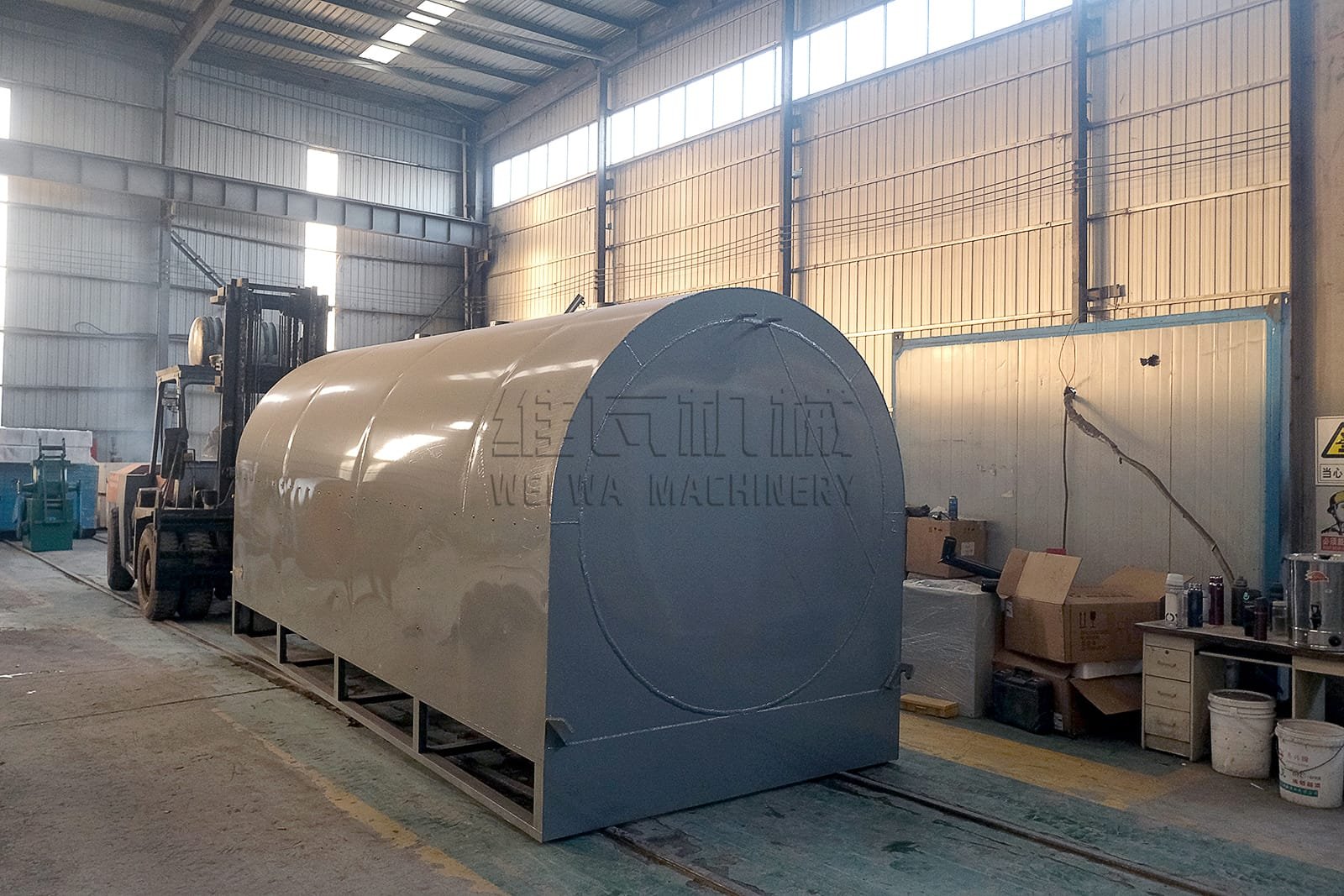
The loading bay at Weiwa Machinery was organized around a single priority. The horizontal carbonization furnace for Ghana had to arrive undamaged, pre-tested, and ready for commissioning within days of unloading. The main furnace body, rail-mounted barrel chamber, condenser tower, induced draft fan, gas purification unit, and control cabinet were staged separately, wrapped with waterproof membrane, and fixed to a steel skid frame.
Unlike traditional brick kilns, this unit does not require on-site masonry. Once the foundation is level, the barrel chamber is rolled into position, the gas lines are connected, and the power supply is hooked to the control panel. That simplicity matters for Ghana buyers who do not have large crane teams or permanent civil engineering crews on site.
Before the furnace entered the container, our quality team ran a no-load heating cycle and a short wood chip trial. The purpose was not only to check welds and seals. The purpose was to capture baseline data for the Ghana client. We recorded ramp-up time, burner response, condenser drip rate, chamber pressure trend, and temperature curve inside the barrel. Those numbers were printed in the manual pouch so the local technician in Ghana would know exactly what normal operation looks like on day one.
Export Packaging Built for Ocean Transit
A charcoal making machine that arrives confused, rusted, or miswired creates a bad first month. Our export team photographs every lifting point, labels each pipe flange, and translates the commissioning checklist into plain English. For the Ghana order, we also added a one-page quick-start sheet covering tropical humidity precautions, because coastal Ghana presents higher moisture exposure than our inland Chinese workshop.
Control panels were packed with desiccant and shock protection. Gaskets, termopares, spray nozzles, fan bearings, and relays were placed in a separate spare kit. Foundation drawings, rail alignment diagrams, gas line schematics, and electrical drawings were placed in a waterproof document tube. The goal is simple. When the container opens in Tema or Kumasi, the buyer should feel like the machine was prepared for their site, not just pushed into a box.
How the Horizontal Carbonization Furnace Works?
A horizontal carbonization furnace is built around a cylindrical barrel chamber mounted on rails. Raw material is loaded into carts or pushed directly into the barrel, then the door is sealed. The chamber is heated indirectly, meaning the flame never touches the wood. Instead, a burner outside the barrel heats the steel wall, and the biomass inside undergoes pyrolysis in a low-oxygen environment.
This design is different from a vertical kiln or a fixed earth mound because heat distribution is more even along the barrel length. Indirect heating protects product quality. The wood does not ignite like firewood. It thermally decomposes, releasing volatile gases that leave the chamber, pass through condensation and purification equipment, and return as clean combustible gas.
Indirect Heating and the 600 Degree Self-Sustaining Cycle
During the Weiwa trial, the furnace reached an internal chamber temperature near 600 degrees Celsius using a combination of starter firewood and recycled process gas. The horizontal carbonization furnace is equipped with a gas purification system that captures tar, Vinagre de madeira, and condensate from the smoke stream. After scrubbing, the cleaned combustible gas is returned to the burner.
Once the thermal cycle stabilizes, external fuel demand drops sharply. In the Ghana trial simulation, after the early heating stage the burner consumed mostly recycled gas rather than fresh firewood. This self-sustaining loop matters for Ghana charcoal makers because firewood is not free, transport cost is real, and charcoal buyers now ask for fixed moisture, fixed size, and low ash content.
Rail-Mounted Barrel Chamber Reduces Labor Pain
The rail-mounted chamber is a defining feature of the horizontal carbonization furnace. Operators load carts in a shaded prep area, push them into the furnace, seal the door, and begin the cycle. After cooling, one worker can pull the cart out without shoveling hot material from a pit.
For Ghana operations where labor cost is rising and young workers prefer cleaner jobs, this ergonomic advantage is part of the business case. A charcoal kiln often means long hours near smoke, embers, and unpredictable heat. A horizontal charcoal making machine moves the hard work into a controlled workflow: sorting, secagem, loading, sealing, monitoring, cooling, triagem, and bagging.
Factory Trial Run Simulating Ghana Conditions
Before sealing the container, Weiwa Machinery conducted a full trial using a mixture of tropical hardwood logs and coconut shells, because that mix is realistic for Ghana buyers. The chamber was loaded, sealed, and slowly heated. Within approximately two hours the internal temperature entered the active carbonization range. Between the fifth and ninth hour the barrel stabilized near 580 para 610 graus Celsius.
The gas-recycling system engaged automatically once sufficient volatile gas was produced. From that point, the burner flame shifted from startup firewood combustion to recycled syngas combustion. Our engineers recorded stable pressure readings and confirmed that the rail-cart mechanism moved freely under load.
Trial Batch Composition and Moisture Preparation
One Ghana-simulated batch used about 1200 kilograms of combined feedstock. Hardwood offcuts were sun-dried for two days and measured near 15 porcentagem de umidade. Coconut shells were below 12 porcentagem de umidade. Sawdust briquettes were tested in a separate smaller cart to check bridging and packing behavior.
Our engineers left airflow gaps between pieces. Overpacking slows pyrolysis and leaves under-carbonized cores, which is one of the main complaints operators have after buying a cheap charcoal making machine. The door was sealed with high-temperature gasket tape, and the purification tower water circulation was started before ignition.
Observed Trial Results
Ignition began with firewood in the startup burner. Internal chamber temperature reached 300 degrees Celsius in about 78 minutos. Between 300 e 500 graus Celsius, gas evolution accelerated. By minute 135, chamber temperature stabilized at 590 graus Celsius. Peak observed temperature was 612 graus Celsius.
The automatic gas return valve opened, and flame appearance at the burner changed from yellow to sharper blue, indicating recycled syngas combustion. Total active carbonization time was about seven hours and twenty minutes. Cooling took additional hours under controlled venting.
Final charcoal output was 368 kilograms from 1200 kilograms of feedstock, a yield of 30.6 por cento. Fixed carbon tested at 72 por cento. Ash content was 3.1 por cento. No continuous smoke column was visible from the stack during steady-state operation. A faint vapor plume appeared only during initial moisture release, which is normal and not the black smoke associated with a traditional charcoal kiln.
The Ghana client reviewed the trial video and weight sheet. For them, the decisive numbers were yield consistency and smoke reduction. A traditional charcoal kiln on the same feedstock typically returns 22 para 26 percent charcoal with high batch variance. The horizontal carbonization furnace in Ghana trial produced 30.6 percent with uniform black luster and low breakage.
Why the Horizontal Carbonization Furnace Suits the Ghana Charcoal Market?
Ghana possesses extensive forestry resources and agricultural by-products, yet many local producers still rely on traditional pit burning or rudimentary kilns that yield inconsistent charcoal and generate heavy smoke. Adopting a horizontal carbonization furnace addresses several market pain points at the same time.
Higher Charcoal Quality Commands Better Prices in Accra and Kumasi
Controlled pyrolysis avoids over-charring or under-carbonized spots typical of earthen pits. Uniform charcoal from a horizontal carbonization furnace meets the density and fixed-carbon standards preferred by commercial buyers in Accra, Kumasi, Tamale, and export markets. That allows producers to negotiate higher per-bag prices instead of competing only on volume.
Barbecue distributors want pieces that light predictably, burn long, break less during transport, and leave low ash. Restaurant buyers do not want pale cores. Export buyers do not want hidden moisture. The furnace gives the operator process evidence: temperature curve, batch weight, yield percentage, and cooldown record.
Reduced Fuel Cost Improves ROI for Ghana SMEs
By recycling pyrolysis gas, the furnace lowers daily fuel expenses. For small and medium-scale enterprises in Ghana, this reduction in operating cost shortens the payback period on the charcoal making machine investment. Many Ghana operators can recover the upgrade cost faster when they stop buying large amounts of firewood for every batch.
In the trial, external firewood demand dropped significantly after the gas return system engaged. For a charcoal yard running multiple batches per week, that saving is not theoretical. It changes the monthly fuel bill, the labor schedule, and the maximum number of batches the site can run during dry season.
Environmental Pressure Is Quietly Reshaping the Ghana Market
Open burning attracts complaints. Traditional kilns release smoke, tar aerosols, and particulate matter. Ghanaian municipalities, community leaders, and development partners are paying more attention to biomass processing. A horizontal carbonization furnace does not eliminate emissions completely, but it changes the process from open pyrolysis to captured pyrolysis.
Tar and wood vinegar are collected. Smoke is not simply released into the neighborhood. Recycled gas returns to the burner, so less external fuel is burned. For a charcoal kiln replacement project, that story matters to banks, NGOs, forestry programs, and export-oriented buyers.
Adaptability to Variable Raw Material Moisture
Tropical rainy seasons can raise wood moisture above ideal levels. While we recommend pre-drying, the insulated chamber and adjustable heating duration allow the horizontal carbonization furnace to handle slightly elevated moisture better than thin-walled metal drums.
The operator still needs discipline. Green wood below acceptable dryness extends cycle time and lowers yield. But the Weiwa design gives the technician adjustable ramp time, condensate drainage capacity, and clearer data than a pit in the ground. That is the difference between hoping for good charcoal and managing for it.
Horizontal Carbonization Furnace vs Traditional Charcoal Kiln
The phrase charcoal making machine covers many designs: vertical retorts, rotary carbonizers, continuous pyrolysis plants, and horizontal batch furnaces. For Ghana buyers who are moving out of pit burning, the horizontal model often fits best because it keeps the workflow simple while adding process control.
Loading and Ergonomics
While vertical furnaces occupy less floor space, they typically require top-loading, which can be physically demanding without a hoist. The horizontal carbonization furnace uses side-loading rail carts, better suited to workshops lacking overhead cranes. Heat distribution is more even along the barrel length, and cleaning out residual ash is simpler through the rear door.
Batch Flexibility
For Ghana producers planning to process mixed sizes of wood and briquettes, the horizontal model offers greater flexibility in batch composition. Hardwood logs, conchas de coco, bamboo sections, and sawdust briquettes can be arranged with airflow gaps instead of forced into one rigid shape.
Quality Consistency
A traditional charcoal kiln can be built cheaply, but it punishes the operator with low yield, weather dependence, fire risk, and smoke disputes. The horizontal carbonization furnace removes most of that uncertainty. Cycle time is more fixed. Yield is more predictable. Charcoal density is higher. And because the unit is enclosed, nearby crops and housing are not exposed to embers.
Expected Commercial Performance for Ghana Producers
A well-run horizontal carbonization furnace for Ghana can deliver 25 para 35 percent charcoal from dry feedstock, depending on material. Hardwood usually sits in the middle of that range. Coconut shell often performs better because of its density. Sawdust briquettes vary by binder and compaction. Agricultural residues such as maize cob or cassava stalk are possible but yield lower and require tighter barrel packing.
Yield by Feedstock
Dry hardwood offcuts typically return 28 para 33 percent charcoal by weight. Coconut shell returns around 32 para 36 por cento. Sawdust briquettes fall in the 30 para 34 percent range if the briquette itself was made at correct pressure. Cocoa pruning wood and general farm residues can work, but the operator should sort first and dry thoroughly.
Yield is not fixed by the machine alone. Yield is fixed by moisture, densidade, sealing quality, packing pattern, and cooldown discipline. The Weiwa trial report shared with the Ghana client lists all of those variables so he can train his team instead of blaming the steel.
Fuel and Labor Savings
Fuel wood consumption can fall 30 para 40 percent compared with a conventional kiln of similar batch size because recycled gas supplies much of the thermal energy. Labor hours drop because loading and unloading become mechanical rather than manual mound work. Smoke complaints drop because the process is enclosed.
For a Ghana entrepreneur selling to Accra barbecue distributors or supplying neighboring West African markets, charcoal grade decides margin. Uniform pieces, low ash, and high fixed carbon command premium price. The horizontal carbonization furnace delivers that grade repeatedly.
Site Conditions in Ghana and How Weiwa Prepares for Them
Ghana is not one climate. Accra and Sekondi are humid and coastal. Kumasi, Sunyani, and Tamale are hotter and dustier. The furnace design handles these differences if the site preparation is correct.
Coastal Humidity and Condensate Management
Near the coast, condensate volume rises. Alcatrão, Vinagre de madeira, and water collect faster in the purification tower. For horizontal carbonization furnace for Ghana orders, Weiwa adds larger condensate collection drums and clearly labeled drain valves. The control panel is packed with extra moisture protection. Local technicians receive a humidity checklist.
Rural Power and Site Utilities
Many Ghana charcoal yards do not have perfect grid power. The furnace itself needs only a small amount of electricity for the induced draft fan and control system. Initial ignition can use firewood, LPG, or diesel. Once gas recycling begins, no continuous external gas supply is required.
For unstable voltage areas, we recommend a voltage stabilizer and properly sized cables. The commissioning manual explains cable size, earthing, fan current draw, and control panel protection in plain language.
Commissioning Plan After the Furnace Reaches Ghana
When the container arrives, the Ghana team should not rush the first fire. The correct sequence is foundation check, leveling, rail alignment, gas line leak test, electrical check, no-load heating test, then a small trial batch.
First Week On Site
Day one is unpacking and inventory. Day two is foundation and rail placement. Day three is gas line and electrical connection. Day four is no-load heating and thermocouple verification. Day five is a small hardwood batch. Only after the small batch looks correct should the team run a full commercial batch.
Common Mistakes to Avoid
The first mistake is wet feedstock. Green wood sounds acceptable, but it extends cycle time and lowers yield. The second mistake is overpacking the cart. The third mistake is skipping the gas line leak test. The fourth mistake is firing at full burner power too early. Pyrolysis needs controlled ramp-up, not aggressive heating.
The fifth mistake is poor cooldown. Opening the door too early can let oxygen reignite hot charcoal and waste product. The Weiwa manual gives target temperatures, waiting times, and safe venting steps so the Ghana operator does not learn these lessons by destroying a batch.
How the Furnace Fits Into a Ghana Charcoal Business?
A new investor in Ghana usually starts with one furnace and one feedstock source. That is sensible. The next step is drying space, raw material storage, cooling area, charcoal screening, and bagging. Later, a crusher and briquette press turn charcoal fines into saleable briquettes instead of waste.
The horizontal carbonization furnace is the heart of that system. It is not the whole factory. But it is the machine that decides charcoal yield, smoke control, and batch consistency. If the furnace is weak, no briquette press can save the product.
From Waste Stream to Saleable Carbon
Cocoa farmers prune trees twice a year. Palm oil processors discard empty fruit bunches. Furniture factories pile sawdust. All of these are marginal waste streams until a charcoal making machine converts them into storable, transportable, saleable carbon.
The horizontal carbonization furnace accepts wood logs, bambu, concha de coco, briquetes de serragem, and agricultural residues provided moisture stays under control. We advise Ghana clients to pair the furnace with a simple hoop dryer or solar shed when processing fresh biomass. Drying is not part of the furnace itself, but it protects cycle time and charcoal quality.
Weiwa Machinery Approach to Ghana Orders
Weiwa Machinery does not sell the same steel to every country. For Ghana, we adjust condensate capacity, label valves in English, choose tropical-grade insulation where needed, and run trial batches with hardwood and coconut shell mixes. Every horizontal carbonization furnace leaves with a weld inspection record, pressure check, electric control test, and trial curve when requested.
Spare parts are kept simple. Door gasket, thermocouple, condenser spray nozzle, fan bearing, and control relay cover most field issues. We send one spare kit with Ghana orders and keep a digital folder per machine serial number. If the client calls six months later with temperature drift, our engineer compares the live reading with the factory baseline.
After-Sales Support for Ghana Clients
Upon arrival at the Ghana destination port, the client receives detailed installation diagrams, foundation drawings, and a step-by-step commissioning manual in English. Our technical team provides remote video guidance for assembly, first firing, and safety checks.
Spare parts lists and maintenance schedules are included to ensure long service life even in humid coastal or dusty inland environments. Weiwa Machinery has served customers across Africa, Sudeste Asiático, South America, E o Oriente Médio. Every horizontal carbonization furnace we export is backed by responsive after-sales support via phone, e-mail, and WhatsApp.
Who Should Buy This Machine in Ghana?
The horizontal carbonization furnace is suitable for charcoal yard owners who want to replace pit burning, timber processors with offcuts, coconut and palm kernel shell traders, furniture clusters with sawdust, cocoa farmers organizing pruning wood, and new investors who want a cleaner charcoal business.
It is also suitable for NGOs and forestry programs that want demonstrable smoke reduction and better biomass utilization. It is not suitable for buyers who expect zero labor, zero drying, and zero learning curve. Carbonization is still thermal chemistry. The machine makes it controllable, not magical.
Final Takeaway From the Ghana Shipment
The horizontal carbonization furnace shipped to Ghana represents more than export revenue for Weiwa Machinery. It represents a shift from informal charcoal burning to measured charcoal production. The trial run proved that tropical hardwood and coconut shell blends can reach near 600 graus Celsius, recycle pyrolysis gas, produce around 30 percent yield, keep fixed carbon high, and operate with far less smoke than a traditional charcoal kiln.
For Ghana producers, the business case is practical. Better charcoal grade, lower fuel cost, cleaner site, easier labor workflow, and data-driven batch records. For Weiwa Machinery, the case is equally clear. A charcoal making machine should not only make charcoal. It should make the workshop safer, the product consistent, and the investment understandable.
Sobre Máquinas de Weiwa
WEIWA MACHINERY is a manufacturer of biomass processing equipment, specializing in horizontal carbonization furnace technology, charcoal making machine systems, briquette production lines, and related thermal equipment. Our machines process wood, bambu, concha de coco, briquetes de serragem, and agricultural residues into high-value charcoal and biochar.
Os produtos são exportados para muitos países e regiões. WEI WA MACHINERY has become the preferred choice for more than 2 million customers worldwide who prioritize long-term reliability over short-term transactions. We provide factory customization, pre-shipment trial runs, export packaging, installation drawings, remote commissioning guidance, and spare parts support.
If you are evaluating a horizontal carbonization furnace in Ghana or comparing a charcoal making machine against a traditional charcoal kiln, our team can help you choose the right chamber size, condenser capacity, and feedstock preparation plan for your site.
Entre em contato com a Weiwa Machinery
MOB: +8613838093177
Whatsapp: +8613838093177
E-mail: info@cjlmachinegroup.com


 WeChat

 +8615937143060
