


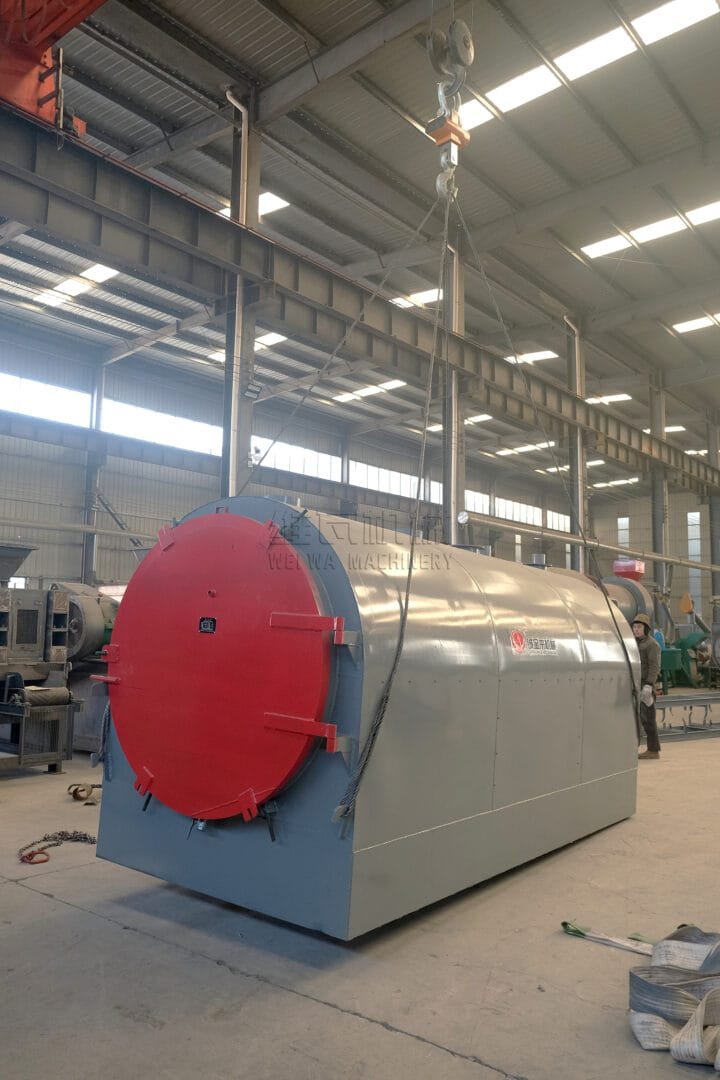
Recently at Weiwa Machinery, we completed the factory acceptance test and export packing of a horizontal carbonization furnace bound for a charcoal production workshop in Colombia. This shipment represents not only the growing demand for charcoal making machine solutions in South America but also our continued commitment to providing reliable charcoal maker equipment such as the horizontal carbonization furnace in Colombia market and traditional charcoal kiln alternatives upgraded with modern smokeless technology.
Shipment Preparation of the Horizontal Carbonization Furnace at Workshop
The horizontal carbonization furnace destined for Colombia is a barrel-style chamber mounted on rails with a matched flue gas purification system that recycles combustible gas back into the burner. Before export, our quality control engineers verified the thickness of the furnace shell, inspected the refractory insulation layer inside the drum, tested the sealing performance of all manholes and doors, and ran a simulated temperature rise on the digital control cabinet to confirm that thermocouples and solenoid valves responded correctly. Each charcoal maker unit is required to hold internal pressure in a low-oxygen state so that volatile gases released during pyrolysis do not escape unchecked but are instead channeled through the condensation and tar separation units. Only after passing these checks was the horizontal carbonization furnace approved for overseas shipment.
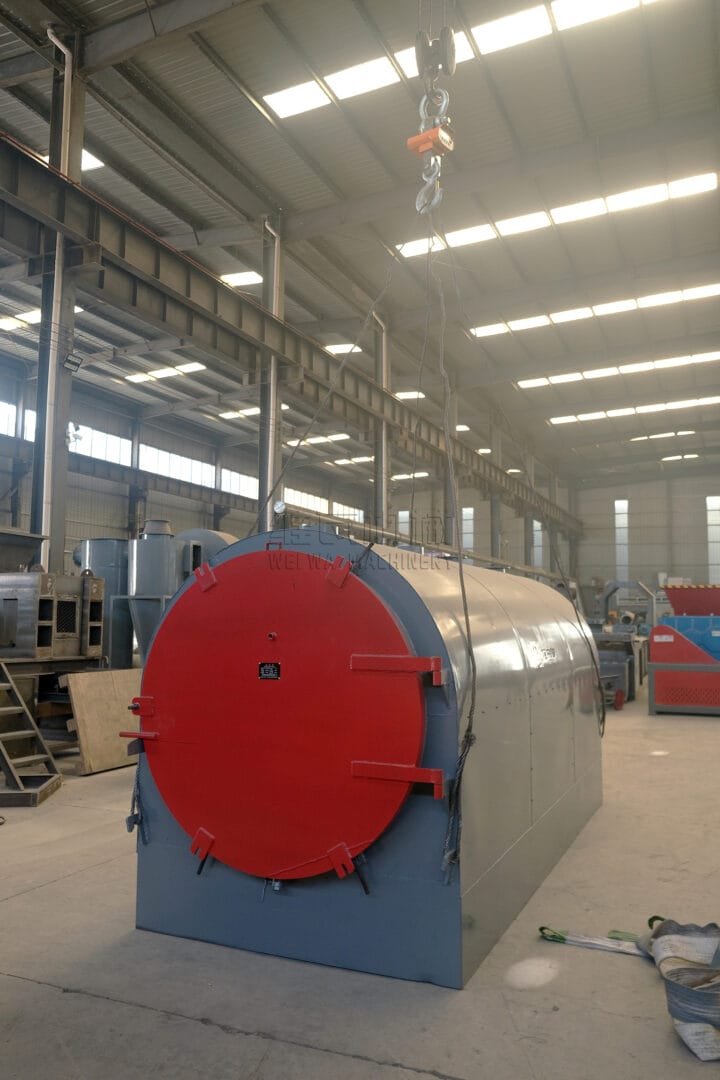
Anti Rust Treatment and Container Loading for the Colombia Order
Because sea freight from China to the port of Barranquilla or Buenaventura can take several weeks with high humidity exposure, we applied anti-rust oil to all exposed carbon steel parts of the charcoal making machine and wrapped the furnace body with waterproof woven fabric. The purification tower, fã, and control panel were packed in reinforced plywood cases marked with lifting points. Inside the forty-foot high cube container the horizontal carbonization furnace was blocked and braced with timber to prevent longitudinal or lateral shifting during ocean transit. Our documentation department prepared the certificate of origin, commercial invoice, packing list, and bill of lading in both English and Spanish so that Colombian customs clearance for this horizontal carbonization furnace in Colombia importation would proceed without administrative delay.
Why Colombian Producers Choose a Horizontal Carbonization Furnace Instead of Traditional Charcoal Kiln?
In many regions of Colombia small-scale charcoal is still produced in earth pits or improvised brick charcoal kiln structures which suffer from low yield, inconsistent carbonization, and heavy smoke emissions. A modern horizontal carbonization furnace or charcoal making machine with indirect heating and gas recovery addresses these problems. The horizontal layout allows raw material to be loaded on a trolley and pushed into the sealed drum where uniform heat surrounds the charge from below and both sides. Compared with a traditional charcoal kiln the charcoal maker of horizontal type shortens carbonization time from more than forty-eight hours to approximately ten to fourteen hours per batch depending on moisture content and raw material density. Colombian buyers also appreciate that the purified syngas from the horizontal carbonization furnace can be ducted back to the burner so that external fuel consumption drops significantly after the initial ignition phase.
Environmental Compliance and Smoke Treatment in the Colombian Context
Colombia has introduced progressively stricter environmental regulations on open burning and uncontrolled charcoal kiln operations especially near protected forest zones. The horizontal carbonization furnace supplied by Weiwa Machinery is equipped with a multi-stage flue gas purification system containing a condenser, sobe escadas, and water seal tank. Combustible volatiles collected during the pyrolysis stage are reignited in the combustion chamber rather than released into the atmosphere. For entrepreneurs transitioning from a conventional charcoal kiln to a certified charcoal making machine this feature helps demonstrate compliance with municipal emission standards and can be an advantage when applying for agro-industry permits or sustainability certifications in the Colombian market.
Raw Materials Suitable for the Horizontal Carbonization Furnace in Colombia
Colombia has abundant forestry resources and agricultural residues that can be processed by a horizontal carbonization furnace. Hardwood species such as oak, eucalyptus, and acacia grown in the Andean region produce dense charcoal with high fixed carbon when carbonized inside a well-sealed charcoal making machine. Bamboo cultivated in the coffee-growing triangle of Quindío, Risaralda, and Caldas is another excellent feedstock for the charcoal maker because its cylindrical shape packs neatly inside the horizontal drum and carbonizes evenly. Coconut shells imported from Caribbean coastal areas or available as waste from local copra processors are ideal for high-value shell charcoal used in water filtration and hookah blends. Even compressed sawdust briquettes made from coffee husks or rice hulls can be carbonized in the same horizontal carbonization furnace in Colombia installations provided they have been dried to below fifteen percent moisture prior to loading.
Moisture Control Before Feeding the Charcoal Making Machine
A common mistake new operators make when switching from a traditional charcoal kiln to a mechanized horizontal carbonization furnace is loading material that is too wet. Excess moisture prolongs the dehydration stage, increases the risk of incomplete pyrolysis, and dilutes the calorific value of the off-gas that would otherwise be recycled to the burner of the charcoal making machine. We recommend pre-drying wood logs or bamboo splits under sunlight or in a rotary dryer until the moisture meter reads twelve to fifteen percent. For coconut shells which are naturally denser and retain internal moisture longer, allowing an extra sun-drying period or using waste heat from the horizontal carbonization furnace flue can improve final charcoal hardness and reduce ash content.
Working Principle of the Horizontal Carbonization Furnace as a Modern Charcoal Maker
The horizontal carbonization furnace operates on the principle of anaerobic or low-oxygen pyrolysis. Raw biomass is placed inside the horizontally oriented rotating or fixed drum which is then sealed. An external firebox or the recycled syngas from the purification system raises the internal temperature gradually. Between one hundred and two hundred degrees Celsius free water evaporates. From two hundred and fifty to four hundred fifty degrees the cellulose and lignin in wood or bamboo undergo thermal decomposition releasing volatile compounds such as carbon monoxide, metano, and hydrogen along with wood vinegar and tar. Above four hundred fifty degrees full carbonization occurs leaving a black porous solid high in fixed carbon. The charcoal kiln method achieves the same chemistry but without temperature instrumentation, uniform insulation, or gas recovery. By contrast the charcoal making machine of horizontal type lets the operator monitor each stage on a digital display and adjust air intake dampers to keep oxygen levels low enough to prevent the material from simply burning to ash.
Temperature Stages Inside the Horizontal Carbonization Furnace
During the dehydration stage the horizontal carbonization furnace is warmed slowly to avoid surface scorching especially on thick-walled hardwood or coconut shell pieces. In the pyrolysis stage the temperature is held steady within the three hundred to four hundred degree window so that maximum volatile release happens without igniting the charge. The final carbonization stage typically targets five hundred to six hundred degrees Celsius inside the drum which corresponds to the optimum balance between charcoal yield and fixed carbon percentage for most Colombian raw materials. After the soak period the charcoal maker is cooled either by natural air cooling with the door closed or by transferring the trolley to a separate cooling bay if the plant operates on a multi-batch schedule. Understanding these phases helps Colombian users of the horizontal carbonization furnace in Colombia fine-tune their process for different feedstocks whether they are producing BBQ lump charcoal, bamboo biochar for soil amendment, or activated carbon precursor from coconut shell.
Expected Charcoal Yield and Quality from the Charcoal Making Machine
Under normal operating conditions a properly adjusted horizontal carbonization furnace converts eight hundred to one thousand kilograms of dry hardwood into two hundred eighty to three hundred twenty kilograms of first-grade charcoal which equates to a yield ratio of roughly thirty to thirty-five percent by weight. Coconut shells tend to give a slightly lower mass yield but produce charcoal with higher density and lower ash making it more valuable per kilogram. Bamboo usually yields twenty-five to thirty percent depending on internode thickness and moisture. These figures compare favorably with a traditional earth charcoal kiln which often delivers only fifteen to twenty percent yield due to partial oxidation losses. The charcoal making machine also produces more uniform pieces because the material is not crushed or disturbed during carbonization as it would be in a pit charcoal kiln that must be broken open and manually sorted.
Fixed Carbon Content and Ash Specification for Export Grade Charcoal
Colombian charcoal exporters targeting the European or North American BBQ market typically require fixed carbon above seventy-five percent and ash below three percent for hardwood lump charcoal. The horizontal carbonization furnace from Weiwa Machinery can achieve fixed carbon values in the seventy to eighty-two percent range when the end temperature is held near five hundred eighty degrees Celsius and the soaking time is correctly set. Users who previously relied on a brick charcoal kiln often notice that the charcoal maker output has less unburned wood core and fewer partially charred outer layers because the horizontal drum distributes heat circumferentially. Sampling the finished charcoal with a simple field test—observing color,敲击 sound, and water float ratio—allows the operator of the charcoal making machine to judge whether process parameters need adjustment before the next batch.
Installation Site Requirements for the Horizontal Carbonization Furnace in Colombia
When the container carrying the horizontal carbonization furnace arrives at the customer site in Colombia the first task is to prepare a level concrete foundation capable of supporting the static weight of the furnace plus the dynamic load of a loaded trolley. We recommend a minimum slab thickness of fifteen centimeters reinforced with steel mesh. The charcoal making machine should be installed under a simple roof structure to protect the control panel from direct rain since tropical afternoon storms are common in many Colombian departments. A three-phase power supply of two hundred twenty or three hundred eighty volts depending on local grid standards is needed to run the induced draft fan and the control cabinet of the charcoal maker. A small water source is required for the seal tank of the gas purification system though total consumption is modest—usually under half a cubic meter per operating day. Space should also be allocated for raw material staging and cooled charcoal screening adjacent to the horizontal carbonization furnace in Colombia production line so that material flow remains efficient.
Safety Precautions When Operating the Charcoal Maker
Although the Forno de carbonização horizontal is designed with multiple safety interlocks including over-temperature alarm and door-lock confirmation operators must still follow basic precautions. Never open the main door while the interior temperature exceeds one hundred degrees Celsius because sudden oxygen ingress can cause glowing embers to flare. Keep a fire extinguisher rated for Class A and Class B fires within easy reach of the Máquina de fabricação de carvão work area. Ensure that the flue gas piping of the purification system on the charcoal kiln upgrade model is inspected weekly for tar accumulation which if neglected could restrict gas flow back to the burner. Training the local team on startup sequence shutdown procedure and emergency stop functions is part of the after-sales service Weiwa Machinery provides with every Forno de carbonização horizontal export order including those shipped to Colombia.
After Sales Support and Spare Parts for Horizontal Carbonization Furnace in Colombia
Weiwa Machinery maintains a stock of commonly replaced consumables such as thermocouple probes, sealing gaskets for the furnace door, and impellers for the induced draft fan used on the charcoal making machine. For Colombian clients we can arrange spare part shipments via international courier to Bogotá, Medellín, or Cali with typical transit times of five to seven working days. Remote troubleshooting of the horizontal carbonization furnace control system is available through video call in English or Spanish. For larger installations involving multiple charcoal maker units or a complete charcoal plant with crusher, misturador, and briquette press we can dispatch an engineer to assist with on-site commissioning of the entire line beyond just the horizontal carbonization furnace in Colombia scope.
Sobre Máquinas de Weiwa
Máquinas de Weiwa (Máquinas de Weiwa) is a professional manufacturer of biomass charcoal processing equipment including the horizontal carbonization furnace, charcoal briquette extruder, sawdust dryer, and complete charcoal making machine production lines. With more than ten years of export experience we have supplied charcoal maker solutions to over two million customers worldwide across Asia, África, Europa, and South America. Our factory in Zhengzhou, China is ISO certified and all charcoal kiln alternative models are tested before shipment. We offer customization on furnace diameter and length, language versions of the control panel, and support with container loading and destination country documentation. Whether you are starting a small family charcoal business or building an industrial scale plant around a horizontal carbonization furnace in Colombia or other markets, our technical team is ready to help you select the right configuration and train your staff for successful operation.
For quotation and technical datasheet of the horizontal carbonization furnace or any charcoal making machine, Contate-nos:
Móvel / Whatsapp: +86 13838093177
E-mail: info@cjlmachinegroup.com
Site: https://cjljx.com/products/tanhua/horizontal-carbonization-furnace


 WeChat

 +8615937143060
