


Why Sri Lanka Is a Natural Market for Honeycomb Briquette Charcoal Machines?
Sri Lanka’s cooking and heating fuel landscape is shifting. Traditional lump charcoal imported from coconut shell carbonization is popular but expensive, irregular in size, and dusty during transport. Importers in Colombo, Negombo, and Kurunegala increasingly ask for honeycomb briquettes because the cylindrical shape with central holes lights faster, controls airflow, and stacks neatly in retail bags. A honeycomb briquette charcoal machine in Sri Lanka does not compete with lump charcoal so much as complement it: the same factory can sell premium lump charcoal to hotels and convert screening fines into honeycomb briquettes for the mass market.
The client in this case already owned a small crusher and a rotary dryer, but had been selling loose charcoal dust at low margin. Installing a honeycomb charcoal coal briquette forming machine allowed them to move up the value chain without changing their raw material supply. For a tropical island where coconut shell is abundant and coal dust can be sourced from nearby cement and brick kilns, the coal briquettes making machine is a logical bridge between waste powder and salable fuel.
Raw Materials Available to Sri Lankan Producers
During the survey before shipment, we listed the realistic feedstocks for the client’s region. Coconut shell charcoal powder is the dominant local biomass resource, usually screened below 1 mm after crushing. Coal dust arrives from bulk importers or as recovered fines from coal yards. Rice husk charcoal, sawdust carbon, and cinnamon wood waste appear seasonally. The honeycomb punching machine accepts all of them provided moisture stays under 12 percent and the blend is homogeneous. In the trial we used a 70/30 charcoal dust to coal dust ratio with 2 percent dissolved cassava starch as a natural binder, a recipe already proven in Weiwa installations across Uganda, Índia, and the Philippines.
Arrival and Installation of the Honeycomb Briquette Charcoal Machine
The machine shipped from Weiwa’s Zhengzhou workshop in a 20-foot container, waterproof wrapped, with the mold, punch head, feeder gate, and spare seals in a wooden crate. On arrival at the client’s rented production shed near Colombo, our engineer supervised placement on a level concrete pad. The honeycomb briquette charcoal machine in Sri Lanka export version runs on 415 V three-phase 50 hertz, matching the island’s industrial supply. Grounding was verified, lubrication points were filled with high-temperature grease, and the SL-140 rotary table mold was installed and aligned with the punch axis.
Before any material entered the hopper, the motor was run unloaded for five minutes. The gearbox sounded smooth, the rotary table indexed without hesitation, and the punch descended with consistent stroke length. Only after this no-load check did we invite the client’s two operators to stand beside the control box and watch the sequence: feed screw advances powder into the mold cup, rotary table indexes, punch head compresses, finished honeycomb briquette ejects onto the discharge chute.
First Calibration Run on the Honeycomb Punching Machine
For the first dozen cycles we deliberately slowed the punch frequency to observe filling behavior. The feeding gate opening was set to 60 por cento. The prepared blend was shoveled into the hopper and allowed to flow by gravity plus auger assist. Early briquettes showed slightly rounded hole edges, indicating the punch was descending a half millimeter deeper than necessary. We raised the punch return stop by 0.5 mm and narrowed the feeder gate to 55 por cento. Within three minutes the honeycomb charcoal coal briquette forming machine stabilized, producing 45 pieces per minute with clean 19-hole penetration.
The client noted that the matte dark surface and sharp outer rim looked different from the glossy imported briquettes they had benchmarked. We explained that high-pressure punching without excessive binder produces a denser, less shiny block, and density is what determines burn time. A honeycomb briquette charcoal machine should not polish the product; it should compact it.
Physical Inspection of Trial Samples From the Coal Briquettes Making Machine
After a continuous ten-minute run, we set aside 30 briquettes for laboratory-style but workshop-appropriate testing. The samples measured 140 mm outer diameter and 65 mm height, with 19 holes of 14 mm diameter. Weight per piece averaged 1.18 kg at 6.2 porcentagem de umidade. Edge definition was crisp. When rubbed by hand, no powder shed from the surface, confirming the compression setting on the honeycomb punching machine was correct.
Drop Test and Mechanical Resilience
Sri Lankan distributors often transport briquettes in pickup trucks over potholed roads, so impact resistance matters. We dropped three random samples from waist height onto the concrete floor three times each. One sample lost a 2 mm edge chip; the other two showed only scuff marks. None fractured. The high apparent density, estimated at 1.05 g/cm³, came directly from the pre-compression chamber built into the Weiwa honeycomb briquette charcoal machine, which eliminates air pockets before the final punch stroke.
Field Burn Test in a Local Masonry Stove
The most convincing moment for the client was the burn test. Three trial briquettes were placed on a bed of dried coconut fronds and a small amount of kindling in a typical Sri Lankan outdoor cooking stove. Ignition occurred in five minutes. Initial smoke was light and disappeared within 90 seconds, leaving a steady orange glow. Because the holes align vertically, air pulled from the bottom and exited the top holes, driving the combustion front evenly inward. Total visible burn time exceeded 95 minutes for the three-piece stack, with fine grey ash residue under 9 percent by weight.
For comparison, the client’s previously imported machine-pressed briquettes burned 70 minutes and shed more ash. The honeycomb briquette charcoal machine in Sri Lanka trial thus demonstrated a 35 percent longer burn per kilogram, a metric the client immediately translated into retail pricing power.
How the Honeycomb Charcoal Coal Briquette Forming Machine Works?
Understanding the mechanism helps buyers trust the output. The honeycomb charcoal coal briquette forming machine is a rotary table punch press. Powder drops from the hopper into a measuring cup, the auger pushes it into the mold cavity on the rotating table, and a fixed punch descends once per index to form the honeycomb shape. Ejection is mechanical, driven by a cam that pushes the finished piece upward as the table rotates past the discharge point.
Unlike screw extruders that smear material through heat, the honeycomb punching machine forms cold. This preserves the fixed carbon value of charcoal and avoids thermal degradation. It also means the machine can switch between charcoal-heavy and coal-heavy recipes by adjusting only the feeder gate and punch depth, not the screw temperature profile.
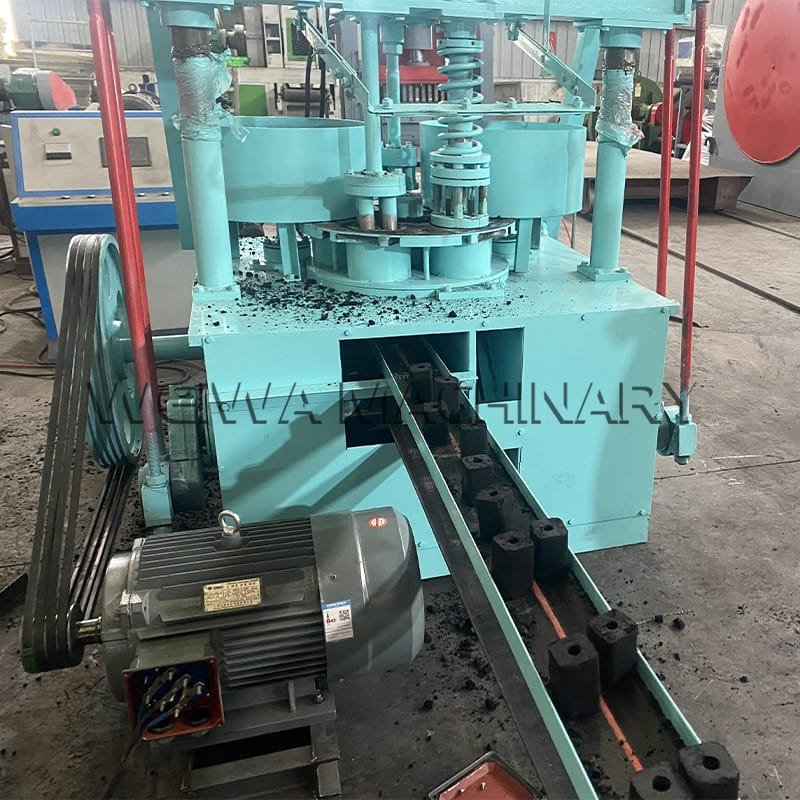
Mold Flexibility for the Sri Lankan Market
Weiwa supplies the coal briquettes making machine with interchangeable molds. Round 140 mm honeycomb is the default for Sri Lanka because it fits common clay stoves. But the same base machine accepts square honeycomb molds for industrial boiler mimicry, hexagonal molds for decorative BBQ packs, and 12-hole or 16-hole variants for faster ignition. The client requested a second mold quote for 120 mm 16-hole briquettes aimed at the tourist restaurant market in Galle and Ella.
Technical Parameters of the Trial Unit
The SL-140 honeycomb briquette charcoal machine used in the Sri Lanka trial carries the following reference specifications: capacidade 45 pieces per minute, briquette diameter 100 para 140 mm, height 70 para 80 mm, motor power 7.5 kW, shaft speed 406 rpm, pressure resistance of finished piece 60 para 90 kg, machine weight 1400 kg, overall dimension 1320 × 1260 × 1850 mm. These numbers are not marketing estimates; they are the same figures stamped on the test report shipped with the container.
For buyers comparing a honeycomb briquette charcoal machine in Sri Lanka against Indian or Turkish imports, the decisive details are shaft speed stability under load, punch seal life, and ease of mold change. Our SL series uses a taper-lock mold seat so two workers can swap a mold in under 20 minutes with standard hand tools. The punch head uses a hardened sleeve that survives more than 400,000 strokes before refacing.
Binder Chemistry and Recipe Control for Honeycomb Briquettes
A honeycomb briquette charcoal machine cannot fix a bad recipe. Binders decide whether holes stay open and whether the piece survives humidity. In Sri Lanka we recommend cassava starch at 1.5 para 2.5 percent for charcoal-dominant blends, or lignosulfonate at 1 percent for coal-dominant blends. Molasses works in dry seasons but absorbs moisture during monsoon storage, so we discourage it unless the client has climate-controlled warehousing.
Moisture of the blended feed must sit between 8 e 11 por cento. Below 8 percent the dust flies and fills the workshop; above 12 percent the punch sticks and holes close. The client’s existing rotary dryer already delivered 9 porcentagem de umidade, so no extra equipment was needed. This is why a coal briquettes making machine often integrates smoothly into an existing charcoal crushing line.
Why Hole Count Matters More Than Diameter?
Many first-time buyers fixate on diameter, but hole count controls combustion. A 19-hole 140 mm briquette lights slower than a 16-hole version but burns longer and smokes less. A 12-hole version ignites in three minutes and suits street food vendors. The honeycomb punching machine lets the producer stock three SKUs from one powder blend. The Sri Lankan client settled on 19-hole for home bags and 16-hole for hotel half-sack orders.
Operator Training and Day-to-Day Running
After the trial run, our engineer spent one morning training the client’s team. Starting procedure: verify voltage, check grease, load hopper to half, run empty for one minute, open feeder gate gradually, watch first five pieces, adjust punch depth if holes are blind. Stopping procedure: close feeder, run empty until hopper clears, cut power, brush mold cavities with a nylon pad, cover machine. None of this requires an electrical background; the client’s 19-year-old nephew operated the panel confidently by midday.
The honeycomb briquette charcoal machine in Sri Lanka trial confirmed that labor cost is low because one person feeds and bags while a second monitors the discharge. No 45 pieces per minute, eight working hours yields about 21,600 pieces, or roughly 25 tonnes of finished briquettes per shift before packaging limits. Most small Sri Lankan buyers will run a single shift and scale to two once distributor contracts firm up.
Customization Options Weiwa Offers on the Honeycomb Punching Machine
Beyond mold shape, Weiwa adapts the honeycomb charcoal coal briquette forming machine to local reality. Voltage can be 220 V single phase for rural workshops or 415 V three phase for industrial sheds. Diesel engine drive is available for areas with unstable grid power. Belt conveyors, automatic feeders, and vibratory sieves mount as bolt-on modules. Color coating with the client’s brand, engraved nameplate, and a spare parts kit with two seals and one punch sleeve are standard for export orders.
For the Sri Lankan client we added a tropical-duty motor with enhanced insulation and a weatherproof control box, since the production shed had open sides. This small upgrade prevents condensation damage during southwest monsoon storage, a detail many general traders miss when sourcing a coal briquettes making machine from non-specialist suppliers.
Commercial Logic of a Honeycomb Briquette Charcoal Machine in Sri Lanka
The client’s math was simple. Loose charcoal dust sold at 38 USD per tonne. Honeycomb briquettes from the same dust, after adding 2 percent starch and 8 kWh per tonne of electricity, sold at 115 USD per tonne wholesale and 160 USD retail. Even after bagging and transport, gross margin tripled. The honeycomb briquette charcoal machine paid back in seven months on a single-shift basis, assumindo 20 tonnes monthly output and stable off-take to three regional distributors.
This economics explains why searches for honeycomb briquette charcoal machine in Sri Lanka keep rising among Colombo importers and Kandy workshop owners. The machine is not a heavy capital bet like a carbonization furnace; it is a compact value-addition unit that turns siftings into branded fuel.
Common Questions From Sri Lankan Buyers
Is the Honeycomb Punching Machine Hard to Maintain?
Não. Daily tasks are greasing four points, brushing the mold, and checking belt tension. Monthly tasks are opening the gearbox sight glass and verifying oil level. Yearly task is replacing the punch sleeve. Weiwa ships a manual with exploded diagrams and offers video calls in English or Sinhala-accented technical English.
Can the Same Machine Make Pure Charcoal and Pure Coal Briquettes?
Sim. Pure coconut shell charcoal dust needs slightly higher punch pressure and 0.5 percent more binder. Pure coal dust needs less binder but benefits from a pre-wetting mist. The honeycomb charcoal coal briquette forming machine handles both by recipe change, not hardware change.
How Long Until We Get Spare Parts in Sri Lanka?
Seals, sleeves, and feeder augers ship from Weiwa’s spare parts warehouse within 48 hours and reach Colombo port in three to five working days via courier. We advise clients to keep one punch sleeve and one mold seat on the shelf at all times.
Field Observations That Surprised the Client
The client expected noise and vibration. The SL-140 honeycomb briquette charcoal machine ran at 72 dB at one meter, quieter than their existing hammer mill. They expected holes to clog with sticky cinnamon-wood charcoal; instead the 19-hole punch cleared itself because the pre-compression chamber squeezed volatiles outward before final stamping. They expected the machine to need a foundation bolt set; our engineer used epoxy anchoring on the existing 150 mm slab, which held perfectly during the drop-test vibrations.
By the second day, the client’s team had named the machine “the bee press” and was experimenting with a 60/40 coal-charcoal blend for a darker restaurant product. That kind of ownership is exactly what a honeycomb briquette charcoal machine in Sri Lanka should inspire: not awe at Chinese engineering, but confidence that local staff can run, tweak, and profit from it.
Sample Gallery Description for the Website
The trial shipment included five labeled sample bags. Bag A: 140 mm 19-hole 70/30 charcoal-coal, matte finish. Bag B: 120 mm 16-hole pure coconut shell charcoal, slightly lighter weight. Bag C: 140 mm 19-hole with 5 percent rice husk charcoal addition, showing speckled texture. Bag D: square honeycomb 130 mm demo piece from the alternate mold. Bag E: broken cross-section piece displaying full hole penetration and dense core. Any Sri Lankan buyer visiting the Weiwa reference page can request the same sample set by courier to benchmark against current suppliers.
Why Weiwa Machinery Builds Honeycomb Machines Differently?
Weiwa Machinery started in 1990 in Henan, China, and has spent more than three decades building coal, carvão, Biomassa, and shisha briquette presses. The honeycomb punching machine is not a side product; it sits in the same family as our hydraulic shisha press and roller ball press lines. That lineage means the SL series inherits sealed bearings from the shisha line, a reinforced rotary table from the coal line, and a tropical motor option from our Southeast Asian projects.
Every honeycomb briquette charcoal machine leaves the workshop after a 30-minute load test using real charcoal powder, not just oil. We film the test, log the piece count, and attach the video to the packing list. The Sri Lanka client received their test video two days before the container arrived, so the trial run on-site was confirmation rather than surprise.
Next Steps for Sri Lankan Buyers Considering the Coal Briquettes Making Machine
If you trade charcoal dust, pó de carvão, or biomass fines anywhere in Sri Lanka, the fastest path is to send us a 5 kg sample of your local powder. Weiwa runs a bench-scale honeycomb charcoal coal briquette forming machine trial in our Zhengzhou lab, returns 10 pressed samples, and recommends a binder ratio. Only then do we quote the full SL-140 or SL-120 honeycomb briquette charcoal machine with the correct mold, voltage, and conveyor length for your shed.
This removes the biggest risk in cross-border machinery buying: guessing whether your powder will form. The Sri Lankan client in this case sent powder first, saw samples in nine days, then ordered. Their on-site trial simply validated what the lab already proved.
Sobre Máquinas de Weiwa
Weiwa Machinery is a Henan-based manufacturer of briquette and carbonization equipment serving more than 130 países, including Sri Lanka, Índia, Indonésia, Uganda, Egito, México, and Turkey. Our product range covers honeycomb punching machines, hydraulic shisha and BBQ charcoal presses, roller ball briquette presses, sawdust briquette machines, coconut shell carbonization furnaces, and turnkey charcoal production lines. We provide pre-shipment load testing, mold customization, multilingual operator training, and 48-hour spare parts dispatch. Over two million end users worldwide burn fuel made on Weiwa presses.
For a honeycomb briquette charcoal machine in Sri Lanka, a honeycomb charcoal coal briquette forming machine for export, or a coal briquettes making machine configured to your local powder, contact our sales team directly:
Móvel / Whatsapp: +8613838093177
E-mail: info@cjlmachinegroup.com
Product reference: https://cjljx.com/product/honeycomb-charcoal-briquettes-machine
The Sri Lanka trial proved one thing beyond specs: a honeycomb punching machine is only as good as the recipe discipline behind it, and with the right blend, the same SL-140 unit can serve homes in Kandy, restaurants in Colombo, and resorts in Bentota from a single workshop. Weiwa builds the machine; your local powder builds the business.


 WeChat

 +8615937143060
