


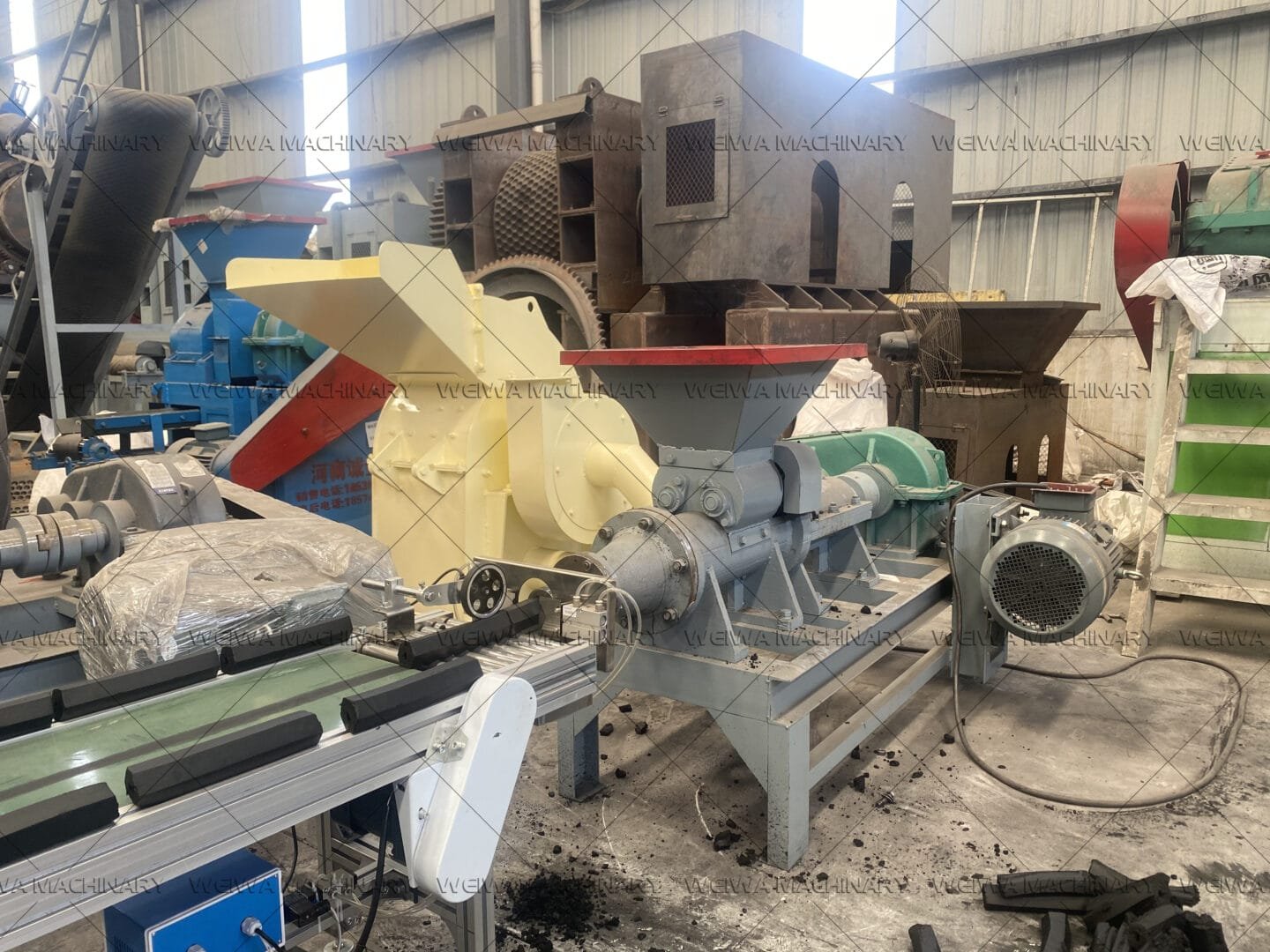
Why Congo Buyers Ask for a Hexagonal Coal Briquette Machine?
Charcoal consumption in Congo stays high because urban households and roadside grill joints still cook with solid fuel. Imported lump charcoal is expensive and inconsistent. Local charcoal dust, sawdust char, and coconut shell powder are cheap but unsellable in loose form. A Hexagonal coal briquette machine for Congo closes that gap: it recycles fines into uniform rods that stack tightly, ignite fast, and burn with steady heat.
The hexagonal cross-section is not decorative. Six flat sides pack closer than rounds in a 25 kg sack, so transport cost per kilogram drops. The shape also leaves continuous edge channels that pull air along the rod surface, giving a calmer flame than square bars and a longer burn than cylindrical sticks of the same diameter. For a Charcoal Extruder for Congo, hexagon tooling is now the most-requested mold after the standard round BBQ stick.
What the Congolese Client Brought to the Test?
His sample was mixed wood charcoal and palm kernel shell char, 70 mesh after screening, moisture around 9 por cento, with a small fraction of mineral coal powder blended in by local brokers. He wanted to know three things: would the machine clog, would the hexagon edges stay sharp, and would the rod survive a 1.2 meter drop onto concrete the way lumps do. Those questions shaped our trial plan.
How a Máquina de extrude de carvão Turns Powder into Solid Rods?
A Charcoal Extrude Machine is a screw-pressure densifier, not a press. Material enters the hopper, drops into a forced mixer zone, and meets a rotating high-manganese alloy propeller mounted on the propulsion shaft. The motor sends torque through a triangle belt to the gearbox, the gearbox output couples to the shaft via a floating coupling, and the propeller drags the paste forward while compressing it against the barrel wall.
Pressure climbs toward the die head. At the die, the mixture is forced through a #45 steel mold bored to the target profile. For this job the profile was a 33 mm across-flats hexagon with a 5 mm central hole. The extruded rod exits hot, semi-plastic, and self-supporting. It cools on a flat bed, hardens within minutes, and can be cut to length or left continuous for later cutting.
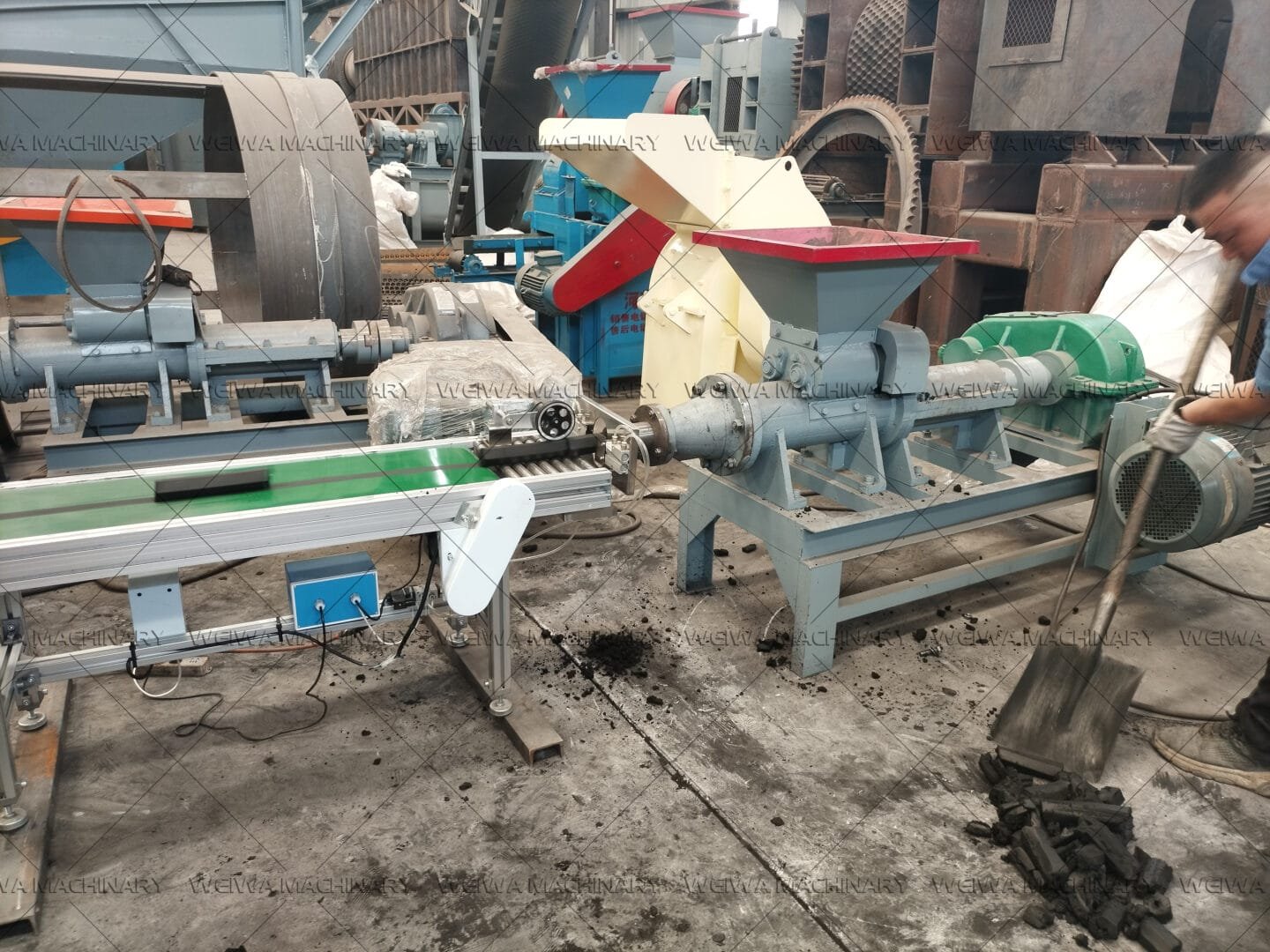
Raw Material Prep Before Extrusion
No extruder fixes bad feed. The Congo sample first passed a 3 mm screen. Oversize chunks went to our swing hammer crusher. The fine fraction then entered a grinding wheel mixer with 6 percent cassava starch slurry and 14 percent water. Mixing lasted nine minutes until the mass rolled into balls that flattened slowly under thumb pressure. That plasticity window is where a Charcoal Extrude Machine for Hexagonal Rod Charcoal performs best.
Power Train and Wear Parts That Decide Rod Quality
Our trial unit used a national-certified carbon steel frame, um 100 percent copper coil motor, and a hardened gearbox rated for 24-hour duty. The propeller was high-manganese alloy; the die insert was #45 steel heat-treated to 48 HRC. These are the parts that touch abrasive char all day. In the Congo client’s words afterward, “the rod looked polished, not sanded,” which is the visual cue that the die surface stayed true under load.
Setting Up the Hexagonal Coal Briquette Machine for Congo Conditions
We mounted the hexagon die, aligned the coupling, and set the V-belt tension so the motor drew 38 A at steady state on 380 V. The hopper gate opened to 40 por cento. Binder ratio locked at 5.5 percent dry starch. Barrel temperature after 20 minutes of running reached 62 ° c, normal for char extrusion because friction softens the lignin-like binders and lets particles weld.
First Meters Out of the Die
The first 40 cm of rod showed slight cracking because the die was cold. We recycled it. By meter five the surface turned glossy, the hexagon corners measured 33.1 mm and 32.9 mm across flats, and the central hole stayed centered within 0.3 mm. No swelling, no spiral twist. The client marked the event on his phone: “this is the shape my buyers in Pointe-Noire want.”
Four-Hour Continuous Trial Run Data
We ran the Charcoal Extruder for Congo for 240 minutes with one 15-minute break to regrease the coupling. Output averaged 280 kg per hour of finished wet rod, equal to roughly 240 kg per hour after curing loss. Motor temperature peaked at 71 ° c. Gearbox oil stayed below 58 ° c. Bearing housing vibration measured 2.1 mm/s, well inside the 4.5 mm/s limit for this class of machine.
Sampling every 30 minutes gave rod diameter variance of ±0.35 mm, umidade 8.2 por cento, bulk density 1.18 g/cm³, and compressive strength 480 N at green stage rising to 1,120 N after 24-hour air cure. Drop test from waist height onto concrete: zero fractures in 50 pieces. The client’s third question was answered before lunch.
Burn Test in Front of the Buyer
We cut 20 cm rods, dried them 48 horas, and lit six in a clay stove using newspaper and one firelighter cube. Full ignition took 3 minutos 40 seconds. Flame stabilized at 4 minutos. Measured burn time to ash was 86 minutes for the hexagon versus 54 minutes for local lump charcoal of the same weight. Smoke was thin and white, not black, because the feedstock was pure char with no green wood. Ash fell under 4 percent by weight.
The client noted that the hexagon rods did not roll when placed on the sloped grate, unlike rounds. That small detail matters at a busy Congolese grill station where sticks roll into the coals and waste fuel.
Why Hexagonal Rod Charcoal Fits the Congolese Retail Chain?
Congo’s charcoal moves through three layers: village carbonizer, city wholesaler, and neighborhood sack reseller. Each layer adds handling shock. Round sticks bridge gaps in a sack and snap. Hexagons tile. UM 50 kg woven sack held 51 kg of our trial rods versus 44 kg of round sticks of equal length. For a Hexagonal coal briquette machine for Congo owner, that 16 percent density gain is margin.
Retail buyers also price by piece count. Hexagons of 20 cm length give a predictable 22 para 24 pieces per kilogram, easy to pre-pack in 5 kg cartons for supermarkets in Brazzaville. The client planned exactly that: supply three grocery chains and ten street BBQ franchises under his own brand.
Mold Changeover and Future Shapes
After the hexagon run we stopped the machine, cooled the barrel, pulled the die ring with the extractor tool, and fitted a 40 mm round BBQ stick die. Changeover took 22 minutes including cleaning. The same Charcoal Extrude Machine then produced round sticks at 310 kg per hour. The client liked that he could serve both the traditional round-stick market and the premium hexagon market from one base machine by stocking two die heads.
Common Mistakes When Starting a Charcoal Extrude Machine Line
Congolese inquiries often underestimate preparation. Three errors appear again and again. Primeiro, feeding material coarser than 3 mm, which scores the die and widens tolerance. Second, using only water with no starch or molasses binder, which gives rods that crumble after cure. Third, running the propeller at wrong clearance; too tight seizes the barrel, too loose drops density below 1.0 g/cm³ and the rod burns too fast.
Our trial report handed to the client listed target specs: feed under 3 mm, binder 5 para 7 percent dry weight, umidade 12 para 16 percent at mixer exit, barrel temperature 55 para 70 ° c, coupling backlash under 0.2 mm. Follow those and a Charcoal Extruder for Congo will hold tolerance for 300 para 400 hours before the die needs rotation.
Maintenance Cadence Proven in the Trial
Grease the propulsion bearing every 8 running hours. Check V-belt tension weekly. Rotate the die insert 60 degrees every 200 hours so wear spreads across all six hexagon faces. Replace the propeller after 800 para 1,000 hours depending on ash content. The Congo sample had high silica from palm shell, so we recommended propeller inspection at 700 horas. None of this needs a technician; the operator can do it with the toolkit we ship.
Full Workflow From Dust to Packed Hexagon Rods
A complete line behind one Charcoal Extrude Machine contains five stations. Station one is the crusher receiving lump char and oversize fines. Station two is the dual-shaft or grinding wheel mixer dosing binder and water. Station three is the extruder with hexagon die. Station four is the curing rack where rods rest 24 para 48 horas. Station five is the cutter and semi-auto weighing machine that fills cartons.
For the Congo client we laid the line in a 12 by 8 meter hall with 4 meter ceilings. Power was 380 V three-phase, 25 kVA transformer. Water and starch tank sat above the mixer. Finished cartons left on a hand trolley to a 40 ft container loaded once a week. No 240 kg per hour and single-shift operation, monthly output reaches 57 tonnes, enough to supply a mid-size city distributor.
Local Adaptation Options for Central Africa
Some Congo towns lack stable three-phase power. We offered a diesel-engine drive kit bolted to the same gearbox flange, dropping motor dependency entirely. Control panel labels were printed in French. Overload relay set to trip at 45 UM. Hopper widened to accept shovel feeding because the client’s labor force is manual. These small adaptations are why a generic Hexagonal coal briquette machine becomes a Hexagonal coal briquette machine for Congo rather than a resold Chinese unit that jams in week two.
Comparing Hexagon Extruder Output to Other Briquette Types
Round sticks remain the volume product because consumers recognize them. Square bars pack almost as well as hexagons but crack more easily at the corners under drop shock. Hollow hexagonal rods with a center hole burn fastest and suit shisha mixes, not BBQ. Solid hexagon rods balance pack density, burn time, and breakage. For Congo’s mix of home cooking and street grilling, solid hexagon is the sweet spot, and the trial confirmed it.
When the client asked whether he should buy a ball press instead, we showed the trade-off. A ball press makes 50 para 80 mm pillow briquettes from dry powder with no binder, but needs 15 para 20 MPa roller pressure and precise moisture under 4 por cento. The extruder tolerates 8 para 16 porcentagem de umidade, uses cheap starch binder, and makes longer rods that Congolese grillers tie in bundles. Different product, different market. He stayed with the extruder.
Cost Picture Shared During the Visit
We did not quote in this blog, but the client’s notebook captured his own math. Raw char fines in his district cost 90 USD per tonne delivered. Starch 420 USD per tonne, usage 55 kg per tonne of rods. Poder 0.35 kWh per kilogram. Labor two operators. Embalagem 0.18 USD per kilogram. His landed cost came to 0.34 USD per kilogram of finished hexagon rod. Retail in Pointe-Noire for imported BBQ charcoal was 0.78 USD per kilogram. Gap closed in seven months including machine amortization. That sheet traveled back to Brazzaville in his bag.
What the Congo Client Said at the End of the Trial?
He recorded a short video beside the cured rod pile: “The machine did not stop. The hexagon did not change size. The burn was clean. I will take one line now and add a second die for rounds.” Our engineers walked him through spare parts: two propellers, one die ring, one coupling kit, belts, grease gun, cutter blades. Commissioning in Congo will be remote video plus one on-site week if needed.
This trial was not a sales show. It was the seventh Africa extruder trial in 2026 after similar runs for Ivory Coast, Nigéria, Zâmbia, and Tanzania. Each run tunes the binder recipe to local char. The Charcoal Extrude Machine for Hexagonal Rod Charcoal is now a configured product at Weiwa, not a stock item with a hexagon die bolted on as an afterthought.
Technical Specs of the Trial Unit
Model WE-EX140 hexagon version. Motor 11 kW 100 percent copper coil. Gearbox ZQ350 hardened. Propeller 160 mm diameter high-manganese. Die #45 steel 33 mm hexagon solid. Capacidade 240 para 300 kg per hour. Frame carbon steel 8 mm plate. Belt B-type double. Coupling floating rubber-block type. Peso 980 kg. Dimensions 2,050 by 900 by 1,250 mm. The same chassis accepts 30 para 50 mm round, 35 mm square, e 40 mm hollow hexagon dies.
Quality Control Before Shipment
Every Weiwa Charcoal Extrude Machine passes a no-load spin test, a 30-minute water-clay run, and a 2-hour char load run with the buyer’s own sample if provided. We film the run, log amperage, photograph the first and last meter of rod, and seal the die in anti-rust paper. The Congo unit will ship in a plywood case with steel frame, motor wrapped in plastic, manuals in English and French, and a QR code linking to the trial video.
Internal Link Plan for This Post
Readers who reach this page from search usually also compare machines. Within the article we connect to the product page of the Charcoal Extrude Machine, to the honeycomb briquette machine Congo trial, to the charcoal crusher spec, and to the wheel mixer page. Three to five contextual links per post is enough to pass relevance without looking like a footer.
Sobre Máquinas de Weiwa
Henan Weiwa Machinery Equipment Co., Ltd. has manufactured charcoal and biomass densification lines for more than twenty years. The product range covers charcoal extrude machines, honeycomb and ball briquette presses, continuous carbonizers, trituradores, misturadores, and mesh belt dryers. Equipment runs in over 130 países incluindo a Indonésia, Índia, Malásia, Vietnã, Peru, Polônia, Egito, Tanzania, and Congo. Each export machine is load-tested with the buyer’s material when samples arrive, then filmed and documented.
Factory visits are welcome. Engineers answer questions in English, French, Spanish, and Russian. Spare parts ship from Zhengzhou within 48 horas. On-site commissioning is available for full production lines.
Entre em contato com a Weiwa Machinery
MOB / Whatsapp: +86 138 3809 3177
E-mail: info@cjlmachinegroup.com
Product reference: https://cjljx.com/product/charcoal-extrude-machine


 WeChat

 +8615937143060
