


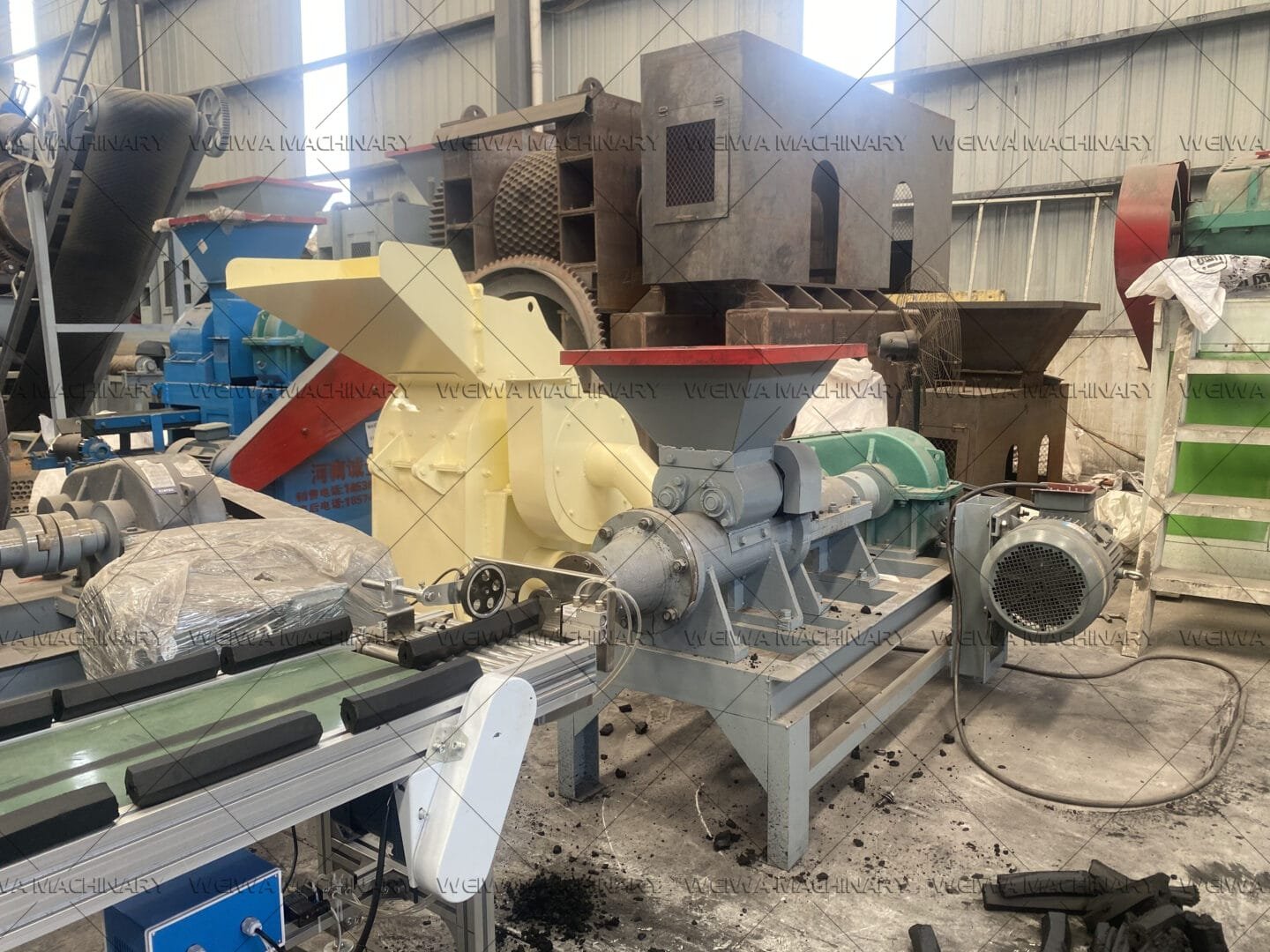
Why a Factory Trial Run Matters for Máquina de extrude de carvão in Turkey?
Turkey has emerged as one of the most active markets for biomass briquetting and charcoal re-processing equipment in the Eurasia region. Many local entrepreneurs compare the charcoal making machine price among Chinese and European suppliers, but few realize that machine performance varies dramatically depending on screw design, barrel heating, and die compression ratio. Before dispatching a rod briquette making machine in Turkey order, our engineers run a full simulation using charcoal powder similar in fineness and moisture to what the Turkish client intends to process. This pre-delivery verification ensures the charcoal extruder produces dense, uniformly shaped rods without frequent jamming—a common complaint among low-cost machines.
During the trial we evaluate motor load stability, auger wear prediction, binder activation temperature, and cut-length consistency. Only when all KPIs are met do we approve the máquina de extrusão de carvão for export crating. For clients comparing charcoal extrude machine price in Turkey options, this extra step is the invisible value added by Weiwa Machinery.
Understanding the Working Principle of a Screw Charcoal Extruder
A charcoal extruder—sometimes called a charcoal extrude machine or rod briquette press—uses a high-torque screw shaft rotating inside a tapered barrel to compress carbonized powder into continuous solid rods. Because charcoal loses its natural lignin during carbonization, a small percentage of organic binder such as starch or cassava flour is normally blended with water to provide cohesion.
Key Components of Our Charcoal Extrude Machine
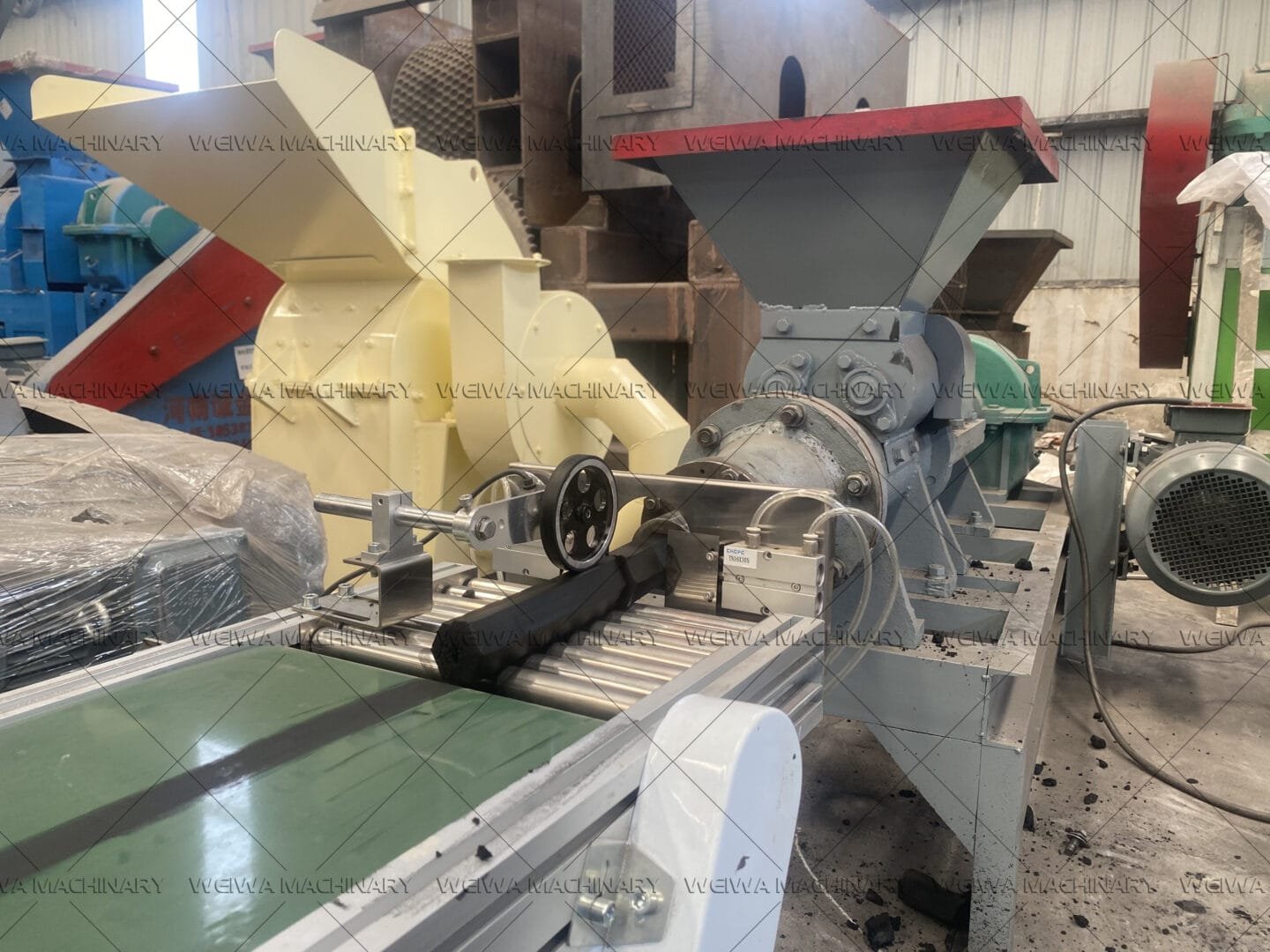
The feeding hopper distributes material evenly onto the screw flights. The main screw propeller—the heart of the charcoal extrude machine in Turkey models we export—is surfacing-hardened to resist abrasive charcoal grit. Behind the screw sits a heating coil around the extrusion barrel; this warms the binder to improve plasticity before the mix enters the forming die. The die (or mold) determines the cross-section of the rod—round, quadrado, or hexagonal with or without a central hole—and is interchangeable so that one rod briquette making machine in Turkey can serve multiple product lines. An automatic rotary cutter then segments the extruded strand into preset lengths.
Compression Ratio and Its Effect on Rod Density
Compression ratio refers to the volume reduction from the feed zone to the die orifice. Our standard charcoal extruder series for the Turkish market typically operates at a 4:1 para 6:1 compression ratio. Too low a ratio yields soft rods that crumble; too high overheats the motor and causes die blockage. During the trial run we adjust the gap between the screw tip and die seat to fine-tune this ratio for the client’s specific charcoal making machine price tier and expected output—usually 300–1200 kg/h depending on model size.
Raw Material Preparation Before Extrusion
Even the best charcoal extrude machine cannot compensate for poorly prepared feedstock. For the Turkey trial we requested the client’s typical raw material—a blend of hardwood charcoal and a small portion of coconut shell charcoal—crushed to pass a 3 mm screen. Particles larger than 3–5 mm create voids and weak spots in the extruded rod.
Moisture Content Window
Ideal moisture for the mixed mat before entering the charcoal extruder is 8%–12%. Below 8% friction rises sharply and rods become brittle; above 13% trapped steam can cause explosive ejection (“popcorning”) at the die. We verify moisture with a portable meter during the trial so Turkish operators know the correct dry/wet balance for their local climate.
Binder Selection and Mixing Ratio
For the rod briquette making machine in Turkey demonstration we used 4–6% cassava starch binder pre-gelatinized in warm water. The viscous starch suspension coats charcoal fines and, once activated by the barrel heater of the charcoal extrude machine, provides sufficient green strength for handling before final oven or sun drying. Some Turkish clients prefer natural Arabic gum or molasses-based binders for premium BBQ briquettes; our double-shaft paddle mixer accommodates any liquid-to-powder ratio.
Detailed Record of the Factory Trial Run for Turkish Export Model
On the test day our production floor was configured to mimic the planned layout of the Turkish customer’s workshop. UM 500 kg batch of crushed charcoal was pre-mixed with binder solution in the horizontal ribbon blender, then fed manually into the hopper of a charcoal extrude machine equipped with a 22 kW main motor and a 4 kW cutter motor.
Startup and Warm-Up Phase
The barrel heating zone was set to 180–220 °C and allowed a 15-minute warm-up. Initial idle run confirmed correct screw rotation direction and lubrication of the reducer. The first material entered the charcoal extruder at half-feed to avoid cold-start stalling. Within two minutes extrudate emerged from the hexagonal 45 mm die with a smooth, glossy surface—an early sign of proper binder activation and adequate compression.
Stable Production Observation
After ramping to full feed gate opening the machine sustained approximately 800–1000 kg/h of uniform charcoal rods. The ammeter on the main motor fluctuated only ±5%—indicating consistent screw filling and no surging. Cut lengths were held to 40 ± 2 mm by the photo-electric sensor on the rotary cutter. The client’s nominated third-party inspector who joined via live video noted that the rod cross-section was symmetrical with no visible lamination cracks, a detail that directly influences later carbonization yield.
Density and Hardness Check
Random samples were cut, resfriado, and measured. Bulk density averaged 1.05–1.15 g/cm³, well within the acceptable range for high-heat BBQ and shisha charcoal precursors. A drop test from 1.2 m onto a concrete floor resulted in less than 3% breakage, confirming the rod briquette making machine in Turkey configuration was correctly tuned. These numbers matter when evaluating charcoal extrude machine price in Turkey because lower-density rods burn faster and raise per-kg fuel cost for end users.
Temperature and Power Monitoring
Barrel skin temperature stabilized at 195 °C under continuous run. O 22 kW motor drew 28–32 A at 380 V, comfortably below rated full-load current. Bearing housing temperatures stayed below 65 ° c. Our engineer logged these parameters into the test report shipped with the charcoal extrude machine in Turkey so that the Turkish team has baseline values for future preventive maintenance.
Charcoal Making Machine Price Considerations for Turkish Buyers
When Turkish importers ask about charcoal making machine price or charcoal extrude machine price in Turkey they often receive wildly different quotes. Understanding what drives cost helps avoid false economies.
Factors Influencing Charcoal Extruder Price
First is capacity and screw diameter—larger models require heavier gearboxes and thicker barrels, raising the charcoal making machine price. Second is material grade; Weiwa Machinery uses wear-resistant alloy liners in the extrusion chamber rather than ordinary carbon steel, extending service life 3–5× before screw rebuild. Third is the inclusion of pre-mixing, conveying, and drying equipment in a complete line versus a standalone charcoal extruder. Finalmente, after-sales support—spare part availability, video commissioning, and English/Turkish operation manuals—should be factored into total cost of ownership, not just the invoice amount.
Common Troubleshooting Observations from the Trial
Even with a well-built rod briquette making machine in Turkey, operators may encounter minor issues during the learning phase. During the trial we intentionally induced two common fault conditions to demonstrate corrective actions.
Die Blockage Due to Over-Wet Mix
We increased moisture to 15% and observed the extruder begin to “puff” material intermittently. The remedy is to stop feeding, reverse the screw briefly if equipped, purge with drier mix, and re-establish correct moisture. This hands-on demo gives Turkish customers confidence they can manage day-to-day variances.
Rough Surface or Laminations
Under-binding (abaixo 3% amido) caused flaky surfaces. Adding binder incrementally while the máquina de extrusão de carvão ran smoothed the rod. We also showed how a worn or misaligned die can mimic this symptom—another reason to source wear parts from the original charcoal extruder supplier.
Why Choose Weiwa Machinery for Your Charcoal Extrude Machine in Turkey?
Weiwa Machinery has been manufacturing biomass briquetting and charcoal processing equipment for more than 30 years. Our charcoal extrude machine in Turkey installations range from small 300 kg/h starter lines to 2 t/h industrial plants. Each charcoal extruder and rod briquette making machine in Turkey we sell is backed by factory acceptance testing, detailed operation videos, and remote commissioning assistance via WhatsApp or Zoom.
We maintain a stock of screws, dies, heaters, and cutters for quick dispatch to Turkey, o Médio Oriente, Sudeste Asiático, e Europa. Whether you are comparing charcoal making machine price across brands or need a customized die shape for a niche shisha charcoal format, our engineering team can advise on the optimal configuration.
Sobre Máquinas de Weiwa
Máquinas de Weiwa (Weiwa Group) is a professional manufacturer of charcoal making machines, briquette extruders, fornos de carbonização, and related biomass processing equipment, headquartered in Gongyi City, Província de Henan, China. Com mais 15 years of export experience, we have supplied máquina de extrusão de carvão, charcoal extruder, and complete charcoal production lines to customers in Turkey, Rússia, Vietnã, Indonésia, Nigéria, e além. All machines are factory-tested before shipment, and we provide installation guidance, treinamento de operadores, and lifetime spare parts support.
Contact us for the latest charcoal extrude machine price in Turkey or to request a factory trial run video:
MOB / Whatsapp: +86 13838093177
E-mail: info@cjlmachinegroup.com


 WeChat

 +8615937143060
