


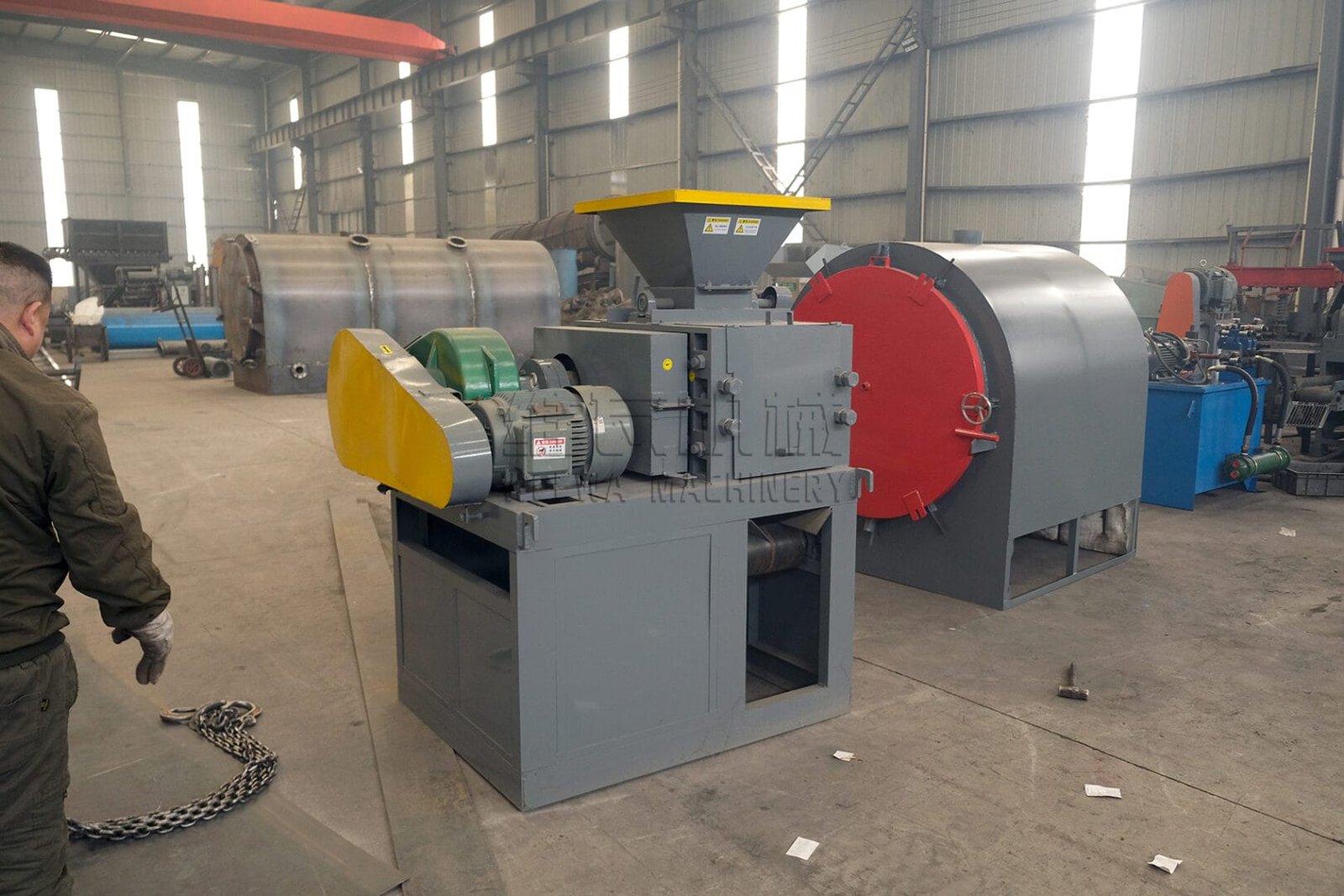
Why Nigerian Buyers Choose a Máquina de prensa de bolas de carvão?
The biggest misunderstanding about charcoal briquettes is that they are simply molded powder. In reality, a ball charcoal briquettes machine is a high pressure roller system. Two counter rotating rollers with matched molds compress charcoal powder, pó de carvão, pó de coca -cola, or biomass carbon powder into oval, egg, pillow, quadrado, redondo, or customized balls at high density. Compared with loose charcoal dust or hand pressed lumps, machine made balls burn longer, break less during transport, stack neatly in sacks, and give restaurant owners predictable cooking time.
For Nigerian entrepreneurs, the math is simple. Raw charcoal fines are cheap near charcoal burning villages. Binding agent cost is low when cassava starch, melaço, or local clay is used in small ratio. A charcoal ball press machine turns scattered waste into uniform fuel that sells at a premium over loose dust and competes with imported BBQ charcoal. Many Lagos suya vendors and Abuja buka kitchens already prefer uniform balls because they ignite faster and smoke less than irregular lump charcoal.
Weiwa does not sell a single isolated press. We design the charcoal briquette machine as part of a line. Crushing controls particle size. Mixing controls moisture and binder. Silo stabilizes feeding. Press forms the ball. Dryer removes surface and inner moisture. This sequence decides whether the client makes 500 kg per day or 5 tons per day with the same roller press.
Roller Pressure and Ball Density
The core of any ball charcoal briquettes machine is the roller pair. Weiwa uses forged alloy steel rollers, CNC machined mold pockets, and a hydraulic or spring loading system that keeps pressure balanced even when feed moisture fluctuates. Pressure determines density. Density determines burn time. For making charcoal balls in Nigeria where humidity swings between rainy and dry season, we normally recommend 28 para 32 MPa line pressure on 20 para 50 mm balls, with pre drying of raw powder below 12 percent moisture before pressing.
How a Ball Charcoal Briquettes Machine Production Line Works?
A complete charcoal briquette machine line is a material flow, not a pile of machines. At Weiwa workshop, we always draw the flow before quoting. The standard flow for Nigerian charcoal ball projects looks like this in practice, not in a bullet list but as a connected process.
Primeiro, lump charcoal or carbonized biomass arrives as chunks below 50 mm. A vertical compound crusher or hammer mill reduces it to below 3 mm powder. Screen return ensures oversize particles go back. Then the powder enters a twin shaft mixer where water and binder are sprayed while blades turn the mass for three to five minutes. Uniform moisture around 8 para 11 percent is the target. From mixer, material drops into a buffer silo with vibration discharge to avoid bridging. The silo feeds the charcoal ball press machine through a variable speed screw. Inside the press, two rollers grab the powder and squeeze it inside mold pockets. Ejected balls fall onto a mesh belt dryer running at 80 para 120 degrees Celsius for 40 para 90 minutes depending on ball size. Cooled balls are packed in 5 kg or 10 kg transparent sacks for BBQ retail or 25 kg woven bags for industrial buyers.
Crusher Mixer Silo Press Dryer Connection
Most first time buyers in Africa ask about press price only. The real cost driver is matching peripheral equipment. If crusher output is too coarse, rollers wear fast. If mixer is too short, balls crack after drying. If silo has no vibrator, feeding pulses and ball weight jumps from 18 g to 26 g randomly. Weiwa solves this by sizing each unit from the press backward. UM 1 t/h charcoal ball press machine normally pairs with a 2 t/h crusher, um 1.5 t batch mixer, um 1.2 cubic meter silo, and a 1.2 m width mesh belt dryer. This balance is why our Nigerian client received a coordinated line instead of separate machines.

Making Charcoal Balls in Nigeria From Waste to Clean Fuel
Making charcoal balls in Nigeria starts with seeing waste as inventory. Palm oil mills in Delta and Rivers State discard shell and fiber. Sawmills around Ogun and Edo pile offcut and dust. Street charcoal sellers in Kano and Kaduna sweep fine dust that buyers refuse. All these can enter a charcoal briquette machine after carbonization or direct mixing with charcoal powder. A small Lagos operator can collect 2 tons of charcoal fines weekly from nearby markets at low cost, press them into 25 mm pillow balls, and supply suya spots at a stable price unaffected by forest charcoal shortage.
The environmental side is equally strong. Nigeria loses forest cover yearly to firewood and lump charcoal demand. Compressed charcoal balls made from recovered fines and biomass residue reduce the need to burn whole logs. They emit less smoke under proper carbonization. They create local jobs for crushing, mixing, pressing, secagem, bagging, and distribution. Development agencies and state governments increasingly view briquette micro plants as rural energy projects, which means making charcoal balls in Nigeria is not only commercial but policy aligned.
Urban demand is shifting too. Young Nigerians running cloud kitchens, shawarma grills, and outdoor events want clean ignitable fuel with no stones and no dust. Machine made balls deliver that consistency. When a brand prints its logo on the 5 kg BBQ sack and keeps ball diameter within plus or minus 1 mm, institutional buyers such as boarding schools, prisons, and hotel kitchens start placing repeat orders.
Payback Logic for Nigerian SME Owners
Weiwa commercial team usually explains payback in plain numbers. Assume a 1 t/h charcoal ball press machine line running two shifts produces about 1.4 para 1.6 tons of finished balls daily. If raw charcoal fines cost 40 para 60 naira per kg depending on state, binder and power add another 15 para 20 naira per kg, and finished BBQ balls sell at 110 para 160 naira per kg wholesale, daily gross margin often covers labor, diesel generator fuel, rent, and depreciation within ten to sixteen months. The equation improves when the owner also owns a carbonization furnace and converts free wood waste into charcoal powder instead of buying powder. This is why making charcoal balls in Nigeria attracts not only charcoal traders but also poultry farmers, sawmill owners, and palm processors who already hold the raw material.
Raw Materials and Mold Shapes for Charcoal Briquette Machine
A ball charcoal briquettes machine is versatile. The Nigerian client in this shipment will mainly process charcoal powder and coconut shell charcoal. But the same charcoal ball press machine can handle coal powder, Coca -cola em pó, pó de ferro, Pó de óxido de magnésio, pó de cobre, minério de cromo, lead zinc scrap, bauxita, pó de metal não ferrado, silicon manganese alloy powder, pó de alumínio, Toner, gesso, lodo, and desulfurization gypsum powder. This flexibility means the machine is not dead if charcoal supply dips. The owner can switch to mineral powder briquetting for foundries or sell pillow shaped coal balls to heating users in northern Nigeria.
Shape choice is a marketing decision. Oval balls are the West African BBQ standard because they roll less in the grill and look familiar. Egg shape fits shisha and middle east export. Pillow shape gives high bulk density and low die cost. Square ball is common in metallurgy. Round ball is popular for automatic feeding stoves. Weiwa CNC mills interchangeable roller sets, so a Nigerian client can start with oval molds for suya market and later buy a second roller pair for 30 mm round balls aimed at institutional boilers.
Weiwa Factory Dispatch and Packing for Lagos Container
The Nigeria shipment left our Gongyi workshop after a full no load test. Technicians checked roller indentation depth, gap alignment, reducer lubrication, motor phase, and safety guard bolts. QC issued a factory inspection report in English. The charcoal ball press machine main unit was wrapped in stretch film, mounted on a reinforced wooden pallet, and placed in a 20 foot container with desiccant bags. Crusher and mixer were loaded next. Silo was knocked down into flat plates. Mesh belt dryer was wrapped in PE film and steel strapped. Spare roller sleeve, scraper blade, bearing set, and electrical contacts rode in a dedicated plywood box marked with the same number as the manual chapter.
Export packing followed ISPM 15 fumigated timber rules because Nigerian ports reject non compliant wooden cases. Each component carried a numbered tag matching the English installation manual, general arrangement drawing, and wiring diagram. Our export coordinator sent the client container stuffing photos, Bill of Lading draft, commercial invoice, packing list, and WhatsApp video walkthrough before vessel departure. This is the difference between buying a charcoal briquette machine online and buying a running plant from Weiwa Machinery.
We also adapted the line for African site conditions. Control cabinet got a recommended voltage stabilizer note because supply in some Nigerian estates floats beyond plus or minus ten percent. Bearings shipped with high temperature lithium grease. Operator training card explained how to check moisture with a handheld meter before feeding. Roller pressure adjustment procedure was written in plain English with millimeter marks, not abstract hydraulic theory. The goal is that a Nigerian technician with basic mechanical background can start the ball charcoal briquettes machine on week one without a Chinese engineer flying in.
Why Weiwa Machinery Is a Reliable Charcoal Briquette Machine Supplier?
Weiwa Machinery has more than thirty years of continuous experience in briquetting, esmagando, mixing, secagem, and carbonization equipment. Our machines run in Indonesia, Índia, Malásia, Laos, Mianmar, Tailândia, Vietnã, Filipinas, Paquistão, Sri Lanka, Líbano, Geórgia, Peru, Polônia, República Tcheca, Mongólia, Coréia do Sul, Romênia, Egito, Sudão, Tunisia, Argélia, Etiópia, Tanzania, Equatorial Guinea, Zâmbia, México, África do Sul, and now again Nigeria. We are not a trading office reselling unknown brands. We are a manufacturer with in house machining, welding, dynamic balancing, and roller engraving.
Our after sales team responds on WhatsApp and email. We provide CAD drawings for site planning, foundation holes, personnel lanes, and fire clearance inside a 150 para 300 square meter shed. We customize voltage, frequency, color, mold shape, capacidade, dryer length, and dust cover based on client budget. For Nigerian buyers, we often suggest 415 V 50 Hz motors, English labels, spare roller in same container, and a laminated binder ratio chart hung beside the mixer. These small details decide whether the charcoal ball press machine runs at 80 percent availability or sits idle in month two.
Choosing a ball charcoal briquettes machine is not about the lowest quote. It is about roller material, gap control, dryer heat balance, and whether the supplier still answers the phone six months later. Weiwa treats every Nigeria order as a plant project. We calculate raw material moisture, local power stability, sea humidity, and target ball size before we cut steel. That is why our charcoal briquette machine lines keep running in African coastal and inland sites.
Market Outlook for Making Charcoal Balls in Nigeria
Demand for machine made charcoal balls in Nigeria will keep rising for five structural reasons. Urban population grows while forest charcoal supply shrinks. BBQ culture expands from Lagos street food to supermarket retail sacks. Hotels and events want smokeless uniform fuel. Agricultural processors want to monetize shell and dust instead of paying to dump it. State governments encourage renewable biomass fuel to cut firewood import pressure and urban smoke complaints.
Investors who enter early with a branded 5 kg BBQ sack, consistent 25 para 30 mm oval ball, moisture below 6 por cento, and a visible workshop in Ogun or Lagos outskirts will likely lock distributor channels before late comers arrive. A charcoal briquette machine is the centerpiece, but the business is really about feedstock control, drying discipline, and packaging trust. Weiwa can supply the machine side. The Nigerian entrepreneur supplies the market rhythm.
Sobre Máquinas de Weiwa
Henan Weiwa Machinery Manufacturing Co., Ltd. has over thirty years of working experience in heavy equipment for mining, metalurgia, carvão, and biomass sectors. We build ball charcoal briquettes machine, máquina de briquete de carvão, máquina de prensa de bola de carvão, hammer mill, twin shaft mixer, mesh belt dryer, forno de carbonização, and full production line engineering. We have served more than two million customers and exported to over one hundred thirty countries.
Our advantage is not one feature. It is the combination of experienced design engineers, strict factory test, customized drawings for site planning, spare parts strategy, and a professional after sales team that guides commissioning by video and email. We welcome Nigerian buyers to send raw material samples, target capacity, local voltage, and workshop size. We reply with a general arrangement drawing, equipment list, price range, and container plan. If you are considering making charcoal balls in Nigeria, the right time to plan the line is before you negotiate land rent, not after.
Contact Weiwa Machinery for quotation and layout plan:
MOB: +8613838093177
Whatsapp: +8613838093177
E-mail: info@cjlmachinegroup.com
Weiwa Machinery — thirty years building briquette lines, shipping from Gongyi to Lagos, and supporting your charcoal ball business from first drawing to first container of finished balls.


 WeChat

 +8615937143060
