


Por que as Filipinas são um mercado estratégico para Fornos de Carbonização Horizontais?
As Filipinas geram grandes volumes de cascas de coco, cascas de arroz, sobras de bambu, e resíduos de serraria todos os anos. A maior parte do carvão rural ainda é feita em covas de terra ou em fornos de tijolos., que perdem 30-40 por cento do carbono fixo devido à combustão incompleta e liberam fumaça intensa. Um forno de carbonização horizontal muda essa equação ao encerrar o processo de pirólise, recuperação de gás combustível, e descarregando carvão resfriado em um ciclo selado. Para um país com crescente demanda por carvão para churrasco, crescentes importações de carvão ativado, e leis ambientais locais mais rígidas, o forno de carbonização horizontal para as Filipinas não é mais uma importação de luxo, mas uma ferramenta de conformidade.
Realidade da matéria-prima em Luzon, Visayas, e Mindanau
Casca de coco é a matéria-prima mais consistente. Possui baixa umidade após secagem ao sol, alto teor de lignina, e produz carvão denso com carbono fixo acima 70 por cento. Briquetes de serragem e bambu são comuns em aglomerados de móveis em Cebu e Pampanga. A instalação do nosso cliente recebe cascas de coco de um processador de copra, madeira mista de uma madeireira, e casca de arroz sazonal. A câmara do cilindro horizontal lida com todos os três em lotes separados sem necessidade de reequipamento, é por isso que uma máquina de fazer carvão com um tambor horizontal carregado com carrinho se adequava melhor à sua estrutura de trabalho do que um aquecedor rotativo contínuo.
Fatores climáticos e de corrosão
Umidade costeira, ar salgado, e uma estação chuvosa que empurra a umidade da biomassa para cima 20 seleção de equipamento de forma percentual. Especificamos aço-liga de alta temperatura para o tanque interno, fibra de silicato de alumínio para a camada intermediária de isolamento, e um primer anticorrosivo epóxi no revestimento externo. Os painéis de controle são selados com IP54. Estas não são atualizações opcionais para um forno de carbonização horizontal nas Filipinas; eles determinam se a máquina sobrevive ao terceiro ano.
O que realmente é um forno de carbonização horizontal?
Um forno de carbonização horizontal é uma câmara de pirólise tipo barril colocada horizontalmente sobre trilhos. A matéria-prima é carregada no barril usando um carrinho de aço, a porta está selada, e um queimador externo eleva a câmara para 450–600 °C sob condições de oxigênio limitado. Gases voláteis escapam para uma torre de purificação, onde o alcatrão e o vinagre de madeira se condensam e o gás de síntese restante retorna ao queimador como combustível. Depois de quatro a seis horas, o barril é desenrolado, resfriado, e esvaziou. Comparado com um forno a carvão tradicional, o processo está fechado, mensurável, e repetível.
Aquecimento indireto versus fornos de fogo direto
Em forno de fogo direto, chama toca a madeira. A distribuição de calor é desigual, termina o char mais rápido que o centro, e até metade da energia sai como fumaça. Em nosso forno de carbonização horizontal, a chama aquece uma jaqueta, não a biomassa. A própria câmara permanece pobre em oxigênio. Este método indireto é a razão pela qual os testes mostram menos de 10 Diferença de °C entre os lados de entrada e saída em 580 ° c, e por que os compradores de máquinas de produção de carvão no Sudeste Asiático evitam cada vez mais as minas verticais.
Ciclo de reciclagem de gás
Durante a pirólise, casca de coco libera metano, monóxido de carbono, e vapor de alcatrão. O sistema de purificação separa os condensáveis. O gás limpo retorna através de uma linha regulada para a câmara de combustão. Depois do primeiro 40 minutos de ignição externa de GLP ou lenha, o forno pode sustentar a temperatura apenas com gás reciclado. Em testes de fábrica para a unidade filipina, combustível externo caiu 38 por cento depois que o circuito de gás se estabilizou.
Preparação pré-embarque na oficina de máquinas Weiwa
Cada forno de carbonização horizontal que sai de nossa fábrica passa por uma verificação de quatro estágios. Os certificados de matéria-prima para a chapa de aço são verificados. As soldas no tanque interno são inspecionadas com corante penetrante. A camada de isolamento é inserida em blocos segmentados para evitar pontes térmicas. Em seguida, a unidade se move para a área de teste de aquecimento sem carga.
Teste de uniformidade térmica sem carga
Os técnicos acendem o queimador e levantam o barril para 600 ° c. Seis termopares ao longo do barril reportam ao PLC. Para a unidade filipina registramos uma curva onde o ponto mais baixo foi 591 °C e o mais alto 599 °C em estado estacionário. Essa propagação é importante: uma máquina de fazer carvão com 30 O gradiente de °C irá sobrecarregar uma extremidade e subprocessar a outra, forçando o operador a misturar lotes manualmente.
Execução simulada de gases de combustão e purificação
Conectamos um simulador de propano para imitar o gás residual da pirólise, então observe a torre de condensação, sobe escadas, e válvula de retorno de gás. As válvulas de alívio estão configuradas para 1.2 bar. A curva do ventilador é verificada em relação à demanda do queimador. Somente depois que o circuito de purificação mantém a pressão por 30 minutos drenamos o condensado e marcamos a unidade pronta para embalagem.
Embalagem de exportação e proteção costeira
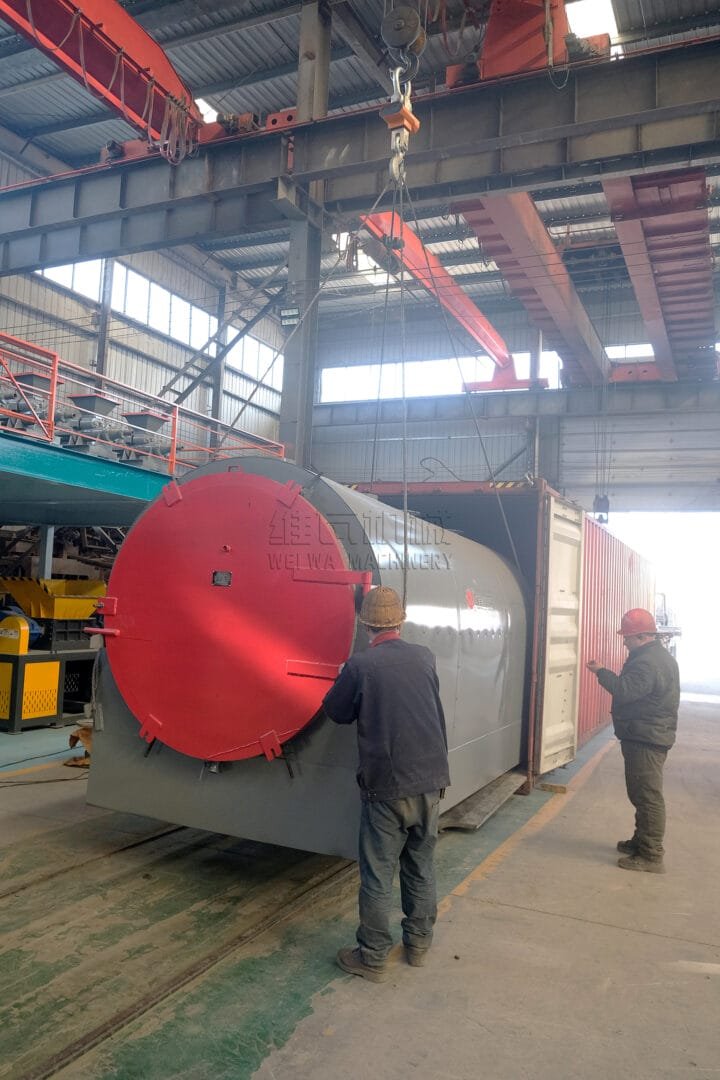
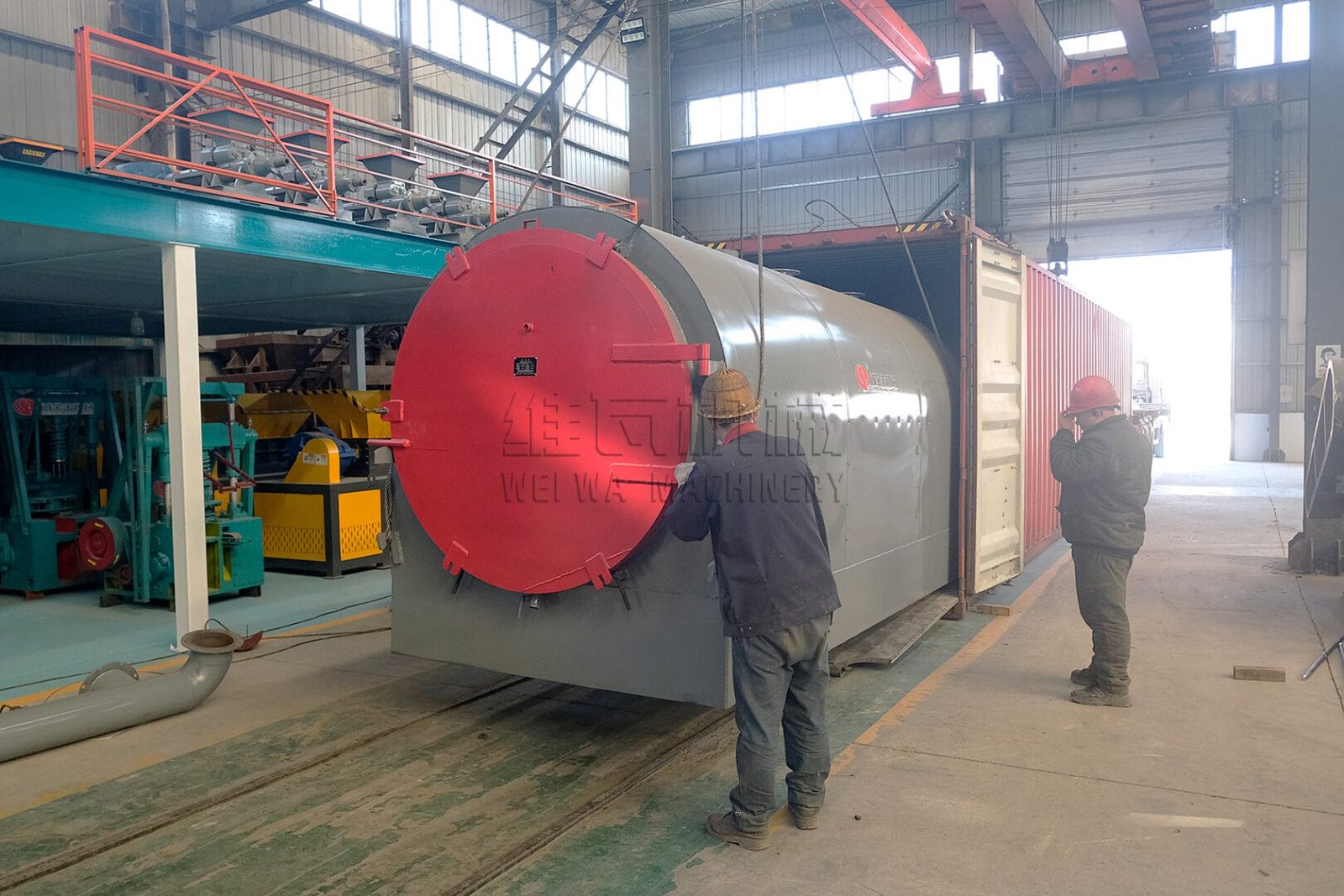
Para as Filipinas, o forno é embrulhado em papel VCI, amarrado a um patim de aço, e coberto com uma barreira de umidade tecida. Selos sobressalentes, termopares, e o manual em inglês viajam em uma caixa à prova d'água separada. O carrinho, trilhos, e chaminé enviada como um segundo pacote. Rotulamos cada conexão com números correspondentes para que o soldador do comprador não adivinhe qual flange atende qual.
Dia da Remessa: De Zhengzhou ao porto de Qingdao
O caminhão carregado partiu às 6:40 sou. Nosso engenheiro percorreu o perímetro com o agente de inspeção do cliente por meio de uma videochamada. A compressão da vedação da porta foi medida em 4 mm. A torre de purificação foi trancada com parafusos de trânsito. O painel de controle foi envolto em espuma antiestática. O conhecimento de embarque descreveu a carga como “fornalha de carbonização horizontal em lote, Máquina de fabricação de carvão, SH 841989”.
Por que filmamos cada carregamento
O frete marítimo de Qingdao para Manila leva de nove a doze dias. Mudança de contêineres. Registrando os pontos de amarração e os valores de torque dos parafusos, damos ao cliente filipino uma linha de base de referência. Se uma junta vazar após a chegada, a primeira pergunta é sempre se estava solto antes da partida. O vídeo responde a essa pergunta em trinta segundos.
Resultados de testes de fábrica usando matéria-prima estilo filipino
Antes de embalar, executamos dois lotes que espelhavam a entrada declarada do cliente. O primeiro lote era de cascas de coco em 12 porcentagem de umidade. O lote dois foi 70 por cento de casca de coco e 30 porcentagem de sobras de serraria de madeira mista em 15 porcentagem de umidade.
Lote Um: Apenas casca de coco
A entrada foi 1,000 kg. A janela de carbonização foi 4 horas 50 minutos a 580–600 °C. A saída foi 362 kg de carvão vegetal com carbono fixo 74.2 por cento, cinzas 3.1 por cento, e umidade abaixo 5 por cento após resfriamento selado. Isso é um rendimento de 36.2 por cento, o que é típico da casca de coco e aproximadamente 8 pontos mais altos do que o antigo forno de tijolos a carvão do comprador, que retornou 28 por cento e queimou parte do produto durante a abertura do poço.
Lote Dois: Casca de coco mista e madeira dura
A entrada foi 1,000 kg. O tempo de execução era 5 horas 20 minutos. A saída foi 318 kg de carvão, carbono fixo 71.6 por cento, cinzas 4.4 por cento. O rendimento ligeiramente inferior reflete a maior fração volátil da madeira dura. Ambos os lotes necessitaram de zero combustível externo após minuto 42 do ciclo porque o circuito de retorno do gás cobriu a demanda de calor.
Observações de fumaça e combustível
A saída da chaminé foi observada 3 metros a favor do vento. Durante o primeiro 20 minutos, uma nuvem pálida de vapor apareceu do vapor de água. Depois que a torre de purificação atingiu a temperatura operacional, a pluma ficou invisível. O representante do cliente mediu a poupança equivalente em lenha de 39 por cento em relação ao seu forno de carvão existente em uma comparação de três lotes em sua própria fazenda no ano passado.
Como o forno de carbonização horizontal supera um forno a carvão tradicional nas Filipinas?
O tradicional forno de carvão filipino é um monte de madeira coberto de terra e folhas de bananeira. Não custa quase nada construir e quase tudo para operar: mão de obra alta, alto risco de roubo, esgotamento descontrolado, e reclamações de vizinhos sobre fumaça. Um forno de carbonização horizontal pede capital mas devolve tempo, colheita, e papelada.
Rendimento e Carbono Fixo
Os fornos de cova têm um rendimento médio de 25 a 30 por cento em casca de coco. Nosso julgamento foi realizado 36 por cento. O carbono fixo ficou acima 70 por cento, o que é importante para os compradores de churrasqueiras em Quezon City, que pagam mais pelo carvão que acende rápido e queima sem faíscas.
Trabalho e Segurança
Um operador carrega o carrinho, fecha a porta, define o perfil de temperatura, e observa o PLC. Sem alimentação noturna. Não é permitido abrir o poço em 3 sou. julgar a cor. Para um forno de carbonização horizontal nas Filipinas, onde a mão de obra é acessível, mas a mão de obra qualificada é escassa fora da região metropolitana de Manila, essa simplicidade é o ponto de venda.
Portarias Ambientais
Vários municípios filipinos agora exigem divulgações de partículas para empresas de carvão. Uma máquina de fazer carvão com condensação de alcatrão e reutilização de gás pode apresentar quase zero fumaça visível. Essa é a diferença entre uma renovação de uma licença comercial e uma ordem de encerramento.
Escolhendo o modelo certo para um comprador filipino
Weiwa constrói forno de carbonização horizontal em 500 kg, 1,000 kg, 1,500 kg, e 2,000 tamanhos de lote em kg. A unidade embarcada para Luzon foi o 1,000 versão kg com carrinhos duplos, uma torre de purificação de três estágios, e um PLC de marca inglesa. Para um empreendedor iniciante em Davao, o 500 unidade kg em um único carrinho é suficiente para validar o mercado. Para um processador de copra em General Santos, dois 1,500 barris de kg em rotação bateram em uma câmara superdimensionada.
Carrinho Único ou Carrinho Duplo
Um único carrinho significa carregar enquanto o forno está frio. Um sistema de carrinho duplo permite que um barril esfrie do lado de fora enquanto o segundo carboniza. A produtividade aumenta 60 por cento sem aumentar a potência de pico do queimador. A maioria dos compradores filipinos que nos ligam sobre um forno de carbonização horizontal para as Filipinas escolhe o carrinho duplo na segunda conversa.
Linguagem PLC e fonte de alimentação
Enviamos o sistema de controle em inglês com etiquetas Tagalog opcionais mediante solicitação. A tensão é 220 V monofásico ou 380 V trifásico, 50 hertz, correspondendo às normas da rede filipina. O queimador pode ser GLP, diesel, ou assistida por lenha, dependendo do preço local do combustível.
Instalação e primeira execução após chegada em Manila
Após desembaraço aduaneiro, o cliente coloca o skid em uma base de concreto, aparafusa os trilhos, levanta o barril com uma empilhadeira, e conecta a chaminé. Nosso engenheiro remoto participa de uma videochamada para a primeira ignição. A sequência é sempre a mesma: teste de vazamento na linha de gás, aqueça o queimador a seco por dez minutos, carregar um 200 kg de lote de teste de casca de coco, e observe a curva do termopar.
Erros comuns na primeira semana
O erro mais frequente é carregar material úmido. Casca de coco em 18 a porcentagem de umidade estende o tempo de execução para sete horas e dilui o gás de síntese. O segundo erro é abrir a porta antes que o resfriamento selado termine; carvão quente oxida, gotas de carbono fixo, e vira cinzas nas bordas. O terceiro está bloqueando o dreno da torre de purificação, que faz o alcatrão entrar na linha de retorno do gás. Nada disso são falhas da máquina. Todos são problemas de treinamento, é por isso que todo forno de carbonização horizontal da Weiwa é enviado com um manual em inglês de 22 páginas e um vídeo passo a passo de 35 minutos.
Imagem de custo para uma startup de carvão nas Filipinas
UM 1,000 kg de forno de carbonização horizontal pousado em Manila custa mais do que construir dez fornos de terra. Mas os fornos terrestres lhe devem trabalho todas as noites e produzem carvão que você não pode certificar. A fornalha lhe deve eletricidade, combustível de queimador menor, e um operador por turno. No 36 rendimento percentual sobre a casca do coco e os preços locais da casca no produtor, a janela de retorno que nosso cliente Luzon modelou foi de onze meses, assumindo 25 lotes por mês. Se os preços do carvão subirem durante a estação seca, o retorno chega mais cedo.
Economias ocultas em alcatrão e vinagre de madeira
A torre de condensação coleta dois subprodutos. O vinagre de madeira pode ser vendido em pequenas lojas agrícolas como spray foliar após diluição. O alcatrão é um incômodo se derramado, mas pode ser direcionado para o queimador como combustível suplementar em doses controladas. Poucos compradores de primeira viagem consideram esses fluxos, ainda assim, eles cortam outros 4–6% nos custos operacionais.
Suporte pós-venda da Weiwa Machinery
Não tratamos o envio como o fim da transação. Vedações de porta sobressalentes, termopares, e manômetros são estocados em nosso depósito para envio na mesma semana. O diagnóstico remoto passa pelo registro de dados do CLP; um cliente pode exportar um CSV dos últimos dez lotes e enviá-lo por e-mail para nós. Para o mercado filipino mantemos o tempo de resposta abaixo 24 horas porque as estações da casca do coco não esperam pelos fusos horários.
Treinamento e Documentação
Cada forno de carbonização horizontal inclui um manual de operação em inglês, um cronograma de manutenção preventiva, e um vídeo de inicialização. A terminologia tagalo é adicionada mediante solicitação. Realizamos chamadas remotas de comissionamento com compradores em Pampanga, Cebu, e Cotabato Sul; o padrão é consistente – primeiro lote nervoso, rotina do quinto lote.
Sobre Máquinas de Weiwa
A Weiwa Machinery é um fabricante de equipamentos de carbonização e briquetagem de biomassa com sede em Zhengzhou. Nossa linha de produtos abrange fornos de carbonização horizontais, fornos verticais de carbonização, máquinas para fazer carvão, secadores rotativos, e prensas de briquetagem. Exportamos para mais de 30 países e forneceram equipamentos para mais de 2 milhões de usuários finais através de distribuidores e projetos diretos. O forno de carbonização horizontal enviado para as Filipinas é um dos 40 unidades semelhantes que construímos nos últimos dois anos para processadores de casca de coco do Sudeste Asiático. Fazemos testes de fábrica, embalagem de contêiner, comissionamento remoto, e fornecimento de peças de reposição a partir de um único ponto de contato.
Se você estiver avaliando um forno de carbonização horizontal nas Filipinas, comparando uma atualização de forno a carvão, ou definir o preço de uma linha de máquinas para fazer carvão para casca de coco e bambu, entre em contato diretamente com nosso balcão de vendas:
MOB / Whatsapp: +86 138 3809 3177
E-mail: info@cjlmachinegroup.com
A unidade Luzon já está em operação. Os números dos testes neste artigo não são projeções; eles são o registro de aceitação da fábrica que compartilhamos com o comprador antes de o caminhão sair de Zhengzhou.


 WeChat

 +8615937143060
