


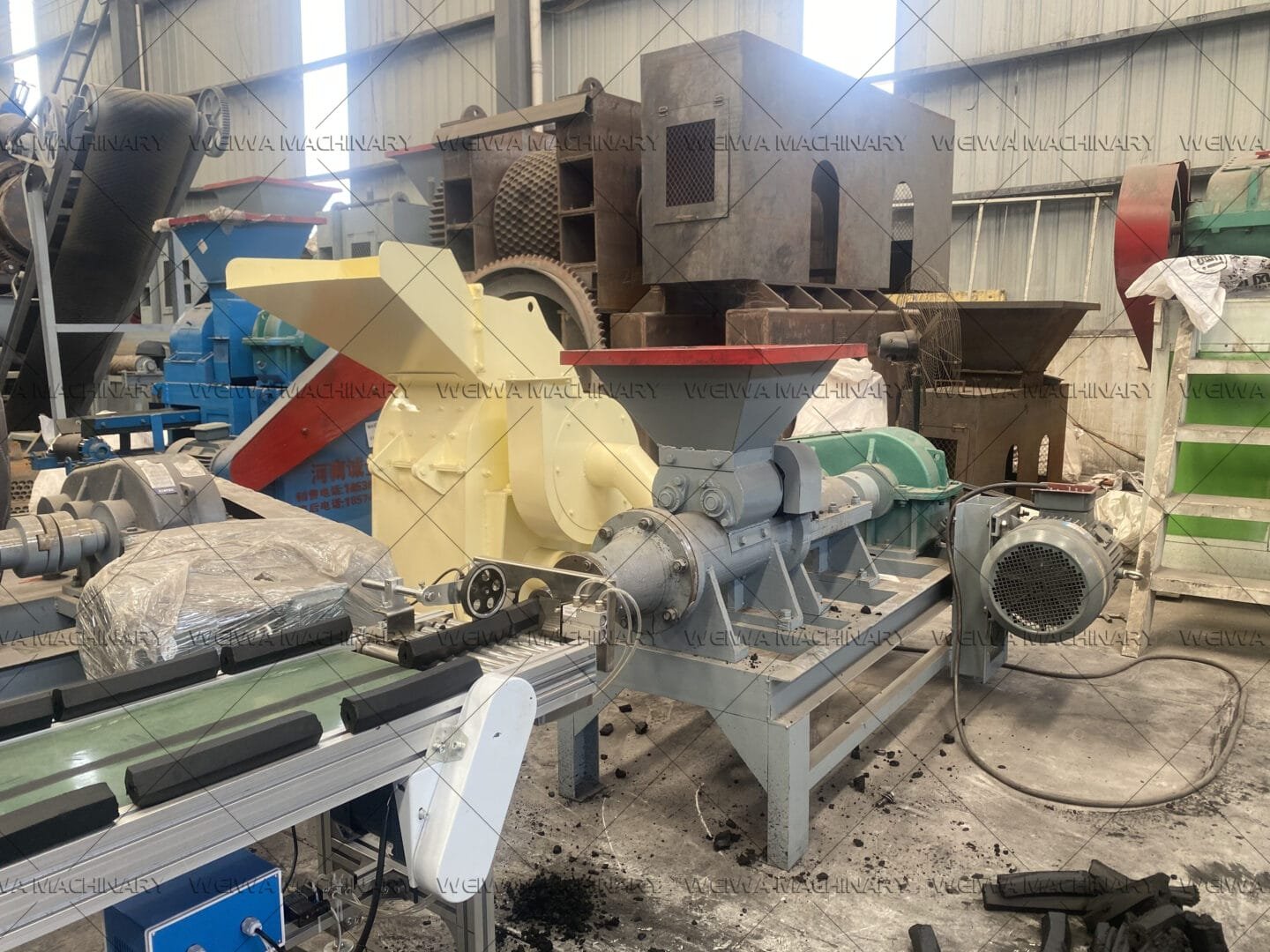
A charcoal extrude machine is not a mystery box that magically turns dust into money. It is a mechanical system where powder size, नमी, बांधनेवाला, screw flight, gearbox load, and die geometry either align or fail together. पिछला महीना, a charcoal factory owner from Lahore contacted Weiwa Machinery and asked for something very specific. He wanted to see his own Pakistani charcoal powder shaped into uniform hexagonal rod charcoal under real load, not polished showroom samples.
Why Pakistani Buyers Are Moving Toward Hexagonal Rod Charcoal?
Pakistan has a strong barbecue culture. From Lahore food streets to Karachi coastal grills and Faisalabad tandoor bakeries, shaped charcoal is not a luxury item. It is daily fuel. Round sticks are common, but they roll inside cartons and create air gaps. Square bars look stable, yet corners can crack under thermal shock. The hexagonal rod has become popular because flat sides stack tighter, ignition is more predictable, and radiant heat stays steady under a grill mesh.
That is why inquiries for a hexagonal coal briquette machine for Pakistan are no longer rare. Buyers want one machine that can process coconut shell charcoal, wood charcoal dust, चावल की भूसी का कोयला, and sometimes coal powder blends. They do not want three machines. They want one reliable charcoal extrude machine with interchangeable dies.
The Lahore client who visited our Gongyi workshop had already tried three imported extruders in eighteen months. His complaints were familiar: mold wear after ten days, propeller overheating, rod surface splitting during drying, and irregular hexagon geometry that made retail packs look like reject grade. He did not ask for the cheapest machine. He asked for a charcoal extruder for Pakistan conditions that could survive voltage fluctuation, dusty feedstock, and long summer shifts.
What the Pakistan Client Brought to the Weiwa Trial?
He did not arrive with a PowerPoint. He arrived with two sealed buckets and a moisture sheet.
The first bucket contained coconut shell charcoal powder sifted below 3 millimeters. The second bucket held a blend of local wood charcoal dust and a small portion of coal powder, representing what his team sources weekly in Punjab. Moisture readings were 6.4 percent for the coconut shell fraction and 7.1 percent for the wood-coal blend.
Our engineer did not switch on the extruder first. He ran the samples through a lab sieve, checked bulk density, and adjusted the binder. For this batch, cassava starch binder was set at 4 percent by weight because the finer fraction needed more bridging without making the rod soft. This step matters because no charcoal extrude machine can save bad feedstock. The first thirty minutes of the trial belonged to the mixer, not the screw.
Raw Material Preparation Comes Before Extrusion
Charcoal powder is not uniform just because it looks black. Particle size controls surface area. If the powder is too coarse, the binder cannot bridge the grains and the rod crumbles after drying. If the powder is too fine and dry, it flows like flour, slips past the screw, and fails to build pressure.
For hexagonal rod charcoal aimed at BBQ use, the workable window is usually a blend below 3 millimeters, with moisture around 8 को 12 percent after mixing. The Pakistan trial started drier, then water and binder were added gradually until the mass formed a cohesive paste that held shape when squeezed by hand but did not stick to the palm.
The wheel grinding mixer kneaded the charcoal powder, starch, and water the same way a small factory would do in Lahore or Karachi. Uniform moisture is the hidden hero of extrusion. A rod can leave the die looking perfect and still crack later if the mixer leaves wet pockets inside the mass.
How a चारकोल एक्सट्रूड मशीन Actually Works?
Many overseas buyers imagine the charcoal extrude machine as a press that stamps powder into shape. In reality, screw extrusion is closer to a continuous high-pressure conveying system. The machine does not form one piece at a time. It feeds powdered carbon through a tapering chamber where a rotating screw converts motor torque into axial pressure, then forces the plasticized mass through a fixed die head.
The die head decides the cross-section. Swap the head and the same base machine can make round sticks, square columns, oval briquettes, or hexagonal rods. This is the reason a hexagonal coal briquette machine stays useful even when raw material particle size jumps between batches.
Motor, Belt, Gearbox, and Floating Coupling
In the Weiwa design, the motor transmits power to the transmission through a triangle belt. The output shaft of the transmission transfers torque to the propulsion shaft through a floating coupling. The floating coupling is small, but it protects the whole machine. When a stray stone or uncrushed lump hides inside charcoal powder, the screw hits sudden resistance. The floating coupling absorbs the shock instead of transferring it to the gearbox bearings.
During the Pakistan trial, the coupling absorbed minor shock loads without tripping the breaker. That detail sounds boring until a buyer has already burned two gearboxes on a cheaper machine.
Screw Propeller Builds Pressure Gradually
The screw does three jobs at once. It conveys powder forward, it kneads binder into the mass, and it builds pressure gradually so the paste becomes dense before reaching the die. On the Weiwa 160-type unit used for this trial, the propeller is cast from high manganese alloy. The flight pitch tightens near the discharge end.
That tightening is not decorative. It is where low-density paste becomes a continuous dense rope. If the pitch is wrong, the rod exits soft and collapses under its own weight. If the screw speed is too high for the feed rate, the barrel overheats. If the feed rate is too high for the screw, the chamber backs up and the ammeter climbs.
Why the #45 Steel Hexagonal Die Head Decides Rod Geometry
The die head sent for this trial was machined from #45 steel with six ground flats and a central hole for the optional hollow channel. Flat-to-flat tolerance was held to plus or minus 0.3 millimeters across the full run.
Cheap extruders often use cast dies with hand-ground openings. Those dies drift after a week. A #45 steel insert keeps the hexagon sharp for months if screw speed and feed rate stay inside the designed band. For a Pakistan buyer who plans two shifts a day, die life is not a specification footnote. It decides whether his retail pack looks premium or reject grade.
The Trial Setup for the Pakistan Hexagonal Coal Briquette Machine
We ran the 160-type charcoal extrude machine because the client’s target was around 1.2 tons per hour of coconut shell rod with headroom for wood-coal blend days. The 160-type uses a 22 kilowatt copper coil motor, a hardened gearbox, and a high manganese propeller. It is not the smallest machine in our range, but it is the workhorse for Lahore-scale factories.
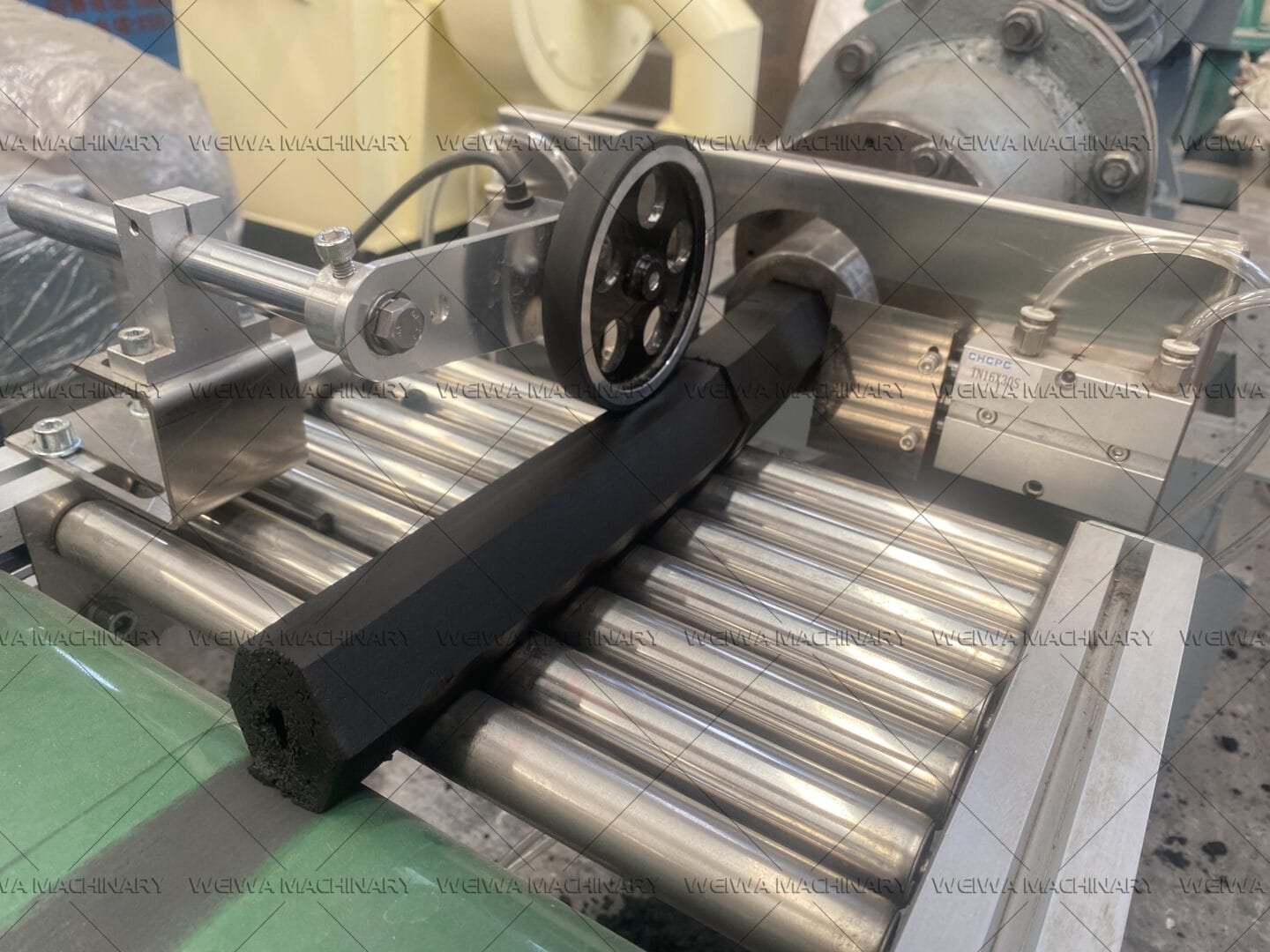
The trial was configured as a production simulation, not a sales demo. The client’s own material entered the hopper. The screw pushed the plasticized mass through the hexagonal die. The continuous rod exited the die head and was cut to 220 millimeters.
Commissioning Sequence Before Full Load
Skipping the idle check is one of the most common mistakes first-time buyers make. Turning the machine straight to full load after installation can shock the coupling and overload the gearbox.
Our commissioning sequence was simple:
The screw ran three minutes idle with no feed. Then five minutes half-feed to confirm material flow. Then full production with the ammeter watched constantly. After planned stops, the barrel was opened and the screw tip was inspected. The gearbox temperature was logged every twenty minutes.
This slow start protects the machine and gives the buyer evidence. A good charcoal extruder for Pakistan should not need drama to prove itself.
What the Hexagonal Rod Charcoal Looked Like?
By the end of the second hour, the discharge table held straight, glossy, crack-free hexagonal charcoal rods. Each piece measured 33 millimeters flat-to-flat. Each rod was cut to 220 millimeters. Each sample was dense enough to sink in water, which is a quick field test buyers in Sindh and Punjab actually use.
The client measured surface temperature on the gearbox, watched the ammeter, and cut three rods open with a hacksaw to check the central hole. He wanted to see whether the interior was porous, cracked, or uneven. It was not. The cross-section showed uniform density from the outer flat to the inner channel.
Trial Data the Client Took Home
Total run time was two hours and eleven minutes including planned stops to check screw temperature. The 160-type charcoal extrude machine processed 1,190 kilograms of mixed Pakistani material into finished hexagonal rod charcoal.
Effective average output was 595 kilograms per hour on the coconut shell batch and 540 kilograms per hour on the wood-coal blend batch. Power stayed between 17.5 और 19.2 kilowatts. Reject rate before the cutter was about 2 प्रतिशत. After trimming, reject rate dropped below 0.5 प्रतिशत. Gearbox peak temperature was 61 डिग्री सेल्सियस. Flat-to-flat tolerance held 33.0 plus or minus 0.3 millimeters across the full run.
Those numbers matter more than adjectives. A salesperson can say “high quality” in any language. A 0.5 percent trimmed reject rate speaks for itself.
Why the Hexagonal Shape Works for Pakistan BBQ and Tandoor Markets?
In Pakistan, shaped charcoal is judged by three things. The piece must stack tightly in a 10-kilogram PP bag. It must ignite with predictable airflow. It must hold radiant heat for more than sixty minutes under a grill mesh.
Round sticks roll and leave air gaps. Square bars can crack at the corner under thermal shock. The hexagonal rod is the compromise shape that answers all three problems. Flat sides improve carton packing. Six edges give stable contact on the grill. The central hole improves airflow and helps the rod light faster without flying apart.
This is why a hexagonal coal briquette machine for Pakistan is now a separate inquiry category for our sales team rather than a footnote under charcoal extruder.
Charcoal Extruder for Pakistan Must Handle Climate and Power Reality
Pakistan buyers do not operate in a laboratory. Voltage fluctuates. Workshops are dusty. Summer ambient temperature can exceed 40 डिग्री सेल्सियस. A machine built for a European trade fair may struggle in Lahore or Multan.
For hot-climate commissioning, we advise a cold-start purge every morning. Idle the screw sixty to ninety seconds. Check belt tension weekly because heat expands the belt and changes slip behavior. Lubricate the floating coupling monthly. Keep one spare #45 steel hexagon insert in stock so die wear never stops a shift.
These habits extended screw life to over 800 hours before flight rebuild in Indonesia and Egypt units we tracked. We expect a similar window for the Lahore client because the powder silica load is comparable.
Common Mistakes Buyers Make Before the First Run
The Pakistan trial also became a short training session. Our engineer shared the most frequent issues we see from first-time buyers across South Asia and Africa.
Mistake One: Buying the Die Before Testing the Powder
If the binder and moisture are wrong, die geometry is useless. A hexagonal hole cannot rescue a sticky, uneven mix. Buyers should test the powder first, then choose the die.
Mistake Two: Chasing Highest Horsepower
A 22-kilowatt machine with a poor propeller makes worse rods than a 15-kilowatt machine with a correct variable-pitch screw. Power helps only when the flight design, barrel taper, and die resistance are matched.
Mistake Three: Blaming the Extruder When Rods Crack
Cracking after drying is often a mixer problem, not an extruder problem. If mixer moisture sits at 8.5 percent with poor binder distribution, the rod may look fine at the die and fail three days later. In the Pakistan trial, we touched the extruder controls twice and the mixer controls eleven times. That ratio is normal.
Mistake Four: Skipping the Dryer for Commercial Output
Green hexagonal rods look solid, yet at 8 percent moisture in Karachi humidity they can mold inside a sealed PP bag within nine days. The trial used air-dried samples in the courtyard, but a commercial line in Pakistan’s monsoon weeks needs a mesh belt dryer. Drying is not optional if the buyer wants export-grade cartons.
Full Production Line Behind One Charcoal Extrude Machine
The charcoal extrude machine is the core, but never the whole system. For the Pakistan client, the realistic daily line looked like this:
A charcoal crusher reduces lumps below 3 millimeters. A wheel grinding mixer blends powder, बांधनेवाला, and water. The charcoal extrude machine forms the hexagonal rod. A mesh belt dryer removes surface and inner moisture over four to six hours. A pneumatic cutter trims the rod to length. अंत में, the rods are packed in 10-kilogram cartons for restaurant supply.
He did not need the dryer during the trial because we air-dried the samples. But for commercial output, the dryer closes the quality gap between “made a rod” and “made a sellable rod.”
Model Selection for Pakistan Workshops
We build the 140, 160, और 180 screw types. The 140 fits a 0.8 को 1.0 ton per hour single-shift workshop on 15 kilowatts. The 160 is the workhorse for Lahore-scale factories at 1.2 को 1.5 tons per hour on 22 kilowatts. The 180 serves 2 को 3 ton per hour lines on 22 को 30 kilowatts.
For most Pakistan barbecue charcoal workshops, the 140 type is enough at the start. Buyers with steady restaurant supply contracts move to the 160. Buyers already exporting containers monthly consider the 180. All three share the same carbon steel base, copper coil motor option, high manganese propeller, और #45 steel die system, so spare parts travel across models.
Interchangeable Molds Make One Machine Serve Several Markets
The client asked a practical question. Could he later switch to a square or cylindrical rod without buying a second machine? We demonstrated the mold swap. With the coupling loose and the barrel front opened, the hexagonal die came off in a few minutes and a cylindrical die went in.
This flexibility lets one charcoal extrude machine serve different customer segments in Pakistan without a second production line. One week he can supply hexagonal BBQ rods to grill restaurants. Another week he can make cylindrical rods for hookah lounges or square bars for tandoor bakeries.
Mold swap time with two wrenches is usually under twenty minutes on the 160-type unit. That is not just convenience. It is inventory control. The buyer carries dies, not duplicate factories.
Environmental and Workshop Advantages of Screw Extrusion
The extrusion process itself does not burn the charcoal. It shapes already-carbonized powder. That means no smoke from the machine body, no chimney needed at the shaping stage, and no coal tar release from the extruder.
For a buyer installing the unit inside a suburban workshop in Pakistan, that point removes a major permit headache. The crusher makes dust, so basic dust control still matters. The dryer consumes energy, so fuel choice matters. But the charcoal extrude machine itself is a cold-shaping device, not a combustion device.
This is also why the same technology works from Siberian workshops to Caribbean containers. The machine is mechanical before it is thermal.
How to Evaluate a Charcoal Extruder for Pakistan Like an Engineer?
If you are comparing suppliers, do not stop at price and photos. Watch the machine during your own trial.
Ask for a die measurement report before running. Run the first 30 centimeters of rod to waste so startup inconsistency does not enter your sample set. Weigh cut samples at minute 5, minute 20, and minute 40 to see if density drifts. Burn one rod in open air and time the glow. Open the barrel after the run and check the screw tip.
A good charcoal extrude machine for hexagonal rod charcoal should show no screw wear, no die enlargement, no ammeter spikes without cause, and no color change along the rod length. If the supplier refuses a live run with your own powder, that refusal is the answer.
Specification Sheet Questions That Actually Matter
Buyers often ask “how many kg per hour” and forget the rest. Better questions are these. What is the screw flight material? What is the die steel grade? What is the gearbox service factor? Does the coupling float or rigidly lock? What is the recommended powder size? What binder does the supplier test with? What moisture range is safe? How long does die change take? Which spare parts ship in the container?
A charcoal extruder for Pakistan should answer all of those questions without hesitation. If the sales chat only repeats “very good machine, very cheap price,” the buyer should slow down.
Weiwa Machinery Approach to Overseas Trials
Weiwa Machinery has manufactured biomass briquette machines, चारकोल एक्सट्रूडर, and carbonization equipment since 1990. Our factory in Zhengzhou, Henan covers 200,000 वर्ग मीटर. We hold CE, एसजीएस, and ISO certifications. More than two million end users across 130 plus countries run Weiwa equipment, from Indonesia and India to Poland, मेक्सिको, टर्की, मिस्र, and Pakistan.
Every charcoal extrude machine is test-run before shipment. Motors, gearboxes, and control panels are inspected individually before assembly. Spare parts such as propellers, coupling bushes, और #45 steel die heads are stocked for fast dispatch.
We do not just ship a machine. We send a layout drawing, a binder formula sheet, a commissioning checklist, and a WhatsApp line to a senior engineer. For the Pakistan client, that meant a video call during the trial, an English-operation manual, and a promised response window for any screw or die question.
Why the Factory Trial Builds More Trust Than a Brochure?
By the end of the visit, the Lahore client confirmed one 160-type charcoal extrude machine with two spare hexagonal die heads, one cylindrical die head, and a matching mixer. He also asked for a 140-type unit quotation for his cousin’s smaller shop in Faisalabad.
More important than the order was his comment. He said he came to catch us hiding something, and he did not see anything hidden. That is the point of a factory trial. The machine either shapes the rod or it does not. The screw either holds pressure or it does not. The hexagonal face either stays sharp or it does not.
Cost Logic Behind a Hexagonal Coal Briquette Machine
Some buyers compare only the machine price. That comparison misses the economics. Charcoal powder is often treated as waste or low-value residue. After crushing, mixing, extrusion, and drying, the same material becomes uniform BBQ rods with a much higher shelf price.
The screw extruder has a low moving-part count compared with complex hydraulic presses. Fewer delicate components means fewer midnight breakdowns. For a Pakistan workshop running long shifts, downtime costs more than the price difference between a strong frame and a thin frame.
A hexagonal coal briquette machine for Pakistan should be evaluated on die life, screw life, power stability, reject rate, and after-sales response. The cheapest invoice can become the most expensive machine on the floor.
Power and Labor Reality for Small Factories
A 160-type unit at around 22 kilowatts is not tiny, but it is manageable for a growing workshop. Labor usually includes one feeder and one packer for a semi-automatic line. The mixer and crusher add modest load. The dryer is the bigger energy conversation because it runs continuously.
Buyers in Pakistan often start with the extruder, then add a dryer after the first export inquiry. Our advice is the opposite. If the market is real, size the dryer early. Green rods stored in humid weather are a quality liability.
Hexagonal Rod Charcoal Export Potential from Pakistan
Pakistan is not only a consumption market. नारियल शेल लकड़ी का कोयला, hardwood charcoal, and coal-charcoal blends can be shaped into premium BBQ rods for Middle East and Gulf buyers. Hexagonal geometry photographs well, packs well, and burns predictably, which makes it attractive for branded charcoal cartons.
A charcoal extruder for Pakistan can therefore serve three layers. Local restaurants need daily supply. Wholesalers need consistent cartons. Exporters need uniform length, uniform flat-to-flat dimension, low moisture, and clean cutting faces.
The trial proved the machine could serve all three if the downstream line is built correctly. Extrusion was stable. The bottleneck would be drying capacity and carton quality, not screw performance.
Difference Between Charcoal Extrude Machine and Coal Rod Machine
Some buyers search for charcoal extrude machine, others search for coal rod machine, and others ask for hexagonal coal briquette machine. In practice, the screw principle is similar. The machine compresses charcoal powder or coal powder into dense rods through a die head.
The difference is feedstock and market language. Charcoal extrude machine usually describes BBQ charcoal, हुक्का चारकोल, and biomass charcoal lines. Coal rod machine often describes industrial coal rod production for boilers and heating. Hexagonal coal briquette machine describes the output shape more than a different technology.
For Pakistan buyers, the smart question is not “what is the machine called” but “what powder will I run, what shape do I sell, and what dryer capacity do I need behind the extruder.”
Can One Machine Run Charcoal and Coal Powder?
Yes, with limits. A charcoal extrude machine for hexagonal rod charcoal can process charcoal powder, wood charcoal dust, नारियल शेल लकड़ी का कोयला, चावल की भूसी का कोयला, and a modest percentage of coal powder. If the mix becomes mostly coal, the abrasion level changes, the binder changes, and the die wear rate rises.
The Pakistan client ran mostly charcoal with a small coal portion. That blend is common and manageable. A heavy coal blend needs a different screw wear calculation and sometimes a different die hardness discussion.
Quality Checks Buyers Can Do Without a Laboratory
Not every buyer has a proximate analysis lab. Still, several field checks separate good rods from rejects.
Drop test: a green rod should survive a 40-centimeter drop onto concrete without bending. Water test: a dense finished rod should sink rather than float. Cut test: a hacksaw cut should show uniform color, not dark crust and pale center. Burn test: the rod should glow evenly, not flare at one edge and die at the other. Stack test: hexagonal rods should stand in a carton without rolling or leaving large voids.
These checks are not scientific papers, but they catch 80 percent of commercial problems before the carton reaches a buyer in Karachi, Dubai, or London.
Moisture Targets After Drying
Fresh extruded rods leave the die with internal moisture even when the surface looks dry. For Pakistani humidity, finished rods should usually be dried until moisture falls into a safe range before packing. Exact target depends on binder, rod diameter, and shipping duration.
If moisture stays too high, mold grows in sealed bags. If moisture drops too far too fast, surface micro-cracks appear. Controlled drying beats sun drying for export orders, even if sun drying feels cheaper on day one.
Spare Parts and After-Sales for a Charcoal Extruder for Pakistan
The screw propeller wears first because it handles abrasive carbon fines. The die head wears second because it defines geometry. The coupling bush, belt, and gearbox oil are routine consumables.
Weiwa stocks propellers, coupling bushes, और #45 steel die heads for same-week dispatch on common models. For Pakistan buyers, we recommend keeping one hexagonal die insert, one set of belt, one coupling bush, and one spare screw flight kit on the shelf. That small inventory prevents a two-week stoppage over a 200-dollar part.
Remote support matters too. A WhatsApp video call can solve feeder bridging, binder clumping, or belt slip faster than a freight shipment. The machine is mechanical, but the commissioning knowledge is the real spare part.
Why Die Steel Grade Is Not a Marketing Detail?
A hexagonal die experiences continuous friction from charcoal silica and binder paste. Cast iron dies are cheap and fail early. Hand-ground openings lose tolerance. #45 steel inserts, properly heat treated and ground, keep the flat-to-flat dimension stable.
For a charcoal extrude machine for hexagonal rod charcoal, die steel decides carton appearance. Retail buyers do not measure flat-to-flat with calipers, but they notice when one rod is fat, another is thin, and the pack looks messy. Uniform geometry builds brand trust faster than any label design.
Screw Flight Design Versus Motor Power
Buyers sometimes say, “I want 30 kW so it is stronger.” Power without flight design is just heat. The screw must convey, knead, compact, and discharge in the right order. If the flight pitch is wrong, more kilowatts only spin the mass faster and overheat the barrel.
Weiwa uses variable-pitch screw logic on key models. The early flight moves material. The middle flight kneads binder. The discharge flight compresses the paste before the die. That sequence is why a 15 kW machine with correct flight design can beat a 22 kW machine with a copied screw.
Pakistan Market Summary After the Trial
The Lahore client came skeptical. He left with a commissioning report, a model recommendation, a binder starting formula, and a spare-parts list. The 160-type charcoal extrude machine proved it could shape his own powder into uniform hexagonal rod charcoal under load.
For Pakistani buyers, the winning configuration is usually a crusher, wheel mixer, 140 या 160 चारकोल निकालने की मशीन, mesh belt dryer, cutter, and packing table. The exact model depends on daily tonnage, available power, and whether the buyer sells locally or exports.
A hexagonal coal briquette machine for Pakistan is not a trend gadget. It is a response to real market needs: tighter packing, steadier grilling heat, better carton appearance, and one machine that can later make cylindrical or square rods.
When a Smaller Buyer Should Start with the 140 Type?
Not every Pakistan buyer needs a 160-type line on day one. A 140-type charcoal extrude machine at 15 kilowatts fits 0.8 को 1.0 ton per hour single-shift operation. It is easier on the electrical connection, easier to learn, and easier to finance.
Many Faisalabad and Multan workshops start with the 140, prove local restaurant demand, then upgrade to the 160 when export inquiries arrive. Because both models share the same die base philosophy, the buyer does not throw away his mold investment during the upgrade.
When a Buyer Should Skip Straight to the 160 या 180?
If the buyer already has restaurant distributor contracts, container booking experience, and stable raw material supply, the 140 may become a bottleneck within three months. The 160 gives headroom. The 180 makes sense only when the buyer already exports containers monthly and has dryer capacity, labor, and packing materials ready.
Buying the biggest machine first is not always ambition. Sometimes it is premature scaling. A charcoal extruder for Pakistan should match confirmed demand, not hope.
Safety and Workshop Layout Notes
The extruder itself is mechanically driven, but a full line still needs basic safety. The crusher inlet should have a guard. The mixer should have a lockout before cleaning. The screw chamber should never be opened while rotating. The cutter zone needs a guard because fresh rods and blades move together.
Workshop layout matters for labor efficiency. Powder should flow from crusher to mixer, mixer to extruder, extruder to cutter, cutter to dryer, dryer to packing. Backtracking creates dust, dropped rods, and confused workers. A clean linear layout reduces reject rate even when the machine is perfect.
Dust Control for Charcoal Powder
Charcoal powder is flammable in suspended concentration. A small spark near a dusty feeder can create a serious incident. We advise grounded equipment, controlled feeding, localized dust extraction at the crusher and mixer, and no open flames near the sizing area.
The charcoal extrude machine shapes wet paste, so the extruder zone is less risky than the crushing zone. Still, the whole line should be planned like a factory, not a backyard shed.
Binders Used in Hexagonal Rod Charcoal Production
Starch binders such as corn starch, cassava starch, and tapioca starch are common because they are food-adjacent, affordable, और साफ करके जला दें. Clay is cheaper but changes ash content and can dull the premium BBQ story. Molasses binds well but attracts moisture and pests if overdosed.
For the Pakistan trial, cassava starch at 4 percent gave good green strength without making the rod soft. Wood-charcoal blends sometimes need 3 को 5 प्रतिशत. Coconut shell charcoal often behaves differently because the particles are harder and less fibrous.
The right answer is never “more binder is safer.” Too much binder makes the rod soft, slow to ignite, and heavier in ash. Too little binder makes it crumble after drying. Binder tuning is part science, part feel, and all repetition.
Water Is Also a Binder Assistant
Water is not filler. It activates starch, lubricates the screw, and helps the mass plasticize. Too little water makes the screw scream and the rod surface rough. Too much water makes the paste slip and the rod sag.
In hot Pakistan summers, surface evaporation changes mixer behavior during the day. Experienced operators adjust water in the afternoon, not just in the morning. A charcoal extruder for Pakistan must be operated by someone who watches the dough, not only the ammeter.
Cutting and Length Consistency for Retail Packs
Hexagonal rod charcoal for restaurants usually needs consistent length. A 200-millimeter rod, a 220-millimeter rod, and a 250-millimeter rod may all burn fine, but retail buyers want uniformity. Inconsistent length makes the carton look careless.
The cutter should follow the die discharge rhythm. If the screw speed changes and the cutter does not, length drifts. If the cutter drags the rod, the end face deforms and stacking suffers. Rotary blade cutters usually give cleaner ends than crude wire cuts for premium packs.
The Pakistan trial used 220-millimeter target length. After trimming, length variation was small enough for restaurant supply cartons. That consistency is what turns a machine owner into a brand supplier.
Drying Methods for Pakistani Conditions
Three options exist: sun drying, tunnel drying, and mesh belt drying. Sun drying is cheapest but weather dependent. Tunnel drying is compact but sometimes uneven. Mesh belt drying gives the most controlled moisture curve for commercial lines.
For Pakistan’s Punjab heat, sun drying can work in peak summer for local orders. For Karachi humidity, monsoon weeks, or export cartons, mesh belt drying is the safer investment. The goal is not just “dry.” The goal is uniformly dry, without surface cracks and without mold risk.
Stacking Fresh Rods Too Early Ruins the Batch
Fresh extruded rods are mechanically weak. The binder has not fully set and the piece still contains moisture. If workers stack them or let them contact hard surfaces before drying, contact-point dents become structural defects in the finished piece.
Conveyor transfer should support the rod without point loading. Packing should happen only after moisture and hardness checks. A charcoal extrude machine can make a beautiful rod, but a careless drying floor can still destroy the batch.
Branding Opportunity for Pakistan Charcoal Entrepreneurs
Uniform hexagonal rods create a branding opportunity. A 10-kilogram carton with straight, glossy, crack-free rods looks like a professional product. A carton with bent, uneven, dusty rods looks like salvage.
Pakistan buyers who invest in die quality, cutter accuracy, dryer control, and carton design can move from “charcoal supplier” to “BBQ charcoal brand.” The charcoal extrude machine is the start of that brand, not the whole brand.
Middle East and Gulf importers pay attention to piece uniformity, low moisture, कम राख, and clean packing. The trial proved the machine side can deliver uniformity. The business side then depends on drying discipline, carton quality, and delivery reliability.
Questions Pakistan Buyers Should Ask Weiwa Before Ordering
Can you run my own powder before payment? Can you share die measurement reports? Can you recommend binder ratio for coconut shell versus wood charcoal? What screw material do you use? What gearbox service factor do you specify? How long does die change take? What spare parts ship inside the container? Do you provide an English operation manual? Can your engineer join a WhatsApp video call during installation? What is the real daily output after drying loss, not just catalogue output?
If a supplier answers all of these clearly, the buyer is probably dealing with a manufacturer, not just a trading chat account.
Questions Buyers Should Ask Themselves
Do I have stable raw material supply? Do I have reliable electricity or generator backup? Do I have a dryer plan? Do I have labor who can run a mixer, not just watch a button? Do I have buyers who will pay for uniform rods, or only buyers who want the lowest price per kilogram? These internal questions matter as much as machine specifications.
A charcoal extruder for Pakistan will not fix a weak market plan. But with the right market plan, it becomes the most important machine in the workshop.
Why Weiwa Does Live Trials Instead of Catalog Promises?
Any website can upload a photo of hexagonal charcoal. The difference is whether the machine can repeat that photo for eight hours, eight days, and eight months. Weiwa treats overseas trials as commissioning sessions, not sales theater.
The Uruguay trial, Laos trial, Martinique inquiry, and now this Pakistan trial all followed the same logic. Measure the powder. Adjust the mixer. Run the screw under load. Cut samples. Burn samples. Inspect the screw. Record the data. Let the buyer see the ugly first 30 centimeters and the good rod after stabilization.
This is slower than sending a PDF. It is also why Weiwa machines end up in more than 130 देशों.
Final Verdict on the Charcoal Extrude Machine for Hexagonal Rod Charcoal
The Pakistan trial confirmed what our Laos, Uruguay, and Martinique projects already suggested. A properly built screw extruder with carbon steel frame, copper motor, quality gearbox, manganese propeller, and ground #45 steel die head will hold hexagon geometry under commercial load.
The charcoal extrude machine is not magic. It is a mature technology that fails only when buyers chase the cheapest frame and wonder why rods crack. Weiwa Machinery treats the charcoal extruder for Pakistan as a long-term production node, not a transaction.
If your market wants hexagonal BBQ charcoal, the shape is solved. The remaining work is crushing, mixing, सुखाने, cutting, and packing, and we draw that line for you before you pay for a container.
संपर्क वेइवा मशीनरी
If you want to see your own charcoal powder shaped into hexagonal rod charcoal before placing an order, contact our team. We can arrange a live video trial, a factory visit, or a customized line proposal with crusher, मिक्सर, ड्रायर, cutter, and packing table sized to your workshop.
Mobile / WhatsApp: +86 13838093177
ईमेल: info@cjlmachinegroup.com
Send your sample, your moisture sheet, and your target market. We will show you what the machine can really do.


 WeChat

 +8615937143060
