


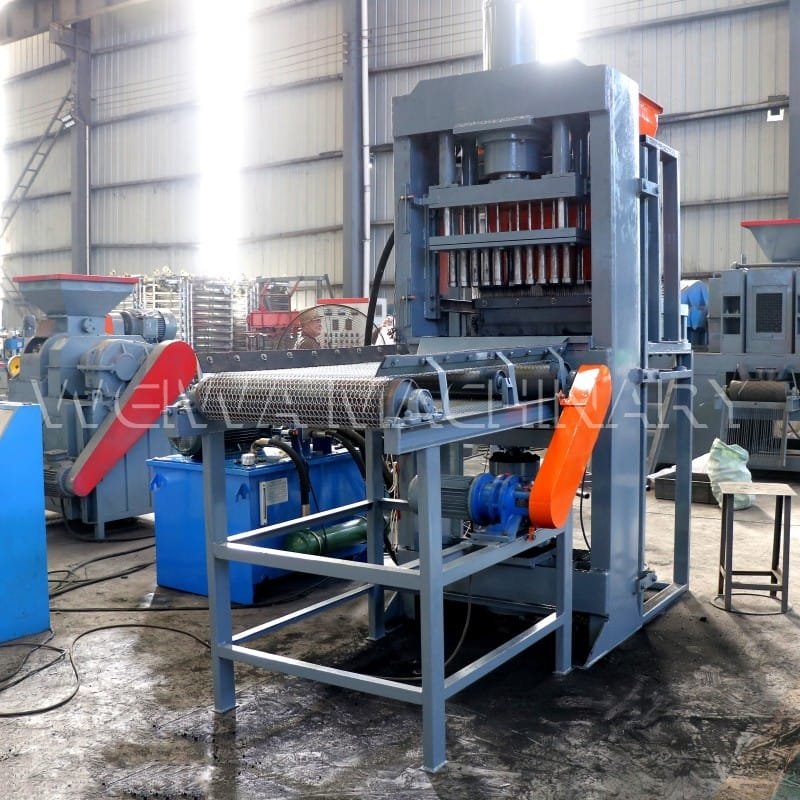
Why Weiwa Machinery Ran a Hydraulic Press Briquetting Machine Trial for Brazil?
Many Brazilian buyers start with the same question. Will a hydraulic briquette machine really handle our charcoal powder, नारियल के खोल, eucalyptus residue and variable moisture levels? Instead of giving a generic answer, our engineering team built a trial around Brazilian feedstock conditions.
The hydraulic press briquetting machine was prepared with adjustable pressure, interchangeable molds and a PLC control system. The goal was to prove that the equipment could produce uniform briquettes without overheating the material, without excessive binder consumption and without unstable density between batches.
For export-oriented buyers, consistency matters more than raw speed. A Brazilian shisha charcoal exporter cannot afford batches that burn too fast, break during packing or fail to meet importer specifications. The trial focused on repeatability, mold changeover, density control and finished-surface quality.
How the Hydraulic Briquette Machine Was Prepared for Brazilian Raw Materials?
Brazilian biomass is diverse. Sugarcane bagasse, चावल की भूसी, चूरा, नारियल के खोल, eucalyptus wood waste and fine charcoal dust all behave differently under pressure. Our team first analyzed particle size, moisture content, ash level and binding behavior before setting machine parameters.
Charcoal Powder and Fine Dust Handling
Fine charcoal dust is common in Brazilian charcoal operations. It is cheap, messy and difficult to sell in loose form. The hydraulic briquette machine compresses this waste into dense blocks with better calorific value, cleaner handling and higher resale value. During the trial, charcoal fines below 3 mm were mixed with a suitable binder and formed into uniform cubes and fingers.
Coconut Shell, Eucalyptus and Wood Waste Testing
Coconut shell and eucalyptus are widely available in parts of Brazil. After carbonization and crushing, these materials become excellent feedstock for premium charcoal briquettes. The hydraulic system allowed slow, controlled compression, which helps preserve the structure of the carbon particles and improves burning time.
Mold and Pressure Settings for Brazil Clients
Different Brazilian customers need different products. Some target churrasco consumers who want large, long-burning BBQ blocks. Others target the Middle East and Europe with finger-shaped or cube-shaped shisha charcoal. The same hydraulic briquette press can serve both segments by changing molds and adjusting pressure between 100 और 200 tons depending on the recipe.
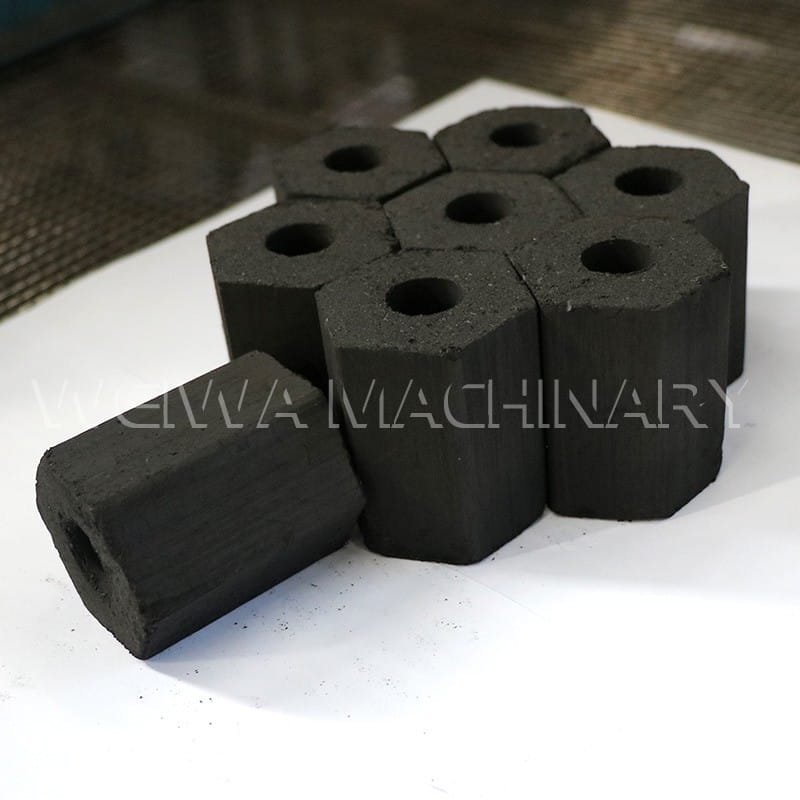
What Happened During the Brazil Client Machine Trial?
The trial began with small batch feeding. Our operator loaded mixed charcoal powder into the hopper, started the hydraulic pump station, and allowed the rear cart to push material into the forming mold. The upper hydraulic head then compressed the material with static high pressure. After forming, the lower head ejected the briquette onto the discharge side.
The Brazilian client observed several points closely. पहला, the briquette edges were sharp and the surface was smooth. दूसरा, density remained stable across repeated strokes. तीसरा, the PLC system made it easy to change pressing time and pressure without mechanical rebuilds. Fourth, the cooling system kept the hydraulic unit stable during continuous running.
One of the most valuable outcomes was waste reduction. Material that previously looked unsellable became a finished product with predictable size, weight and burning behavior. For a Brazilian charcoal yard, that difference can turn disposal cost into export revenue.
Another important observation was mold flexibility. The client tested round shisha charcoal, cubic BBQ charcoal and rectangular industrial briquettes on the same frame. Only the mold and pressure recipe changed. This reduces capital risk for Brazilian buyers who want to enter several markets instead of relying on one product type.
Why Hydraulic Briquette in Brazil Has Strong Market Potential?
Brazil is not a small niche for briquette equipment. It is one of the largest agricultural and forestry economies in the world, with a deep barbecue culture and a growing industrial charcoal sector. A hydraulic briquette machine for Brazil is attractive because the raw material is local, the demand is local and the export demand is also expanding.
Biomass Waste Available in Brazil
Sugarcane bagasse, कॉफी की भूसी, चावल की भूसी, चूरा, coconut shell and eucalyptus residues are generated in large volumes across Brazilian states. Much of this material is burned, dumped or underused. Hydraulic briquetting converts low-value residue into transportable, storable and combustible dense fuel.
BBQ and Churrasco Charcoal Demand
Brazilian churrasco culture creates steady demand for high-quality charcoal. Consumers want charcoal that lights well, burns longer and produces less dust. Hydraulic briquette presses can produce uniform BBQ blocks with controlled density, which improves customer experience and brand reputation for Brazilian charcoal brands.
Shisha Charcoal Export Opportunities
The global shisha charcoal market values low odor, low spark, long burn time and consistent size. Brazilian producers with coconut shell or hardwood carbon can supply this segment if their machine delivers repeatable quality. The hydraulic briquette machine gives exporters the process control required for Middle Eastern, European and Asian buyers.
Industrial Charcoal and Metallurgy Demand
Brazil also uses charcoal in industrial applications such as pig iron and metallurgy. In these segments, briquette uniformity, fixed carbon retention and low breakage rate are critical. Hydraulic compression is especially suitable because it forms dense briquettes without excessive friction heating that can degrade carbon quality.
How Brazilian Buyers Can Use a Hydraulic Briquette Press Profitably?
A profitable Brazilian briquette project usually starts with feedstock mapping. The buyer identifies what waste is available nearby, what moisture level it has, and what final product has the best local or export margin. Then the machine configuration is selected.
For small workshops, a single hydraulic briquette press with two or three molds may be enough to serve local BBQ shops and nearby restaurants. For larger operations, the machine can be combined with carbonization furnace, कुचल डालने वाला, मिक्सर, conveyor and dryer to create a full production line.
The financial logic is simple. Waste material has low purchase cost. Briquetting adds density, cleanliness and marketability. Finished shisha or BBQ charcoal sells at a much higher unit value than loose dust. When the machine is stable, labor is trained and molds are standardized, Brazilian producers can scale output without reinventing the process every week.
Another advantage is product diversification. The same hydraulic briquette machine for Brazil can produce shisha cubes in the morning, churrasco blocks in the afternoon and industrial fuel briquettes for boiler clients in the evening. This flexibility protects the business when one market becomes seasonal or price-sensitive.
Logistics also improve. Loose charcoal powder loses volume to dust, spillage and poor stacking. Dense briquettes pack better, ship better and present better to distributors. For exporters, container utilization and product appearance can determine whether a buyer repeats the order.
वेइवा मशीनरी: 30+ Years of Briquette Machine Manufacturing
Weiwa Machinery has more than thirty years of experience in manufacturing briquette machines, carbonization equipment and related production lines. Our factory receives international visitors every week and our machines have been exported to more than 90 countries and regions.
We do not only sell equipment. We help clients plan the project. Our team can review your raw material, suggest the right binder and crushing process, design machine configuration, provide custom molds, draw factory layout drawings and support commissioning. For Brazilian clients, this means the hydraulic briquette press is matched to local material instead of being sold as a generic machine.
Our after-sales team handles installation guidance, spare parts, operation training and troubleshooting. For overseas projects, we can arrange factory testing videos, packaged shipment, wooden case or container loading, and technical documents in clear industrial English.
Customization is central to our work. Brazilian customers may need special voltage, Portuguese labels, tropical cooling configuration, larger hopper, longer conveyor, customized mold shape or a full line from carbonization to packing. Weiwa Machinery can engineer around those requirements instead of asking the client to adapt to a fixed machine.
संपर्क वेइवा मशीनरी for Brazil Project Consultation
If you are planning a charcoal, biomass or shisha briquette project in Brazil, the best starting point is a raw material discussion. Send us your material type, नमी, daily capacity target and final product shape. We will recommend the right hydraulic briquette machine configuration and prepare a practical factory layout.
Weiwa Machinery welcomes Brazilian agents, charcoal producers, biomass entrepreneurs and industrial fuel suppliers to visit our factory. We can run a material test, show the hydraulic press briquetting machine in operation, and help you calculate investment return before shipment.
भीड़: +8613838093177
Whatsapp: +8613838093177
ई-मेल: info@cjlmachinegroup.com


 WeChat

 +8615937143060
