


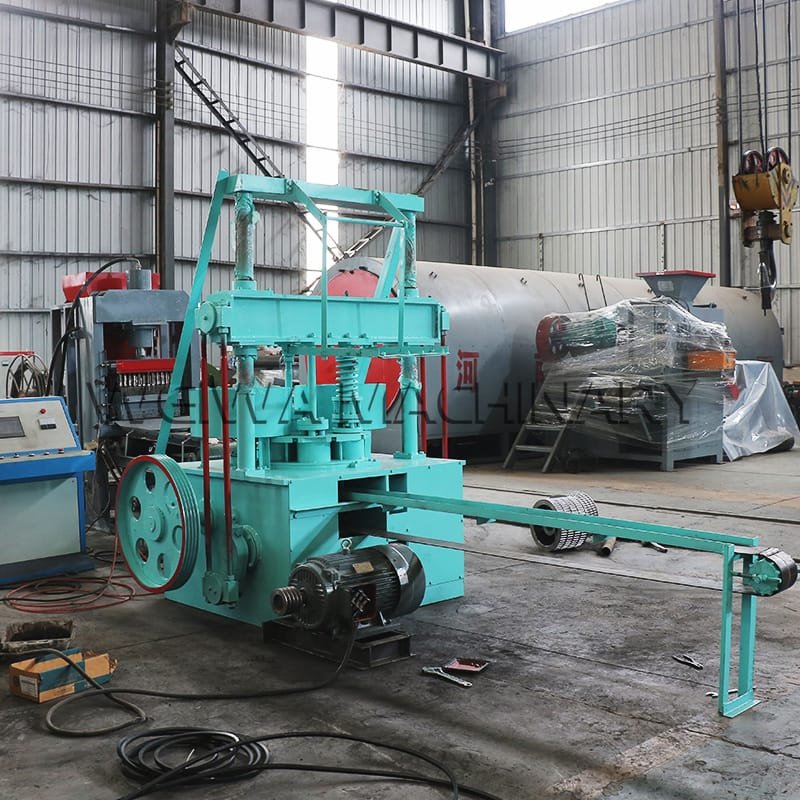
Why Russia Buyers Request a Dedicated Honeycomb Briquette Charcoal Machine in Russia?
The demand for a honeycomb briquette charcoal machine in Russia is driven by long winters, widespread solid-fuel stove usage outside city gas networks, and a retail channel that already sells cylindrical coal honeycomb blocks. Russian end users expect a briquette that lights in minutes, holds shape during transport, and burns bottom-up with minimal ash. That forces the equipment side to control hole count, hole diameter, compressive strength, and moisture window far more strictly than general-purpose lines.
For this client, the non-negotiable specs were 140 mm outer diameter, 19 ventilation holes, 75 mm height, and compatibility with blended hardwood charcoal powder plus anthracite fines. They also required 380 V / 50 Hz industrial power, CE-marked motor, and Russian-language labels on the emergency stop and greasing points. Our export version of the Honeycomb Charcoal Coal Briquette Forming Machine already covers 220 V / 380 V / 415 V, so the electrical cabinet only needed a label swap and a terminal torque check.
Local Fuel Habits Shape the Machine Configuration
In Moscow and Yekaterinburg retail yards, honeycomb charcoal is often stacked beside classical black coal honeycomb. The Russia client explained that mid-income households blend purchases: charcoal honeycomb for shashlik and sauna stoves, coal honeycomb for overnight heating. A Coal Briquettes Making Machine in this region therefore cannot be tuned only for charcoal. The same Honeycomb Punching Machine base must accept recipe changes without mold redesign.
What Is a Honeycomb Charcoal Coal Briquette Forming Machine?
A Honeycomb Charcoal Coal Briquette Forming Machine is a rotary-table cold punch press. It does not extrude material through a heated screw. Instead, prepared powder drops into a measuring shoe, fills a mold cavity on an indexing turntable, and a cam-driven punch compresses it into a beehive shape with through-holes formed by fixed pins. Cold forming protects the fixed-carbon value of charcoal and keeps the binder from scorching.
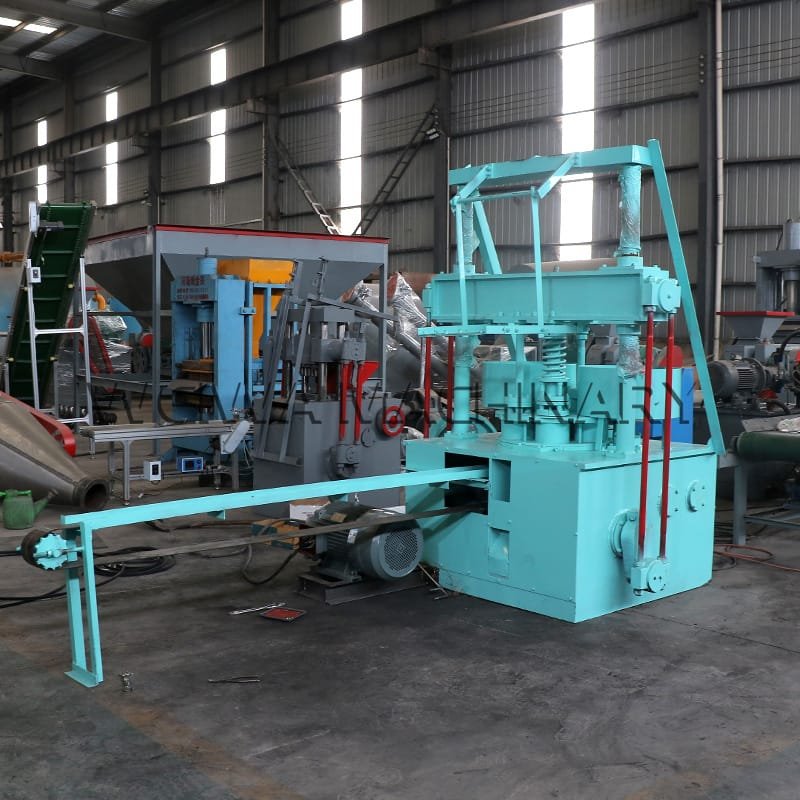
Core Assemblies of the Honeycomb Punching Machine
The Honeycomb Punching Machine demonstrated to the Russia team contained five subsystems. The machine body is a stress-relieved steel plate frame. The transmission uses a hardened gear reducer with forced lubrication. The feeding device is an agitated hopper with an adjustable shoe. The stamping unit carries the eccentric shaft and high-manganese steel punch. The discharge side uses a mechanical ejector and a short belt conveyor. No hydraulic unit was involved, which the client preferred because winter workshop temperatures in Siberia can thicken hydraulic oil and slow cycle time.
Why Cold Punching Beats Extrusion for Charcoal?
Screw extruders work for some biomass pellets, but for charcoal powder the friction heat degrades volatile content and roughens the hole wall. The honeycomb briquette charcoal machine we build forms at room temperature, so hole edges stay sharp, ignition channels stay open, and the bulk density stays in the 1.15–1.22 g/cm³ range that Russian stove tests favor.
Raw Material Preparation Before the Trial
Before the Russia client arrived, our technician prepared two batches. Batch A was 70% hardwood charcoal powder (below 3 मिमी) और 30% anthracite fines. Batch B was 85% coconut shell charcoal powder and 15% bituminous coal dust. Both batches were mixed with 2% cassava starch binder and water to 10%–11% moisture. The Coal Briquettes Making Machine feeding system behaves badly outside that moisture band: under 8% the powder aerates and fills the hopper neck; above 12% the punch sticks and holes close.
Binder Ratio and Moisture Window
We showed the client our lab sheet. Starch binder sits at 1.5%–3% by weight for charcoal-dominant recipes. Lignosulfonate at 1% suits coal-dominant recipes. Clay or bentonite is acceptable for pure coal honeycomb but dulls the premium charcoal burn image. The Russia buyer chose starch for the first container because his retail brand positions itself as low-smoke household fuel.
Russia Client Trial Run at Weiwa Workshop
The unit on the floor was our WHC 140 Honeycomb Charcoal Coal Briquette Forming Machine, equipped with a 7.5 kW motor, 380 V / 50 Hz, and a 140 मिमी / 19-hole round mold. The client witnessed a 30-minute continuous run with no stoppage.
Output and Stability Data
Average output was 38 pieces per minute, equal to roughly 2,280 honeycomb briquettes per hour. No abnormal vibration was recorded on the frame feet. Motor current stayed at 9.4 A under load, below the 15 A nameplate draw. After 1,100 punching cycles the high-manganese steel mold showed no deformation. The client measured noise at 82 dB(A) from one meter, acceptable for his regional factory permit.
Sample Geometry Verification
Random samples gave outer diameter 140.2 mm ±0.3 mm, height 75.1 mm ±0.4 mm, hole diameter 13.5 मिमी, and bulk density 1.18 g/cm g. Surface finish was smooth, hole edges sharp, no visible cracks after 24-hour air drying. The Russia client physically handled the samples and confirmed the hardness met his expectation for retail packaged charcoal briquettes stacked five layers high in a carton.
Combustion Observation of the Trial Samples
We did not run a full calorific lab test on site, but we placed a sample on glowing embers in a test stove. Ignition started in 3–5 minutes. The flame front moved top-down, which is the correct burn pattern for Russian honeycomb because it pushes heat into the chimney draft instead of smoldering sideways. Estimated total burn time for a 140 × 75 mm piece was 90–120 minutes. Ash residue was light gray and minimal, indicating thorough carbonization of the input charcoal.
How Hole Count Affects Ignition in Cold Climate?
The client originally asked for 21 holes, then agreed 19 holes was the better compromise. More holes mean faster ignition but lower compressive strength. For a honeycomb briquette charcoal machine in Russia shipping by truck over rough roads, 19 holes at 13.5 mm delivered both quick light and survivable stacking pressure. We documented this trade-off in the trial report so his procurement team could not later dispute the mold choice.
Technical Parameters of Recommended Models for Russia
Weiwa Machinery offers several models of Honeycomb Charcoal Coal Briquette Forming Machine suitable for different production scales. The Russia client reviewed four.
WHC 120
5.5 kW motor, diameter 100–120 mm, height 60–80 mm, 35–45 pieces/min, 1280 × 1160 × 1750 मिमी, 1200 किलोभास. Good for startups supplying one district.
WHC 140
7.5 kW motor, diameter 100–140 mm, height 60–80 mm, 35–45 pieces/min, the unit demonstrated in this trial. Most popular choice for medium-scale Coal Briquettes Making Machine operations in Eastern Europe.
WHC 160
7.5 kW motor, diameter up to 160 मिमी, same height band, suited to larger honeycomb blocks for industrial heating applications.
WHC 220 Heavy Duty
11 kW motor, diameter 180–220 mm, reinforced frame, 4000 किलोभास. Built for continuous three-shift plants that blend coal and charcoal for municipal depots.
All models accept customized molds for hole number, hole diameter, and shape. All can be configured for 220 V / 380 V / 415 V power supply upon request, which is essential for Russia-bound equipment.
Honeycomb Punching Machine Maintenance and Mold Care
To protect the client’s investment, we handed over a maintenance schedule written in Russian and English. Daily greasing of the eccentric shaft bearings, weekly check of punch-head clearance, and immediate replacement of worn mold sleeves. The high-manganese steel molds normally withstand 500,000–800,000 punching cycles before rework, depending on abrasiveness of anthracite fines. Operators must keep the hopper clear of bolts or stones, and avoid running the machine empty with the mold installed because that accelerates punch-tip wear.
Mold Changeover Time
We demonstrated a mold swap from 140 मिमी / 19-hole to 120 मिमी / 16-hole. Two technicians completed it in 17 minutes with taper-lock clamps and standard hand tools. For a Coal Briquettes Making Machine serving both household and restaurant channels, fast changeover is the difference between profitable small batches and idle downtime.
Internal Value of a Factory Trial for Overseas Buyers
The Russia client told us he had watched three supplier videos before booking a flight to China. Videos show the machine running; they do not show the binder sticking to the shoe, the ejector timing drifting after heat buildup, or the carton-stack crush test. A physical trial on a honeycomb briquette charcoal machine in Russia project removes that blind spot. He left with 30 dried samples, a USB stick containing the 30-minute run footage, and a signed acceptance sheet referencing WHC 140 serial number.
What We Recommend Before You Import?
Buyers planning to import a honeycomb briquette charcoal machine in Russia should request a factory trial with their own raw material. Ship us 20 kg of your local charcoal or coal powder in advance. We will tune the moisture, बांधनेवाला, and punch pressure, then record the run. You receive real samples instead of studio photos.
के बारे में वेइवा मशीनरी
Weiwa Machinery is a manufacturer of honeycomb briquette charcoal machine, Honeycomb Charcoal Coal Briquette Forming Machine, Coal Briquettes Making Machine, and Honeycomb Punching Machine systems, together with carbonization furnaces, crushers, and dryers. We have exported to more than 130 countries and support Russian, English, Spanish, Arabic, and French manuals. Every export line is delivered with foundation drawings, wiring diagrams, spare-punch kit, and remote commissioning via WhatsApp video.
If you are evaluating a honeycomb briquette charcoal machine in Russia project and want to see your own powder pressed into samples, contact our team before container booking.
वेवा मशीनरी से संपर्क करें
भीड़ / WhatsApp: +8613838093177
ई-मेल: info@cjlmachinegroup.com


 WeChat

 +8615937143060
