


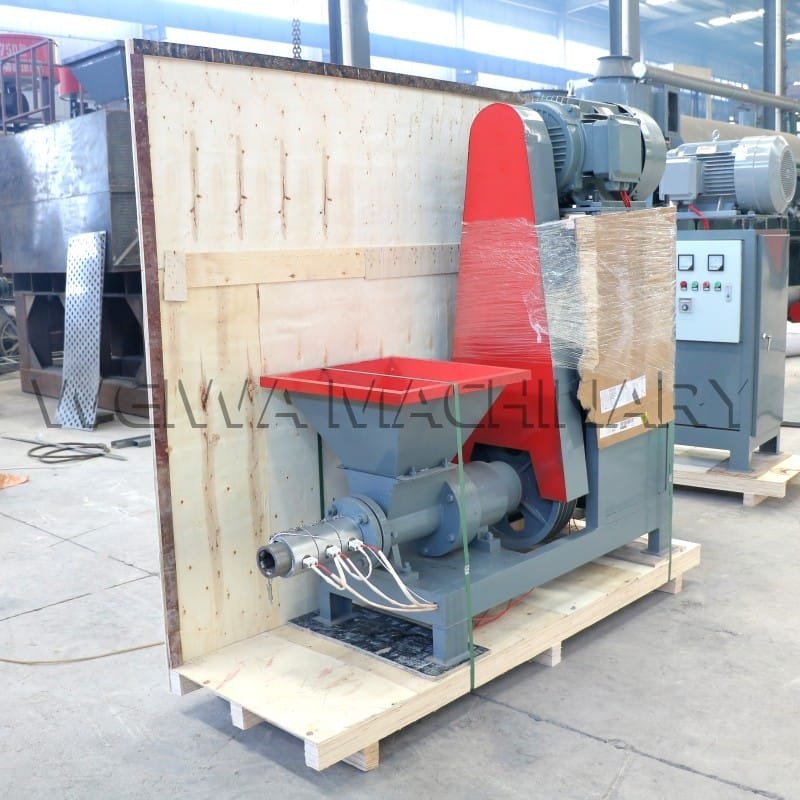
几个月前, 一位来自巴拉圭的木材废料贸易商联系了威瓦机械,询问了一个简单但非常实际的问题. 他已经知道他需要一台锯末挤出机, 但他想要证明相同的设备能够在潮湿的夏季生存, 尘土飞扬的院子, 电压不稳定,工人没有煤球经验. 而不是发送另一个 PDF, we invited him to watch a live trial of a Sawduat Extrude Production Line configured for one of our West African clients. The trial was not staged for show. It was a working day in a Ghanaian workshop where sawdust, palm husk and cocoa-shell residue were converted into dense briquette sticks, then carbonized into clean charcoal.
Why Paraguay Buyers Now Ask About 木屑挤出机 in Paraguay Setups?
Paraguay has a growing furniture cluster, active sawmills near Ciudad del Este, and agricultural residues from soybean, cassava and sugarcane regions. For years that waste was either burned openly or dumped. 今天, with LPG and firewood prices moving unpredictably, local entrepreneurs see charcoal as a hedge. A charcoal making machine in Paraguay is no longer a curiosity. It is a business tool. But Paraguayan buyers are careful. They compare European piston presses, Indian screw machines and Chinese lines. The deciding factor is rarely price alone. It is whether the sawdust extruder in Paraguay climate will keep forming sticks at 11 kW without choking on 11 percent moisture material.
That is exactly why we arranged the cross-continent reference. Africa is not a detour from the Paraguay project. It is the closest stress test available. If a sawdust extrude production line runs stable in Tamale or Kumasi, it will run in Paraguarí.
What the Paraguay Client Wanted to Verify Before Paying Deposit?
The buyer from Paraguay sent us five non-negotiable points. 第一的, he wanted to see screw wear after continuous 8-hour shift. 第二, he needed moisture tolerance because Paraguayan rainy season pushes sawdust above 14 百分比. 第三, he asked whether one operator could manage crusher, 干衣机, extruder and carbonization furnace. 第四, he wanted finished stick diameter consistency between 50 毫米和 70 毫米. 第五, he cared about carbonization smoke control because municipal rules in Asunción are tightening. During the African trial we answered all five live.
Anatomy of a Sawduat Extrude Production Line Tested in Africa
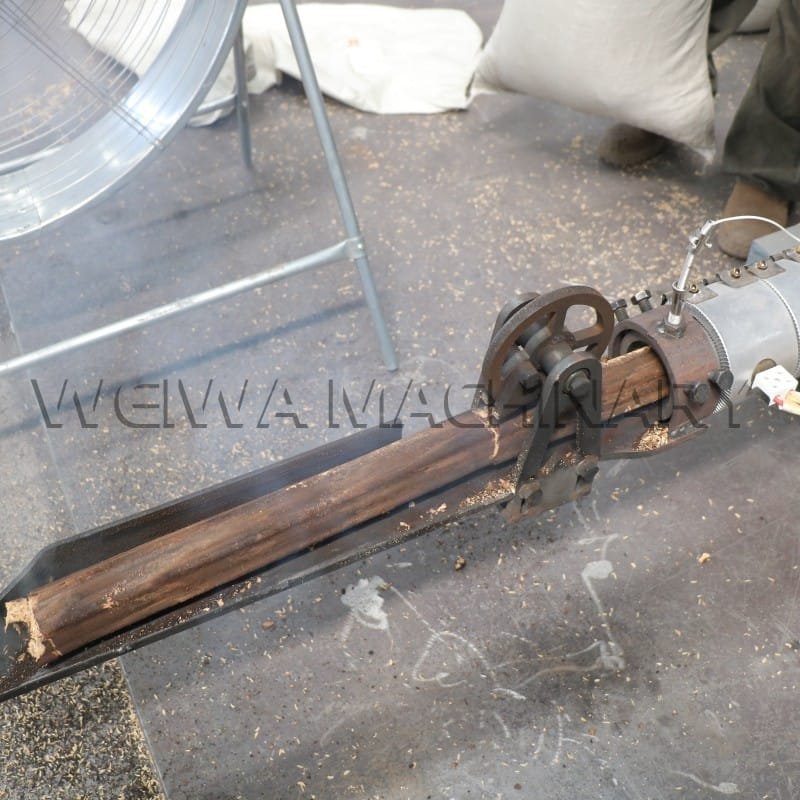
The line we ran for observation contained five functional zones. A hammer mill reduced offcuts below 5 毫米. A rotary drum dryer pulled moisture from 18 percent down to 9 percent using a 280 Celsius exhaust loop. The core sawdust extrude machine then compressed material through a heated barrel where natural lignin activated as binder. Sticks exited at 55 mm hexagonal shape with a 18 mm central hole. A belt conveyor moved them into a horizontal carbonization furnace. 后 14 hours the output was machine-made charcoal with metallic ring sound when struck, uniform black surface and 1.2 gram per cubic centimeter density.
Raw Material Reality in the African Trial Yard
Most brochures say sawdust only. In the field we fed mixed biomass. Sawdust from mahogany and obeche. Palm kernel shell broken into granules. Cocoa pod husk. Rice husk at 12 水分百分比. The sawdust charcoal making machine accepted the blend because we pre-sized everything below 5 mm and kept average moisture near 10 百分比. When the Paraguay team saw cocoa husk going in and clean charcoal coming out, the conversation changed from specification to logistics.
Screw Temperature and Lignin Activation Without Chemicals
No starch, 不是木薯酱, no molasses. The sawdust extrude machine relies on thermoplastic binding. 桶内, heating rings hold 260 到 300 Celsius. Pressure exceeds 25 MPa at the die. Lignin softens, wraps cellulose fibers, and after cooling the stick holds shape permanently. This matters for Paraguay because chemical binders increase cost and fail emission checks. Our trial proved binder-free briquetting is not theory.
Field Trial Data From the Africa Charcoal Line
We ran the Sawduat Extrude Production Line for three consecutive days. Day one focused on pure sawdust. Day two blended 70 percent sawdust with 30 percent palm husk. Day three pushed moisture to 12.5 percent to simulate bad weather. The machine never jammed. Output dropped slightly on day three, 从 240 kg per hour to 205 公斤每小时, but stick integrity remained acceptable. 功耗保持在 18.5 kW and 21 kW on the 50 mm model. Carbonization yield averaged 3.1 tons of green sticks producing 1 ton of charcoal, which matches our factory benchmark.
Calorific Value and Combustion Behavior
Laboratory sample from the trial showed 27.8 MJ per kg after carbonization, 相比 15.5 MJ per kg for seasoned firewood. Fixed carbon reached 78 百分比. 阿什留在下面 4 百分比. For a charcoal briquette machine in Paraguay investor, those numbers translate into fewer bags per household meal and higher resale margin. The Paraguay client noted that hexagonal sticks with central hole burned 12 minutes longer than solid piston blocks in side-by-side stove test.
停机时间, Spare Parts and Operator Learning Curve
We deliberately stopped the line at hour six to change the screw sleeve. Total downtime was 22 minutes with two untrained local workers guided by WhatsApp video. That answered the Paraguay buyer’s worry about technician availability. A sawdust extruder in Paraguay workshop does not need a Chinese engineer on site. It needs one spare screw, one heating coil, and a 40-minute training video in Spanish.
Why African Conditions Are a Valid Preview for Paraguay?
Some readers may ask whether Ghana or Nigeria is relevant to South America. The answer is yes, because the failure modes are identical. High ambient humidity. Voltage fluctuation. Abrasive dust. Manual feeding. Long idle periods between batches. If a sawdust extrude production line survives Tamale, it survives Caacupé. The Paraguay client understood this immediately when he saw the African operator shoveling wet sawdust into the dryer after a morning rain.
Moisture Control Lesson That Saved the Paraguay Quote
African trial showed that above 13 水分百分比, the extruder heats unevenly and sticks develop hairline cracks. We solved it with a two-stage dryer and a moisture meter at the inlet. For Paraguay, where sawmills often store sawdust uncovered, we proposed the same two-stage dryer even though it added 8 percent to line cost. The buyer accepted because trial data proved payback came from reduced reject rate, not from cheaper equipment.
Carbonization Smoke and the Asunción Emission Question
In the African yard we used a horizontal furnace with secondary combustion chamber. Measured smoke opacity dropped below local limit. For Paraguay, we recommended adding a simple scrubber option for inner-city workshops. A charcoal making machine in Paraguay placed near residential zone cannot ignore this. Weiwa treats emission control as part of the line, not an accessory.
Production Flow Explained for First-Time Charcoal Investors
The complete chain behind a sawdust charcoal making machine is crushing, 烘干, extruding, 冷却, carbonizing and packing. Crushing sets particle size below 5 毫米. Drying targets 8 到 12 水分百分比. Extruding forms the stick. Cooling stabilizes shape. Carbonizing removes volatiles. Packing seals hygiene. Skipping any stage ruins the next. Many Paraguay inquiries ask for only the extruder. We explain that buying a lone sawdust extrude machine without dryer is like buying a printer without paper calibration.
Choosing Stick Diameter and Shape for Market Fit
We tested 50 毫米和 70 mm dies during the trial. 这 50 mm hexagonal stick suited household BBQ bags. 这 70 mm square stick suited industrial boiler clients. For Paraguay we suggested starting with 50 mm hexagon because Asunción backyard grills dominate early demand. Later the same sawdust extruder in Paraguay can swap die to 60 mm pentagon for shisha export if the client finds regional buyers.
Capacity Planning From 200 kg/h到 1 ton/h
The Paraguay buyer initially wanted 500 公斤每小时. African trial ran a 240 kg per hour unit. We showed him scaled layout: 二 50 mm extruders in parallel reach 480 kg per hour with one shared dryer and one shared carbonization furnace. This modular logic lets a charcoal briquette machine in Paraguay project start small, prove the market, then double without replacing the foundation.
Economic Angle Paraguay Cannot Ignore
Equipment is 30 percent of the story. Margin is 70 百分比. In the African trial, raw sawdust cost 18 dollars per ton delivered. Electricity averaged 0.14 dollars per kWh. Labor was two people per shift at 6 dollars each. One ton of finished charcoal needed 3.1 tons sticks, equal to 3.4 tons sawdust input. Total conversion cost landed near 96 dollars per ton charcoal. Local wholesale price was 240 dollars per ton. Even after bagging and transport, net margin exceeded 38 百分比. For a sawdust extrude production line in Paraguay, where sawdust is sometimes paid to remove, the math is stronger.
Payback Period Observed in Field Cases
African client recovered machine cost in 11 months on a 240 kg per hour line. We project 9 到 14 months for Paraguay depending on bagged retail vs bulk industrial sales. A sawdust charcoal making machine is not a get-rich-quick gadget. It is a steady cash converter from forest waste to cooking fuel.
How Weiwa Configures a Sawdust Extruder in Paraguay Context?
Every Paraguay quote from Weiwa starts with raw material audit. We ask for sample sawdust, moisture reading, available power voltage, workshop length and target daily bags. Then we design. For the client in this case we proposed a 500 kg per hour Sawduat Extrude Production Line with 22 kW玩摩托车, 800 mm drum dryer, 18-meter belt, and one 4-cart horizontal carbonizer. Control panel in Spanish. Manual in Spanish. Spare kit with two screws. WhatsApp after-sales group with video troubleshooting.
Voltage and Motor Adaptation
Paraguay uses 220V single phase in small towns and 380V three phase in industrial parks. Our sawdust extrude machine ships with configurable motor box. In the African trial we ran on unstable 415V supply with surge protector and the screw did not lose torque. That detail convinced the Paraguay team more than any catalogue photo.
船运, Fumigation and Paraguay Customs Notes
We pack in plywood box with steel frame. For Paraguay we add fumigation certificate, commercial invoice in Spanish and English, bill of lading marked Asunción or Encarnación, 和海关编码 8474.80. The same charcoal making machine in Paraguay shipment that passed Ghanaian Tema port cleared easier because Wood packaging compliance was already in our standard export pack.
Common Mistakes First-Time Buyers Make
The first mistake is chasing lowest price extruder and ignoring dryer capacity. The second is assuming all sawdust is equal, then feeding 20 percent moisture eucalyptus fluff. The third is underestimating carbonization time. The fourth is forgetting spare screws. The fifth is asking for charcoal briquette machine in Paraguay delivery in two weeks when proper trial and painting take four. Weiwa slows the buyer down on purpose during engineering phase so the field phase is boring and profitable.
When Not to Buy a Sawdust Extrude Machine?
If your monthly sawdust volume is below 8 吨, a full line is oversized. Use a small piston press or partner with a nearby sawmill cooperative. If your local charcoal price is below 120 dollars per ton, margins vanish. If electricity exceeds 0.25 dollars per kWh and raw material is far, rethink logistics. A sawdust extruder in Paraguay project must clear these gates before we issue proforma invoice.
Paraguay Client Verdict After the Africa Trial
After watching the third day run, the Paraguay representative sent one line: “The machine does not lie when the raw material is honest.” He placed deposit for a 500 kg per hour line with 50 mm hexagon die, Spanish panel, extra screw and dryer upgrade. We are now preparing factory acceptance test in China before ocean freight. The African trial yard became his reference plant although it sits 8000 km away.
What We Improved Because of That Trial?
We thickened the hopper wall after seeing cocoa husk abrasion. We added a moisture alarm light after day three fluctuation. We rewrote the Spanish manual with flatter sentences. The sawdust extrude production line leaving for Paraguay in 2026 will not be the same unit we sold in 2021. Field trials in Africa are how Weiwa upgrades quietly.
结论: From Africa Trial to Paraguay Charcoal Business
A sawdust extrude machine is not a metal box with a screw. It is a system that starts at the sawdust pile and ends at the charcoal bag on a truck. The Paraguay client understood this only after seeing an African workshop sweat through rain, dust and shift changes. Whether you plan a charcoal briquette machine in Paraguay setup, a sawdust charcoal making machine line in Santa Cruz, or a Sawduat Extrude Production Line for export to Brazil, the principles stay fixed. Control moisture. Respect lignin. Keep spare screw. Train one operator well. Let the trial data speak.
Weiwa Machinery has installed biomass and charcoal lines in over 130 国家. We do not sell promises. We sell the same screw that ran in Tamale and will run in Paraguarí.
关于 WEIWA机械
Weiwa Machinery is a Chinese manufacturer of biomass processing and charcoal production equipment, serving global clients since the early 2000s. Our core range covers sawdust extrude machines, 木材破碎机, 旋转式干燥机, screw briquette presses, carbonization furnaces and turnkey charcoal lines. We have shipped to Indonesia, 印度, 马来西亚, 越南, 火鸡, 波兰, 南非, 加纳, 尼日利亚, 肯尼亚, Mexico and now expanding closer cooperation with distributors in Paraguay and Argentina. Every machine is run empty, then loaded with real biomass before container loading. We provide free line design, Spanish or English manuals, remote video commissioning and spare parts kits.
联系Weiwa机械
暴民: +86 13838093177
WhatsApp: +86 13838093177
电子邮件: info@cjlmachinegroup.com
产品参考: https://cjljx.com/product/sawdust-xtrude-machine


 微信
微信

 +8615937143060
