


介绍
As a leading manufacturer of biomass energy equipment, 威瓦机械长期专注于为全球客户提供可持续的解决方案. 最近几年, 全球对生物炭(一种生态友好的土壤改良剂和可再生燃料)的需求激增, 由农业脱碳和循环经济举措推动. 印度尼西亚, 拥有丰富的棕榈仁壳 (PKS)- 来自棕榈油厂的高热量生物质废物 - 成为我们连续碳化炉的战略市场.
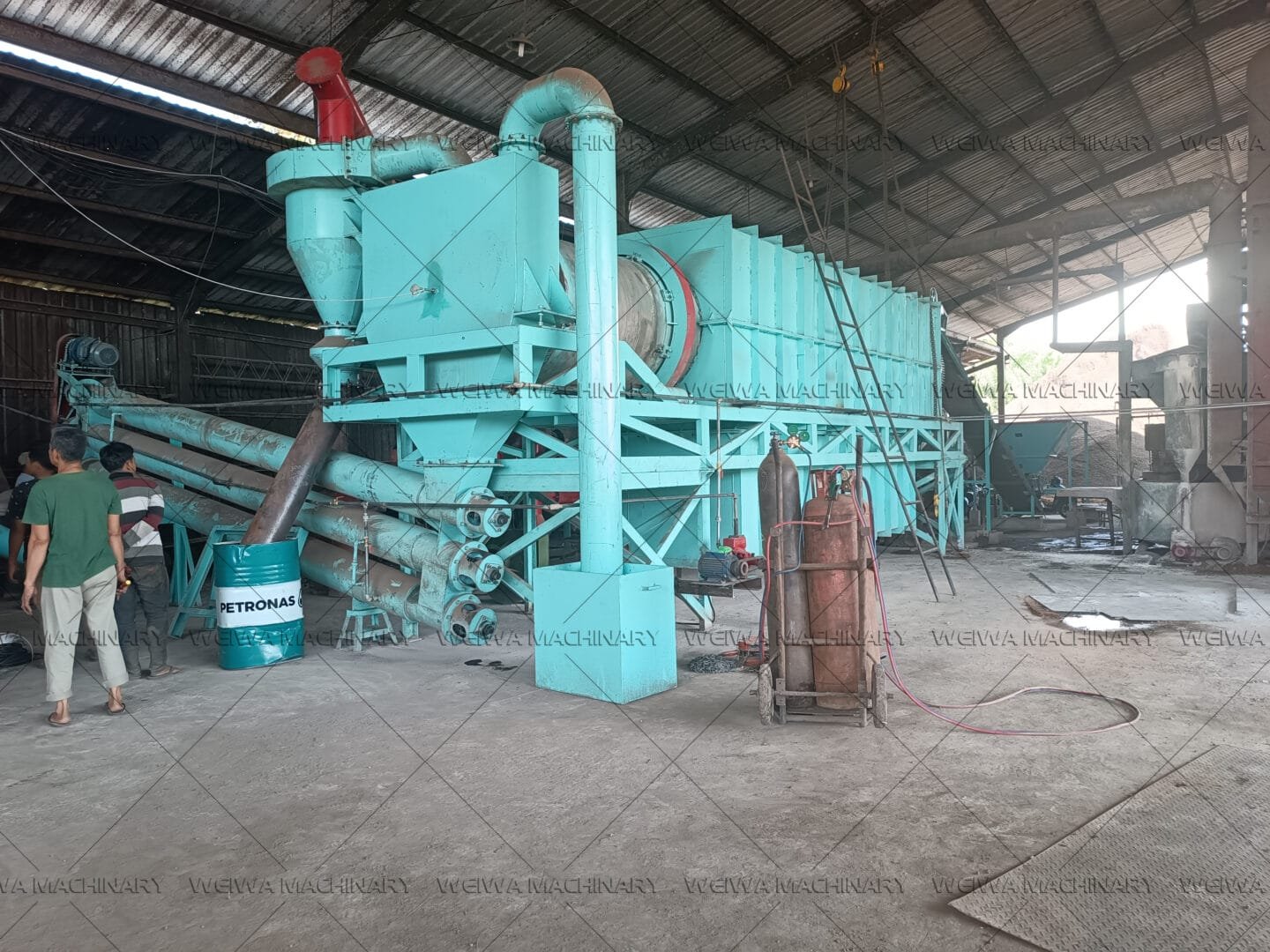
二月 2026, 我们的技术团队前往东加里曼丹, 印度尼西亚, 在当地棕榈油加工厂对我们的旗舰连续碳化炉进行现场试验.
什么是 连续碳化炉?
To understand the value of our equipment, 让我们首先揭开这项技术的神秘面纱. 一个 连续碳化炉 is a state-of-the-art system designed to convert biomass (例如。, PKS, 椰子壳, 木屑) into biochar 不间断. 与传统间歇窑不同, which require frequent loading, 冷却, and reloading, continuous systems operate 24/7, significantly boosting efficiency.
它如何工作: The Science of Pyrolysis
The core process is 热解—thermal decomposition of organic material in the absence of oxygen. Here’s a step-by-step breakdown:
- 烘干: 原始生物质 (水分含量: 10–15%) enters the preheating zone, where residual moisture evaporates at 100–200°C.
- 热解: The dried material moves to the main carbonization zone (300–600°C), where volatile gases (例如。, 甲烷, 公司) are released, leaving behind carbon-rich char.
- 燃烧 & Heat Recovery: The emitted volatiles are partially burned in a controlled chamber, generating heat that sustains the pyrolysis process. Excess gas can be used to power generators or dry additional biomass.
- 冷却 & 释放: The hot biochar exits the furnace and passes through a water-cooled screw conveyor, reducing its temperature to below 50°C before storage.
Key Advantages Over Batch Kilns
- 更高效率: Continuous operation eliminates downtime, achieving 80–90% throughput compared to batch systems.
- 一致的质量: Uniform temperature control ensures biochar with stable carbon content (60–85%) and low ash.
- Energy Self-Sufficiency: Volatile gas recovery reduces external fuel needs by 30–50%.
- 可扩展性: Modular designs allow capacity adjustments (500–5,000 kg/h) to match client needs.
印度尼西亚现场试用: Testing the Furnace with Palm Kernel Shells (PKS)
印度尼西亚产量超过 15 million tons of PKS annually, most of which is underutilized as low-value boiler fuel. 我们的客户, a mid-sized palm oil mill, sought to upgrade their waste management by producing biochar for both domestic agriculture and export. We selected their facility for the trial due to its access to high-quality PKS and commitment to sustainable practices.
Pre-Trial Preparations
测试前, our engineers conducted a site survey to assess:
- Biomass Availability: The mill generates ~20 tons/day of PKS, ideal for a 1,000 kg/h continuous carbonization furnace.
- 基础设施: Existing electricity (380伏/50赫兹) and water supply met operational requirements.
- 安全合规: Local regulations on emissions (PM2.5 < 50 mg/m³) and worker safety were reviewed.
Trial Execution: Day-by-Day Performance
Over five days, we monitored the furnace’s performance across key metrics:
Day 1–2: Startup & Parameter Optimization
Initial startup faced minor challenges—PKS’s irregular particle size caused slight blockages in the feeding system. Our team adjusted the screw feeder’s rotation speed and added a pre-crushing unit, resolving the issue within 4 小时. By day 2, the furnace reached a steady state, processing 980–1,020 kg/h of PKS.
Day 3–4: Core Performance Metrics
- 屈服: 280–300 kg/h of biochar (28–30% conversion rate), consistent with lab predictions.
- 质量: Lab tests showed 78% 固定碳, 12% 灰, and pH 9.2—ideal for neutralizing acidic Indonesian soils.
- 能源消耗: External diesel use dropped to 8 升/小时 (与. 15 liters/hour for batch kilns).
- 排放量: PM2.5 levels measured 32 mg/m³, well below the 50 mg/m³ limit, thanks to the built-in cyclone dust collector.
天 5: 客户反馈 & Local Stakeholder Visit
The mill’s management and representatives from Indonesia’s Ministry of Environment observed the trial. “The continuous operation is a game-changer,”先生说. Surya, the mill’s operations director. “We no longer need to stop production for 6–8 hours daily, and the biochar quality is far superior to what we got from our old kiln.”
Why Indonesia? The Perfect Market for Continuous Carbonization Furnaces
Indonesia’s unique combination of biomass resources, policy support, and agricultural demand makes it a prime market for our technology.
Abundant & Underutilized Biomass: PKS as a Goldmine
随着超过 17,000 palm oil mills, Indonesia generates ~50 million tons of PKS yearly. 现在, only 35% is reused—mostly as boiler fuel—while the rest is dumped or burned, 造成空气污染. Converting PKS into biochar addresses two critical issues: waste reduction and creation of a high-value product.
Government Policies Driving Biochar Adoption
Indonesia’s National Action Plan for Greenhouse Gas Reduction targets a 29% emission cut by 2030, with biochar playing a key role in soil carbon sequestration. 在 2025, the government launched subsidies for biochar producers, covering up to 20% of equipment costs. 此外, new regulations restrict open burning of agricultural waste, pushing mills to adopt cleaner technologies like continuous carbonization furnaces.
Agricultural Demand for Biochar
Indonesian farmers face declining soil fertility due to intensive farming. Biochar improves water retention (by 30–50%), 养分利用率, and microbial activity—critical for crops like rice, cocoa, and palm oil. Local trials show biochar-treated soils increase yields by 15–25%, creating strong demand from cooperatives and large plantations.
连续式炭化炉价格: Balancing Cost & Long-Term Value
A common question from Indonesian clients is: “What is the continuous carbonization furnace price, and is it worth the investment?”
成本明细
我们的 1,000 kg/h model, tested in Indonesia, has a base price of $85,000 (FOB Shanghai), 包括:
- Furnace body, feeding system, and cooling unit.
- 1-year warranty and 24/7 技术支援.
- On-site installation and operator training.
Additional costs include shipping ($3,500 to Jakarta) and local permits ($1,200), bringing the total to ~$90,000.
ROI Analysis: Payback in 18–24 Months
For a mill processing 20 tons/day of PKS:
- Annual Revenue: 300 kg/h × 8 h/day × 300 days/year = 720,000 kg/year. At $0.30/kg (export price to Japan/Korea), revenue = $216,000.
- Operational Costs: 劳动 ($12,000/year), 维护 ($5,000/year), and utilities ($8,000/year). Total = $25,000.
- Net Profit: $191,000/year → ROI achieved in ~14 months (excluding subsidies).
Compared to batch kilns ($45,000 upfront but 40% lower yield), continuous systems offer faster payback despite higher initial investment.
超越 PKS: Adapting the Furnace to Indonesia’s Biomass Diversity
While PKS was the focus of our trial, Weiwa Machinery’s continuous carbonization furnace is versatile enough to handle other Indonesian biomass wastes:
- 椰子壳: High lignin content makes them ideal for premium-grade biochar (85%+ 固定碳).
- Rice Husks: Low density requires pre-compression, but the furnace’s adjustable airflow handles it efficiently.
- Rubber Wood Sawdust: Abundant in Sumatra, this feedstock produces biochar suitable for activated carbon production.
Our modular design allows quick adaptation—changing the feeding system or adjusting temperature zones takes less than 48 小时.
结论: A Sustainable Future with Continuous Carbonization
The Indonesia trial confirmed what we’ve seen globally: continuous carbonization furnaces are not just equipment—they are catalysts for circular economies. By transforming PKS waste into valuable biochar, Indonesian mills can boost profits, 减少排放, and improve soil health.
在Weiwa机械, we are committed to supporting this transition. Our team provides end-to-end solutions—from feasibility studies to after-sales service—ensuring clients maximize their investment. With Indonesia’s biomass potential and growing biochar demand, the future of sustainable agriculture starts here.
关于 WEIWA机械
成立于 1990, Weiwa Machinery specializes in designing and manufacturing biomass energy equipment, 包括连续式碳化炉, 木炭制造机, 和压块机. Headquartered in Zhengzhou, 中国, 我们为超过 30 国家, with a dedicated R&D team focusing on energy efficiency and emission reduction. 我们的使命很简单: 变废为宝, 可持续地.
Need help evaluating a continuous carbonization furnace for your business? Contact our experts today—we’re ready to tailor a solution for your needs.


 微信
微信

 +8615937143060
