


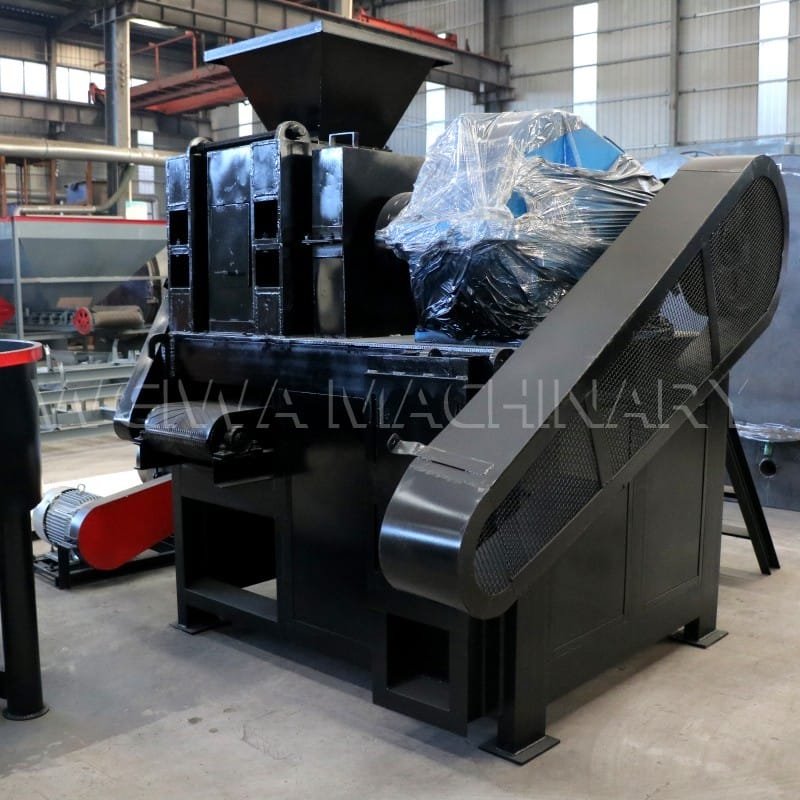
For thirty years, Weiwa Machinery has built roller press equipment, 碳化炉, 压碎机, 搅拌机, and dryers for more than 130 国家. Our engineers do not treat a ball charcoal briquettes machine as a standalone steel box. We treat it as the centerpiece of a material flow: crush, mix, press, dry, pack. When a Kenyan client asks about 在肯尼亚制作木炭球, the answer is never only “here is a machine price.” The answer is a layout drawing, a moisture target, a binder ratio, a roller pocket shape, and a commissioning plan.
From Factory Aisle to Mombasa Dock
The shipment began in our Gongyi machining hall. The charcoal ball press machine destined for Kenya uses two counter-rotating alloy rollers. Each roller carries a pocket pattern—in this case, an oval ball pocket 40 经过 25 毫米, the most common shape for East African BBQ charcoal balls. 包装前, the unit ran a 4-hour load test with coal powder at 8% moisture and 5% starch binder. Pressure was stabilized at 18 兆帕. Discharge density reached 1.35 grams per cubic centimeter. No abnormal vibration. No roller slip.
We disassembled the gearbox, hydraulic unit, and feeder hopper into separate modules. The main frame was sprayed with anti-corrosion oil, then shrink-wrapped. Electrical cabinets received vacuum sealing because humidity during ocean transit can quietly destroy contactors. Wooden skids were heat-treated to meet ISPM-15 export rules. A 40mm steel wire rope fixed the base to container eyelets. The same container also carried a twin-shaft mixer, a small hammer crusher, and two spare roller skins. The Kenyan client chose this combination because 在肯尼亚制作木炭球 from imported charcoal dust alone is rare; most startups blend charcoal fines with carbonized sawdust, so pre-mixing matters more than buyers expect.
Our logistics team tracked the bill of lading from Qingdao to Mombasa, then inland to Nairobi. Transit time is roughly 28 到 34 days depending on transshipment at Colombo or Singapore. We sent the client a pre-arrival checklist: level concrete foundation, 380V 3-phase power, 6-meter clearance for crane unloading, and a 2-meter-wide aisle for roller skin replacement. A ball charcoal briquettes machine weighs between 2.8 和 5.2 tons depending on roller diameter. You do not unload that with manual labor.
Why Kenya Buys Roller Type Instead of Screw Extruder?
Kenya’s charcoal briquette scene splits into two camps. The first camp uses screw extruders for stick charcoal. The second camp, growing faster since 2023, uses a charcoal ball press machine for oval or pillow balls that fit traditional jikos and modern grill baskets. Roller press lines give higher bulk density, lower electricity per ton, and less die wear when the feed is fine charcoal powder below 3 毫米. Screw extruders shine with coarse biomass and rod shape, but they struggle with pure charcoal fines because the material has low natural lignin to self-bind.
When a Nairobi distributor told us they wanted 在肯尼亚制作木炭球 在 800 kilos per hour, we did not propose a screw machine. We proposed a 290 mm roller ball charcoal briquettes machine with mechanical pressure adjustment and a manual grease pump. 为什么? Because charcoal ball buyers in Kenya care about three things: the ball must not crumble in a sack, it must light within 8 minutes on a jiko, and it must stack neatly in a 25-kilo carton. Oval balls from a roller press do all three better than extruded rods.
Kenya Market Potential for Charcoal Balls
Kenya burns a lot of wood charcoal. Households in Kisumu, 埃尔多尔, 纳库鲁, and Mombasa still cook on charcoal. The government pushes for cleaner alternatives, but the cultural preference for charcoal heat is not disappearing. That creates space for densified charcoal balls made from waste fines instead of fresh trees. A charcoal briquette machine that converts kiln waste into sellable fuel directly attacks deforestation pressure while keeping the same cooking habit.
Field studies in Kenya show most small briquette producers use electric presses, either imported or locally fabricated, with imported units priced from around KES 10 million upward depending on capacity. Local manual presses exist below KES 15,000, but they cannot serve commercial volume. The middle gap—300 kilos to 2 tons per hour—is exactly where a Chinese charcoal ball press machine fits. It is cheaper than a European press, more durable than a backyard fabrication, and available with CE/SGS-backed quality documents that banks and clearing agents respect.
Raw Material Advantage in Kenya
Kenya is not short of feedstock. Coffee husks from Ruiru, sugarcane bagasse from Mumias, coconut shell from the coast, sawdust from Timber yards in Nandi, and charcoal fines from informal kilns near Machakos—all can enter a ball charcoal briquettes machine after carbonization and crushing. The client who just received our shipment will collect charcoal dust from three kiln clusters within 60 km of his plot. He estimates 4 tons of fines per week at a purchase price far below finished charcoal retail. That margin is the business model.
Another driver is urbanization. Nairobi’s informal food stalls, nyama choma joints, and mid-size bakeries want predictable heat. Wood charcoal prices swing with rain and patrols. Charcoal balls from a charcoal briquette machine give a standardized calorie pack. Once a stall owner switches, repeat purchase follows. We have seen Kenyan clients move from 10 bags per week to 120 bags per week within five months simply by locking ball size and moisture.
Regulatory and Distribution Reality
Kenya Bureau of Standards requires a standardization mark for briquettes sold in the formal chain. A ball charcoal briquettes machine does not grant that mark, but consistent shape, 低水分, and low ash make the lab test easier to pass. Our advice to every Kenyan buyer is to fix process control before chasing sales. 一个 6% moisture ball passes. 一个 14% moisture ball cracks in the sun and fails ash limits. The machine is half the story; the drying yard is the other half.
Distribution runs through wholesale hardware stores, LPG-alternative fuel shops, and direct supply to hotels. Some clients list on Jumia and Instagram. The ones who win combine machine reliability with packaging discipline. A charcoal ball press machine that produces 1.4-gram-density oval balls at 22 mm thickness will out-sell a cheaper press that drifts to 18 mm after 200 hours of roller wear. That is why Weiwa ships spare roller skins, not just the press.
真是个 球木炭煤球机 实际上确实如此?
A ball charcoal briquettes machine is a roller press. Two rollers rotate inward. Material falls into the top hopper, is forced into opposing pockets, and is squeezed at line pressure until it forms a coherent ball. The pocket shape decides the product: 椭圆形, 蛋, 枕头, 正方形, or custom bread shape. Roller skin material decides lifespan. We use 65Mn or 9CrSi alloy, surface hardened to 58 HRC. A well-run charcoal ball press machine holds pocket geometry for 800 到 1,200 working hours before resurfacing.
Pressure comes from springs, 液压缸, or screw nuts depending on model. For charcoal fines, spring-loaded adjustment is enough. For metal powder or magnesium oxide, hydraulic is better. The Kenyan line we shipped uses spring-loaded mechanical adjustment because the client’s feed is uniform powder, not variable mineral mix. He can turn a bolt to raise pressure when binder ratio drops.
Feeder and Pre-compaction
The hidden hero of a ball charcoal briquettes machine is the variable-speed screw feeder. If feed is uneven, pockets overfill or starve. Overfill throws powder everywhere; starve gives light balls. We tune feeder RPM against roller RPM so that pocket fill stays at 92 到 96 百分比. This single calibration changes bulk density by 0.15 gram per cubic centimeter, which changes freight cost per ton and burn time per kilogram.
Pre-compaction occurs inside the hopper wedge before the nip point. Some suppliers ignore this and blame roller wear later. We cast the hopper with a tapered pre-press zone so charcoal powder is lightly densified before the main squeeze. That is why our charcoal briquette machine units keep ball weight variance under 4 percent across an 8-hour shift.
Full Production Line Behind the Press
No one makes good charcoal balls with only a charcoal ball press machine. The press is the midpoint. Upstream you need size reduction and mixing. Downstream you need drying and screening. A standard Kenya-scale line looks like this in practice, not in a brochure.
Raw charcoal chunks or carbonized sawdust arrive at 15 到 30 水分百分比. A hammer crusher or jaw crusher breaks oversize pieces. A rotary screen removes above-3 mm fraction. The fine fraction drops into a twin-shaft mixer where water and binder join. Starch binder runs 4 到 8 百分比. Molasses runs 6 到 12 百分比. Clay runs 10 到 20 percent but lowers calorific value, so Kenyan clients prefer starch. Mixed material at 8 到 12 percent moisture feeds the ball charcoal briquettes machine. Balls drop onto a mesh belt dryer or a shaded curing rack. 后 24 到 48 小时, moisture falls below 6 百分比. Then weighing and carton packing.
Crusher Selection for Charcoal Fines
If the feed is already fines from kilns, a hammer mill is overkill and generates excess dust. A simple toothed roll crusher or a low-speed double-shaft shredder is enough. If the feed is raw wood, you need a hammer mill first, then carbonization, then a ball press. Mixing these stages confuses new buyers. They ask for a charcoal briquette machine but actually need a carbonization furnace upstream. We always send a flowchart before quoting.
Mixer and Binder Science
Binding is chemistry, not guesswork. Charcoal has no natural glue. Starch gelatinizes at 60 degrees Celsius and locks particles. Molasses caramelizes and smells like sugar when burning—some Kenyan buyers like that for BBQ. Clay is cheap but drops net calorific value from 28 MJ/kg to 22 兆焦/公斤. A ball charcoal briquettes machine cannot fix a bad binder recipe. We send every Kenya client a binder trial sheet: 5 samples, 5 binder ratios, 5 drying times, one burn test protocol.
Drying Climate Advantage in Kenya
Kenya’s sun is a free dryer. Many small plants lay balls on raised mesh racks for 3 到 5 天. That works at 25-degree ambient with low humidity. But rainy seasons in Kisumu or coastal Kwale stretch drying to 9 days and invite mold. A 12-meter mesh belt dryer at 80 degrees Celsius finishes balls in 40 分钟. The Kenyan client we shipped to chose a hybrid: sun drying for 60 percent of volume, one small belt dryer for contract orders that need same-day dispatch. A charcoal ball press machine running 8 hours makes more balls than the sun can dry in April. Mechanical drying is not luxury; it is bottleneck relief.
Making Charcoal Balls in Kenya Step by Step
A new Kenyan operator can reach stable production in three weeks if the line is right. Week one is civil work and machine setting. Week two is binder tuning and roller gap calibration. Week three is shift training and first 5-ton batch. Below is the field sequence our engineers use, written in plain language, not a manual dump.
第一的, level the foundation. A ball charcoal briquettes machine vibrates. If the base rocks, rollers skew and balls become lens-shaped. Pour 150 mm reinforced concrete, cure 7 天, mount machine on rubber dampers. 第二, align feeder center with hopper center. Offset causes one roller to load more. 第三, run empty rollers for 30 分钟, listen for metallic scrape. 第四, feed mixed material at 60 percent capacity, check ball weight, adjust gap bolt by quarter turns. 第五, raise to full capacity, sample every 20 分钟, log weight and moisture. 第六, pack a 25-kilo carton, drop it twice from 1 仪表, open and count broken balls. If breakage exceeds 3 百分比, lower moisture or raise binder.
This routine sounds basic until you watch a plant lose 18 percent of output to avoidable breakage. The charcoal ball press machine is precise, but only if the human in front of it respects powder behavior.
Common Kenya Site Mistakes
Buyers underestimate power stability. 一个 22 kW press with a 7.5 kW mixer and a 4 kW crusher trips village transformers. We specify 380V 3-phase with a 30 kVA buffer. Buyers underestimate dust. Charcoal powder explodes above 65 grams per cubic meter airborne concentration. We add a cyclone and a water curtain option. Buyers underestimate roller change skill. Swapping a 290 mm roller skin takes two mechanics half a day. If you never trained staff, you wait for a Chinese engineer. That wait costs two weeks of sales.
All of these are solvable. A charcoal briquette machine project fails less on steel quality and more on site preparation. Weiwa’s pre-shipment package includes a 14-page Kenya site readiness checklist in English. That document travels inside the container, not as a PDF forgotten in email.
Why Weiwa Ball Press Machines Hold Up in Africa?
Africa is not a gentle environment. 灰尘, voltage swing, untrained labor, and 30-degree mornings followed by 34-degree afternoons test every seal. Our ball charcoal briquettes machine frames use thick-wall rectangular tube, not folded sheet. Roller shafts are forged 40Cr, not welded round bar. Bearings are SKF or HRB sealed units. Gearboxes use hardened helical gears, not worm gears that heat under continuous load. These choices add 12 percent to manufacturing cost and subtract 40 percent from breakdown complaints.
For the Kenyan client, we also customized the pocket shape. Standard Chinese market uses 38 经过 28 毫米 椭圆形. He requested 42 经过 26 mm with a shallow center dimple so balls nest in cartons without rolling. That small CAD change took our designer two hours and gave his packaging line 9 percent more carton density. A charcoal ball press machine is not a catalog item when you let the buyer talk to the drafter.
Spare Parts and Roller Skin Economics
Roller skin is the wear part. A Kenyan plant pressing 800 kilos per hour, 8 一天几个小时, 25 days a month, presses 160 tons monthly. 在 1,000 hours skin life, you change skins every six weeks. Two skins cost less than one week of lost production. We price skins openly, ship them with the container, and laser-engrave the install date on the shaft so the operator cannot forget. A ball charcoal briquettes machine without a skin strategy is a time bomb with a brand label.
Internal Plant Layout for a Kenya Starter Line
一个 300 到 500 kilo per hour Kenya line fits in 120 square meters under roof plus 80 square meters open drying yard. Flow runs straight: raw pile, 破碎机, bucket elevator, 混合器, press, belt conveyor, drying rack, packing table. We avoid U-shape layouts for first-time buyers because they confuse material direction. The charcoal briquette machine sits in the middle, not against a wall, so both rollers are reachable for skin change.
Ceiling height is 4 meters minimum. You need headroom for the bucket elevator and future dryer upgrade. Floor slope is 1 percent toward a dust collection pit. Kenyan councils ask about fire separation; we keep the carbonization furnace 15 meters from the press hall if the client carbonizes onsite. Many Kenya buyers skip onsite carbonization and just buy kiln fines, which simplifies the permit story.
Capacity Math Buyers Ignore
A ball charcoal briquettes machine rated 1 ton per hour means 1 ton of pressed balls per hour at 8 percent moisture and correct binder. It does not mean 1 ton of raw charcoal chunks in. Crushing and mixing lose 6 到 10 percent as dust. Drying loses another 4 到 7 percent moisture mass. Net finished carton weight is roughly 82 到 88 percent of pressed ball weight. When a Kenyan buyer says “I need 2 吨每小时,” we ask: 2 tons of what, at which moisture, in which shape. The charcoal ball press machine number is only one term in that equation.
Comparing Ball Press With Other Briquette Machines
Beyond the roller press, the market offers screw extruders, hydraulic block presses, and manual lever presses. Screw extruders make rods and honeycomb cakes; they bind better with biomass that has lignin. Hydraulic presses make large blocks for industrial boilers; they are slow and expensive. Manual presses make 200 balls a day for a women’s group, not a Nairobi wholesaler. For 在肯尼亚制作木炭球 at commercial scale, the charcoal ball press machine wins on density, 速度, 和形状一致性.
That said, a smart Kenya investor sometimes runs both. Extruder for stick charcoal to coastal hotels, ball press for oval balls to jiko households. Weiwa supplies both lines and shares a common mixer and dryer between them. The ball charcoal briquettes machine is then not a rival to the extruder but a second revenue lane sharing the same roof.

After-Sales Reality for Kenya Buyers
Shipping the machine is 20 percent of the job. The other 80 percent is the first 90 天. Weiwa assigns one WhatsApp engineer to each Kenya order. The client sends a 30-second video of the feeder, the roller discharge, and the dryer exit. Our side replies with a voice note and a marked photo. No ticket queue, no “please fill the form.” For the recent Mombasa shipment, our engineer already walked the buyer through hopper alignment over a WhatsApp call at 9 pm Nairobi time.
We also train by simulation. Before the container leaves Zhengzhou, we record a 25-minute walkthrough video specific to that order: roller gap, grease points, 皮带张力, mixer blade direction. The Kenyan operator watches it on a phone while standing next to the real machine. A charcoal briquette machine is not complex, but the first gap adjustment without guidance wastes a full shift.
Custom Drawings and Site Planning
Every Kenya inquiry gets a free CAD layout. We draw the foundation, the machine centerline, the electrical panel position, the dryer length, and the carton stacking aisle. Buyers take that drawing to a local welder and a concrete guy. The ball charcoal briquettes machine then arrives to a site that already fits it. This single service cuts installation time from 10 days to 3 天. For a client who burns money on rent and labor, 7 saved days is real cash.
WEIWA机械 in One Paragraph
Weiwa Machinery has over thirty years of workshop experience in briquette and carbonization equipment. We are not a trading company with a catalog scraped from Alibaba. We run a 200,000 square meter manufacturing base in Zhengzhou, 河南, with senior mechanical consultants, certified welders, and a spare parts warehouse that ships rollers, skins, 轴承, and mixers to 130-plus countries. Our ball charcoal briquettes machine lines run in Indonesia, 印度, 火鸡, 坦桑尼亚, 墨西哥, and now this new Kenya site. We offer customized production line design, free factory layout drawings, on-site commissioning where visa and client budget allow, and a 24-hour response promise on technical questions. When you contact us, an engineer answers, not a call center script.
If you are evaluating 在肯尼亚制作木炭球, do not start with a price comparison table. Start with your raw material sample. Send us 2 kilos of your charcoal fines or carbonized sawdust. We crush, mix, press, dry, and burn it in our test hall, then send you the ball photo, the density number, and the binder recipe. Only then do we talk machine model. That is how a charcoal ball press machine becomes a profitable Kenyan plant instead of a rusting container asset.
联系Weiwa机械
WhatsApp or Mobile: +8613838093177
电子邮件: info@cjlmachinegroup.com
工厂: 黄山路, 紫荆路, 巩义, 郑州, 河南, 中国
网站: https://cjljx.com/product/ball-charcoal-briquettes-machine
We reply in English, Spanish, Arabic, French, and Swahili-friendly English. Send your daily feedstock volume, your moisture level, and your target ball shape. We will return a line proposal, 足迹图, and a landed Kenya cost estimate. A charcoal briquette machine decision made on a clear drawing beats one made on a cheapest quote every single time.


 微信
微信

 +8615937143060
