


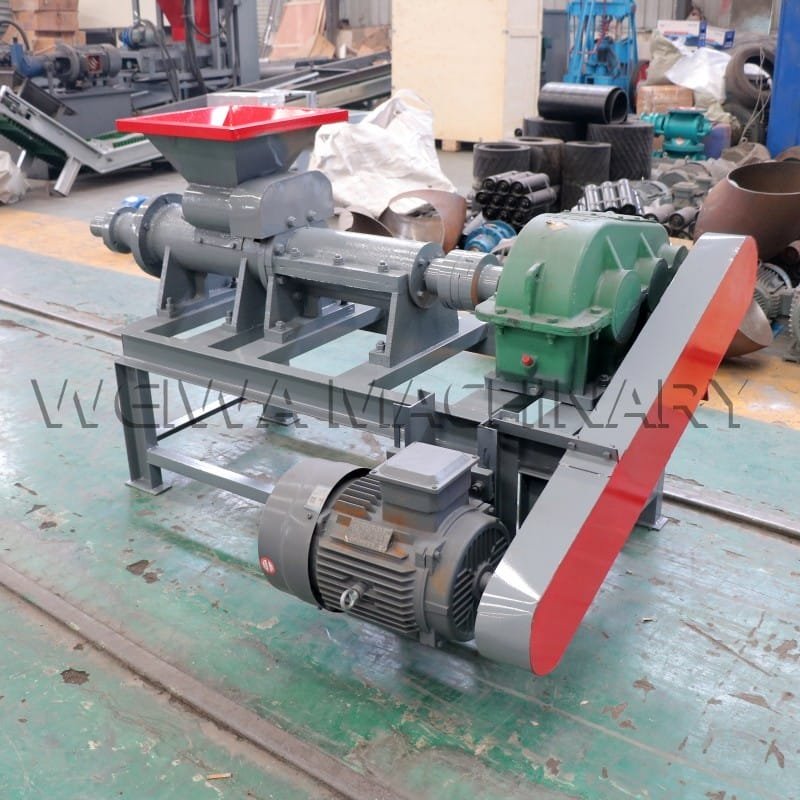
Why a Laos Charcoal Buyer Asked Weiwa for a Hexagonal Coal Briquette Machine?
Lao barbecue culture is not a side business. Night markets in Vientiane, Luang Prabang, Savannakhet and Pakse move large volumes of grilled chicken, sticky rice balls wrapped in banana leaf, and river fish cooked over shaped charcoal. 多年来, many small shops bought imported lump charcoal or low-grade cylindrical sticks from regional traders. That supply chain is unstable. Lump size varies, moisture hides inside the piece, and packing density is poor. Distributors who want a cleaner retail bag are moving toward machine-made shapes.
在所有的形状之中, the hexagonal rod is gaining attention in Laos for three practical reasons. 第一的, the flat sides let rods stack tightly in 10 kilogram woven bags without rolling. 第二, the geometry leaves small air channels along the edges, so ignition is faster than with solid square bars. 第三, when cut to the same length, hexagonal rods look uniform on a grill mesh and photograph better for social media resellers. A Laos importer who plans to serve both urban BBQ stalls and wholesale hardware stores will usually ask for a Hexagonal coal briquette machine for Laos rather than a generic stick press.
The client who visited Weiwa had already burned through one second-hand extruder from a neighbor country. His complaints matched what our engineers hear from Cambodia, Myanmar and Vietnam. The screw wore out in eleven days. The die head lost center alignment. The rods cracked during sun drying. The hexagon edges rounded off until the product looked like a worn pencil. He did not ask for the cheapest quote. He asked for a Charcoal Extruder for Laos condition that could handle village-level power fluctuation, dusty feedstock, and a binder recipe built on local tapioca starch instead of imported cassava powder.
What the Laos Client Brought to the Weiwa Workshop?
We treat overseas trials as commissioning sessions, not sales theater. The Laos client flew in with three things. The first was a 25 kilogram sample of wood charcoal powder made from mixed hardwood offcuts, sieved to roughly 2 毫米. The second was a 15 kilogram sample of coconut shell charcoal powder purchased from a Thai border supplier. The third was a small plastic cup of dried binder powder with a note saying the mix ratio was eight percent binder, thirty percent water, sixty-two percent charcoal by weight after pre-wetting.
He also brought two competitor samples. One was a Chinese cylindrical rod with a shiny skin and a hollow core. The other was a Vietnamese hexagonal rod that rang well when tapped but showed a hairline crack along one flat. His acceptance criteria were written in plain factory language. The rod had to be solid hexagonal, 34 毫米平面对平面, 200 毫米长, with no open crack, no tail bloom at the cutter, and enough green strength to survive a 40 centimeter drop onto the concrete floor without bending.
Before any machine started, our chief engineer measured the moisture of both Laos samples with a halogen meter. The wood charcoal mix read 28 百分比. The coconut shell mix read 26 百分比. Both sat inside the workable window for screw extrusion, but the wood mix needed five minutes longer in the wheel mixer to fully wet the fines.
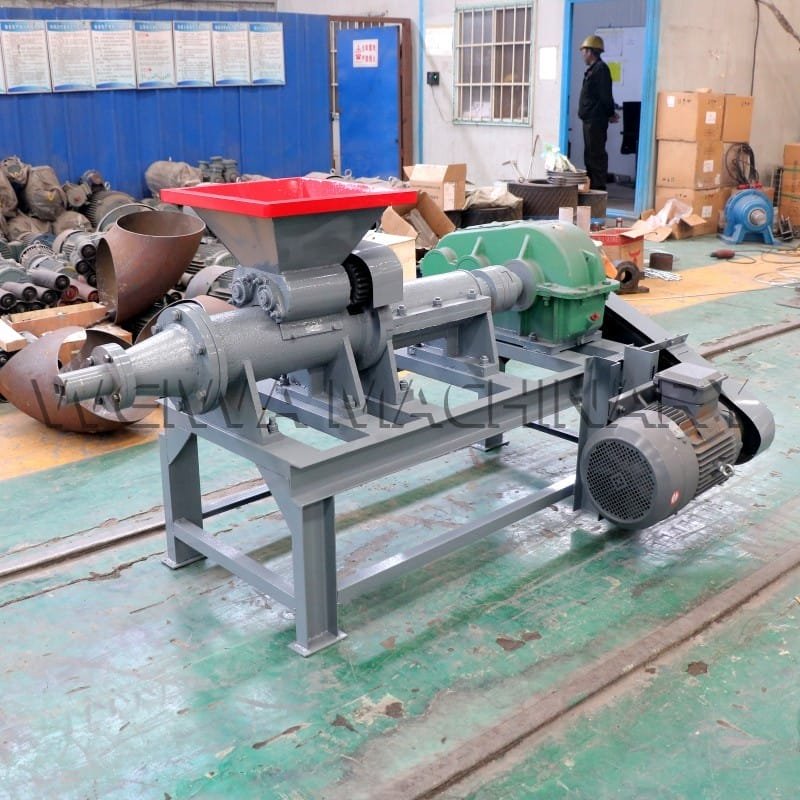
如何 木炭挤出机 Works Before the Hexagonal Mold?
木炭挤压机不是冲床. It does not drop a measured puck into a cavity and stamp it. It uses a rotating screw propeller inside a tapered barrel to push moistened charcoal paste forward until pressure rises enough to force the mass through a fixed die head. The cross-section of that die decides the final shape. Swap the head and the same base machine can make round sticks, square columns, oval briquettes, 或六角棒. This screw principle is the reason a Hexagonal coal briquette machine stays productive even when raw material particle size jumps between batches.
Screw Propeller and Pressure Build-Up
螺丝同时完成三项工作. It conveys powder forward, it kneads binder into the mass, and it builds pressure gradually so the paste becomes dense before reaching the die. On the Weiwa 160-type unit used for this trial, the propeller is cast from high manganese alloy. The flight pitch tightens near the discharge end. That tightening is not decorative. It is where low-density paste becomes a continuous dense rope. If the pitch is wrong, the rod exits soft and collapses under its own weight.
Floating Coupling and Gearbox Load Control
Power leaves the 22 千瓦 100 百分铜线圈电机, travels through a triangle belt, enters a hardened gearbox, and reaches the propulsion shaft through a floating coupling. The coupling is a small component that saves the whole machine. When a stray 4 millimeter stone hides inside charcoal powder, the screw hits sudden resistance. The floating coupling absorbs the shock instead of transferring it to the gearbox bearings. During the Laos trial, the couple absorbed two impurity shocks without tripping the breaker.
为什么 #45 Steel Hexagonal Die Head Decides Rod Geometry?
The die head sent for this trial was machined from #45 steel with a central 8 millimeter core hole and six ground flats. The flat-to-flat tolerance was held to plus or minus 0.15 毫米. Many cheap extruders use cast dies with hand-ground openings. Those dies drift after a week. 一个 #45 steel insert keeps the hexagon sharp for months if the screw speed and feed rate stay inside the designed band. For a Laos buyer who plans to run two shifts a day, die life is not a spec sheet detail. It decides whether his retail pack looks premium or reject grade.
Raw Material Preparation for Hexagonal Rod Charcoal
没有任何木炭挤出机可以挽救不良输入. The trial began not at the extruder but at the crusher and mixer. The Laos wood charcoal arrived at 3.5 millimeters in spots. Our operator ran it through the hammer crusher for one pass, screened it at 3 毫米, and discarded the oversize fraction. The coconut shell powder was already fine but carried a few fibrous strands that clogged the screw flight in a separate pre-test, so we screened it twice.
Crushing Charcoal Powder Below 3 Millimeters
Particle size controls surface area. Too coarse and the binder cannot bridge the grains, so the rod crumbles after drying. Too fine and the paste turns pasty, sticks to the barrel, and overheats the screw. For hexagonal rod charcoal aimed at BBQ use, the sweet spot is 70 percent below 1 毫米, 30 percent between 1 和 3 毫米. The Laos wood sample hit that split after one crush cycle. The coconut sample needed a light re-crush because it contained a few 4 millimeter chips from incomplete carbonization.
Binder Ratio and Moisture Window for Laos Recipes
The client insisted on tapioca starch because it is cheaper in his province than imported cassava extract. Our lab team tested his 8 percent binder formula against our standard 6 percent corn starch formula. 在 8 percent tapioca, green strength was higher, but the rod needed 38 percent total moisture to extrude cleanly. 在 6 percent corn starch, the machine accepted 31 percent moisture and still held the hexagon. We met in the middle at 7 percent tapioca, 33 水百分比. That blend gave a smooth rope, a sharp hexagon, and a drying time short enough for the Laos sun season.
Live Trial Run of the Charcoal Extruder for Laos
The trial ran on a Wednesday starting at 9:12 in the morning. Ambient temperature in the workshop was 31 摄氏摄氏度. We mounted the 160-type Charcoal Extrude Machine on the test bench, fitted the hexagonal die head, and warmed the screw at 60 percent speed for twelve minutes with a dummy batch of recycled charcoal paste.
第一的 30 Minutes Warm-Up and Feed Adjustment
In the first ten minutes, the rod exited with slightly rounded corners. The engineer lowered the feed hopper vibrator frequency so the barrel did not overfill, raised screw speed from 38 到 42 hertz, and watched the pressure gauge climb from 4.8 bar to 6.2 bar. Within four minutes the hexagon edges sharpened. The client marked the change on his phone video and nodded. The first acceptable rod came at 9:41.
Two Hour Continuous Load and Rod Sampling
从 9:45 到 11:45 the machine ran without stop using the wood charcoal blend. A worker cut rods every fifteen minutes and laid them on the sampling table in rows of ten. Every hour we pulled five rods for measurement. The screw temperature stabilized at 58 摄氏摄氏度. The gearbox oil stayed under 46 度. There was no tail bloom, meaning the cutter timing matched the extrusion speed.
在 11:00 we switched to the coconut shell blend for thirty minutes. Coconut charcoal is denser and more abrasive. Screw load rose by 0.4 bar. The rods came out glossier and rang with a higher pitch when tapped. Flat-to-flat held at 34 毫米. Length held at 200 millimeters plus or minus 2 毫米.
Measuring Density, Length, Flat-to-Flat and Surface Cracks
We weighed 100 random rods from the wood blend. Average length 200.4 毫米, average flat-to-flat 33.9 毫米, average green weight 142 克, estimated dry density 1.18 grams per cubic centimeter. Water immersion test showed three rods out of 100 floating briefly before sinking, meaning 97 percent achieved the dense structure Laos buyers want for long-burn BBQ use. Surface inspection found zero open cracks and two rods with a faint hairline that disappeared after the first hour of shade drying.
Trial Output Numbers From the Weiwa 160-Type Extruder
The 160-type Charcoal Extrude Machine used in this trial carries a 22 kilowatt motor. During the wood charcoal run it produced roughly 1.35 metric tons per hour of green hexagonal rods. During the coconut shell run output eased to 1.18 metric tons per hour because the denser paste required slightly higher torque. Power draw averaged 17.8 千瓦. The client calculated that one machine could cover his current Vientiane order book of 9 tons per day if he ran it 7 hours with one operator and one cutter assistant.
Die head temperature after two hours was 61 摄氏摄氏度. We removed the head, inspected the six flats under a magnifier, and found no measurable wear. The high manganese screw lost roughly 0.05 millimeter on the flight tip, well inside service limits. The client asked how long the die would last on Lao material. Based on similar runs with Myanmar wood charcoal, we quoted 45 到 60 days of two-shift service before a planned rotation, not failure.
Why Hexagonal Rod Charcoal Fits the Laos BBQ Market?
Hexagonal rod charcoal is not a global standard shape. It is a regional answer to a regional problem. Laos grills often use shallow steel trays with a wire mesh. Round sticks roll and leave uneven gaps. Square bars pack tight but choke airflow and need more draft. A hexagonal rod gives six small contact lines with the mesh, leaving edge channels for oxygen while still stacking like a brick. For a stall owner, that means faster light-up, 更稳定的热量, and less fanning with a plastic board.
Retail packaging is the second driver. 一个 10 kilogram bag of 200 millimeter hexagonal rods holds about 70 棒. The same bag filled with round sticks rolls down to 58 pieces after transport vibration. Distributors pay for piece count, not air. A Hexagonal coal briquette machine for Laos indirectly improves margin because the same sack weight looks fuller on the shelf.
The third driver is export leakage. Laos buys charcoal adjacent to Thai and Vietnamese border towns. If a Lao factory can match the Vietnamese hexagonal quality at a lower delivered cost, it can sell back into border wholesalers. The trial client already had two Thai resellers asking for samples. The Weiwa run gave him those samples with his own raw material, not a polished factory demo batch.
Common Mistakes Laos Buyers Make With Charcoal Extrude Machines
The first mistake is buying die shape before testing raw material. A hexagonal die cut for Indonesian coconut shell charcoal will not behave the same on Laos wood charcoal because moisture response and ash content differ. The die angle, core hole size, and screw compression ratio must match the powder, not the catalog photo.
The second mistake is ignoring binder chemistry. Many new Laos buyers copy a YouTube ratio meant for sawdust briquettes. Sawdust has lignin. Charcoal powder does not. Without the right starch gel temperature, the rod crumbles in the dryer. The trial showed that tapioca starch needs 82 到 85 degrees Celsius water to gelatinize properly, and the wheel mixer must hold that slurry for at least four minutes before charcoal enters.
The third mistake is overstating moisture. Some operators think wetter paste is safer. 它不是. Above 36 percent moisture the screw slips, the pressure drops, and the hexagon rounds off. 以下 24 percent the mass does not knit and the rod surfaces with a torn skin. The Laos wood blend worked at 33 百分比. The coconut blend worked at 31 百分比. Those numbers are not universal. They are the numbers for that client’s material.
The fourth mistake is skipping the crusher screen. A charcoal extrude machine is only as good as its finest 70 百分比. If the screen breaks and 2 millimeter stones enter the barrel, the screw flight chips within a day. The Weiwa trial included a 3 millimeter vibrating screen before the mixer, and we kept it there on purpose.
How Weiwa Packing and After-Sales Support Laos Shipments?
庭审结束后, the client ordered one 160-type Charcoal Extrude Machine with two spare hexagonal die heads, one round die head for export samples, and a 140-type unit as backup for his second shed. Packing followed our standard export method. The machine was wrapped in plastic film, corners padded, then fixed inside a plywood case with bolt-down skids. The die heads traveled in a separate foam-lined steel box so the ground surfaces never touched wood dust.
老挝, shipping moves by rail to Kunming, then truck to Boten, then Vientiane. Transit is roughly nine days door to warehouse if customs papers are clean. Weiwa prepares commercial invoice, 包装清单, and French-Lao bilingual operation manual on request. The client also received a 22 minute factory video showing die change procedure, screw removal sequence, and cutter timing adjustment, because those three tasks decide whether his local mechanic can service the machine without flying a Chinese technician.
Spare parts policy for Laos buyers includes one screw, 一套耦合套件, one belt set, and two die heads per machine in the first container. Whatsapp support is answered within one working day. 对于这个客户, our engineer joined a video call at 8:00 PM Vientiane time to watch his electrician wire the control panel. The machine started on the first try.
关于 WEIWA机械
Weiwa Machinery is a Henan based manufacturer of charcoal and coal briquette equipment, 碳化炉, 压碎机, wheel mixers, 和干燥系统. The company supplies charcoal extrude machine units to more than 130 国家, 包括印度尼西亚, 印度, 马来西亚, 老挝, 缅甸, 泰国, 越南, 菲律宾, 巴基斯坦, 斯里兰卡, 火鸡, 波兰, 埃及, 苏丹, 阿尔及利亚, 埃塞俄比亚, 坦桑尼亚, 墨西哥, 和南非. National certified carbon steel frames, 100 percent copper coil motors, hardened gearboxes, and high manganese screws are standard on the extruder line. Factory acceptance trials using the client’s own raw material are available before payment balance, and multilingual support covers English, Thai, French, Spanish, Arabic, and Russian.
Weiwa Machinery contact details:
暴民: +8613838093177
WhatsApp: +8613838093177
电子邮件: info@cjlmachinegroup.com
The Laos trial proved one thing that no brochure can prove. A Charcoal Extrude Machine for Hexagonal Rod Charcoal is not a magic box. It is a tuned system of screw, 死, 活页夹, 水分, and raw material. When those five variables meet in the right band, the rod comes out straight, 稠密, and ready for the night market. When one variable drifts, the hexagon rounds, the crack opens, and the bag loses value. Weiwa’s job is to keep the band wide enough for real factories in real countries like Laos to run two shifts without fear.


 微信
微信

 +8615937143060
