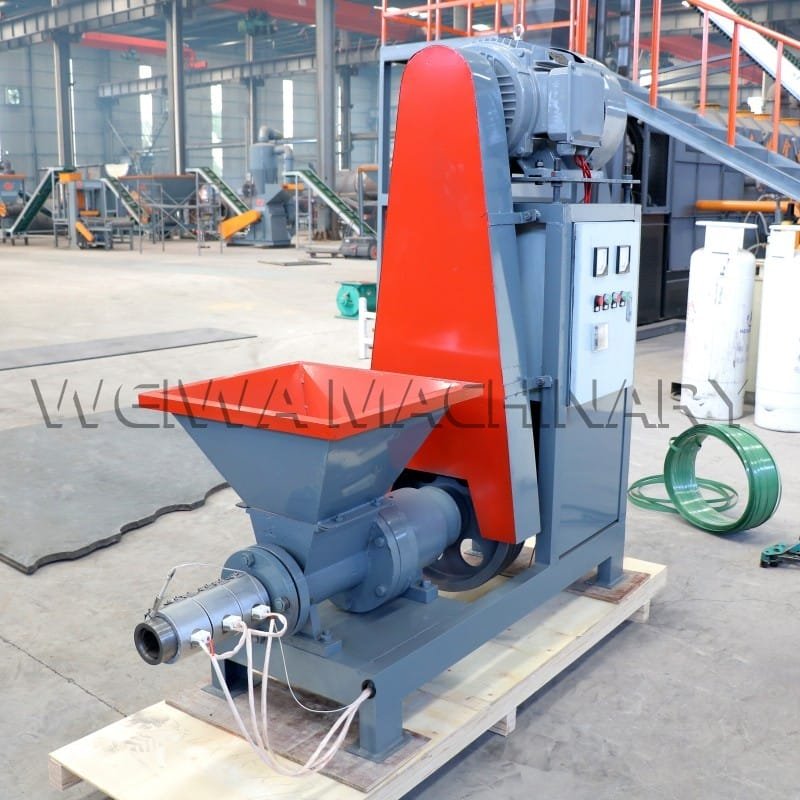
在Weiwa机械, every container we load is more than just steel equipment heading overseas. It represents a commitment to help our partners turn local biomass waste into profitable, 清洁燃烧的木炭. 上星期, our factory completed the inspection, 包装, and shipment of a full charcoal production line—centered on our heavy-duty sawdust extrude machine—bound for a charcoal manufacturing startup in Ghana. This delivery marks another step in supporting West Africa’s transition toward sustainable fuel production.
Shipment Scene – Weiwa Charcoal Line Loaded for Ghana
The production line for our Ghanaian client includes a wood crusher, rotary drum dryer, 锯末挤压机 (木屑压块机), and a horizontal carbonization furnace. Before container loading, each unit was test-run in our workshop to confirm stable performance. The screw shaft, heating ring, and forming sleeve of the sawdust extrude machine were pre-assembled and protected with anti-rust oil.
All machines were fixed with steel wire ropes inside the container to prevent shifting during ocean transport. Export-standard wooden cases were fumigated according to international phytosanitary requirements. Spare parts such as screw propellers, heating coils, and forming dies in different diameters (50 毫米, 60 毫米, 70 毫米) were packed separately and clearly labeled in English for easy identification upon arrival in Ghana.
We also provided the client with a full English operation manual, wiring diagram, and pre-commissioning checklist so that local technicians can install the line with minimal delay. Remote video guidance is available from our engineering team after the container reaches Tema Port.
Why Ghana Needs Sawdust Briquette Machine for Charcoal Production?
Ghana has a mature timber processing sector and abundant agricultural activity. Sawmills in Kumasi, Accra, and Takoradi generate large volumes of sawdust and wood chips daily. Rice mills in the northern regions produce rice husks that are often burned in open fields. Maize stalks, 花生壳, and sugar cane residue are also widely available.
Traditional earth-kiln charcoal making cuts green trees and yields low-quality charcoal with high emissions. 相比之下, a sawdust briquetting machine allows producers to compress dry biomass into uniform, high-density briquettes without any chemical binders. These briquettes can then be carbonized in a modern furnace to produce machine-made charcoal that burns longer, smokes less, and commands a higher market price.
For Ghanaian entrepreneurs, investing in a biomass briquette machine line means:
- Using low-cost or free waste raw materials
- Reducing dependence on deforestation-based charcoal
- Creating local jobs in collection, 手术, and distribution
- Producing a standardized charcoal product for domestic sale or export
How a Sawdust Extrude Machine Works?
The core of the charcoal line is the sawdust extruder. It uses a large screw (auger) to push prepared biomass through a heated barrel and a forming die. As the material moves forward, friction and the heating ring raise the temperature to approximately 280–320°C. 在这个温度下, the natural lignin in wood fibers softens and acts as a self-binder, gluing the particles together under high pressure.
The compressed material exits the die as a solid rod—usually quadrangular or hexagonal in shape with a central hollow hole of 15–20 mm. The hollow core improves airflow during later carbonization and increases combustion efficiency when the final charcoal is burned.
Key advantages of Weiwa’s sawdust briquetting machine:
- No binders or chemicals required—lignin is the natural adhesive
- High compression ratio produces briquettes with density of 1.0–1.2 g/cm³
- Adjustable molds allow square, 五角大楼, or hexagon shapes in diameters from 45 MM TO 80 毫米
- Stable temperature control ensures consistent product color and hardness
Raw Material Requirements for the Sawdust Extruder
To achieve good briquettes, raw material must meet two basic conditions:
Particle Size: Biomass should be crushed to 3–5 mm. Pieces larger than 5 mm prevent proper compression and may damage the screw. Overly fine powder (like flour) can cause feeding instability.
水分含量: Material must be dried to 8–12%. Too much moisture creates steam inside the barrel, causing the briquette to burst or the machine to eject material uncontrollably. Too dry, and lignin will not plasticize sufficiently, resulting in brittle briquettes.
在加纳, many customers combine a hammer mill for crushing with a rotary dryer or even solar drying beds to reach the target moisture level economically.
Step-by-Step Charcoal Production Line Process
A complete line using the sawdust extrude machine typically follows five stages:
第一的, crush coarse biomass—branches, 竹子, wood offcuts—into particles under 5 mm using a wood crusher or hammer mill.
第二, dry the material in a rotary dryer until moisture drops below 12%. An airflow dryer can be used for smaller capacities; a drum dryer is recommended for outputs above 500 kg/h.
第三, feed the dried material evenly into the sawdust briquette machine. The screw extrudes it into dense rods under heat and pressure, with no additive needed.
第四, carbonize the extruded briquettes in a horizontal or hoist-type carbonization furnace under limited oxygen. The result is machine-made charcoal with high fixed carbon and low ash.
Fifth, cool, grade, and package the finished charcoal for market distribution.
Each stage is interconnected. Poor crushing or inadequate drying directly affects briquette quality, which in turn influences carbonization yield. Weiwa Machinery can design the full layout based on your daily capacity requirement and available workshop space.
Best Raw Materials for Sawdust Briquetting Machine in Ghana
Thanks to Ghana’s mixed forestry and agriculture, multiple feedstocks work well with our sawdust extruder:
Hardwood sawdust from timber mills gives the best charcoal with high fixed carbon and low ash. Softwood sawdust also works but may produce slightly more volatile matter. Rice husk and rice straw require thorough drying but are excellent low-cost options. Coconut husk and shell, after grinding, make very dense briquettes. Maize stalks, 棉茎, and sugar cane bagasse can be blended with sawdust to reduce raw material cost.
A common practice among Ghanaian producers is to mix 70–80% hardwood sawdust with 20–30% agricultural residue. This balances binding performance with cost savings.
Finished Product Specifications from Weiwa Sawdust Extrude Machine
The sawdust briquetting machine produces rods in the following typical specs:
- Diameter options: 45 毫米, 50 毫米, 60 毫米, 70 毫米, 80 毫米
- Shapes: 正方形, 五角大楼, 六边形, 六角形的边缘
- Center hole: 15–20 mm (hollow design)
- Surface color: dark brown to black (due to in-barrel heating)
碳化后, the rods become charcoal sticks of uniform size, easy to pack and preferred by BBQ wholesalers and household fuel retailers in Ghana and neighboring countries such as Ivory Coast and Nigeria.
Maintenance Tips for Long Service Life of the Sawdust Extruder
The screw propeller inside the sawdust extrude machine experiences the most wear because it pushes abrasive biomass continuously. Weiwa equips our machines with wear-resistant alloy surfacing on the screw tip, but periodic replacement is normal. We recommend keeping at least one spare screw and one spare heating coil on site.
Check the temperature gauge daily to avoid overheating, which can scorch material and accelerate part wear. Lubricate bearings according to the schedule in the manual. If you notice the briquette surface becoming rough or the outlet jammed frequently, inspect the forming sleeve for wear or check whether moisture content has risen above 12%.
With proper care, our sawdust briquetting machines run reliably for years, even in hot and dusty environments like West Africa.
ROI Perspective – Running a Charcoal Line in Ghana
Although equipment cost is an important factor, the bigger picture is operating margin. 在加纳, quality machine-made charcoal sells at a premium compared to traditional lump charcoal. By using sawmill waste or purchased sawdust—often very inexpensive—your main ongoing costs are electricity, labor, and minor consumables.
A 500–1000 kg/h line typically pays for itself within 8–18 months depending on local raw material price and selling price of the finished charcoal. Many of our African clients expand capacity after the first year once they establish reliable supply chains for biomass and distribution channels for the charcoal.
Weiwa Machinery offers free production line design and capacity planning. Tell us your budget, 可用原材料, and daily target output—we will propose the optimal configuration.
关于 WEIWA机械
Weiwa Machinery is a professional manufacturer of biomass processing and charcoal production equipment, located in China with more than 15 多年行业经验. Our product range covers sawdust extrude machines (木屑压球机), 木材破碎机, sawdust dryers, 碳化炉, and auxiliary conveyors.
We have supplied equipment to over 130 countries including Ghana, 尼日利亚, 肯尼亚, 坦桑尼亚, 印度尼西亚, 印度, 马来西亚, 越南, 火鸡, 和巴西. All machines are tested before shipment, packed for export, and backed by English manuals plus remote technical support. Custom production plans are provided free of charge.
If you are planning to start or upgrade a charcoal briquette production line with a reliable sawdust extruder in Ghana or elsewhere in Africa, 立即联系我们.
网站: https://cjljx.com/product/sawdust-xtrude-machine
移动的 / WhatsApp: +86 13838093177
电子邮件: info@cjlmachinegroup.com
You are welcome to visit our factory. Let Weiwa Machinery power your sustainable charcoal business.


微信
+8613838093177